
Packaging Line Solutions— Turnkey End-of-Line Automation
From case erecting to robot palletizing — one turnkey line, one responsibility, engineered around your product, speed and floor plan.
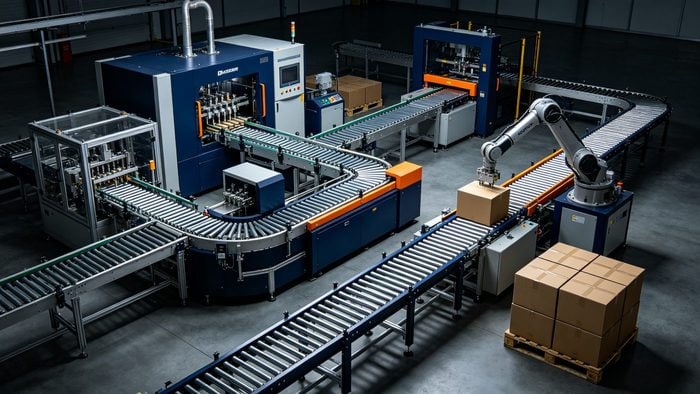
SunAura Packaging Lines Range
Click any model for the full spec sheet, video and inquiry form.
Case Erector Module
CE-600 / MSCE-1000 — forms and bottom-seals cartons automatically
Filling Module
Piston / servo / vacuum fillers, 1–12 heads
Carton Sealing Module
Semi-auto, automatic or corner sealing
Strapping Module
ASM-2000 / ASSM-2000 automatic PP strappers
Shrink Module
L-bar sealer + shrink tunnel for multipacks
Palletizing Module
Robot palletizing + stretch wrapping for hands-off end-of-line
How to Choose a Packaging Line: The Full Guide
A packaging line links individual machines — case erecting, filling, sealing, strapping, shrink wrapping, palletizing — with conveyors so product flows from one station to the next without manual handling. Here is how to decide when a line pays for itself, and how we build one.
When a Single Machine Stops Being Enough — and a Line Pays for Itself
A packaging line links individual machines — case erecting, filling, sealing, strapping, shrink wrapping, palletizing — with conveyors so product flows from one station to the next without manual handling. The trigger for moving from single machines to a line is rarely one dramatic moment; it is the slow accumulation of labor cost, inconsistency, and the transfer-point bottlenecks between machines. As a rule of thumb, if you run two or more packaging machines and still have staff hand-carrying product between them, a line study will almost certainly pay for itself in 12–24 months.
SunAura designs and builds turnkey packaging lines end-to-end in our 48,000㎡ Qingdao factory — from case erectors to robot palletizing — for food, beverage, daily chemical, pharmaceutical, electronics, hardware and agricultural customers in 100+ countries. You get one supplier, one engineering responsibility, one service line: no finger-pointing between brands when something needs fixing.
Three Levels of Automation — Start Where the Math Works
Level 1 — Semi-automatic entry (500–2,000 units/day): case erector or manual erecting + semi-auto sealing + strapping + manual palletizing. Low capex, typically 1–2 operators per station, payback under 12 months against a 3–4 person hand-packaging crew.
Level 2 — Medium automation (2,000–8,000 units/day): automatic erecting, automatic sealing, strapping and shrink wrapping with conveyor linking, 1–2 supervisors running the whole line. This is where most food and e-commerce operations land.
Level 3 — Fully automatic turnkey (8,000+ units/day): adds auto filling, continuous-motion wrapping, and robot palletizing at the end. Headcount drops to line supervision + QC; output is limited by the upstream production line, not packaging.
Do not overshoot. A fully automatic line that runs one shift uses its automation only a third of the day — the extra capex rarely pays back. We will tell you honestly which level fits your volume; that is part of the free design study.
Typical Line Architectures We Build
Carton end-of-line: case erector → filling/packing station → carton sealer (standard or corner) → strapping (optional) → pallet wrapper → label. The most common architecture; scales from Level 1 to 3.
Liquid bottle line: bottle feeding/orienting → filling (piston/servo/vacuum) → capping → labeling → shrink multipacking → carton packing. SunAura’s filling-capping-labeling lines cover edible oil, sauces, honey, beverages and pharma.
Shrink / multipack line: product infeed → L-bar sealing → shrink tunnel → carton packing or direct palletizing. For beverage multipacks, cosmetics kits and consumer goods.
Vacuum food line: vacuum packing (single or double chamber, matched to throughput) → drying/inspection → carton packing. Often combined with shrink wrapping for retail packs.
Layout: Where Lines Succeed and Where They Fail
Our 2026 failure-case study of packaging line layouts found the same four mistakes across industries: (1) conveyor height mismatches between machines from different suppliers, (2) transfer bottlenecks where cartons must be moved by hand, (3) no buffer zones — one machine’s downtime stops the whole line, and (4) underestimating maintenance access, leaving no room to service the sealing head or vacuum pump.
A good line design solves all four before any steel is cut: matched conveyor heights, auto transfers with minimal manual steps, 3–5 minutes of buffer between stations, and service aisles on every machine. Send us your floor plan (even a hand sketch with dimensions) and we design around it.
Our 5-Step Delivery Process
1. Data collection: product type, sizes, daily output, shift pattern, floor plan, existing equipment. 2. Line design: our engineers produce a 3D line layout with equipment list, speeds, manning and budget within about a week. 3. Build & test: every machine built in-house, then the assembled line runs continuously for 48 hours at rated speed with your samples. 4. Installation: overseas engineers available for on-site installation and commissioning; every line ships with remote video guidance. 5. Lifecycle support: 12-month warranty, spare parts within 48 hours, lifetime remote support.
Budgeting and Payback Reality
Use the three levels as your budget skeleton: L1 lines start in the low five figures, L2 typically runs mid-five to low-six, and L3 lines are quoted individually after the design study. The payback math that matters is labor saved minus automation cost per month — most of our line customers cross into positive cash flow inside 12–24 months at the volumes shown above, and the design study gives you the exact number before you commit a single dollar. Why SunAura as your line partner: because we manufacture nearly every machine on the line ourselves, we control speed matching, conveyor heights, PLC integration and spare-part availability — the three things that kill multi-supplier lines. We are CE and ISO 9001 certified (SGS-audited), hold 20+ patents, and have delivered custom lines to 100+ countries.
Daily Output
500–2,000 → L1 semi-auto; 2,000–8,000 → L2 medium; 8,000+ → L3 full auto. Don’t overshoot — a 1-shift line uses automation a third of the day.
Labor Saved
Line study pays back in 12–24 months when staff hand-carry between machines or packaging labor exceeds 3 people.
Line Architecture
Carton end-of-line, liquid bottle, shrink/multipack and vacuum food lines — each with its own module set.
Layout & Buffer
Matched conveyor heights, auto transfers, 3–5 min buffers between stations, service aisles on every machine.
Budget Level
L1 low five figures; L2 mid-five to low-six; L3 quoted individually after the design study.
Five Mistakes That Cost Buyers Time and Money
- Overshooting automation — A fully automatic line on one shift uses its automation a third of the day — the extra capex rarely pays back.
- Mixed-supplier conveyor heights — Height mismatches between brands create manual transfers. One manufacturer avoids them by design.
- No buffer zones — Without 3–5 minutes of buffer, one machine’s downtime stops the whole line.
- Ignoring maintenance access — No room to service the sealing head or vacuum pump turns routine care into line downtime.
Technical Specifications at a Glance
Ten parameters, production configurations. All values customizable at no extra engineering cost.
| Dimension | L1 Semi-Auto Entry | L2 Medium Automation | L3 Full Turnkey |
|---|---|---|---|
| Daily output | 500–2,000 units | 2,000–8,000 units | 8,000+ units |
| Typical build | Erector (or manual) + semi-auto sealing + strapping + manual palletizing | Auto erecting + auto sealing + strapping + shrink, conveyor-linked | Auto filling + continuous wrapping + robot palletizing |
| Manning | 1–2 operators per station | 1–2 supervisors + QC | Supervision + QC, no handlers |
| Payback | < 12 months | 12–18 months | 18–24 months (by utilization) |
| Typical industries | Small e-commerce / workshops | Food, beverage, daily chemical, logistics | Large food, beverage, pharma, export plants |
Where These Machines Earn Their Keep
Proven in production lines across food, logistics, electronics and pharma.
Food & Beverage
Liquid bottle lines: filling → capping → labeling → shrink multipacking → carton packing.
Daily Chemical
Medium automation lines for detergent, personal care and household product cartons.
Pharma
Level 2–3 lines with precise filling, labeling and full traceability-ready packaging.
Electronics & Hardware
Carton end-of-line with corner sealing and strapping for heavy, vibration-prone shipments.
Agriculture
Vacuum food lines for produce and meat, often combined with shrink for retail packs.
Manufactured by SunAura — the Maker, Not a Trader
SunAura manufactures nearly every machine on the line ourselves, so we control speed matching, conveyor heights, PLC integration and spare-part availability — the three things that kill multi-supplier lines. We are CE and ISO 9001 certified (SGS-audited), hold 20+ patents, and have delivered custom lines to 100+ countries. Every assembled line runs continuously for 48 hours at rated speed with your samples before shipment. Standard lines ship 30–45 days from design approval; large custom lines 60–90 days, with overseas engineers available for on-site installation and a 12-month warranty plus lifetime remote support.
Frequently Asked Questions
How do I know if I need a full packaging line?
The trigger is manual handling between machines. If you run two or more packaging machines and staff still hand-carry product between them, or if packaging labor exceeds 3 people, a line study usually pays back in 12–24 months.
What is the typical project timeline?
Standard lines 30–45 days from design approval; large custom lines (filling + robot palletizing) 60–90 days. Every machine is 48-hour run-tested before shipment.
What information do you need for a line design?
Product type and sizes, daily output, shift hours, floor plan (even a sketch), available power, and any existing equipment you want to keep. We produce an initial layout and budget within about a week.
Can you integrate our existing machines?
Yes. We match conveyor heights and controls to your existing equipment. Honest advice included — if an existing machine should be replaced for reliability, we will tell you why.
Who installs and commissions the line?
Overseas engineers are available for on-site installation; every line ships with remote video guidance and a commissioning protocol. Most customers commission with our engineers in 5–10 days on site.
What is the budget range?
L1 semi-automatic lines start in the low five figures; L3 turnkey lines with filling and robot palletizing are quoted individually after the design study. We publish honest ranges in the proposal, never a vague quote.
Can the line be customized to my product?
Yes — line speed, machine configuration, conveyor layout, voltage, machine color and documentation are all customized. OEM/ODM branding is available.
What warranty and support come with a line?
12-month full warranty, lifetime remote support, spare parts shipped within 48 hours, and a dedicated project engineer for the life of the line.
Get a Factory-Direct Quote in 24 Hours
Tell us your box size, daily output and voltage — our engineers reply with a model recommendation, price and lead time within one business day.