
Liquid Filling Machine— Piston, Servo & Multi-Head Fillers
From 30 ml to 1,000 ml per fill, ±0.5–1% accuracy — piston and servo fillers for sauces, oils, cosmetics and pharma, 304 stainless steel.
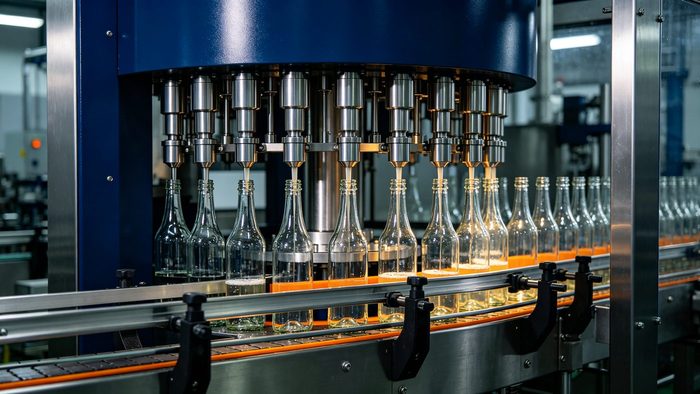
SunAura Liquid Filling Machines Range
Click any model for the full spec sheet, video and inquiry form.
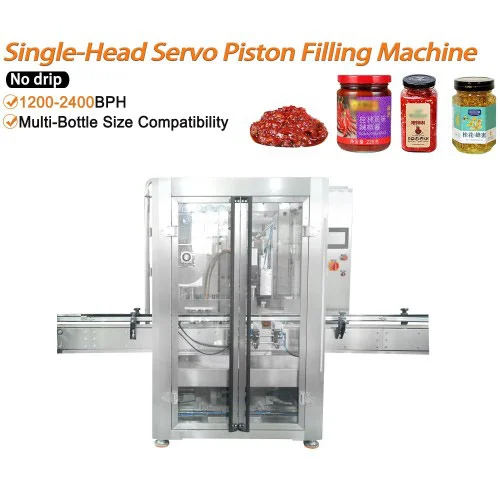
Single-Head Servo Piston
High-precision filling for viscous and delicate products
8-Head Piston
Mid-volume workhorse for liquids, creams and pastes
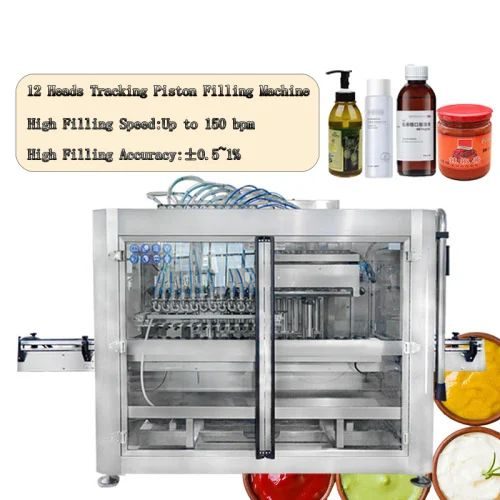
12-Head Piston
Maximum throughput multi-head piston filler
8-Head Tracking (Edible Oil)
Continuous-motion filling for high-speed oil and beverage lines
Magnetic Pump
Economical filling for water-like liquids
2-in-1 Bottle Filler-Capper
Filling + capping in one machine for small bottles
Tube Filler-Sealer
High-speed filling and sealing for tubes
How to Choose a Liquid Filling Machine: The Full Guide
A liquid filling machine meters a set volume of product into bottles, jars, cups or tubes. The choice of filling technology — not just the machine — is what determines your giveaway cost, your accuracy and whether your product runs at all.
Liquid Filling Is a Precision Business — Choose the Technology That Matches Your Product
Under-fill and you risk regulation and customer complaints; over-fill by 1% on a high-volume line and you give away thousands of dollars a year. That is why the filling machine is the most product-specific purchase in a packaging line.
SunAura builds liquid filling machines across five technologies: piston fillers (1 to 12 heads) for liquids, creams and pastes; servo piston fillers with SIEMENS PLC for high-precision viscous products; vacuum back-suction fillers for thin, foaming liquids; magnetic pump fillers for water-like liquids (vinegar, floral water, alcohol); and tracking multi-head systems for continuous-motion lines. All product-contact parts are 304 stainless steel, meeting FDA and CE hygiene standards.
Which Filling Technology Fits Your Product?
Piston filling is the workhorse: a piston draws a set volume and pushes it into the container. It handles liquids, creams, honey, jam, ketchup and pastes — even products with particulates — with ±0.5–1% accuracy. Choose head count by speed: 1 head (1,200–2,400 bottles/hour), 8 heads (30–50 bottles/min), 12 heads for the highest throughput.
Servo piston filling replaces the mechanical drive with servo motors and a SIEMENS PLC + touchscreen. It gives recipe management, production logging, remote diagnostics, and smooth motion that matters for delicate or aerated products like salad dressing and cosmetic creams. Vacuum back-suction draws the fill level to a constant height — ideal for thin, foamy liquids where surface-level accuracy matters more than volume. Magnetic pump is the economical choice for water-like liquids where precision requirements are moderate. Tracking (continuous-motion) fillers fill while the container moves with a conveyor — the choice for 8,000+ bottles/hour edible oil and beverage lines.
How to Spec Your Filling Machine — 5 Numbers to Prepare
1. Fill volume range. Standard piston models cover 30–1000 ml (customizable wider). Know your smallest and largest SKU — the range drives the cylinder size.
2. Viscosity and particulates. Free-flowing liquids, pastes and particulate products need different nozzle and valve designs. Describe the product honestly — a sauce with chili flakes is not the same machine as water. Our engineers size the cylinder and nozzle accordingly, and we recommend a sample test before ordering.
3. Target speed. Work backwards from your daily output and shift hours. 2,000 bottles/day ≈ 250/hour = one head is plenty. 10,000 bottles/day = 8+ heads or a tracking filler. Buy speed in heads, not in running the machine faster — accuracy drops when you push a single head.
4. Container type. Glass bottles, jars, PET, tubes, cups or pails — each needs the right container handling. SunAura offers 2-in-1 filling-capping machines for small bottles and semi-automatic pail lines for 1–25 kg containers.
5. Cleaning requirement. Food, pharma and cosmetics lines should plan CIP (clean-in-place) or quick-disassembly contact parts. Specify your cleaning regime so the machine is built with the right valve and manifold design.
Common Mistakes Buyers Make
Buying a water filler for a paste product — piston is the only generalist that handles pastes; peristaltic and gravity fillers choke. Ignoring headroom for growth — if you are under 6,000 bottles/day, buy the 8-head and keep the option to expand. Under-specifying accuracy — for premium products, ±1% giveaway on 500 ml at high volume is real money; the servo piston holds ±0.5% and pays for itself. Skipping the sample test — we run your actual product through a test machine and record fill-weight data before you commit.
The Giveaway Math
If you fill 1,000,000 units a year at 500 ml, every 1% over-fill gives away 5,000 liters of product. On a premium honey or cosmetic line that is often more than the machine costs. The servo piston’s ±0.5% accuracy versus a loose mechanical tolerance of ±1% is the difference between controlled giveaway and silent profit erosion — worth putting on the spreadsheet before you choose a model.
Why SunAura for Filling
Filling machines are engineered, built and 48-hour tested in our Qingdao factory. Standard piston fillers ship in 15–20 business days; fully automatic lines (filling → capping → labeling) are quoted individually with a 25–40 day build. All machines carry a 12-month warranty, lifetime remote support, and SIEMENS-based control where specified. If you are planning a full bottle line, our engineers will integrate the filler with capping, labeling, conveying and inspection as one line.
Technology
Piston for liquids/creams/pastes (generalist); servo for precision viscous; vacuum for thin foamy; magnetic pump for water-like; tracking for continuous high speed.
Fill Volume
Standard 30–1000 ml, customizable. The range drives cylinder size — your main format-change task.
Speed
2,000 bottles/day ≈ 1 head; 10,000+ needs 8–12 heads or tracking. Buy speed in heads, not machine speed.
Product Type
Describe viscosity and particulates honestly — nozzle and valve design depend on it.
Cleaning
Plan CIP or quick-disassembly for food/pharma/cosmetics at the quoting stage.
Five Mistakes That Cost Buyers Time and Money
- Buying a water filler for a paste product — Piston is the only generalist that handles pastes; peristaltic and gravity fillers choke.
- Ignoring headroom for growth — Under 6,000 bottles/day, buy the 8-head and keep the option to expand rather than overspending on a 12-head.
- Under-specifying accuracy — ±1% giveaway on premium honey or cosmetics at 500 ml is real money — the servo piston holds ±0.5%.
- Skipping the sample test — We run your actual product and record fill-weight data before you commit. Skipping it is how re-negotiation starts.
Technical Specifications at a Glance
Ten parameters, production configurations. All values customizable at no extra engineering cost.
| Parameter | Single-Head Servo | 8-Head Piston | 12-Head Piston | Vacuum Back-Suction |
|---|---|---|---|---|
| Filling heads | 1 | 8 | 12 | Multi-station (per model) |
| Fill range | 30–500 ml (custom) | 100–1000 ml (custom) | High-volume multi-station | Small volume, high accuracy |
| Speed | 1,200–2,400 BPH | 30–50 bottles/min | Higher (per product) | Per station |
| Accuracy | ±0.5–1% | ±0.5–1% | ±0.5–1% | Level accuracy |
| Products | Sauce, honey, jam, paste, dressing (with particles) | Liquid / cream / emulsion | Liquid / cream | Essential oil, eye drops, oral liquid |
| Hopper | Per config. | 200 L | Per config. | Per config. |
| Control | SIEMENS PLC + touchscreen | — | — | — |
| Material | 304 stainless | 304 stainless | 304 stainless | 304 stainless |
| Power | Per config. | 2.1 kW | Per config. | Per config. |
| Dimensions | 2000×850×2200 mm | 2000×1300×2100 mm | Per config. | Per config. |
Where These Machines Earn Their Keep
Proven in production lines across food, logistics, electronics and pharma.
Sauces & Condiments
Ketchup, chili sauce, mayonnaise — piston fillers handle pastes and particulates at ±0.5–1%.
Edible Oil
8-head tracking filler keeps 8,000+ BPH lines moving without stopping.
Honey & Jam
High-viscosity, premium product — servo piston holds ±0.5% to protect your giveaway margin.
Cosmetics & Personal Care
Creams, lotions and delicate aerated products benefit from servo-driven smooth motion.
Pharma & Oral Liquids
Vacuum back-suction and small-bottle 2-in-1 filler-cappers for potions, eye drops and reagents.
Manufactured by SunAura — the Maker, Not a Trader
Filling machines are engineered, built and 48-hour run-tested in our 48,000㎡ Qingdao factory. All product-contact parts are 304 stainless steel meeting FDA and CE hygiene standards, and SIEMENS PLC control is specified where precision matters. We run your actual product through a test machine and record fill-weight data before you commit — no guesswork. Standard fillers ship in 15–20 business days; automatic filling-capping-labeling lines 25–40 days. Every machine carries a 12-month warranty and lifetime remote support.
Frequently Asked Questions
What is the difference between piston and other filling technologies?
Piston fillers meter a fixed volume and handle liquids, creams, pastes and particulate products with ±0.5–1% accuracy — the generalist choice. Vacuum filling suits thin foaming liquids by level; magnetic pump suits water-like liquids; peristaltic suits small sterile doses.
What accuracy can I expect?
±0.5–1% depending on product viscosity and filling volume. Servo-driven models hold the tighter end of the range with SIEMENS PLC control.
Can it fill products with particles, like chunky sauce?
Yes. Piston fillers with the correct nozzle and valve design handle particulates (ketchup with pieces, honey, jam). Describe your product and send a sample for testing.
How do I clean the machine?
Product-contact parts are 304 stainless steel with quick-disassembly design; CIP options are available for food and pharma lines. Specify your cleaning regime at the quoting stage.
How long does a format changeover take?
Typically 15–30 minutes for volume/container changes (cylinder + nozzle + guides). Servo models store recipes on the touchscreen for one-touch recall.
How do I calculate the speed I need?
Divide daily output by shift hours. 2,000 bottles/day ≈ 1 head is enough; 10,000+ bottles/day needs 8–12 heads or a tracking filler.
Can the machine be customized for my containers?
Yes — glass, PET, jars, tubes, cups and pails are supported, including 2-in-1 filling-capping machines and semi-automatic pail lines up to 25 kg.
What is the lead time and warranty?
Standard fillers 15–20 business days; automatic filling-capping-labeling lines 25–40 days. 12-month warranty, lifetime remote support, spare parts within 48 hours.
How a Liquid Filling Machine Meters Volume
Every automatic liquid filling machine on this page solves one physics problem: repeatably delivering a fixed volume (or a fixed weight) into a moving container. We choose the metering principle around your product's viscosity, foaming, and particulates — not around a brochure spec.
Positive-displacement piston filling
A piston drawing from a product cylinder and pushing through a precision valve is the workhorse of our piston filling machine line. The barrel bore is fixed, so one piston stroke equals one volume — stroke length sets the dose. We size the barrel bore against your target fill (30 ml to 5 L) so the piston never strokes more than ~95% of barrel volume; that leaves headroom and keeps volumetric error below ±0.5%. A servo-driven ball-screw (our single-head servo piston filler) controls stroke velocity profile: fast near the top of the stroke, decelerating as the nozzle closes to stop stringy products (honey, shampoo, molten chocolate) from drooling. For chunky sauces — salsa with vegetable pieces, chili oil with sesame, fruit jam with whole berries — we specify a through-hopper outlet and a ball-type product valve so particles don't shear.
Servo filling vs. pneumatic piston filling
Pneumatic cylinders repeat within roughly ±1–1.5% stroke variance because compressed air compresses. When you run 5,000+ bottles per shift at 250 ml, that spread shows up as giveaway on every label. A servo filling axis closes that gap to ±0.2–0.5% and lets us program independent speeds for suction, injection, and shut-off. We reach for servo when (a) fill volume changes frequently, (b) giveaway margin matters on expensive product, or (c) the product thins out at running temperature (edible oil filling at 40 °C behaves differently than cold-oil filling). Our 8-head tracking filler for edible oil is servo on every head.
Overflow, gravity, and flow-meter filling
Overflow fillers fill to a fixed bottle level regardless of internal volume — ideal for transparent bottles where the consumer sees the meniscus (spring water, glass cleaner). Gravity fillers open a valve and let hydrostatic pressure dose; cheapest, but foaming products misbehave. Mass / volumetric flow-meter fillers insert a Coriolis or oval-gear meter on each nozzle and close on measured mass; we use this for premium edible oil, detergent concentrates, and any product where net weight law (e.g. NIST Handbook 133, EU 765/2008) is audited. Pick your technology by viscosity bracket below.
| Product viscosity (cP) | Typical products | Filling principle we specify | Typical accuracy |
|---|---|---|---|
| < 5 cP (water-like) | Water, juice, spirits, solvent | Gravity / overflow / magnetic pump | ±0.5–1.0% |
| 5–500 cP | Dish soap, lotion, edible oil, wine | Servo piston or flow-meter | ±0.3–0.5% |
| 500–5,000 cP | Shampoo, shower gel, ketchup, honey (warm) | Servo piston with suction dampener | ±0.5% |
| 5,000–50,000 cP | Toothpaste filling, mayonnaise, peanut butter | Valveless servo piston, heated hopper | ±0.5–0.8% |
| > 50,000 cP (with particulates) | Cosmetic creams, chunky sauces, gels | Through-hopper ball-valve piston | ±0.8–1.0% |
Viscosity brackets are starting points; we run a sample test at our 48,000 m² facility before locking the design. Send 2–5 kg of product and your bottle — we will send back a fill-report chart.
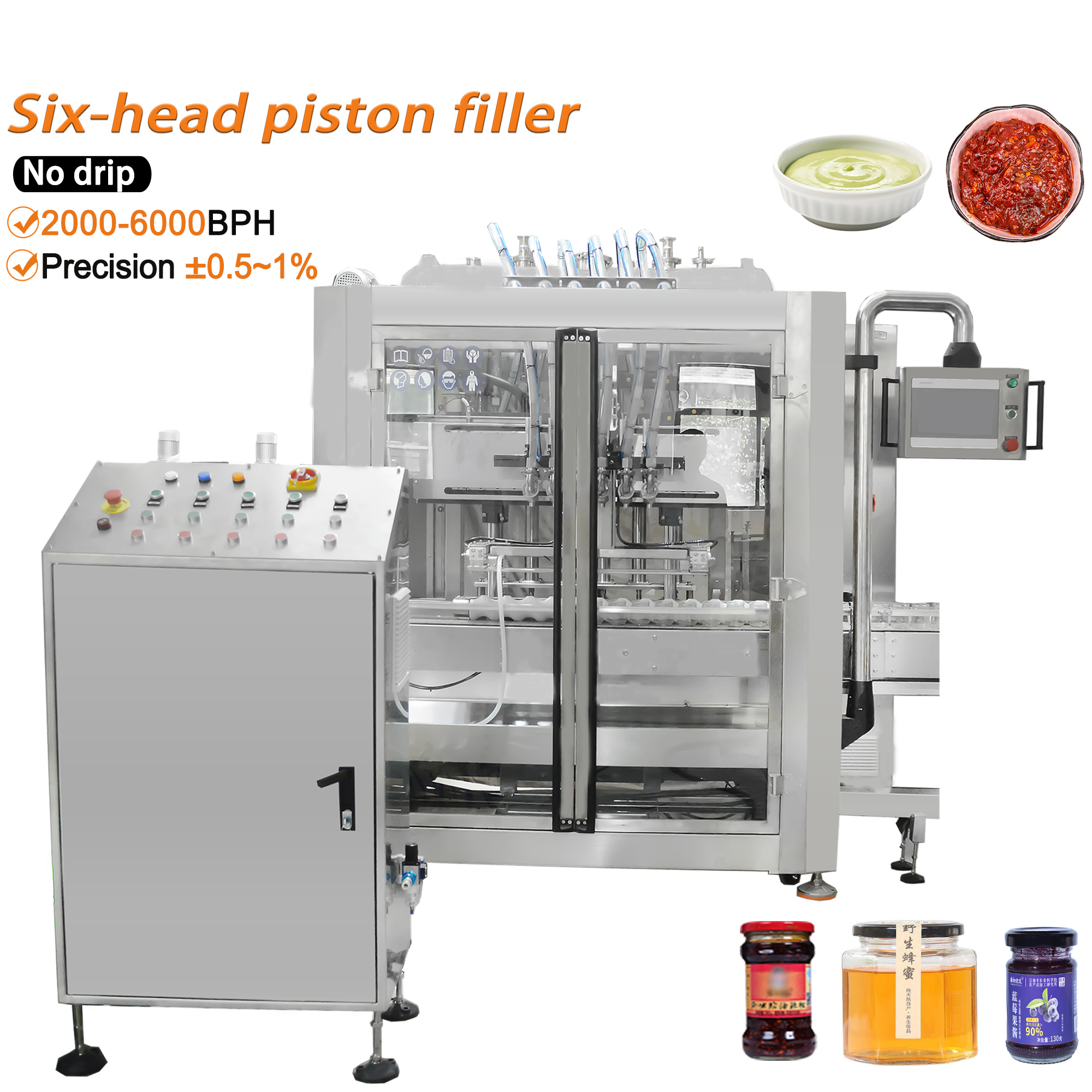
Key Specifications for the Filling Block
Numbers we actually quote on a linear / servo liquid filling machine — use them as a sanity check against any other vendor proposal.
| Parameter | Single-head servo | 6–8 head linear piston | 10–12 head rotary/tracking |
|---|---|---|---|
| Filling heads | 1 | 6 / 8 | 10 / 12 |
| Speed (typical) | 20–40 bpm | 40–80 bpm | 120–240 bpm (edible oil 1 L) |
| Fill volume range | 30–1,000 ml | 100–5,000 ml | 250–5,000 ml |
| Volumetric accuracy | ±0.2–0.5% | ±0.5% | ±0.3–0.5% |
| Product contact material | 304 / 316L SS, FDA silicone | 304 / 316L SS | 316L SS, sanitary clamp |
| Drive | Servo + PLC (Siemens / Delta) | Servo per row | Servo per head + starwheel cam |
| Installed power | 1.5–2.5 kW | 4–6 kW | 8–12 kW |
| Air consumption | 0.3 m³/min @ 0.6 MPa | 0.6 m³/min | 1.0 m³/min |
| Hopper | 60–100 L, optional jacketed | 200–400 L | 500–1,000 L with level probe |
| Changeover time | 10–15 min (recipe recall) | 20–30 min | 30–45 min (starwheel + guides) |
CE & ISO 9001 build standard; optional 3-A sanitary and EHEDG-certified design for dairy and pharma. Every machine runs a 72-hour FAT on our floor before container loading.
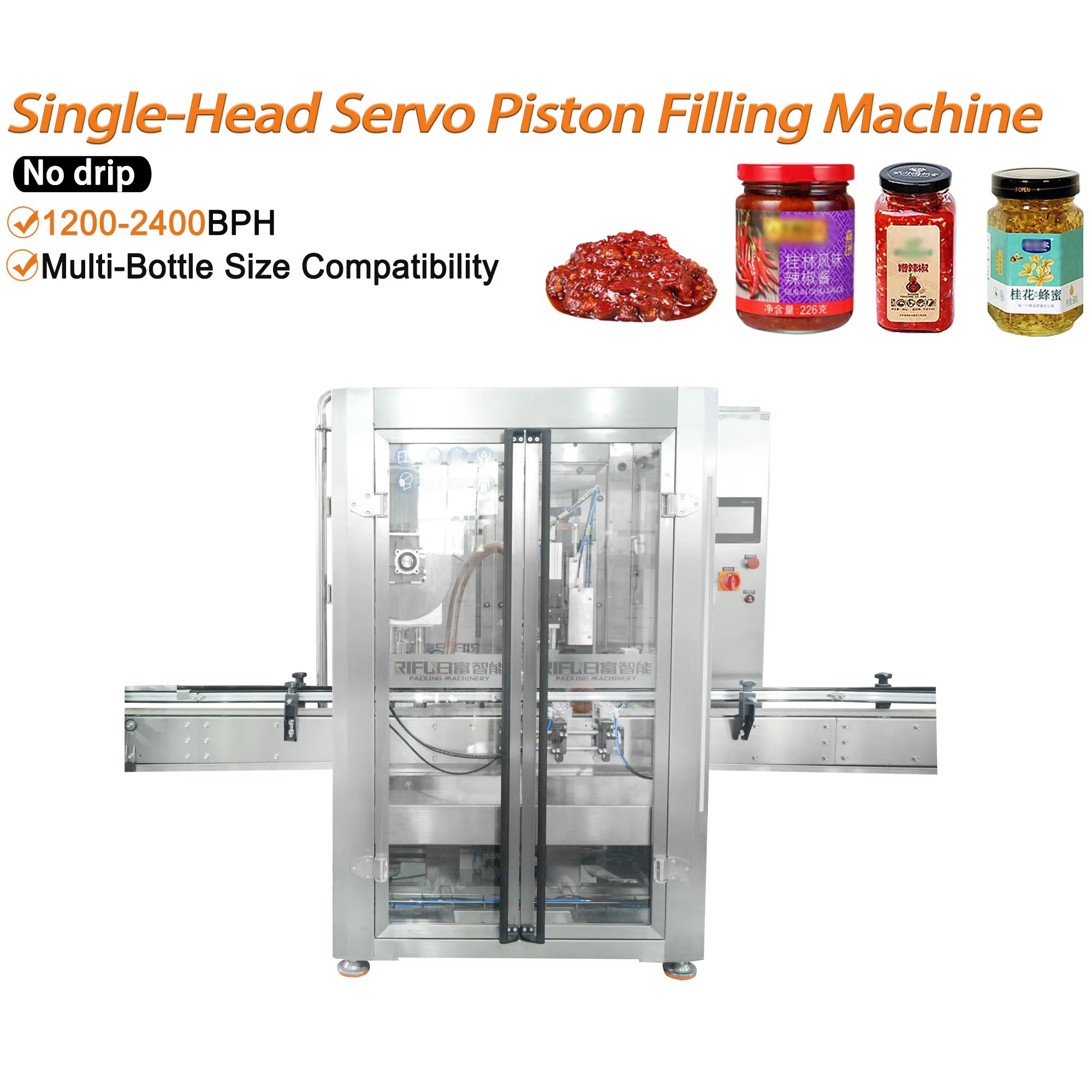
How the Filler Sits Inside a Filling–Capping–Weighing Line
A filler is never an island. On a SunAura front-end line it is the center station; we engineer the upstream in-feed, the downstream capping machine, and (for dry-goods-to-bottle scenarios) the multihead weigher feeding bulk product into the jar before the liquid or brine goes in.
Bottles arrive on a slat or tabletop conveyor, accumulate into a single-file lane through a hopper-cleated timing screw, and are released one-pitch at a time to the filling starwheel. The screw speed is slaved to the filler head count so an empty gap never lets two bottles collide under a nozzle.
After filling, bottles ride on a vacuum-centering belt or a neck-handling starwheel to the high-speed bottle capping machine. We set the conveyor speed as a ratio of filler RPM so there is 1.5× spacing between filled and capped bottles — no back-pressure, no knocking shoulders.
For pickled vegetables, instant noodle cups, or sauce-and-particle jars, a 18-head combination weigher drops solids into the container first; the filler then tops up brine, oil, or sauce. Interlocks prevent the filler from opening if a weigher discharge is misaligned — see our weigher integration guide.
All three stations share one Siemens / Mitsubishi PLC. Missing-cap detection at the capper triggers a pneumatic reject 1.5 m downstream; fill-weight giveaway is monitored by a checkweigher (we spec it separately) that auto-trims the servo stroke if the mean drifts.
⚠ Common Line-Integration Mistakes We Fix on FAT
- Sizing the filler for peak BPM but the capper for average BPM — the capper becomes the bottleneck. We balance the slowest station at 85% of rated speed.
- Ignoring CIP return: a filler on a heated oil line needs a drain slope of 3° and heated return loop, or you lose 20 kg of product on every changeover.
- Slaving conveyor speed to filler motor encoder instead of to a real bottle sensor — causes skips when bottles back up. We always put a photo-eye at the capper in-feed.
More on upstream balancing: see cost of an automatic filling-capping line and the liquid filling buying guide.
Engineering Questions We Get Before Quoting
How do I choose between a linear filling machine and a rotary filler?
Below 80–100 bpm, a linear filler (fixed centers, reciprocating or continuous motion) is cheaper and faster to clean. Above ~150 bpm on round bottles 200 ml–2 L, a rotary / tracking filler wins because bottles move with the nozzle — no stop-start impact, and we can hit 240 bpm on 1 L edible oil. We size head count as BPM ÷ fill-time-per-bottle, then add 20% spare.
How do I size a piston barrel for my fill volume?
We target barrel stroke utilization of 60–85% of geometric barrel volume. A 250 ml fill uses a 350–400 ml barrel; a 1,000 ml fill uses a 1,300–1,500 ml barrel. Oversizing the barrel kills accuracy because the piston sits near top-dead-center where seals leak; undersizing caps your max fill.
Can one piston filling machine handle both sauce and oil?
Mechanically yes — same bore, same valve. But the product-wetted parts, seals, and cleaning logic differ. We build a common frame with quick-change product valves and a CIP loop, so changeover between ketchup and sunflower oil takes ~25 minutes. Tell us every SKU on the machine at RFQ; we will list the change parts.
What accuracy do you actually achieve on toothpaste filling?
Toothpaste is 30,000–80,000 cP and abrasive. We specify a valveless servo piston with a hardened-wear liner, heated collar to 35–40 °C to thin the paste, and a positive cut-off nozzle. On a 100 ml tube we hold ±0.8% gross weight — enough for net-content audit, and roughly 30% tighter than pneumatic fillers.
How do you handle CIP / SIP on a liquid filling machine?
For food and pharma, our CIP loop runs through the product tank, piston barrels, valves, and nozzles on a timed sequence (pre-rinse 60 s, 1.5% NaOH at 80 °C 300 s, water rinse, optional acid). We supply the loop, return pump, and conductivity sensors as a package. See our CIP/SIP guide.
How long is lead time after order?
Standard 6–8 weeks for a single-head servo or 8-head linear filler, 10–14 weeks for a 12-head rotary / tracking edible-oil line. Every machine goes through a 72-hour factory acceptance test on our floor — you or your agent are welcome to witness.
Get a Factory-Direct Quote in 24 Hours
Tell us your box size, daily output and voltage — our engineers reply with a model recommendation, price and lead time within one business day.
Looking for Bottle Labeling Machines?
After filling and capping, our bottle labeling machines apply wrap-around, pressure-sensitive and top-press labels on round and square bottles — integrated into the same front-end line. Explore the labeling range →
How a Piston Filler Works
A liquid filling machine doses a fixed volume of product into each container by displacing a known internal volume. In a piston filling machine, the core element is a precision-bored cylinder fitted with a food-grade piston. During the suction stroke, a rotary or pneumatic valve draws product from the supply tank into the cylinder chamber; during the discharge stroke, the same piston pushes that exact volume out through the nozzle into the bottle. Because the dose is defined purely by cylinder cross-section times piston travel, repeatability is excellent and largely independent of product viscosity change between batches.
The drive choice defines both accuracy and throughput. A servo-driven unit uses a closed-loop servo motor with encoder feedback, so the HMI can set the dose volume in 0.1 ml increments, program slow-start / slow-end nozzle profiles, and store up to 100 recipes. A pneumatic piston variant is simpler and lower cost, best for low-accuracy, low-mix runs where the operator sets travel mechanically. For high-volume, multi-SKU plants, servo is the default; for a single-SKU pilot line, pneumatic remains a cost-effective option. Our single-head servo piston filler is the classic entry point for laboratories, pilot batches and start-up cosmetic brands.
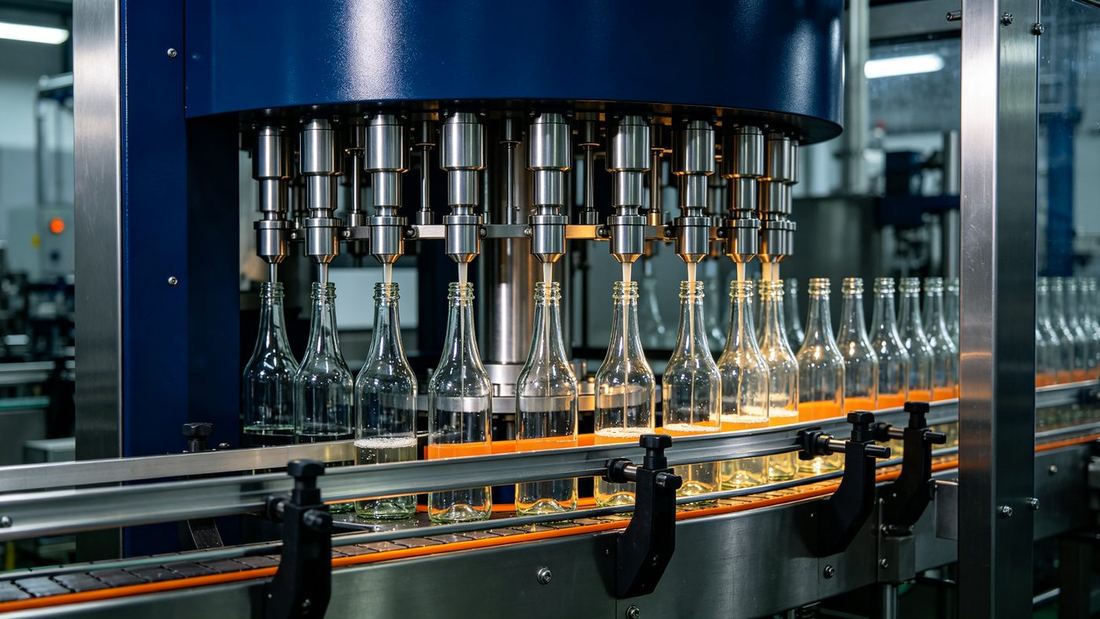
Key Specifications & Selection Guide
Choosing the right filler starts with three questions: how thin or thick is the product, how fast must the line run, and how clean must the wetted path be. Piston fillers dominate the mid-viscosity band; overflow fillers handle foaming thin liquids; gravity fillers suit low-cost water-thin products; flow-metric (mass / Coriolis) fillers handle very high-speed or particle-sensitive products. The table below summarises typical ranges for SUNAURA piston-based equipment.
| Parameter | Typical Range | Notes |
|---|---|---|
| Dosing volume | 5 ml – 5 L per nozzle | Change cylinder sleeve to cover different bands |
| Dosing accuracy | ±0.2 – 0.5% | Servo-driven, stable viscosity, degassed product |
| Viscosity range | 1 cP – 100,000 cP | Water, juice, oil, sauce, honey, paste, cream |
| Nozzle count | 1 – 12 heads | Scales linearly with target output |
| Output (linear) | 10 – 80 bottles/min | Depending on volume and nozzle count |
| Output (tracking/flying) | up to 200 – 300 bottles/min | Continuous-motion for high-speed lines |
| Container range | 50 ml – 5 L | PET, glass, HDPE, round / square / oval |
| Wetted parts | 304 / 316L stainless, FDA silicone / EPDM | CIP / SIP compatible |
| Drive | Servo (default) or pneumatic | Servo offers recipe recall and slow-end profile |
| Nozzle shut-off | Anti-drip, under-face cut-off | For thin to viscous, foaming products |
When the product changes, the filler changes with it. Thin beverages prefer overflow or gravity designs to kill foam; sauces with particulates need a large-bore piston and a ball-check valve; honey and creams need a heated hopper and heated nozzle jacket; solvents need explosion-rated valve packs. Our 8-head piston filler for high-precision liquids and pastes is the workhorse for sauce, honey and personal-care cream production, while our 8-head tracking filler for edible oil and viscous liquids runs in continuous motion at oil-bottling speeds.
Industries & Applications
A SUNAURA filler is deployed across four front-end markets. In food and beverage, it handles edible oil, juice, sauce, honey and dairy alternatives on lines that feed into our complete edible oil filling, capping and labelling production line. In cosmetics and personal care, the machine acts as a cosmetic filling machine for toner, lotion, shampoo, body wash, serum and cream, with 316L wetted parts and mirror-polished product contact surfaces. In pharmaceuticals, it supports oral liquids and topical preparations under GMP-conscious hygiene design. In chemicals, it fills detergents, surface cleaners and automotive fluids with acid-resistant seals and guarded dumping zones.
Integration with Other Front-End Equipment
A filler rarely stands alone. In a linear filling machine configuration, the unit sits between an unscrambler and a capper, with a conveyor that indexes bottles under each nozzle for a fixed fill station. In a tracking (flying) configuration, the nozzle carriage moves with the bottle as it fills, eliminating stop-start cycles and doubling throughput on fast lines. Downstream, the filled bottle passes to a capping machine, then optionally an induction sealer, then a labelling machine. The master PLC synchronises the filler's output pulse with the capper's star wheel, so a missing-cap event triggers a filler pause and a reject station. Our standard automatic linear filling machine for liquids is built to drop directly into this kind of line with pre-wired photoelectric sensors and a Profinet / Ethernet IP handshake.
Why Choose SUNAURA
We build on a 48,000 m² campus in Qingdao with in-house sheet metal, CNC machining, tube bending, electrical assembly and FAT testing. Every piston unit runs a four-hour witnessed FAT on your shipped containers and product before crating. Our machines carry CE marking, our quality system runs under ISO 9001, and we support you after handover through remote after-sales service, a technical help center and a global installation network covering Southeast Asia, the Middle East, Europe, Latin America and Africa. Spare parts, nozzle kits and seal sets ship from Qingdao within 48 hours.
Frequently Asked Questions
When should I choose a piston filler over an overflow or gravity filler?
Choose a piston design when your product is viscous (sauce, honey, cream, paste) or when you need volumetric accuracy independent of viscosity shifts. Choose overflow for thin, foaming beverages, and gravity for low-cost water-thin products at modest accuracy targets.
What dosing accuracy can I expect from a multi head liquid filling machine?
With a servo-driven piston and a degassed, stable-viscosity product, expect ±0.2–0.5% per nozzle. Trapped air, foaming or temperature drift will widen this band, which is why we spec heated hoppers and anti-foam nozzles for difficult products.
Can one filler handle both 50 ml and 5 L bottles?
Not on one cylinder sleeve. We spec a cylinder change-over or a second set of nozzles to cover more than a 10:1 volume ratio. Tell us your full SKU range at quotation and we will size the machine and the change parts accordingly.
Is the wetted path CIP compatible?
Yes. Standard 316L wetted parts, tri-clamp fittings and flush diaphragms allow CIP circulation. We can also supply SIP-ready steam-tight valve packs for pharma-grade duties.
What are the most common faults and how do we fix them?
Inaccurate dose usually means trapped air in the cylinder or a worn seal; bleed the line and replace piston O-rings. Dripping nozzles indicate a worn valve seat or incorrect shut-off timing; lap the seat or extend the slow-end profile. Foaming is cured by under-level nozzles and slower fill-down speed. Bottles that overflow suggest the product supply tank pressure is unstable; fit a level-controlled float valve.