
Packaging Line Solutions— Front-End to Final Integration Turnkey Automation
From filling, capping and flow wrapping through multihead weighing, thermoforming and induction sealing, SunAura Machinery designs and integrates the front-end line. End-of-line modules (case erecting, carton sealing, strapping, shrink wrapping, palletizing and stretch wrapping) are supplied by our sister site SunAura Packaging Machines. One turnkey line, one engineering responsibility, engineered around your product, speed and floor plan.
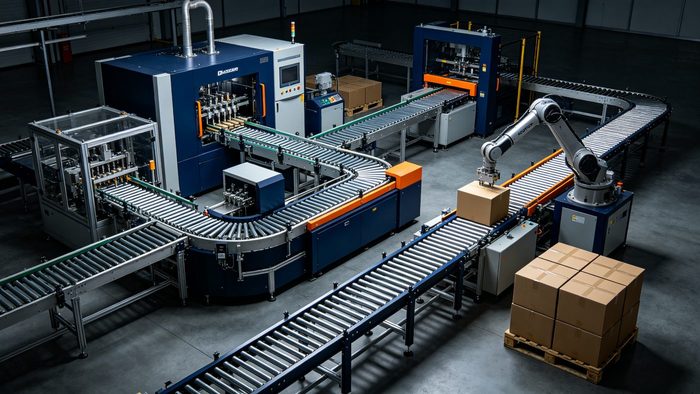
SunAura Packaging Lines Range
Click any model for the full spec sheet, video and inquiry form.
Scope note: Filling, capping, flow wrapping, multihead weighing, thermoforming and induction sealing modules are designed and built by SunAura Machinery in Qingdao. End-of-line modules — case erecting, carton sealing, strapping, shrink wrapping, palletizing and stretch wrapping — are supplied by our sister site SunAura Packaging Machines and integrated into the line under SunAura Machinery's engineering responsibility.
Case Erector Module (sister site)
Forms and bottom-seals cartons automatically — supplied by SunAura Packaging Machines
Filling Module
Piston / servo / vacuum fillers, 1–12 heads
Carton Sealing Module (sister site)
Semi-auto, automatic or corner sealing — supplied by SunAura Packaging Machines
Strapping Module (sister site)
Automatic PP strappers — supplied by SunAura Packaging Machines
Shrink Module (sister site)
L-bar sealer + shrink tunnel for multipacks — supplied by SunAura Packaging Machines
Palletizing Module (sister site)
Robot palletizing + stretch wrapping for hands-off end-of-line — supplied by SunAura Packaging Machines
How to Choose a Packaging Line: The Full Guide
A packaging line links individual machines — filling, capping, flow wrapping, multihead weighing, thermoforming, induction sealing on the SunAura front end, plus end-of-line stations (case erecting, carton sealing, strapping, shrink wrapping, palletizing) supplied by our sister site SunAura Packaging Machines — with conveyors so product flows from one station to the next without manual handling. Here is how to decide when a line pays for itself, and how we build one.
When a Single Machine Stops Being Enough — and a Line Pays for Itself
A packaging line links individual machines — filling, capping, flow wrapping, multihead weighing, thermoforming, induction sealing on the SunAura front end, plus end-of-line stations (case erecting, carton sealing, strapping, shrink wrapping, palletizing) supplied by our sister site SunAura Packaging Machines — with conveyors so product flows from one station to the next without manual handling. The trigger for moving from single machines to a line is rarely one dramatic moment; it is the slow accumulation of labor cost, inconsistency, and the transfer-point bottlenecks between machines. As a rule of thumb, if you run two or more packaging machines and still have staff hand-carrying product between them, a line study will almost certainly pay for itself in 12–24 months.
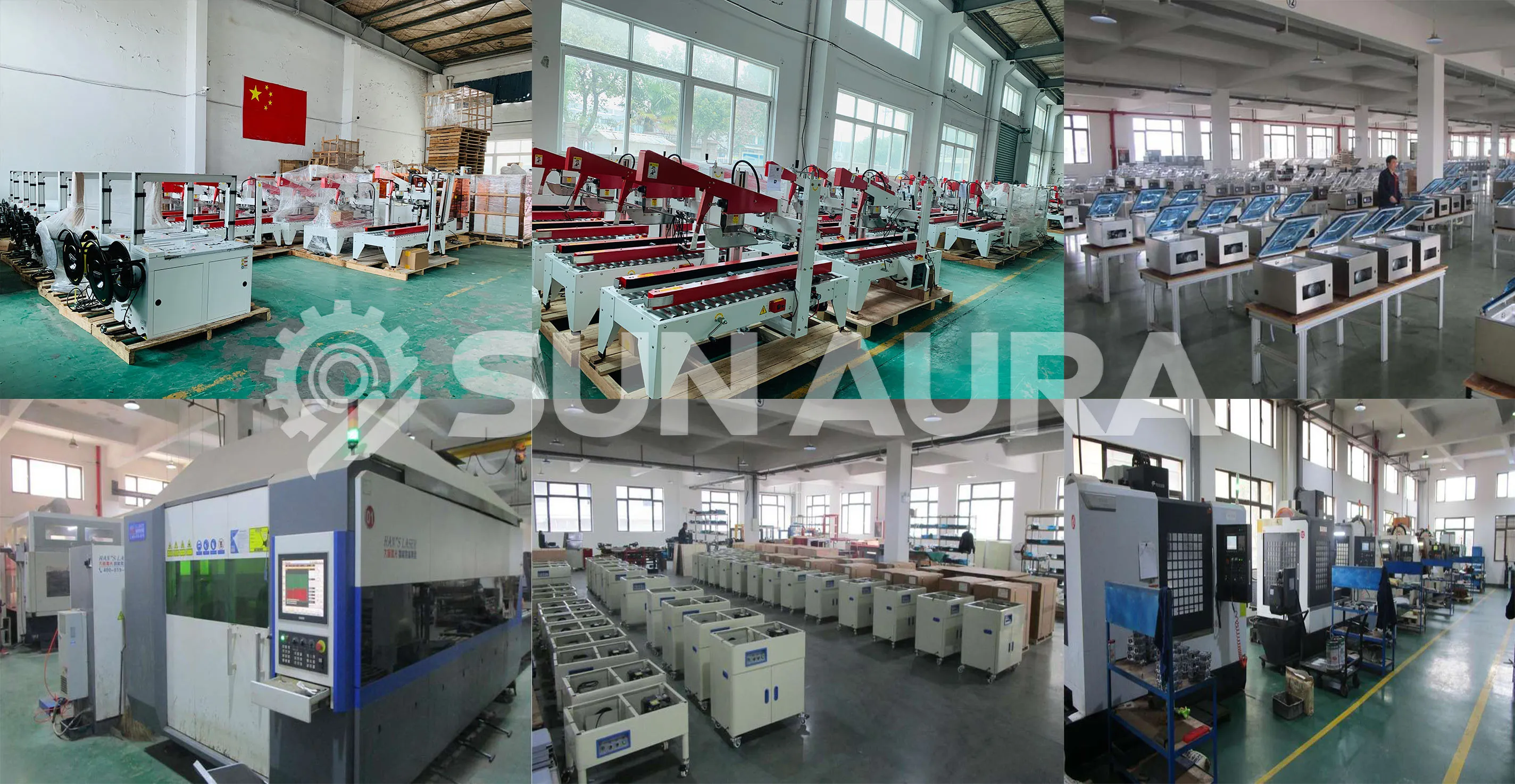
SunAura designs and integrates turnkey packaging lines in our 48,000㎡ Qingdao factory — front-end stations (filling, capping, flow wrapping, multihead weighing, thermoforming, induction sealing) are built in-house, while end-of-line stations (case erecting, carton sealing, strapping, shrink wrapping, palletizing and stretch wrapping) are supplied by our sister site SunAura Packaging Machines — for food, beverage, daily chemical, pharmaceutical, electronics, hardware and agricultural customers in 100+ countries. You get one supplier, one engineering responsibility, one service line: no finger-pointing between brands when something needs fixing.
Three Levels of Automation — Start Where the Math Works
Level 1 — Semi-automatic entry (500–2,000 units/day): filling/packing station (SunAura) plus manual or sister-site-supplied case erecting, carton sealing, strapping and manual palletizing. Low capex, typically 1–2 operators per station, payback under 12 months against a 3–4 person hand-packaging crew.
Level 2 — Medium automation (2,000–8,000 units/day): SunAura front-end filling/wrapping with conveyor linking plus sister-site automatic erecting, sealing, strapping and shrink wrapping; 1–2 supervisors running the whole line. This is where most food and e-commerce operations land.
Level 3 — Fully automatic turnkey (8,000+ units/day): adds SunAura auto filling and continuous-motion wrapping, plus sister-site robot palletizing and stretch wrapping at the end. Headcount drops to line supervision + QC; output is limited by the upstream production line, not packaging.
Do not overshoot. A fully automatic line that runs one shift uses its automation only a third of the day — the extra capex rarely pays back. We will tell you honestly which level fits your volume; that is part of the free design study.
Typical Line Architectures We Build
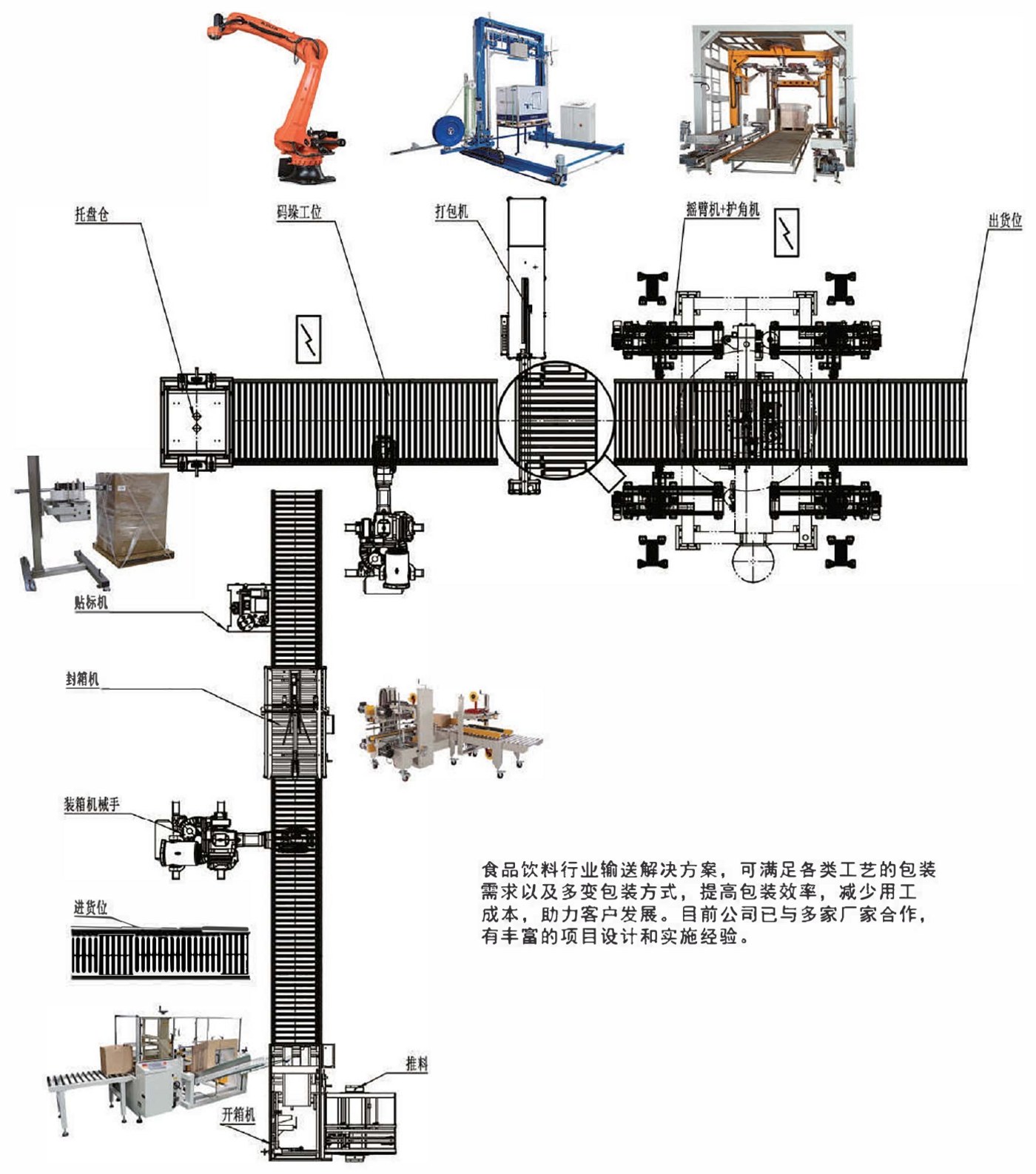
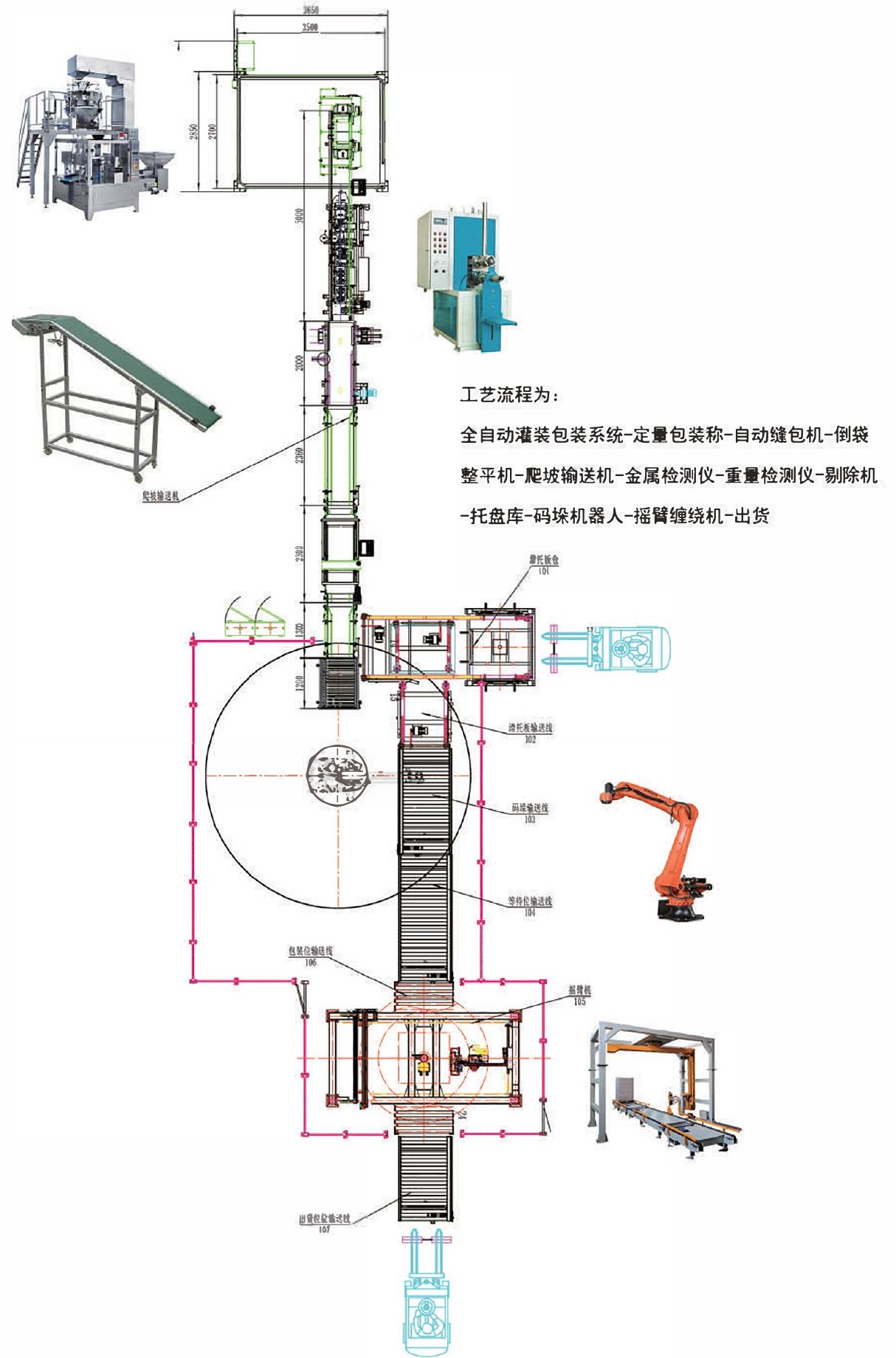
Carton line: case erector (sister site) → filling/packing station (SunAura front end) → carton sealer (sister site) → strapping (sister site, optional) → pallet wrapper (sister site) → label. The most common architecture; scales from Level 1 to 3. End-of-line stations are supplied by SunAura Packaging Machines and integrated by SunAura Machinery.
Liquid bottle line: bottle feeding/orienting → filling (piston/servo/vacuum) → capping → labeling → shrink multipacking → carton packing. SunAura’s filling-capping-labeling lines cover edible oil, sauces, honey, beverages and pharma.
Shrink / multipack line: SunAura product infeed and flow wrapping → sister-site L-bar sealing and shrink tunnel → sister-site carton packing or direct palletizing. For beverage multipacks, cosmetics kits and consumer goods. End-of-line stations supplied by SunAura Packaging Machines.
Vacuum food line: SunAura front-end product handling, weighing and flow wrapping → sister-site vacuum packing (single or double chamber, matched to throughput) → drying/inspection → sister-site carton packing. Often combined with sister-site shrink wrapping for retail packs. Vacuum and carton-pack stations supplied by SunAura Packaging Machines.
Layout: Where Lines Succeed and Where They Fail
Our 2026 failure-case study of packaging line layouts found the same four mistakes across industries: (1) conveyor height mismatches between machines from different suppliers, (2) transfer bottlenecks where cartons must be moved by hand, (3) no buffer zones — one machine’s downtime stops the whole line, and (4) underestimating maintenance access, leaving no room to service the sealing head or vacuum pump.
A good line design solves all four before any steel is cut: matched conveyor heights, auto transfers with minimal manual steps, 3–5 minutes of buffer between stations, and service aisles on every machine. Send us your floor plan (even a hand sketch with dimensions) and we design around it.
Our 5-Step Delivery Process
1. Data collection: product type, sizes, daily output, shift pattern, floor plan, existing equipment. 2. Line design: our engineers produce a 3D line layout with equipment list, speeds, manning and budget within about a week. 3. Build & test: every machine built in-house, then the assembled line runs continuously for 48 hours at rated speed with your samples. 4. Installation: overseas engineers available for on-site installation and commissioning; every line ships with remote video guidance. 5. Lifecycle support: 12-month warranty, spare parts within 48 hours, lifetime remote support.
Budgeting and Payback Reality
Use the three levels as your budget skeleton: L1 lines start in the low five figures, L2 typically runs mid-five to low-six, and L3 lines are quoted individually after the design study. The payback math that matters is labor saved minus automation cost per month — most of our line customers cross into positive cash flow inside 12–24 months at the volumes shown above, and the design study gives you the exact number before you commit a single dollar. Why SunAura as your line partner: because we manufacture nearly every machine on the line ourselves, we control speed matching, conveyor heights, PLC integration and spare-part availability — the three things that kill multi-supplier lines. We are CE and ISO 9001 certified (SGS-audited), hold 20+ patents, and have delivered custom lines to 100+ countries.
Daily Output
500–2,000 → L1 semi-auto; 2,000–8,000 → L2 medium; 8,000+ → L3 full auto. Don’t overshoot — a 1-shift line uses automation a third of the day.
Labor Saved
Line study pays back in 12–24 months when staff hand-carry between machines or packaging labor exceeds 3 people.
Line Architecture
Carton, liquid bottle, shrink/multipack and vacuum food lines — SunAura front-end modules integrated with sister-site end-of-line stations.
Layout & Buffer
Matched conveyor heights, auto transfers, 3–5 min buffers between stations, service aisles on every machine.
Budget Level
L1 low five figures; L2 mid-five to low-six; L3 quoted individually after the design study.
Five Mistakes That Cost Buyers Time and Money
- Overshooting automation — A fully automatic line on one shift uses its automation a third of the day — the extra capex rarely pays back.
- Mixed-supplier conveyor heights — Height mismatches between brands create manual transfers. One manufacturer avoids them by design.
- No buffer zones — Without 3–5 minutes of buffer, one machine’s downtime stops the whole line.
- Ignoring maintenance access — No room to service the sealing head or vacuum pump turns routine care into line downtime.
Technical Specifications at a Glance
Ten parameters, production configurations. All values customizable at no extra engineering cost.
| Dimension | L1 Semi-Auto Entry | L2 Medium Automation | L3 Full Turnkey |
|---|---|---|---|
| Daily output | 500–2,000 units | 2,000–8,000 units | 8,000+ units |
| Typical build | Erector (or manual) + semi-auto sealing + strapping + manual palletizing | Auto erecting + auto sealing + strapping + shrink, conveyor-linked | Auto filling + continuous wrapping + robot palletizing |
| Manning | 1–2 operators per station | 1–2 supervisors + QC | Supervision + QC, no handlers |
| Payback | < 12 months | 12–18 months | 18–24 months (by utilization) |
| Typical industries | Small e-commerce / workshops | Food, beverage, daily chemical, logistics | Large food, beverage, pharma, export plants |
Where These Machines Earn Their Keep
Proven in production lines across food, logistics, electronics and pharma.
Food & Beverage
Liquid bottle lines: filling → capping → labeling → shrink multipacking → carton packing.
Daily Chemical
Medium automation lines for detergent, personal care and household product cartons.
Pharma
Level 2–3 lines with precise filling, labeling and full traceability-ready packaging.
Electronics & Hardware
Front-end flow wrapping and weighing, with sister-site-supplied corner sealing and strapping for heavy, vibration-prone shipments.
Agriculture
Vacuum food lines for produce and meat, often combined with shrink for retail packs.
Manufactured by SunAura — the Maker, Not a Trader
SunAura manufactures nearly every machine on the line ourselves, so we control speed matching, conveyor heights, PLC integration and spare-part availability — the three things that kill multi-supplier lines. We are CE and ISO 9001 certified (SGS-audited), hold 20+ patents, and have delivered custom lines to 100+ countries. Every assembled line runs continuously for 48 hours at rated speed with your samples before shipment. Standard lines ship 30–45 days from design approval; large custom lines 60–90 days, with overseas engineers available for on-site installation and a 12-month warranty plus lifetime remote support.
Frequently Asked Questions
How do I know if I need a full packaging line?
The trigger is manual handling between machines. If you run two or more packaging machines and staff still hand-carry product between them, or if packaging labor exceeds 3 people, a line study usually pays back in 12–24 months.
What is the typical project timeline?
Standard lines 30–45 days from design approval; large custom lines (SunAura front end plus sister-site robot palletizing) 60–90 days. Every machine is 48-hour run-tested before shipment.
What information do you need for a line design?
Product type and sizes, daily output, shift hours, floor plan (even a sketch), available power, and any existing equipment you want to keep. We produce an initial layout and budget within about a week.
Can you integrate our existing machines?
Yes. We match conveyor heights and controls to your existing equipment. Honest advice included — if an existing machine should be replaced for reliability, we will tell you why.
Who installs and commissions the line?
Overseas engineers are available for on-site installation; every line ships with remote video guidance and a commissioning protocol. Most customers commission with our engineers in 5–10 days on site.
What is the budget range?
L1 semi-automatic lines start in the low five figures; L3 turnkey lines with SunAura filling/wrapping and sister-site robot palletizing are quoted individually after the design study. We publish honest ranges in the proposal, never a vague quote.
Can the line be customized to my product?
Yes — line speed, machine configuration, conveyor layout, voltage, machine color and documentation are all customized. OEM/ODM branding is available.
What warranty and support come with a line?
12-month full warranty, lifetime remote support, spare parts shipped within 48 hours, and a dedicated project engineer for the life of the line.
How a SunAura Complete Packaging Line Balances Throughput
A complete packaging line is only as fast as its slowest machine. We size every upstream and downstream module so the line cadence — not the filler alone — determines real bottles-per-hour (bph) out the door.
Most line failures we troubleshoot on commissioning are not broken parts. They are a filler rated at 6,000 bph feeding a capper that tops out at 4,200 bph, so the filler either starves or the capper backs up against a reject wall. We start a turnkey packaging line the other way around: we fix the bottleneck machine first, then give every neighbor 15–20% headroom above that bottleneck. In practice that means a 6,000 bph filler sits on a line whose capper is spec'd to 7,200 bph and whose labeler runs at 8,000 bph, so micro-stops on one station do not cascade into the next.
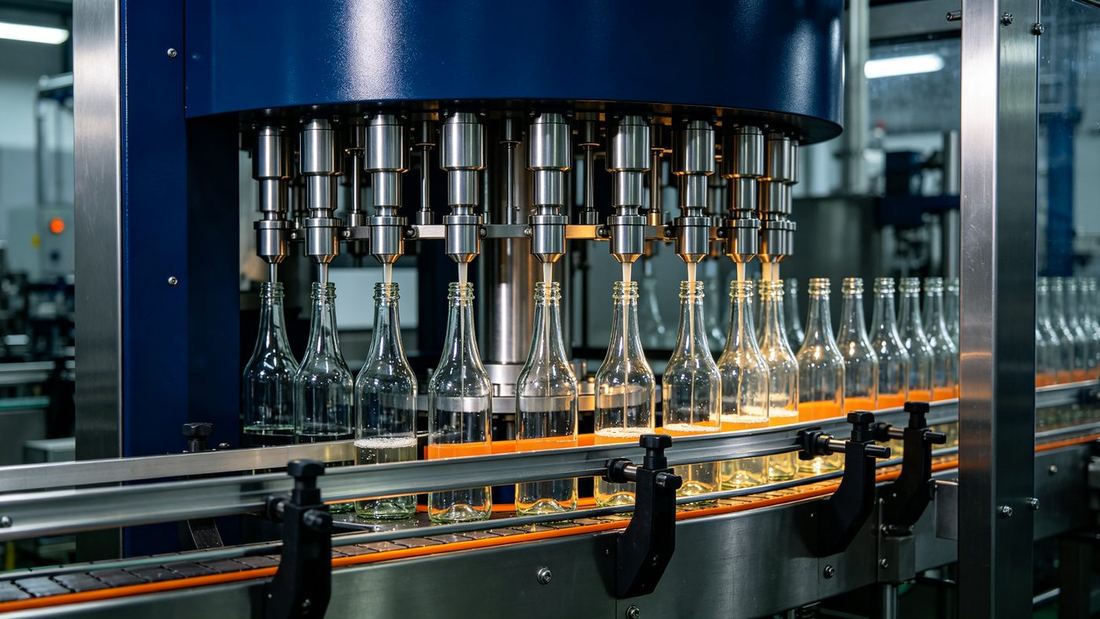
The cadence itself follows the container. On a bottle line, the sequence is unscrambler → rinser/air cleaner → filler → flow plug or induction sealer → screw capper → leak tester → labeler → checkweigher → case packer (we stop here on this site; case erecting, strapping and pallet wrapping belong to our sister line). Each station sits on a 750 mm conveyor datum, with 1.5–2 m of accumulation between filler and capper and between capper and labeler. Those two buffers are what let a 3-second capper torque-cycle pause absorb without tripping the filler. On a cup or tray line the upstream replaces the unscrambler with a thermoforming machine that forms the cup in-line, then indexes straight into a roll-stock sealing station — no unscrambler, no air rinser, one less feeder to jam.
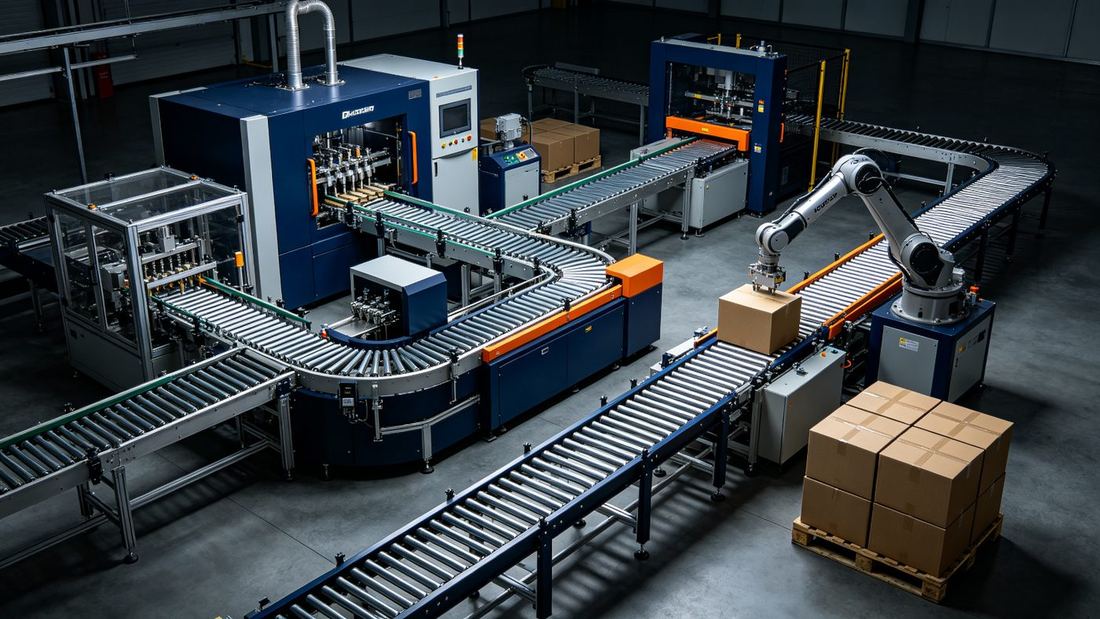
The other half of line cadence is changeover. A line that runs 6,000 bph on SKU A but takes 90 minutes to swap to SKU B loses roughly 900 bottles of effective output per SKU switch. We tune liquid filling machines, capping machines and the shared conveyor recipes to a common PLC, so a product changeover is a single HMI recipe recall rather than three machines adjusted by hand. More on that in the selection guide below.
Typical Line Parameters We Quote
Numbers below are representative of the packaging line solutions we have shipped in the last 24 months. Your project will land somewhere in this envelope depending on container, product viscosity and target OEE.
| Parameter | Bottle / Jar Line | Cup / Tray Line | Note |
|---|---|---|---|
| Line speed (nominal) | 3,000 – 12,000 bph | 30 – 120 cups/min | Bottles 50–1,000 ml; cups 50–500 ml |
| Container diameter range | φ30 – φ110 mm | 40 × 60 – 180 × 260 mm | Change parts per format |
| Container height range | 60 – 320 mm | 20 – 80 mm (formed) | Index screw + guide rail adjust |
| Changeover time (single operator) | 25 – 45 min | 30 – 60 min | Tool-less where possible |
| Target OEE at 12 months | ≥ 85% | ≥ 82% | Based on 2-shift operation |
| Installed power | 22 – 55 kW | 30 – 75 kW | Incl. filler, capper, labeler, checkweigher |
| Compressed air | 1.2 – 2.5 m³/min @ 0.6 MPa | 1.5 – 3.0 m³/min @ 0.6 MPa | Dry, oil-free |
| Contact parts | 304 / 316L stainless | 304 / 316L stainless | Gaskets EPDM / silicone per product |
| Control | Single PLC + 10" HMI | Single PLC + 12" HMI | Siemens or Schneider per customer spec |
| Footprint (typical) | 14 m × 3.5 m | 10 m × 3.0 m | Excludes upstream bulk pallet and downstream case area |
Tolerances: fill volume ±0.5% of nominal at 20 °C for free-flowing liquids; ±1.0% for sauces and pastes with visible particulates. Cap torque repeatability ±5% of set value on screw cappers. These numbers are contract-guaranteed during our 72-hour FAT, not best-case lab figures.
Where We Deploy These Lines
Packaging line automation is not one size. We tailor contact materials, wash-down rating and validation documentation to the sector.
Food & Beverage
Juice, tea, carbonated soft drinks, sauces and condiments in PET or glass. CIP circuits built into the filler, IP66 wash-down on the capper enclosure, and a turntable-fed labeler that handles both pressure-sensitive and roll-fed wrap. Typical output 6,000–10,000 bph.
Home & Personal Care
Shampoo, shower gel, dish soap, lotion and liquid detergent. Piston or gear-pump filling for viscosities up to 50,000 cP, screw or press-on capping, and anti-dive nozzle timing so surfactants do not string between cycles.
Pharmaceutical & Nutraceutical
Oral liquids, syrups, supplements and tincture bottles. GAMP 5 documentation trail, validated recipe management, AISI 316L wetted parts, and a checkweigher with 0.1 g resolution feeding a reject bin that is interlocked with the line PLC for traceability.
Edible Oil
Olive, sunflower, peanut and blended oils in 250 ml – 5 L PET or glass. Gravity or timed-flow filler with nitrogen blanketing option, flow-plug induction sealing for oxygen headspace control, and torque-coded screw capping that survives a hot fill at 70 °C.
How We Spec the Right Line for Your Floor
Before we draw a layout, four decisions drive the bill of materials. Get these right and the rest is detail.
Below 6,000 bph on bottles, a single lane is almost always cheaper, easier to clean and easier to change over. Above 8,000 bph, dual lane halves filler speed per lane and lets you run one lane for small SKUs while the other is idle. We size this from your target 2-shift output, not your marketing slide.
Pneumatic is fine at ≤60 cycles/min and for non-critical motion. Above that — and anywhere the motion affects fill accuracy or cap torque — we go servo. Servo gives us recipe-controlled acceleration profiles and repeatability you cannot get from a cylinder with a flow control.
We wire filler, capper, checkweigher and labeler to one PLC with one HMI, not four panels bolted to four machines. This is the difference between a turnkey packaging line and four pieces of equipment bolted together. Read our single PLC integration guide for the architecture.
Line length is easy to shrink on paper; 900 mm maintenance aisles on the operator side and 600 mm on the back are what customers regret removing. Our line layout and footprint guide shows the minimum envelope.
⚠ Common Selection Mistakes We Catch on Site
- Spec'ing the filler at maximum bph and forgetting the capper is 20% slower — the capper becomes the bottleneck the day you start production.
- Buying four machines from four vendors and expecting them to talk. OPC-UA helps, but interlocks, reject logic and recipe sharing still need a single controls contractor. See automated packaging line integration.
- Sizing the compressed air for nameplate flow and not for peak cycle demand. Pneumatic cappers spike 2× nominal on first cycle after a weekend.
- Skipping the FAT because "we'll catch it at commissioning". A 72-hour FAT in our Qingdao workshop costs a fraction of what a two-week commissioning delay costs on your floor.
- Ignoring utility headroom. A line that needs 30 kW but lives on a 25 kW feeder will brown out every time the sealer energizes.
For budget framing, our team publishes a separate cost breakdown for an automatic filling-capping line so you can compare apples to apples before we quote. For the broader front-to-back arrangement, the sister article on complete packaging line solutions from filling to sealing covers the same territory from the integration-engineer side.
How We Tie Filler, Capper and Weigher Into One Line
We have built packaging line solutions for 18+ years out of a 48,000 m² Qingdao campus, shipped to 100+ countries, and every line leaves our shop after a 72-hour factory acceptance test.
Integration starts at the controls level. We do not ship the filler on Tuesday, the capper on Thursday and hope the installer figures out the handshake. All machines arrive on the same truck, pre-wired to a common control cabinet, and the line runs in our workshop for three full days before packing. During FAT we run your actual container and your actual product (or the closest proxy if you cannot release it), and we log fill accuracy, cap torque, reject rate and OEE against the contract spec. Customer signs off on the data before the crate is sealed. CE and ISO documentation ship in the same crate as the manuals.
Mechanical integration is the less glamorous half. We standardize on 750 mm conveyor height across every machine, so bottle transfer between filler and capper never drops or climbs. We size accumulation conveyors to hold 60–90 seconds of production between stations — long enough to absorb a capper torque pause, short enough that a jammed line does not dump product into a 2 m pile. Where the product is dry goods, the upstream becomes a multihead weigher feeding a linear bucket filler; the weigher's discharge timing is locked to the filler's index so every bucket gets the target weight on the first drop.
On-site, commissioning is normally 5–7 days: mechanical alignment, belt tracking, recipe upload, operator training and a production burn-in. We leave a spare-parts kit on site, a dedicated project engineer on WhatsApp for the life of the line, and remote diagnostics enabled so our controls team can read the HMI from Qingdao if a fault code trips at 2 a.m. your time.
Frequently Asked Questions
What is a complete packaging line, and how is it different from buying separate machines?
How long does changeover take between SKUs on an automated packaging line?
What OEE should I expect from a new packaging line after 12 months?
Do you supply packaging line solutions for both liquid and dry products?
Can you integrate machines we already bought from other vendors?
What utilities does a typical automated packaging line need?
How long is lead time for a turnkey packaging line?
Get a Factory-Direct Quote in 24 Hours
Tell us your box size, daily output and voltage — our engineers reply with a model recommendation, price and lead time within one business day.
How a Complete Front-End Packaging Line Works
A complete packaging line is more than a row of machines plugged into the same wall socket. It is a synchronised flow of containers, product, caps, closures and labels designed to move at one balanced cadence from the unscrambler exit to the final conveyor discharge. At SUNAURA, our turnkey packaging line scope deliberately covers the front end only: container feeding, filling, capping, induction sealing, labelling and conveying. The line ends where your downstream packer takes over, which keeps our responsibility boundary clean, certified and easy to accept.
The typical sequence starts with an unscrambler or feed screw that orientates empty bottles into a single-file lane. Bottles then travel on a centre-less or gripper conveyor to the filler, where product is dosed by piston, overflow or flow-meter valves. Next, a capping machine places and tightens screw caps, press-on lids or pump/spray closures. For products that demand tamper evidence, an induction sealer bonds a foil liner to the bottle neck before a labelling machine applies front/back, wrap-around or sleeve labels. A final conveyor routes the finished, sealed and labelled containers to your downstream station. Every station is wired into a shared PLC with a master HMI, so a stop at the filler automatically pauses the unscrambler and slows the capper, preventing pile-ups, missing caps and crushed bottles.
Key Specifications & Selection Guide
When we engineer packaging line solutions, we balance the slowest station against the fastest. In practice, the filler or the labeller almost always sets the ceiling; the unscrambler, capper and sealer are sized with 10–15% headroom so they never become the bottleneck. The table below shows typical parameter ranges for a SUNAURA front-end installation.
| Parameter | Typical Range | Notes |
|---|---|---|
| Line output | 20 – 200 containers/min | Up to 300/min on tracking-filler configurations |
| Container volume | 50 ml – 5 L | Round, square, oval PET / glass / HDPE |
| Filling accuracy | ±0.2 – 0.5% | Piston servo-driven, volumetric repeatable |
| Cap types | Screw, ROPP, press-on, spray, pump, trigger | Change parts per closure type |
| Induction sealing | 15 – 120 mm neck diameter | Foil liners for PET / glass / PP / HDPE |
| Labelling accuracy | ±1 mm | Wrap-around, front-back, sleeve, self-adhesive |
| Electrical supply | 380 V / 50 Hz, 3-phase (customisable) | UL/NEMA variants available |
| Compressed air | 0.6 – 0.8 MPa, filtered & dry | Typical 0.6 – 1.2 m³/min |
| Changeover time | 15 – 45 min | Tool-less guides, recipe recall on HMI |
| Wetted contact parts | 304 / 316L stainless steel | CIP-friendly for food, pharma, cosmetic lines |
To size your line correctly, we ask every buyer for the same five inputs: container drawing (neck diameter, height, base shape, material), product data (viscosity, temperature, foaming tendency, particles), target output per shift, site floor-plan dimensions and ceiling height, and your utilities (power, compressed air, water, drainage). With those five answers, we can produce a CAD layout and a firm quotation within days.
Industries & Applications
Our front-end platforms are deployed across four regulated markets. In food and beverage packaging lines, equipment handles sauces, honey, edible oil, juice and dairy alternatives with 316L wetted parts and CIP routines. In cosmetic and personal care packaging lines, products range from thin toners and lotions to thick creams and shampoos, often with pump and trigger spray closures that demand torque-controlled cappers. In pharmaceutical packaging lines, we build to GMP-conscious hygiene design, with sloped surfaces, aseptic wetted parts and fully traceable dosing. In chemical packaging lines, we accommodate corrosive liquids, solvents and detergents using Hastelloy-tipped valves, Viton seals and fully guarded dumping zones.
Integration with Other Front-End Equipment
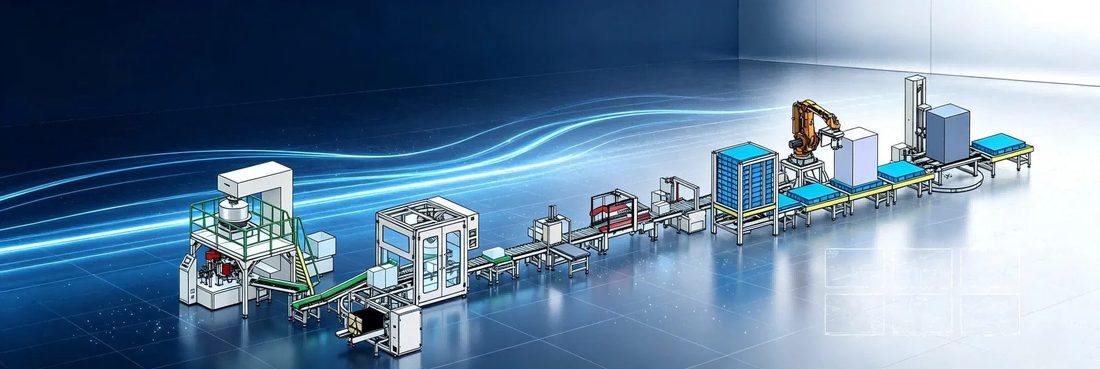
A turnkey project is only as strong as its interfaces. We integrate our liquid filling machines, capping machines, induction sealing machines, labelling machines and conveyors under one electrical and software umbrella. The benefits of a single-vendor integrated front-end line are concrete: one PLC program, one HMI recipe set, one FAT sign-off, one commissioning team, one spare-parts list and one warranty document. When you instead assemble a line from four vendors, you inherit finger-pointing at every interface, mismatched photoelectric sensors, different fieldbus protocols and changeover procedures that no operator can remember.
Our project workflow is standardised: requirements gathering → CAD layout → component selection → in-house FAT at our 48,000 m² factory → container and product shipment → export crating → sea freight → site installation → SAT (site acceptance test) with your production containers → operator training → handover. Utilities are pre-planned: we mark exact points for 3-phase power, 0.7 MPa compressed air, CIP water supply and floor drainage, so your civil works team knows where every trench goes before the crates arrive.
Why Choose SUNAURA
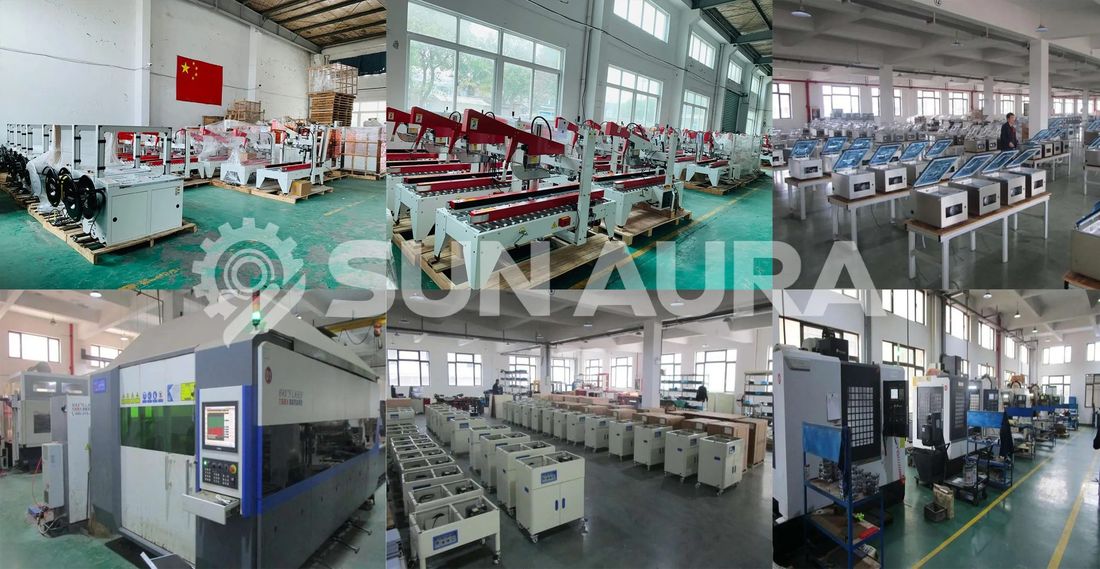
We are a front-end specialist with a 48,000 m² manufacturing base in Qingdao. Every integrated line leaves our factory only after a witnessed FAT, where your containers, caps, labels and actual product run at full line speed for a minimum of four hours. Our machines carry CE marking and our quality system runs under ISO 9001, with documented certifications and patents on record. We maintain a global installation network with local engineers in Southeast Asia, the Middle East, Europe, Latin America and Africa, backed by remote after-sales support and a technical help center. Whether you need a pilot line, a production line or a multi-shift plant, the same engineering team handles your project from first sketch to handover.
Frequently Asked Questions
What information do you need to quote a complete packaging line?
We need five inputs: container drawing with dimensions and material, product viscosity and temperature, target output per shift, site floor plan with ceiling height, and available utilities (power, compressed air, water, drainage). With those, we can return a CAD layout and firm quotation quickly.
How long does a typical turnkey packaging line project take?
Standard lines take 45–75 days from deposit to shipment, including FAT. Custom or pharma-grade lines typically run 90–120 days, depending on validation documentation and imported component lead times.
Do you handle installation and commissioning at our site?
Yes. Our engineers travel to your plant for mechanical installation, electrical hookup support, SAT with your production containers and product, and operator training. Remote support continues after handover through our global network.
Can the line handle future container changes?
Yes. Every station is designed with change parts, quick-release guides and HMI recipe recall. Typical changeover between two container formats is 15–45 minutes depending on cap and label complexity.
What is the difference between FAT and SAT?
FAT (Factory Acceptance Test) is run at our Qingdao factory before shipment, using your shipped containers and product. SAT (Site Acceptance Test) is run at your plant after installation, confirming the line performs on your real utilities and real production environment.