
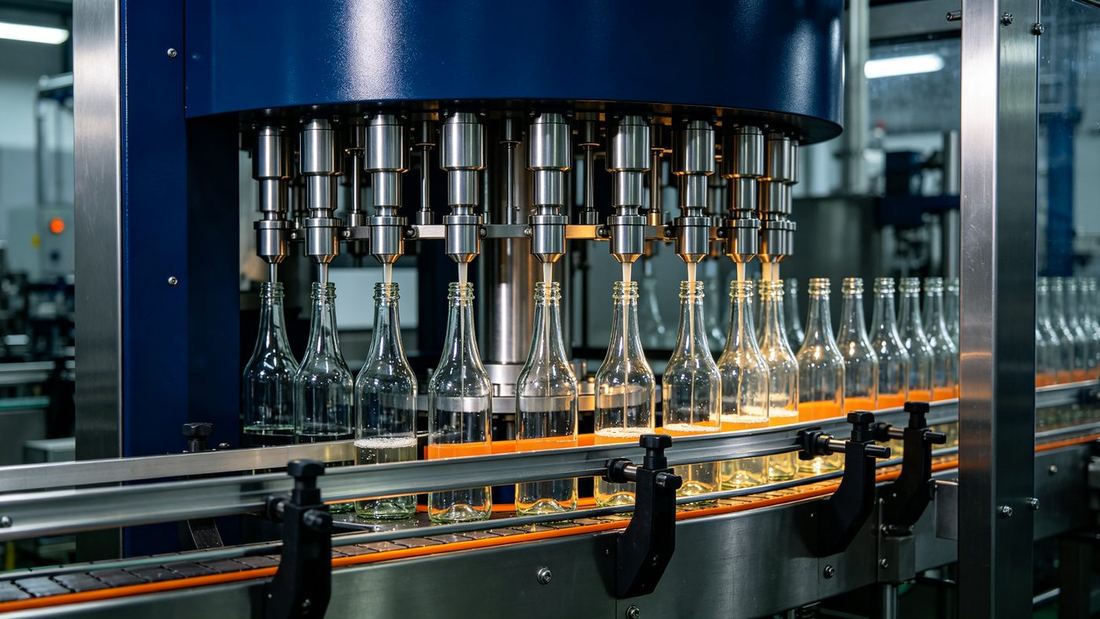
SunAura Machinery has commissioned a 12-head servo rotary piston filling line with screw capping and induction sealing for a honey and molasses producer in the Aegean region of Turkey. The customer packs 250 g, 500 g and 1 kg glass and PET jars of blossom honey, wild-thyme honey and grape molasses (pekmez), at a target of 40–55 jars per minute. The project replaced a semi-automatic piston filler that could not hold fill weight through the Turkish summer, when stored honey warms and thins by 30–40%.
A “liquid filling line” quoted for water, juice or oil would have failed on three points: it would not control temperature, it would trap air into viscous honey, and its nozzles would drip between cycles. This line was specified around honey’s actual behavior.
Why a Heated Rotary Piston Filler — Not Overflow or Gravity
Thin liquids use overflow or gravity fillers: they run fast, self-level and tolerate viscosity changes. Honey does the opposite. Its viscosity swings hard with temperature — at 20 °C it is near solid, at 45 °C it pours. That is why we specified a servo piston filler with a temperature-controlled heated hopper and heat-traced filling nozzles, holding product at 40–45 °C to keep viscosity stable day to day. Without temperature control, the same piston stroke overfills in summer and underfills in winter.
| Filler type | Best viscosity range | Honey suitability | Why |
|---|---|---|---|
| Gravity / overflow | 1–50 cP (water, juice) | Not suitable | Cannot move honey; self-leveling pointless in viscous product |
| Flowmeter | 50–3,000 cP (sauces, oils) | Poor | Honey aerates and reading drifts; slow response on thick product |
| Unheated piston | 1,000–10,000 cP at constant temp | Limited | Weight drifts as ambient temperature changes viscosity |
| Heated servo piston (this line) | Up to ~20,000 cP with temperature control | Selected | Stable volume per stroke regardless of season; anti-aeration program |
Three Details That Decide Honey Fill Quality
Slow, bottom-up filling. Honey poured from height whips in air, which slows settling and leaves cloudy, ferment-prone jars. The nozzles descend near the jar base and retract slowly as the piston discharges — a program a generic thin-product filler does not run.
Anti-drip shut-off nozzles. Viscous product strings between nozzle and jar after each cycle. The nozzles use a pneumatic ball-valve cut-off rather than a simple pinch, which keeps jar threads clean and reduces rejection rate.
Gentle jar handling. Glass honey jars break easily at the neck when incoming star wheels push them hard. The line uses servo-driven, friction-fed infeed and torque-limited star wheels rather than fixed clutches.
Who This Line Suits — and What We Would Specify Differently
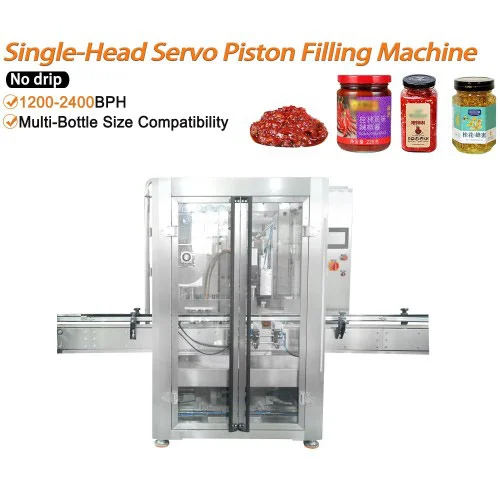
This configuration targets viscous food producers at 30–60 jars/min running honey, molasses, nut butters, jams or caramel in glass or PET jars, where fill weight must hold across seasons. Buyers above 80 jars/min step to a higher-head rotary platform; buyers below 20 jars/min are better served by a semi-automatic heated piston filler. For runny oils or juices, the heated hopper and slow-fill program are unnecessary cost, and an overflow filler is the better fit.
The line passed FAT at our Qingdao workshop with the customer’s actual honey run at 43 °C, checked net-weight tolerance at both the start and end of a fill run, and shipped with heated hose spares, nozzle seals and commissioning support covered under our after-sales service terms. For more on dosing principles, see the guide on liquid filling machines.
Filling honey, nut butter, jam or other viscous product? Send your product viscosity, jar size and target jars/min to [email protected] or on WhatsApp. We will tell you whether you need heated piston filling or a simpler overflow platform. Browse our integrated filling lines and other commissioning news.