
Multihead Weighers — ±0.1 g, 70+ Weighings/min
Combination weighers that dose snacks, nuts, frozen food and hardware by weight — discharging directly into a pillow wrapper or bucket filler.
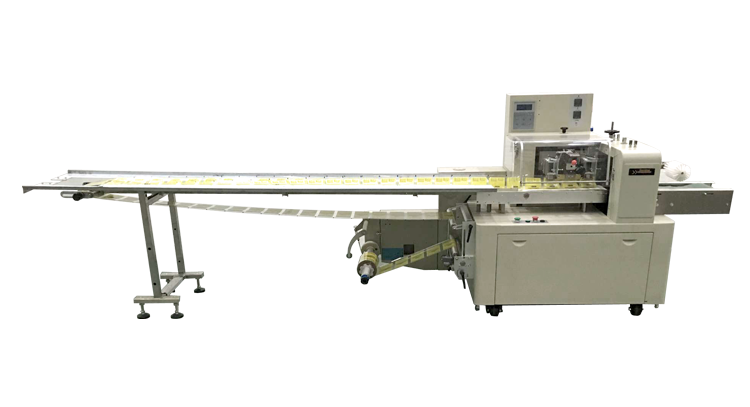
Weighing as the front-end dosing step
A multihead weigher fills 10–18 weigh hoppers simultaneously and the controller picks the combination of hoppers closest to target weight. It weighs faster and more accurately than volumetric cups, and it discharges directly into a pillow wrapper, vertical form-fill-seal machine, or bucket. SunAura weighers are built on a SUS304 frame with IP65 washdown for food environments.
Feeds your front-end line
Pair a SunAura multihead weigher with our high-speed pillow wrapper for a complete weigh-and-wrap line. The weigher sits on a steel frame above the wrapper's infeed, discharges weighed product directly into the forming film, and the two machines share one PLC for synchronized timing. We also supply vibratory feeders and work platforms.
How a Multihead Weigher Counts to an Exact Target Weight
A multihead weigher looks like a ring of buckets under a vibrating funnel. The magic is not in the buckets — it is in the math that picks which combination of buckets dumps into the packer. Get the algorithm wrong and you either over-fill (giving away product) or under-fill (failing net-content law). We size and tune every combination weigher on our floor before it ships.
The combination-weighing algorithm
Product is fed from a feed hopper through two vibrating trays — a main spreader tray and 10, 14, 18, or 22 individual linear feed trays — into as many weighing buckets. Each bucket sits on a load cell that reads its weight to ±0.1 g. Every ~40–80 ms the controller solves a subset-sum problem: which combination of buckets sums closest to the target weight without going under it. On an 18-head weigher, that is C(18, k) ≈ 262,000 possible combinations per weighment — the PLC solves it in under 20 ms. The chosen buckets open, dump into a single discharge funnel, and the empty buckets refill for the next cycle. This is why it is also called a combination weigher.
Target weight accuracy: why multihead beats manual
Hand-packing 100 g of nuts gives ±5–8 g spread. A 10-head multihead weigher holds ±0.5–1.0 g on a 100 g target; an 18-head weigher on a stable, free-flowing product (frozen peas, coffee beans, candy) holds ±0.2–0.5 g. The extra heads buy you two things: more combinations to choose from (tighter target-weight accuracy), and redundant buckets so a dribbling feed never stalls the cycle. For a 200 g snack bag at 60 packs/min, that tightness is worth 1–2% product giveaway per shift — easy payback on a 12–18-month ROI.
Load cells, vibration, and cycle time
Two load-cell technologies dominate: strain-gauge cells (cost-effective, ±0.1 g, good for most foods) and fiber-optic / electromagnetic force restoration (EMFR) cells (±0.05 g, for pharmaceuticals and high-value candy). Vibration feed is tunable per head — a nut with a jagged edge needs different amplitude than a smooth chocolate chip. We set the feed trays at FAT with your actual product so the cycle time hits rated BPM on day one. A typical 14-head weigher runs 60–90 weighments/min on snacks; an 18-head runs 90–120 on free-flowing product.
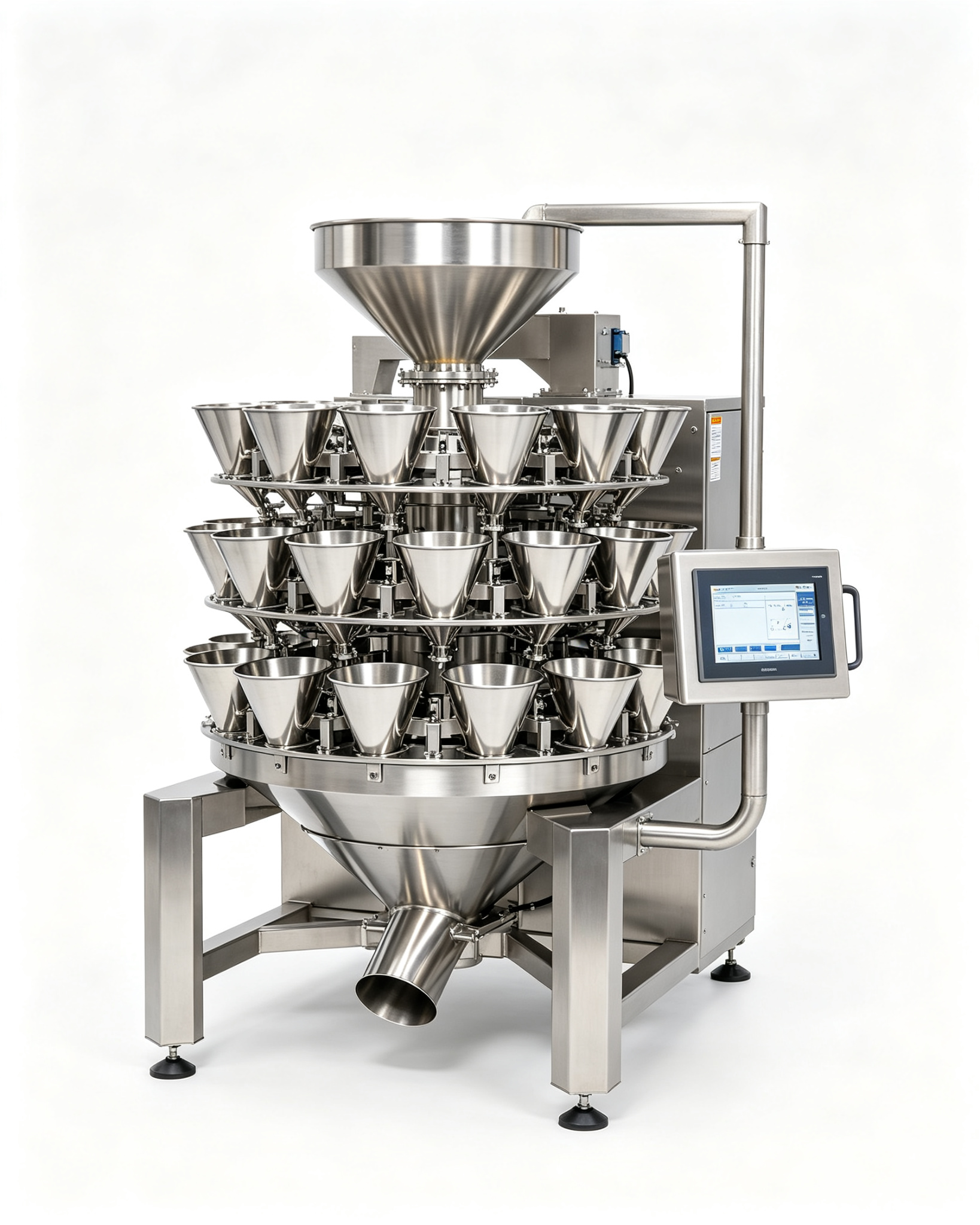
Multihead Weigher Parameters We Quote
Real numbers from our 18-head multihead weigher and smaller configurations. Use them as a benchmark.
| Parameter | 10-head compact | 14-head standard | 18-head high-speed | 20-head / 2-layer |
|---|---|---|---|---|
| Weighing heads | 10 | 14 | 18 | 20 (double layer) |
| Weighment range | 10–500 g | 10–1,500 g | 20–3,000 g | 50–5,000 g |
| Typical speed | 30–60 wpm | 60–90 wpm | 80–120 wpm | 100–150 wpm |
| Accuracy (target weight) | ±0.3–0.5 g | ±0.2–0.4 g | ±0.1–0.3 g | ±0.1–0.2 g |
| Load cell type | Strain gauge | Strain gauge | Strain gauge / EMFR option | EMFR option |
| Hopper type | Smooth / reject | Smooth / dimple | Dimple / angle for sticky | Special (frozen, sticky) |
| Feed system | Electromagnetic vibration | Electromagnetic, per-head | Electromagnetic + servo feeder option | Servo feed tray |
| Display | 7" touchscreen | 10" color HMI | 10–15" HMI, 100+ recipes | 15" HMI, Ethernet |
| Installed power | 0.5–0.8 kW | 0.8–1.2 kW | 1.2–1.8 kW | 1.8–2.5 kW |
| Air consumption | 0.1 m³/min @ 0.6 MPa | 0.2 m³/min | 0.3 m³/min | 0.4 m³/min |
| Material | 304 SS contact | 304 SS | 304 / 316L SS | 316L SS |
wpm = weighments per minute. CE & ISO 9001 build; NTEP / OIML R61 approval available for regulated markets. Every weigher runs a 72-hour FAT on our 48,000 m² floor with your product before container loading.
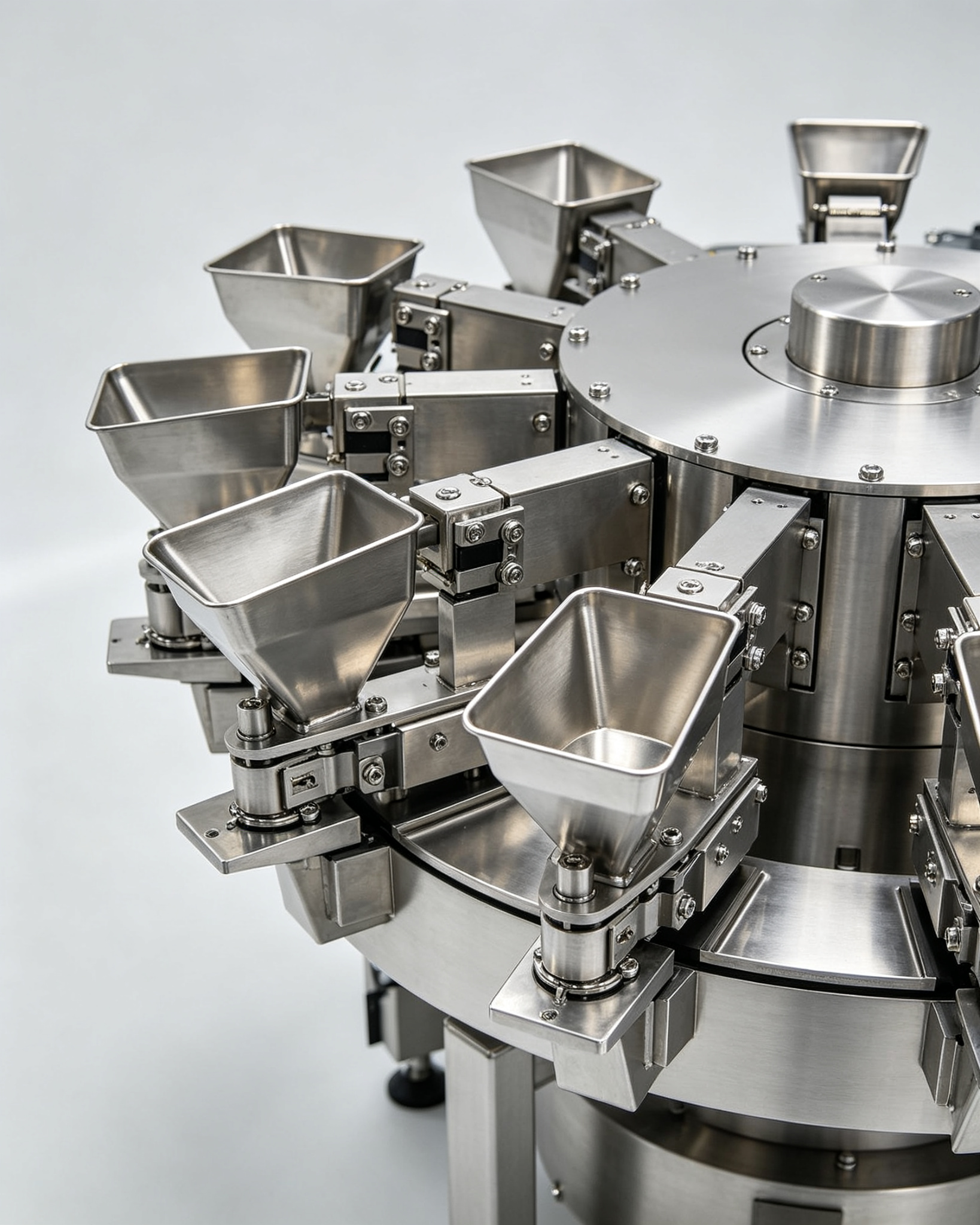
Where Multihead Weighers Earn Their Keep
Eighteen years of multihead weighing lines across 100+ countries — here is where the head count and accuracy really pay off.
Snacks & Nuts
Potato chips, peanuts, cashews, trail mix at 50–200 g bags. We spec 14–18 heads; dimple buckets for oily nuts; target weight accuracy ±0.3 g on a 100 g target.
Frozen Food
Frozen peas, french fries, berries, shrimp. Frozen product sticks at −18 °C; we spec angled buckets, air-knife vibration, and a heated discharge chute to prevent bridging.
Candy & Chocolate
Gummy bears, jelly beans, chocolate lentils. EMFR load cells hold ±0.1 g on a 50 g target; polished buckets prevent sugar buildup.
Pet Food & Animal Treats
Kibble, jerky bites, biscuit packs. 18-head weigher at 100 g–1 kg target; angle buckets for irregular jerky shapes.
Instant Food & Cup Noodles
Topping solids (shrimp, egg, veggies) dosed into cup before the liquid filling machine adds broth. We integrate the weigher discharge directly above the cup filler inlet.
Hardware & Small Parts
Screws, nails, plastic anchors, brackets. Bulk-counted by weight on a 10–14 head weigher; accuracy ±0.2 g lets you count 20 screws without a counter.
Choosing the Right Multihead Weigher Head Count
More heads costs more, but buys tighter accuracy and faster cycles. This is the decision we walk through with every buyer.
For 10–500 g targets at 30–60 wpm. Small cups, sample packs, co-op retail. Accuracy ±0.5 g. Good for pilot lines and low-SKU products.
The workhorse for snacks, nuts, candy at 60–90 wpm. Accuracy ±0.2–0.4 g. Covers 80% of food multihead weighing applications.
For 80–120 wpm on free-flowing product, or 200 g–3 kg bags where giveaway matters. Accuracy ±0.1–0.3 g. See 18-head weigher.
For 100–150 wpm on sticky or fragile product (chocolate, frozen berries). Two layers of buckets mean refill never blocks discharge.
For small sachets (sugar, spice, coffee) at 4–10 lanes. One weigher feeds 4–10 lanes simultaneously; head count is split by lane.
Always pair the multihead weigher with a checkweigher downstream. It trims the target weight recipe if the mean drifts — closing the loop on giveaway.
⚠ Common Multihead Weigher Selection Mistakes
- Under-sizing head count for the product. A 10-head weigher on potato chips will give away 2–3% because combinations are limited. Step up to 14 heads before you complain about giveaway.
- Ignoring product shape. Irregular, sticky, or fragile product needs angled buckets, dimple finish, and lower vibration — a smooth-bucket 18-head will jam on dried mango.
- Forgetting the feed system. A multihead weigher is only as fast as the vibratory feeder above it. If the hopper under-feeds, the controller has fewer buckets to combine and accuracy collapses.
- Not planning discharge height. The weigher sits 1.5–2.5 m above the packer. Fragile product (chocolate, potato chips) needs a gentle discharge chute with a baffle, or you bag broken pieces.
- Skipping the checkweigher. Without downstream weight feedback, the recipe drifts with ambient temperature and product moisture. A checkweigher pays for itself in 6–12 months on giveaway.
- Buying on price alone. A cheap strain-gauge weigher that drifts ±1 g on a 100 g target will give away 10 g per minute at 60 wpm — that is 576 kg of product per 8-hour shift.
More detail in our multihead weigher selection guide.
How the Multihead Weigher Sits in a Filling–Capping–Weighing Line
A multihead weigher is the front-end dosing step for dry-product lines. On a SunAura line it sits above a cup filler, a bagging machine, or a jar filler — discharging the target weight into each container before the liquid filler adds brine, oil, or broth, and the capping machine seals the pack.
The weigher discharge funnel drops into the packer inlet (vertical form-fill-seal bagger, cup filler, or jar filler). Timing is critical: the packer calls the weigher, the weigher discharges one weighment, the packer seals. We slave the weigher cycle to the packer index via a common PLC.
For instant noodle cups, pickled vegetable jars, or sauce-with-particle packs, the weigher doses solids first, then the tracking liquid filler tops up brine or oil. Interlocks prevent the filler from opening if the weigher discharge is misaligned.
A checkweigher downstream of the packer verifies gross weight. Out-of-tolerance packs are rejected; the mean weight feeds back to the weigher recipe so the target weight self-trims. See weigher integration guide.
Weigher, filler, capper share one Siemens PLC. We balance the slowest station at 85% of rated speed so no machine starves. For a 60 wpm weigher + 80 bpm filler line, the weigher is the bottleneck — we upsize to 18 heads to clear 90 wpm.
Multihead Weigher Engineering Questions
What is the difference between a multihead weigher and a combination weigher?
They are the same machine. "Multihead weigher" describes the hardware (a ring of weighing heads); "combination weigher" describes the math (the controller solving which bucket combination hits the target weight). We use both terms interchangeably in proposals.
How accurate is a multihead weigher on a 100 g target?
A 14-head weigher with strain-gauge cells holds ±0.2–0.4 g; an 18-head with EMFR cells holds ±0.1–0.2 g. Real accuracy depends on product flowability, bucket finish, and feed-tray tuning — we tune all three at FAT with your product.
How many heads do I need?
10 heads for small cups at 30–60 wpm; 14 heads for most snack/nut/candy lines at 60–90 wpm; 18 heads for high-speed 80–120 wpm or high-value product where giveaway matters; 20 heads double-layer for sticky or fragile product. Send target weight, target BPM, and product sample.
Can a multihead weigher handle sticky or frozen product?
Yes, with the right hardware: angled buckets, dimple or PTFE-coated finish, air-knife vibration, and a heated discharge chute. Frozen product at −18 °C bridges easily; we spec a live agitation tray and a slow, even feed rate.
How do you integrate the weigher with my existing filler or bagger?
We send a timing cable and a common PLC handshake. The packer calls the weigher, the weigher discharges one weighment into the inlet, and the packer indexes. We support Siemens, Mitsubishi, and Omron PLC handshakes; see our weigher integration guide.
What is the payback on a multihead weigher vs manual packing?
Manual packing at 100 g target holds ±5–8 g spread and 4–6 operators per shift. An 18-head weigher at ±0.3 g and 90 wpm replaces 4–6 people and cuts giveaway by 2–3%. Typical payback is 8–14 months on a snack or nut line.
Do you supply the feed hopper and discharge chute?
Yes. Every weigher ships with a top feed hopper, spreader tray, per-head linear feed trays, and a discharge chute. For fragile product we add a gentle discharge baffle; for frozen product we add a heated chute and air knives.
Get a Factory-Direct Quote in 24 Hours
Tell us your box size, daily output and voltage — our engineers reply with a model recommendation, price and lead time within one business day.
How a Multihead Weigher Works: The Combination-Weighing Principle
A multihead weigher — also called a combination weigher — solves a problem that single-head scales cannot: fast, accurate weighing of free-flowing, irregular or mixed products at high speed. A typical unit has 10, 14, 18 or 24 independent weigh heads arranged in a ring. Each head consists of a vibratory feed pan, a weigh bucket suspended on a dedicated load cell, and a discharge gate. Product from the feeder above falls into every bucket; the control system weighs each bucket independently within milliseconds, then runs an internal algorithm that tests every possible subset of buckets and selects the combination whose total mass is closest to the target. Those gates open together and drop the product into the funnel below. The empty buckets are refilled while the next combination is computed, which is why this weighing machine can run 40–120 weighments per minute with accuracies a single-head scale cannot approach.
Timing hoppers below the weigh buckets decouple the weighing cycle from the discharge cycle: they hold the selected combination until the downstream bag or mold is ready, then dump cleanly. Vibratory feeder pans at the top distribute product evenly; their amplitude and dwell time are tuned per product — gentle for fragile snacks, aggressive for dense granules. An IP65 washdown construction lets food and dairy customers hose the unit down between runs.
Key Specifications & Selection Guide
Choosing the right multihead weigher means matching head count, target weight, product characteristics and downstream speed. More heads improve accuracy and speed because the algorithm has more combinations to choose from, but add cost and cleaning area. The table below covers the SUNAURA standard range.
| Parameter | Typical Range | Notes |
|---|---|---|
| Head configurations | 10 / 14 / 18 / 24 heads | More heads = finer accuracy at same speed |
| Target weight range | 50 g – 5 kg | Small-head version down to 10 g for candy / hardware |
| Accuracy | ±0.1 – ±0.5 g at target | Depends on product bulk density and piece size |
| Weighing speed | 40 – 120 weighments/min | 18-head configurations for highest speed |
| Product types | Snacks, nuts, candy, dried fruit, frozen food, granules, small hardware | Sticky or oily products require enhanced surface finish |
| Feeding method | Vibratory pans + timing hopper | Belt feeder option for fragile or large-piece product |
| Construction | SUS304 / SUS316 stainless, IP65 washdown | Food-grade gaskets and easily removable buckets |
| Electrical | 220 V / 50 Hz, ~1.5–3 kW, color HMI | CE-marked, ISO 9001 manufactured |
For target weights under 100 g use a small-head (1.6 L or smaller) bucket; for 1–5 kg bags of rice, pet food or frozen vegetables use large buckets and 14–18 heads. Browse the 18-head multihead weigher detail page for dimension drawings.
Industries & Applications
SUNAURA combination weighers are widely used in snacks and confectionery (potato chips, nuts, gummy candy, chocolate), dried fruit and dehydrated vegetables, frozen food (fries, dumplings, berries), pet food, grains and rice, granules (coffee, sugar, salt) and small hardware (screws, plastic parts, fasteners). Their strength is mixing: two or more weighers can feed one funnel to build a recipe bag — for example a trail-mix pack with separate nuts, raisins and chocolate chips. See the food and beverage packaging line reference for a typical snack-bag installation.
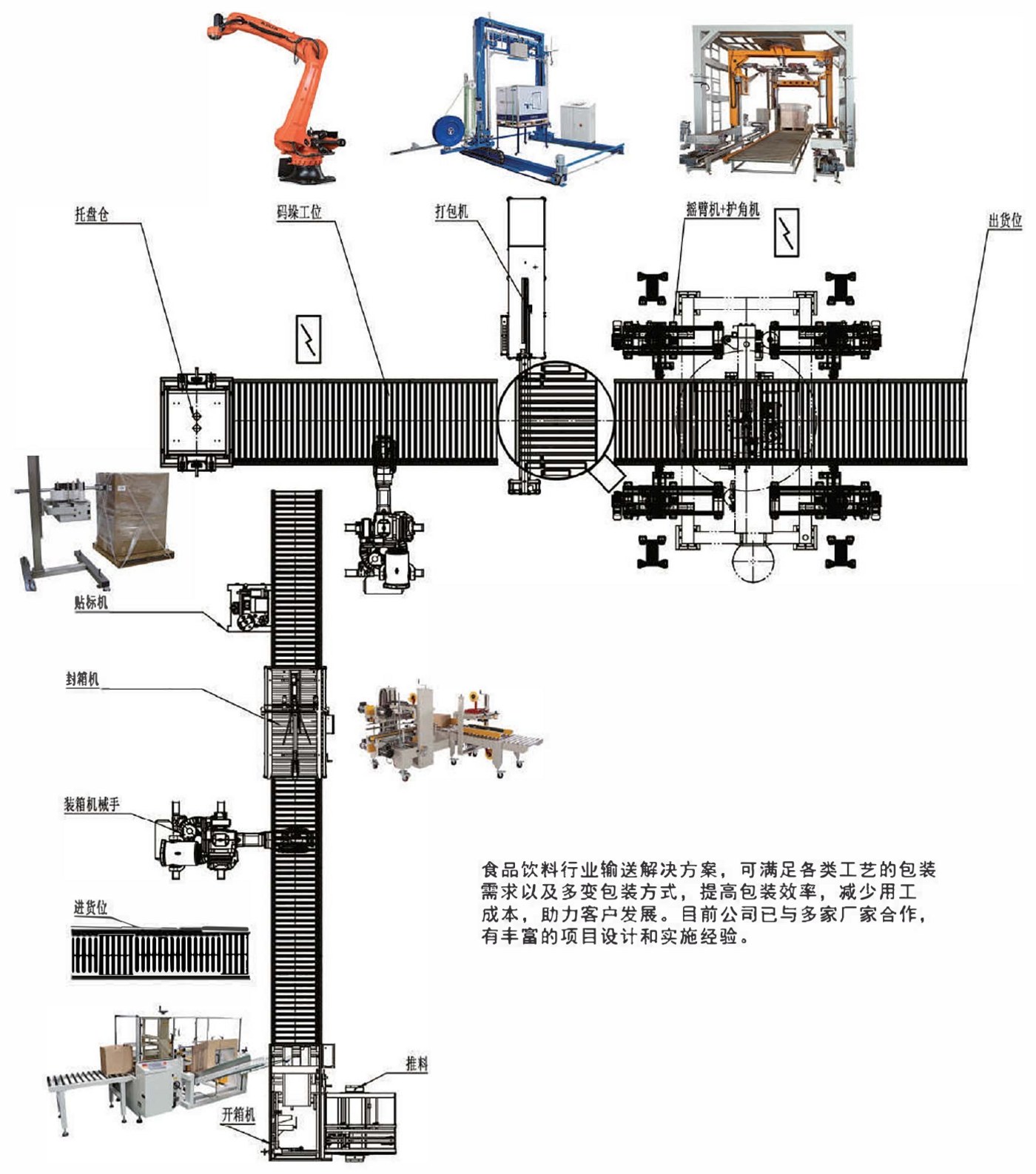
Integration with Other Front-End Equipment
A weighing machine of this type sits at the top of a packaging tower. Upstream, a loading conveyor and rotary or linear feeder deliver product from the factory floor; downstream, the weigher drops into a vertical form-fill-seal bagger, a pre-made-bag machine, a thermoforming filler, or the funnel of a complete packaging line. SUNAURA supplies matching conveyors and a common control interface so the weigher, bagger and downstream sealer start, stop and reject together. For rigid-tray and cup products, the weigher feeds a thermoforming machine that forms, fills and seals the pack in one continuous web.
Why Choose SUNAURA for Your Weighing Line
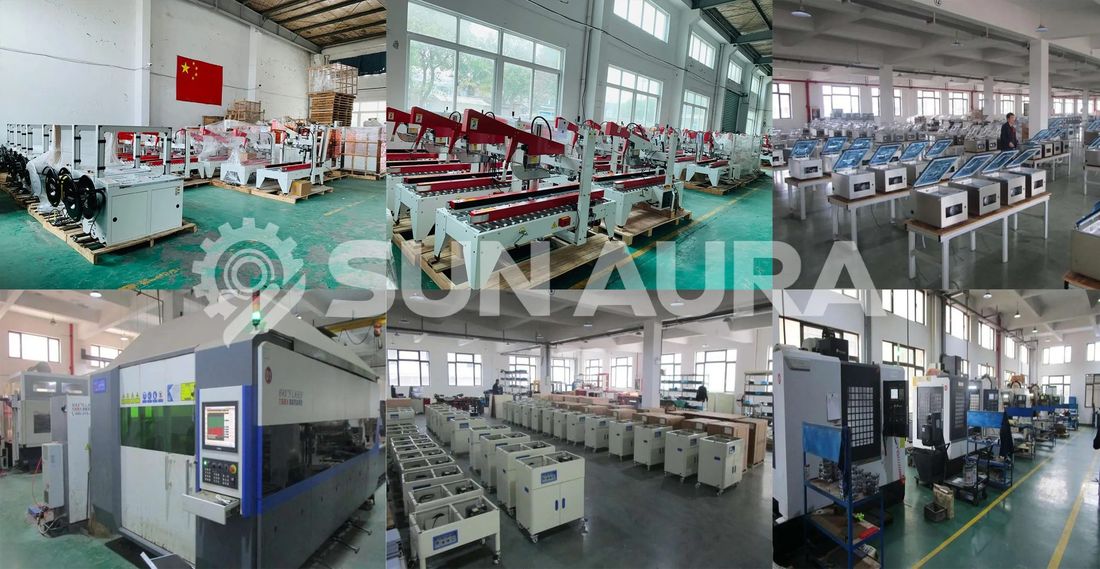
SUNAURA Machinery manufactures combination weighers on a 48,000 m² campus in Qingdao, alongside the fillers, cappers, sealers and conveyors that make up a turnkey front-end line. Every unit is FAT-tested on customer product before shipment: load cells are calibrated with NIST-traceable test weights, the combination algorithm is run at production speed, and a weight-distribution report is delivered with the machine. We are CE-marked and ISO 9001 certified — see our certifications and patents — and our global installation network supports commissioning on site, backed by after-sales service.
Frequently Asked Questions
How accurate is a multihead weigher compared to a single-head scale?
A well-tuned 14- or 18-head unit holds ±0.1–0.5 g on a 100–500 g target, while a single-head netweigher typically holds ±1–3 g at the same speed. The combination algorithm averages out bucket-to-bucket variation, which is why these scales are the standard on high-speed snack and frozen-food lines.
How many heads do I need?
10 heads suit slow, large-piece products (frozen dumplings, whole mushrooms); 14 heads cover most 60–90 wpm snack lines; 18 heads are standard for high-speed chip and candy lines; 24 heads are used when both speed and tight giveaway must be optimized. More heads cost more and take longer to clean, so size to the product.
Can I weigh sticky or oily products?
Yes, but specify them at order time. SUS316 contact surfaces, PTFE-coated buckets, slightly oversized gates and more aggressive vibratory tuning all help. Very sticky products (fresh meat, cheese cubes) are usually better handled by a belt weigher rather than a multihead unit.
How often should load cells be calibrated?
Verify each load cell with a known test weight at least once per shift (30-second routine), and perform a full multi-point recalibration every 3–6 months, or after a bump, a spillage jam, or any change in ambient temperature near the machine. Keep the weigh-bucket suspension clean — spillage buildup is the number-one cause of slow drift.
What downstream machines can the weigher feed?
The standard discharge funnel feeds vertical form-fill-seal baggers, pre-made-bag (doy) machines, thermoforming fillers and cup-filling machines. SUNAURA integrates all of these; see complete packaging lines for reference layouts.