
Thermoforming Machines — Cups, Trays & Lids from Sheet
SunAura builds inline thermoformers that heat and form plastic sheet into cups, trays, clamshells and lids — the primary packaging that goes straight to your filling line.
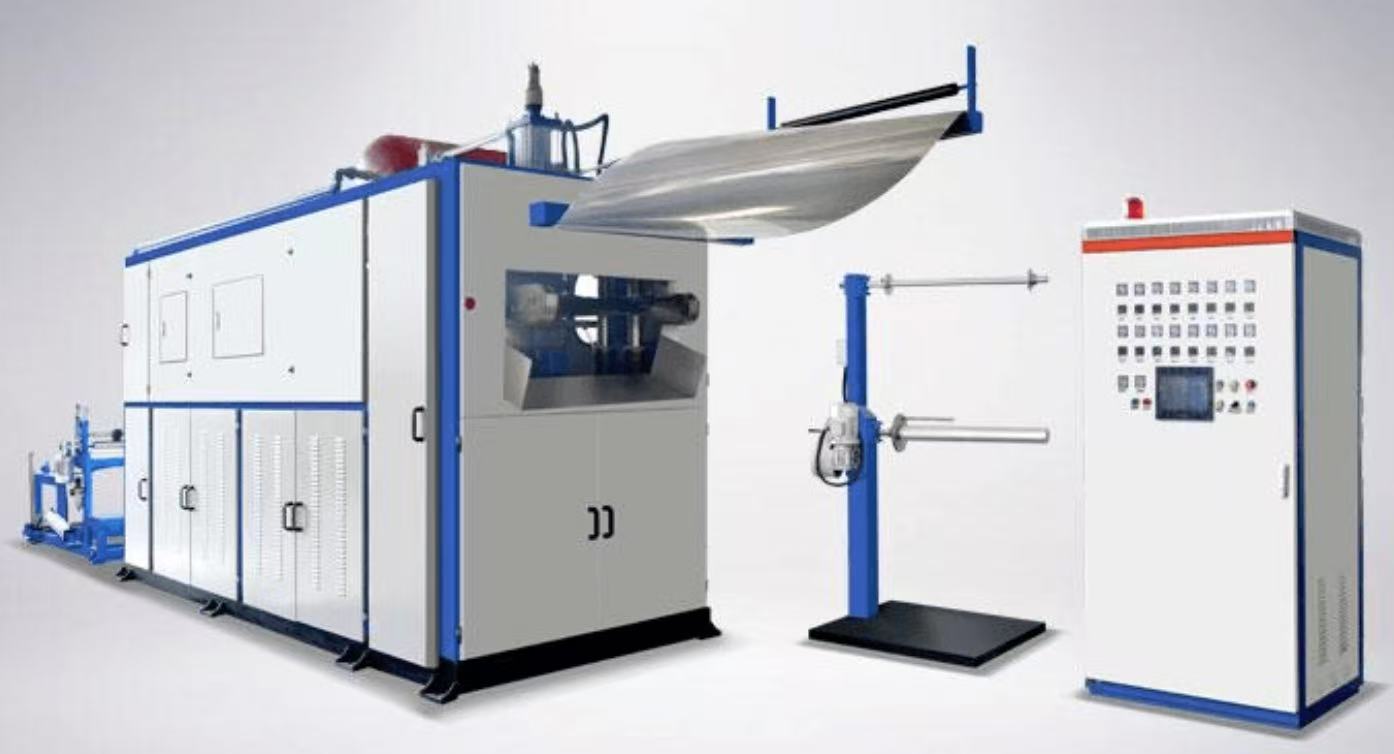
Form your own packaging in-house
A thermoforming machine heats plastic roll sheet and pulls it over a mold with vacuum or compressed air to form cups, trays, lids and clamshells. In-house forming cuts packaging cost versus buying pre-made containers, and the formed cups or trays feed directly into a SunAura filling-sealing machine — one continuous forming-filling line.
Thermoforming machine range
| Model | Type | Best for |
|---|---|---|
| High-Speed Cup Former | Pressure forming | Water, yogurt, sauce cups |
| Negative-Pressure Former | Vacuum forming | Trays, clamshells |
| Positive/Negative Former | Pressure + vacuum | Deep-draw trays |
| Servo-Driven Former | Servo index | Medical, precision trays |
| Heavy-Gauge Former | Thick sheet | Automotive, inserts |
| Double-Layer Former | Thick sheet | Large hollow parts |
Forms, then fills
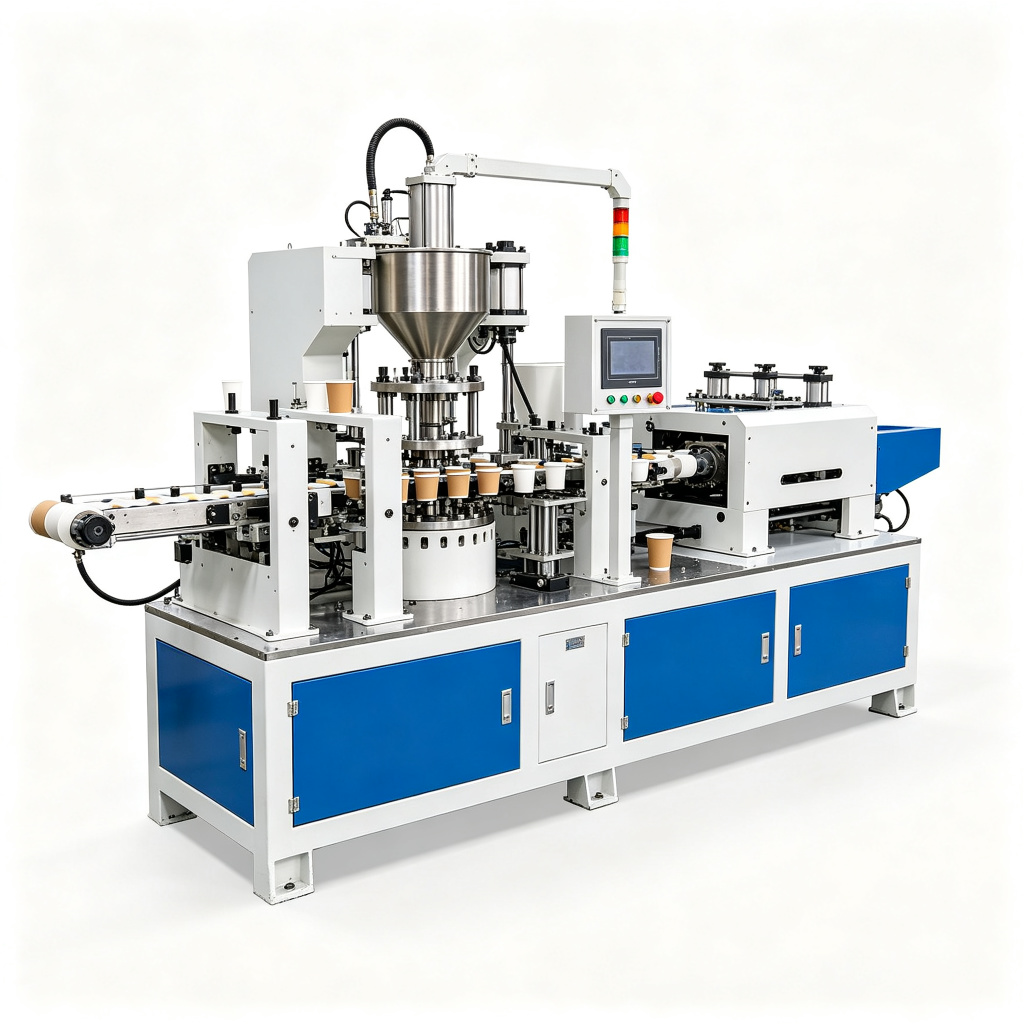
Pair a SunAura cup former with our roll-film cup filling-sealing machine for an inline form-fill-seal line — formed cups move directly to filling and sealing. We supply the conveyor, stacker and take-away as one controlled system.
How a thermoforming machine turns flat roll stock into finished packaging
A lot of buyers shop for a thermoforming machine by sheet width and cups-per-minute alone. We do not. Those numbers only matter once you understand what the machine is actually doing cycle by cycle, because the heating and forming steps are where 80% of your part quality is decided.
Every plastic thermoforming line we build follows the same five-step cycle, and we size each station to the material you run rather than to a generic spec sheet. Sheet comes off a powered unwind, passes through a set of dancer arms that hold tension constant, and is fed forward by a servo or pneumatic index chain. Once indexed, the clamp frame closes and locks the sheet across the full forming area. That frame matters more than people think: if it flexes, your draw is uneven and your trays come out with thin corners.
The clamped sheet then moves into the oven. We run multiple independently zoned ceramic or infrared heater banks — front and back, top and bottom — so the sheet reaches its forming window evenly rather than overheating the surface while the core stays cold. PP and PLA sit in a narrow window; PET a touch wider. Hold the sheet too long and it sags and crystallizes; move it too soon and the material is stiff and refuses to draw. This is the step operators learn to tune, and it is why our ovens give you per-zone temperature readback on the HMI, not a single dial.
Next comes the forming station itself. On a negative pressure thermoforming machine, vacuum alone pulls the softened sheet down over the male plug or into the female cavity — fast, cheap, and fine for shallow parts like lids and shallow trays. Where you need deeper draws or more wall-thickness control, we step up to positive/negative pressure thermoforming, where compressed air pushes the sheet from the top while vacuum pulls from below, and a mechanical plug assist stretches the material pre-stretch before it touches the mold. That combination is what lets us hold even wall thickness across a 120 mm deep yogurt or dessert cup without thinning the base to the point it cracks on filling.
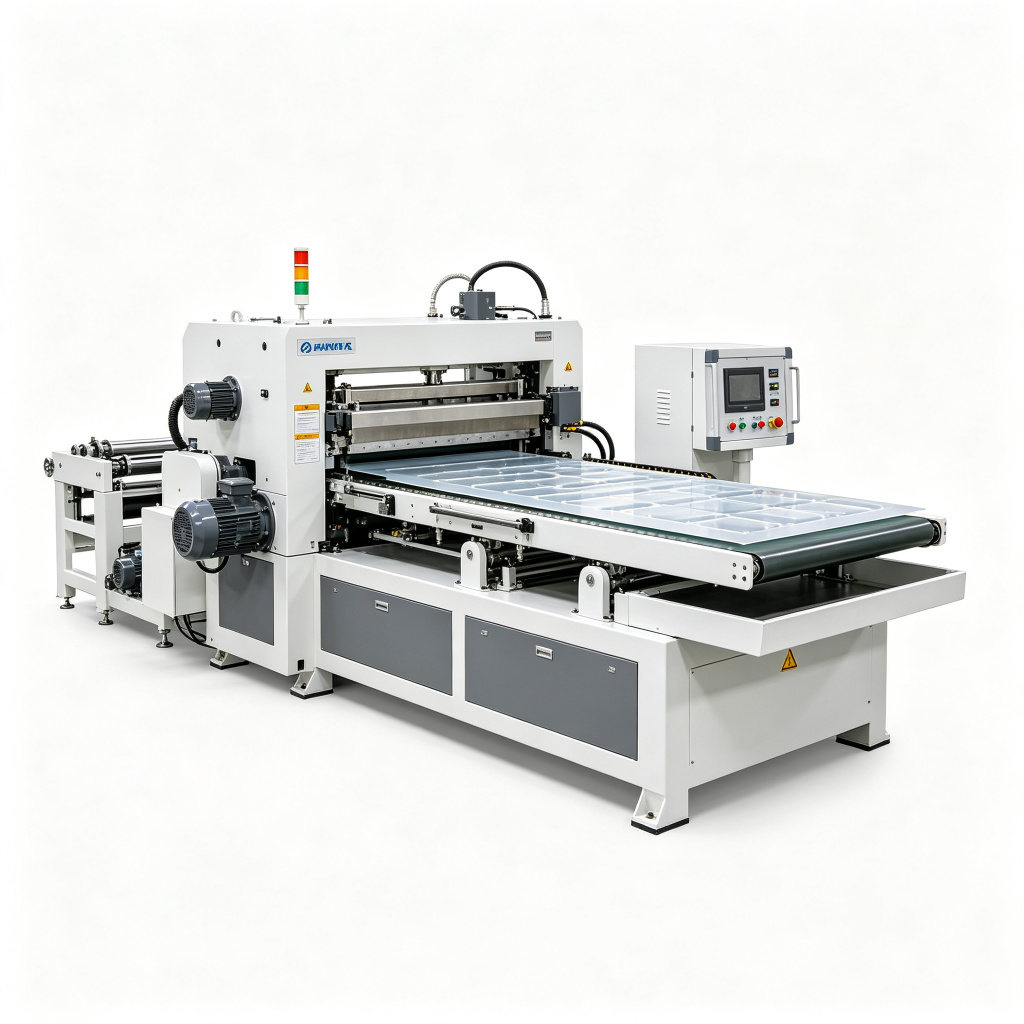
After forming, the part moves to the punch and cut-off station, where a hardened steel die separates the formed web from the scrap frame. Scrap is pulled away by a rewind granulator and either reground inline or wound for disposal. The finished parts drop onto a stacker, where a photoelectric eye counts and separates them into neat stacks ready for your filler or pack-off. A cup forming machine running thin PP at high speed will throw several hundred of these cycles a minute; a thick sheet thermoforming cell running 4–10 mm ABS or HDPE for automotive liners runs the same cycle slowly, because the heat soak demands it.
What our thermoforming platform delivers in the field
The numbers below are the working range of the machines we ship, not marketing peaks. We tune the final figure to your part, your material and your cycle target.
| Parameter | Thin-gauge cup / tray line | Positive/negative pressure line | Thick-sheet (heavy gauge) cell |
|---|---|---|---|
| Forming speed | Up to 60 cups / strokes per minute | 30–45 strokes per minute | 3–8 cycles per minute |
| Max forming width | Up to 720 mm | Up to 760 mm | Up to 1200 × 2000 mm sheet |
| Sheet thickness range | 0.2 – 2.0 mm | 0.2 – 3.0 mm | 2.0 – 10.0 mm |
| Heating zones | 12–20 independently controlled zones | 16–24 zones, top & bottom | 6–12 zones with long soak profile |
| Vacuum level | −0.08 MPa (reservoir accumulator) | −0.08 MPa, vented in <0.5 s | −0.09 MPa, high-volume pump |
| Compressed air | 0.6 – 0.8 MPa, 1.0 m³/min | 0.6 – 0.8 MPa, up to 2.0 m³/min | 0.7 – 0.9 MPa |
| Index / drive | Servo index chain, repeatability ±0.1 mm | Servo index ±0.05 mm | Servo sheet feed ±0.2 mm |
| Plug assist | Pneumatic, optional | Servo-driven plug, programmable speed | Manual / servo male mold |
| Clamping force | Up to 80 tons frame | Up to 120 tons | Up to 200 tons press frame |
| Materials handled | PP, PET, PS, PLA, PVC, OPS | PP, PET, PS, multilayer, barrier film | ABS, HDPE, PP, PC, PMMA, HIPS |
Figures are representative of machines shipped from our 48,000 m² plant. Final values depend on cavity layout, draw depth and material; we lock them with you during layout review before the build starts.
Where these machines earn their keep
We have shipped thermoforming equipment to more than 100 countries. The part shapes recur across industries even when the customer never shares the name.
Food cups and dessert pots
PP and PET drinking cups, yogurt cups, dessert and sauce pots run on a high-speed thermoforming machine directly inline to a cup filling-sealing line. Wall thickness and rim flatness decide whether your downstream filler seals cleanly.
Medical and pharma trays
Blister-style trays, procedure trays and device packs form from PETG or APET under our servo driven thermoforming machine, where repeatable pocket depth matters more than raw speed.
Fresh-produce and meat trays
MAP-compatible tray shells with defined rim sealing surfaces, vent holes and stack nests — the kind of shallow draw where negative pressure thermoforming does most of the work.
Electronics and insert packaging
Conductive PS trays and component inserts with tight pocket geometry, often paired with a twin sheet / double-layer thick sheet format for shipping protection.
Which thermoforming platform fits your part
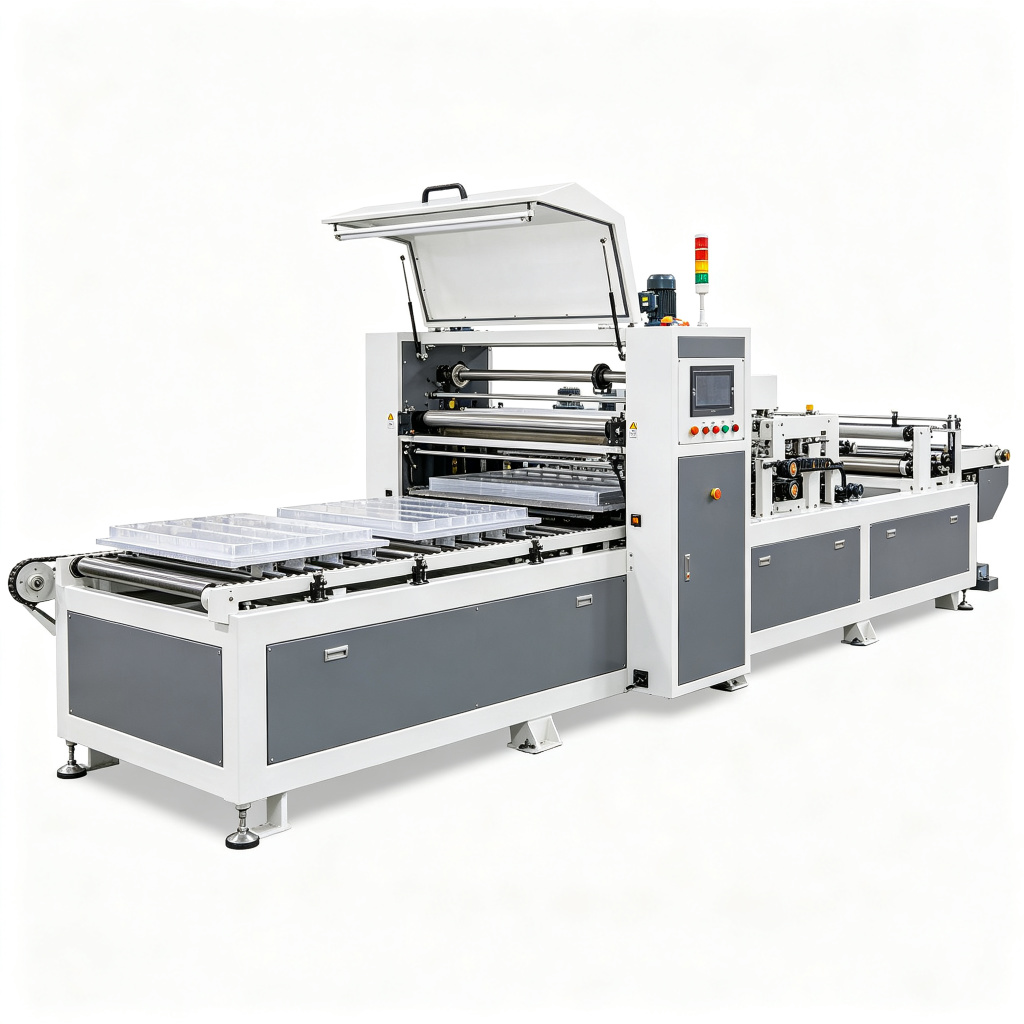
Buyers regularly come to us after ordering the wrong class of machine. The decision usually comes down to four questions about draw depth, wall control, sheet gauge and speed.
Choose this for shallow draws under roughly 40 mm deep — lids, shallow trays, covers. Lowest capital cost, fastest to run. Our negative pressure thermoforming page walks through the trade-offs.
Add this when the draw is deep (60–150 mm) or the cup needs even wall thickness, such as 90 mm dessert cups or seal-ready food pots. The top air blast plus plug assist is what buys you that control.
Pick a servo driven thermoforming frame when changeover frequency, repeatability and quiet clean-room behavior matter — medical trays, barrier packaging, short runs across many SKUs.
When sheet runs above 2 mm, the physics change. Heat soak, slower cycles and a 200-ton frame become the norm. See our heavy-gauge sheet thermoforming machine for that world.
⚠ Common selection mistakes we see in the field
- Buying vacuum-only for a deep draw. A 90 mm cup on a vacuum-only machine thins the base until it splits on the filler. Spec the pressure-forming version before you quote.
- Ignoring scrap ratio. Forming area versus web width decides how much regrind you generate. A wide web for a small part quietly raises material cost by double digits.
- Oversizing the oven for short runs. More heater zones are not free — they cost energy and warm-up time. Match zone count to the materials you actually run.
- Forgetting the downstream interface. A fast former feeding a slow filler just creates queued stacks. Balance cycle times with your filler and weigher first.
Our longer write-ups on this topic: the thermoforming machine buying guide walks through the full RFP, the sheet material guide for PP, PET, PS and PLA helps you pick the resin, and thermoforming vs pre-made tray sealing compares forming in-house against buying ready trays.
Formed cups and trays do not stop at the stacker
In a real plant the former sits at the front of a packaging line, not on its own island. We integrate it so the parts you form immediately feed a filler, a weigher and a sealer — without manual off-loading.
On a cup line, the formed cups exit the stacker and drop directly into an inline liquid filling machine, where they are filled, foil-sealed and re-stacked — the classic yogurt, water, sauce and instant-noodle cup route. Where product is weighed solid rather than dosed by volume, a multihead weigher drops product into the open tray or cup as it passes, and a sealing station closes the lid over the formed rim. The formed rim is doing real work here: it has to be flat enough and parallel enough that the sealer makes a hermetic seal every stroke. That is why we tune plug-assist and clamp frame rigidity with the sealing step in mind, not just the formed part alone.
We balance the former's strokes-per-minute against the filler heads and the weigher discharge timing on a single line PLC, so neither machine is starving or overflowing. We do not design the downstream case packer, palletizer or strapping into this conversation — those are post-packaging systems we scope separately once the primary packaging loop is closed. If you are laying out the whole route, our packaging lines overview is the right starting point.
Thermoforming machines, answered by the people who build them
Short answers to the questions our sales and process engineers get on nearly every consultation.
What is the difference between negative pressure and positive/negative pressure thermoforming?
How many cups per minute can your thermoforming machine produce?
Which materials can a plastic thermoforming machine handle?
Do I need a servo driven thermoforming machine, or is pneumatic index enough?
Can you connect the former directly to our filler and weigher?
What tolerances and repeatability can we expect?
How do you handle thick sheet or twin sheet thermoforming?
Get a Factory-Direct Quote in 24 Hours
Tell us your box size, daily output and voltage — our engineers reply with a model recommendation, price and lead time within one business day.
How a Thermoforming Machine Works: Vacuum, Pressure and Twin-Sheet Forming Explained
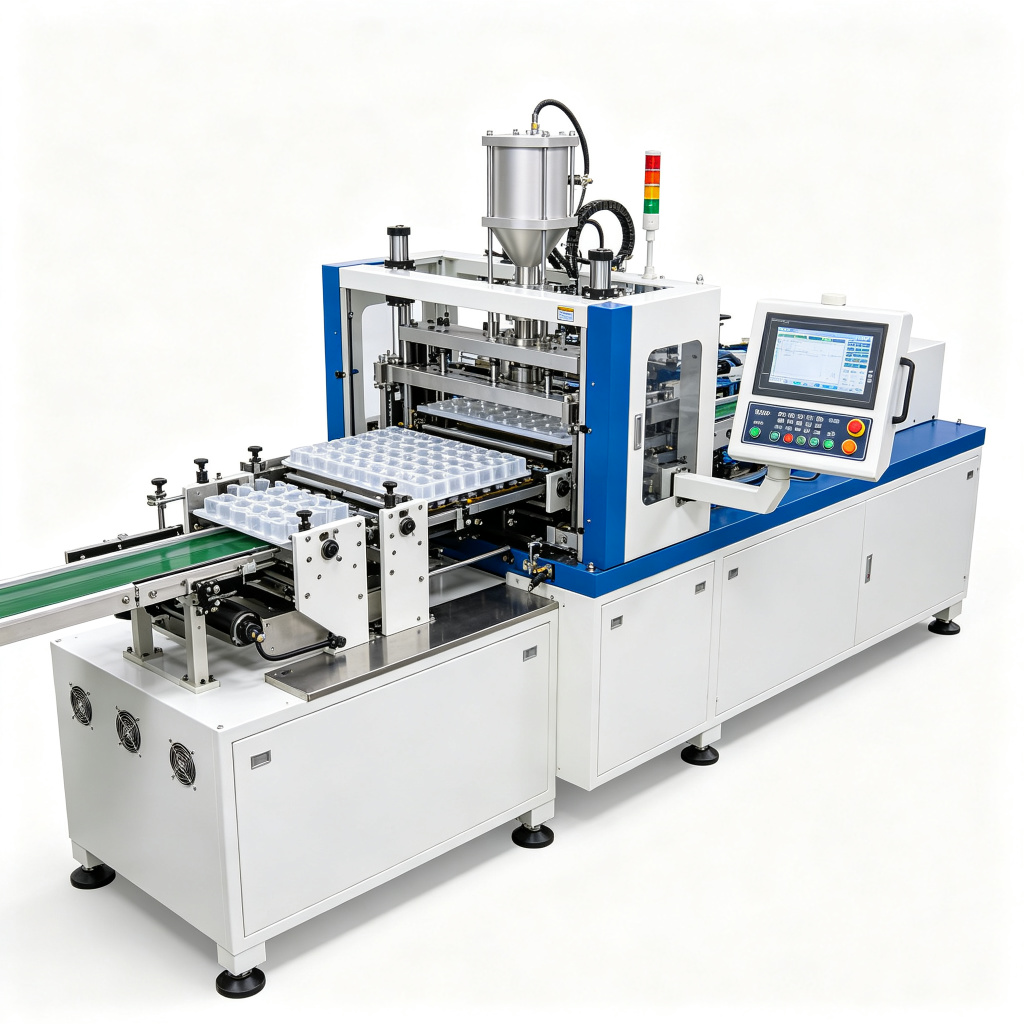
A thermoforming machine converts a flat, heated thermoplastic web into a three-dimensional packaging part by clamping the sheet over a mold, softening it in a multi-zone oven, and pulling or pressing it against the mold cavity until it cools and retains the shape. As a front-end thermoforming packaging machine, it sits upstream of fillers, cappers and labelers, producing cups, trays, clamshells, lids and blister skins on the same line that discharges the finished product. Understanding the three forming methods is the first step in selecting the right thermoforming equipment.
Vacuum / Negative-Pressure Forming
In negative-pressure thermoforming, only vacuum is drawn through the mold after the hot sheet drapes over the cavity. Atmospheric pressure pushes the sheet against the mold wall, producing parts with moderate detail and wall-thickness variation. It is the lowest-cost forming method and is widely used for thin-gauge trays, lids and disposable cups where deep draw or fine cosmetic detail is not required.
Pressure Forming and Positive-Negative Pressure Forming
Pressure forming adds compressed air (typically 4–7 bar) above the sheet while vacuum is pulled below. The higher differential pressure delivers sharper mold detail, more uniform wall distribution and shallower draw ratios than vacuum alone. Twin sheet thermoforming — more precisely called positive-negative pressure forming — uses simultaneous forming from both sides and is the process recommended for deep, rigid packages such as hinged clamshells, insulated cups and dual-compartment containers. A positive-negative-pressure thermoforming machine combines a plug assist, top pressure box and bottom vacuum platen to control material draw-in.
Plug Assist and Drive System
A machined aluminum or epoxy plug descends into the sheet before air is applied, pre-stretching the material so that corners and side walls stay thin and even. Modern servo-driven thermoforming platforms replace pneumatic or hydraulic cylinders on the clamp frame, plug and sheet feed with closed-loop servo axes. The result is repeatable cycle-to-cycle timing, quieter operation, lower energy consumption and faster recipe changeover than fully pneumatic or hydraulic machines.
Key Specifications and Selection Guide
Selecting an automatic plastic thermoforming machine starts with four numbers: part draw depth, output per minute, web width and material gauge. The table below summarizes the working ranges covered by the SUNAURA thermoforming platform; final parameters are confirmed during FAT after tooling trials.
| Parameter | Thin-Gauge Cup / Tray Line | Positive-Negative Pressure Line | Heavy-Gauge / Thick-Sheet Line |
|---|---|---|---|
| Web / sheet thickness | 0.20–1.50 mm | 0.30–2.00 mm | 2.00–12.00 mm |
| Forming area | up to 700 × 1100 mm | up to 850 × 1250 mm | up to 2100 × 1250 mm |
| Cycle time | 1.5–4 s / stroke | 3–8 s / stroke | 15–60 s / part |
| Clamp force | up to 30 t | up to 60 t | up to 120 t |
| Forming pressure | vacuum only | vacuum + 4–7 bar air | vacuum + up to 6 bar air |
| Heating zones | 20–40 independent | 30–60 independent | 40–80 independent |
| Compatible materials | PP, PET, PS, PLA, PE | PP, PET, PVC, PS, PLA | ABS, PP, PE, PETG, PMMA, HDPE |
| Typical output | 30–120 strokes/min | 12–30 strokes/min | 6–25 parts/min |
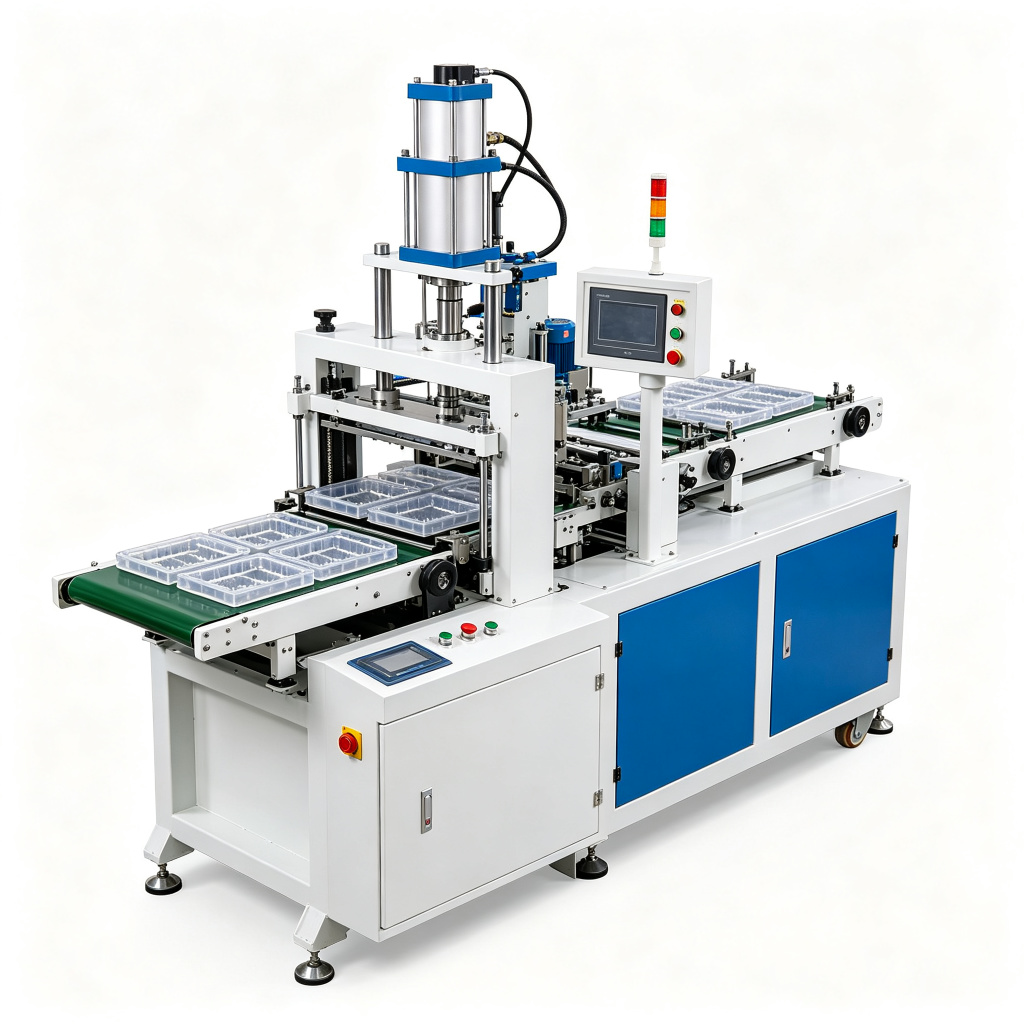
Mold material follows part volume: epoxy or composite molds for prototyping, aluminum molds for production runs above 100,000 parts, and water-cooled cast aluminum for high-cadence cup lines. In-line trimming is integrated into the press frame on thin-gauge lines, while thick-sheet parts are off-line trimmed on a separate punch or CNC router. Re-grind from skeleton trim is fed back at up to 25% virgin ratio, depending on resin specification.
Industries and Applications
SUNAURA thermoforming packaging machine platforms are deployed across food, beverage, dairy, cosmetics, pharmaceuticals and industrial goods. Thin-gauge lines produce PP yogurt cups, PET salad clamshells, PS dessert pots and PLA compostable lids; heavy-gauge cells produce product inserts, equipment covers, refrigerator liners and automotive interior components. The high-speed cup forming machine variant is purpose-built for drinking cups, portion cups and lids at 30–120 strokes per minute, while the heavy-gauge sheet thermoforming machine serves durable packaging and industrial applications.
Integration with Other Front-End Packaging Equipment
A stand-alone former rarely delivers value on its own. SUNAURA engineers integrate the former into a complete packaging line that matches output cadence with downstream equipment: a denester drops formed cups or trays onto a conveyor, a piston or volumetric filler doses product, a rotary capper applies lids or foils, and a labeler prints and applies sleeves or pressure-sensitive labels. Web break detectors, vacuum-pump status monitors and mold-temperature alarms are tied into the line PLC so a fault at the former stops the filler upstream and prevents product waste. The former is sized to the highest line speed and buffer-fed to absorb short interruptions.
Why Choose SUNAURA as Your Thermoforming Equipment Supplier
SUNAURA operates a 48,000 m² manufacturing campus where the former frame, clamp, oven and control cabinet are built in-house. Every machine passes a Factory Acceptance Test (FAT) on our own floor with the customer's resin, tooling and production-speed targets before crating. The platform is engineered to CE Machinery Directive and built under ISO 9001; see the certifications and patents page. A global installation network commissions machines on six continents, and the after-sales service team stocks heating cartridges, vacuum valves, clamp brushes and HMI touchscreens for next-day dispatch.

Frequently Asked Questions
What is the difference between vacuum forming and pressure forming?
Vacuum forming pulls a soft sheet onto the mold using negative pressure only, while pressure forming adds compressed air above the sheet to drive it harder against the cavity. Pressure forming produces sharper details, better wall-thickness distribution and more accurate corners, and is the process used for twin sheet thermoforming and rigid clamshell work.
Which plastics can an automatic plastic thermoforming machine process?
Standard SUNAURA formers run PP, PET, PVC, PS, PE and PLA on thin-gauge lines, and ABS, HDPE, PETG and PMMA on heavy-gauge cells. Oven temperature profiling, tooling draft angles and cooling-channel layout are adjusted per resin; amorphous materials such as PVC and PETG need slower cooling than crystalline PP.
How do I choose between in-line and off-line trimming?
In-line trimming is integrated into the press frame and preferred for high-volume thin-gauge work where the skeleton must be separated at forming speed. Off-line trimming is used for heavy-gauge parts where punch forces exceed press capacity, or where decorative trim and kiss-cut scoring require a dedicated station.
What cycle time can I expect for a food tray line?
A servo-driven thin-gauge tray or clamshell line typically cycles at 1.5–4 seconds per stroke, producing between 30 and 120 strokes per minute depending on mold cavity count, part depth and oven recovery time. Thick-sheet heavy-gauge parts run 15–60 seconds per part.
How is the machine commissioned on-site after FAT?
After Factory Acceptance Test at our works, the line is shipped, anchored, leveled and connected to utilities by our installation team. The customer's operators run production trials at defined speed and scrap targets; training covers HMI recipe management, mold changeover, heating-zone setup and basic troubleshooting. Remote diagnostics are available via the onboard PLC VPN.