
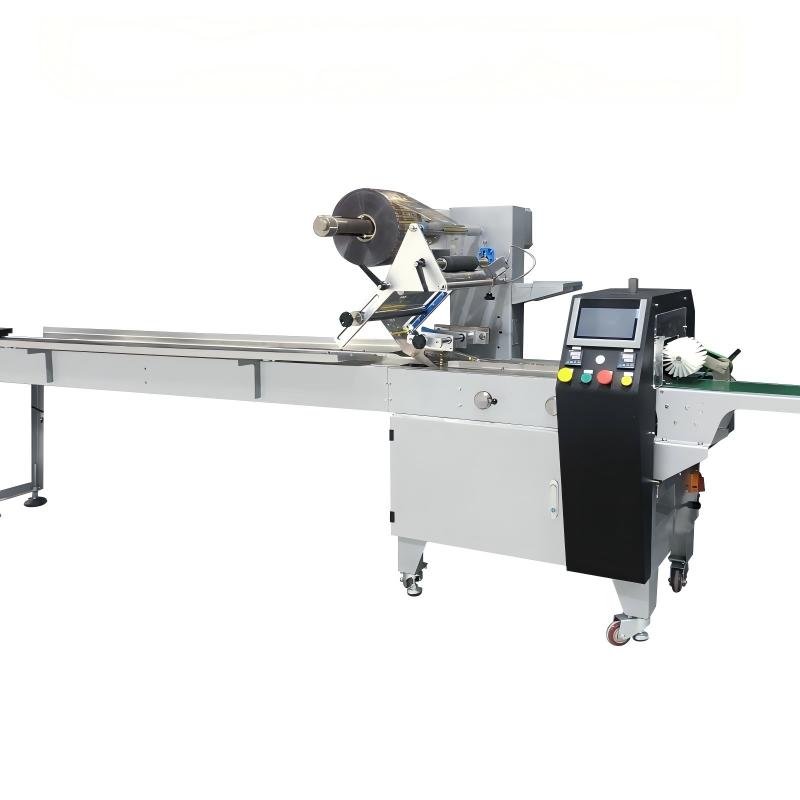
SunAura Machinery has commissioned a dual-servo horizontal flow wrapper rated at 200+ bars/min for a chocolate and energy bar co-packer in Flanders, Belgium. The customer packs 40 g, 80 g and 100 g chocolate bars and cereal bars for three regional brands, in printed high-barrier OPP film. The project replaced a mechanical cam wrapper that crushed bars at changeover and could not hold print registration on the smaller 40 g format.
A generic snack flow wrapper would have worked on speed, but it would have failed on three chocolate-specific points: it would crush delicate bars, it would not hold print registration on short runs, and its jaw temperature would melt chocolate. This line was specified around confectionery reality.
Why a Dual-Servo Wrapper — Not Mechanical Cam
A mechanical cam wrapper packs one fixed product length. When the customer switches between 40 g and 100 g bars, the cam must be re-timed and the jaw position hand-adjusted — 45–90 minutes of lost production and 40–60 m of film waste. We specified a dual-servo wrapper with optical registration and recipe recall: the 40 g and 100 g formats are stored in the HMI, and changeover is under 10 minutes with under 15 m of film waste.
| Dimension | Old mechanical cam | New dual-servo (this line) | Why it matters |
|---|---|---|---|
| Changeover | 45–90 min | Under 10 min | More SKUs per shift without losing production |
| Print registration | ±2–3 mm, drifts | ±0.5–1 mm, optical eye | Brand graphics land correctly on every bar |
| Bar crushing | Jaw fixed length, crushes short bars | Product detector adjusts jaw position | Rejection rate drops on mixed formats |
| Top speed | 120 bars/min | 200+ bars/min | One machine covers both SKU families |
| Film waste per changeover | 40–60 m | 10–15 m | High-barrier film is expensive; this pays back fast |
Two Confectionery Details That Decide Quality
Jaw temperature control. Chocolate melts around 30–34 °C. A wrapper whose cross-seal jaw runs hot for thick snacks will scuff the chocolate surface. The jaws on this line run with independent temperature control down to 60 °C and a forced-air cooling duct after the seal, so bars leave the line sealed but not melted.
Product infeed belt with photoelectric detection. Bars vary in length by a few millimetres from the former. A fixed-length jaw would crush the short ones. The infeed photoelectric triggers the servo jaw to position itself per product, which is why rejection on the 40 g SKU dropped after FAT.
Who This Line Suits — and What We Would Specify Differently
This configuration targets confectionery, bakery and cereal-bar co-packers at 150–250 bars/min running printed high-barrier film and 3–8 SKUs per shift. Buyers below 60 packs/min or running a single SKU do not need servo; a mechanical cam wrapper is the cheaper correct choice. Buyers above 300 bars/min on a single format step to a high-speed rotary jaw platform. For bags or pouches rather than flow-wrapped bars, a VFFS or pre-made pouch machine is the better fit.
The line passed FAT at our Qingdao workshop with the customer’s actual bars and film, checked registration across a full run, and shipped with spare jaws, sealing bands and commissioning support covered under our after-sales service terms. For more on drive choices, see the guide on pillow packaging machines.
Packing chocolate, cereal bars, biscuits or other delicate products? Send your product length, packs/min and film type to [email protected] or on WhatsApp. We will tell you whether a dual-servo wrapper pays back against a mechanical one for your SKU mix. Browse our integrated lines and other commissioning news.