
The decision between a roll-stock thermoforming line and a pre-made tray sealing machine is one of the few choices in a packaging hall that changes the entire cost structure of a product, and it is usually made once and lived with for a decade. Buyers tend to frame the question as “which machine is better”, when it is really a question about their own volume, their format count and their pack economics. A plant sealing one ready meal at 40 cycles a minute across three shifts is buying a different business from a co-packer running forty SKUs in short campaigns. This guide lays out how each technology actually works, where the money goes, and the decision points that separate a good fit from a costly one. The same comparison explains why SunAura Machinery recently shipped a roll-stock servo-driven thermoforming line to a Polish frozen food producer, while recommending a pre-made tray sealer to a smaller premium ready-meal start-up two weeks later.
How the Two Technologies Actually Work
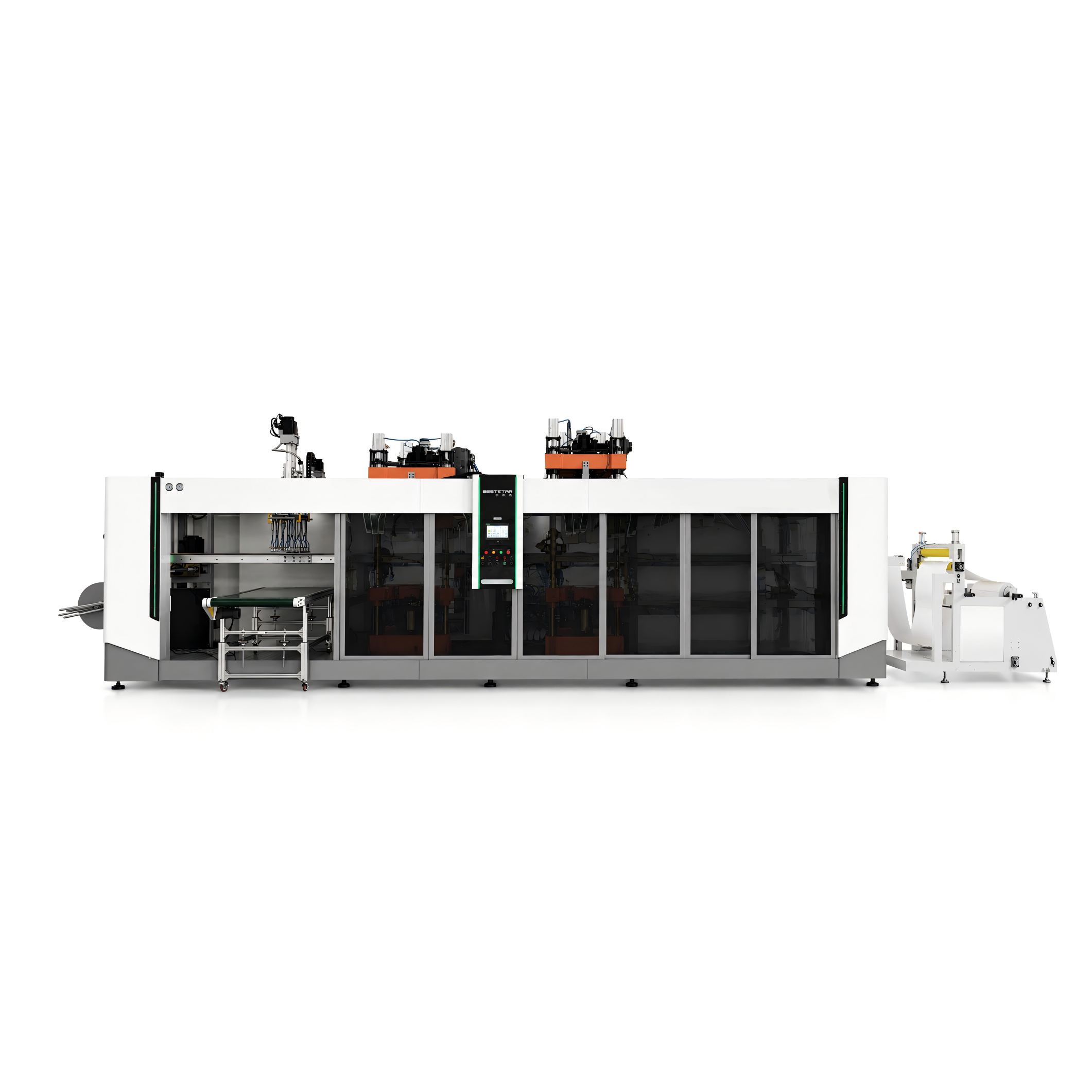
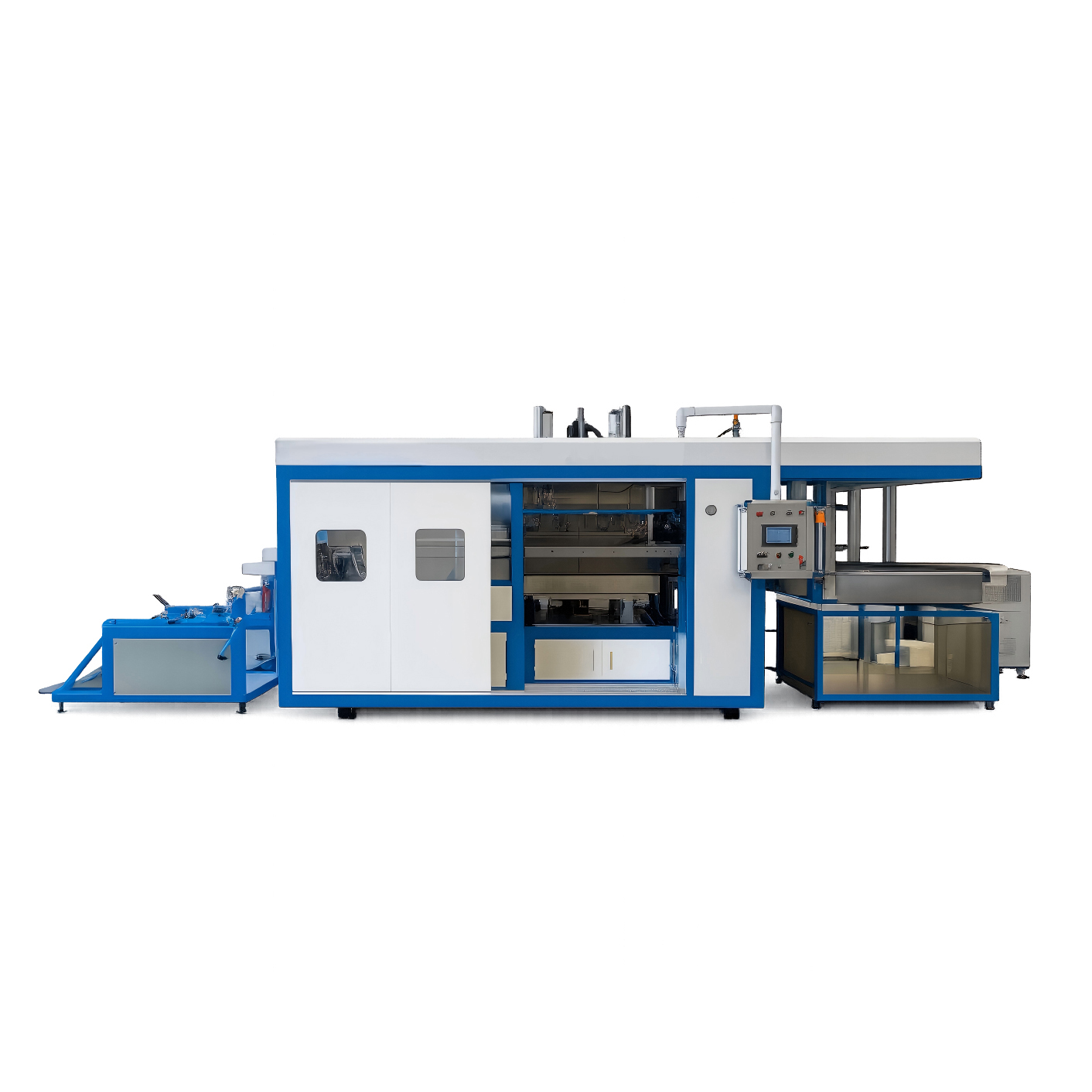
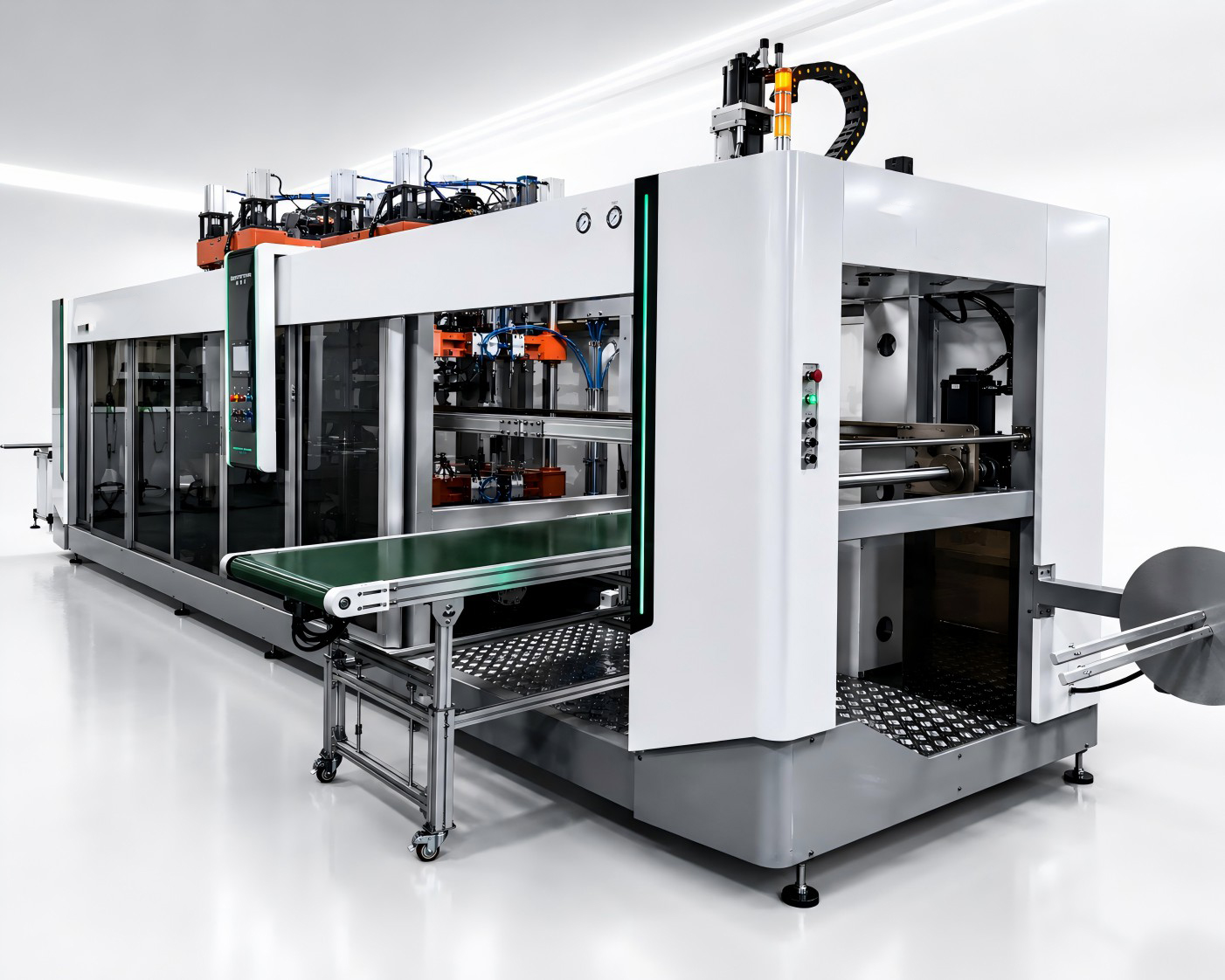
Roll-stock thermoforming. A thermoforming machine builds the pack on the line. It indexes a bottom film through a heated forming station where the plastic is drawn into a mould cavity by vacuum, by pressurized air, or by both — which is why you will see vacuum forming and positive-negative pressure forming specified for different products. The freshly formed cavities are filled by dosing or hand-loaded stations, a top film is sealed over them (often under modified atmosphere or vacuum), and the web is then cross-cut into individual packs. The trays never exist before they reach the machine; they are formed, filled, sealed and separated in one continuous cycle. The relevant platform is the thermoforming machines family, with options from the negative-pressure (vacuum) thermoforming machine for standard products to the servo-driven thermoforming machine for high-speed, repeatable indexing.
Pre-made tray sealing. A tray sealer assumes the tray already exists. A denester drops rigid pre-formed trays (APET, CPET, PP, pulp or board) into the indexing pockets, the product is filled in, and a lidding film is heat-sealed onto the tray flange — again under ambient, MAP or vacuum conditions. The machine does nothing to form the tray; it seals a lid onto a container bought from a tray manufacturer. The investment is in the sealing die, the denester and the gas system rather than in forming stations.
Head-to-Head Comparison
| Factor | Roll-stock thermoforming | Pre-made tray sealing |
|---|---|---|
| Pack cost per unit | Lower; bottom and top film on rolls, no tray conversion or freight | Higher; includes the tray manufacturer’s forming, stacking and transport margin |
| Machine capital cost | Higher; forming stations, web handling, tooling | Lower; sealing head, die, denester and gas system |
| Typical throughput | High; multiple cavities per cycle, often 6–12 cycles/min and up | Moderate; inline or rotary, often 1–4 trays per cycle |
| Format flexibility | Fixed to a mould set; changeover needs a forming die and sealing die | More flexible; change the die and run any tray that fits the pitch |
| Changeover time | Longer, typically 1–3 hours for a full format change | Shorter, often 20–45 minutes including film |
| Labour | Low once loaded; two operators can run a full line | Low to moderate; tray loading and denesting can need attention |
| Footprint | Long, continuous machine; significant linear space | Compact; rotary sealers fit in a small hall |
| Material handling | Rolls delivered; days of packs per roll | Empty trays shipped and stored; pallet space needed |
| Pack appearance | Formed-to-size, skin-tight; premium skin and MAP possible | Rigid, self-supporting trays; strong shelf presence and stackability |
| Best fit | High-volume, few SKUs, cost-sensitive, MAP/skin | Multi-SKU, short runs, premium rigid packs, lower capital |
Where the Unit-Cost Difference Comes From
The pack is where these two machines diverge in money. A pre-made tray is a thermoformed product that has already been made in a factory, stacked, packed, warehoused and freighted, and every one of those steps is in the price. A roll-stock line does that forming on the buyer’s own floor, so the buyer pays for resin on a roll rather than a converted tray. For a rigid APET or PP tray the material and conversion saving is commonly in the range of 20–40 percent per pack, and there is a second, often overlooked saving: the top and bottom films arrive on rolls, so the inbound freight and the warehouse space for thousands of nested empty trays largely disappear. A roll of film that fits on a single pallet can hold several days of production.
That saving is real, but it is not free. The buyer has to run enough volume to amortize the higher machine cost and the mould sets, which is why the break-even arithmetic is the heart of the decision. At low volumes the tray sealer wins on capital; at high volumes the thermoformer wins on every pack and the margin gap widens with each cycle. A plant that runs a single SKU across a shift or more will usually reach the crossover quickly; a plant that runs a different SKU every afternoon may never reach it.
When Roll-Stock Thermoforming Is the Right Answer
- High, stable volumes of a small number of formats. Bacon, sliced cheese, cured meats, hot dogs, fish portions, frozen meal components and portioned butter — the classic thermoforming products are made in hundreds of thousands of identical packs.
- Modified atmosphere or skin packaging. Forming the cavity in-line lets the top film seal over the product under a gas mix or in full skin contact, which is the core technology for extended shelf life on fresh and cured protein.
- Cost pressure on the pack. When the packaging is a significant share of the product margin, the per-unit film saving repays the machine quickly.
- Control over the pack format. Moulding the cavity in-house means the dimensions, depth and presentation are owned by the producer rather than dictated by a tray catalogue.
When Pre-Made Tray Sealing Is the Right Answer
- Wide SKU ranges and short campaigns. A premium ready-meal producer or a co-packer may run vegetarian, meat, sauce and side-dish SKUs in different tray sizes within a week; a die change beats a mould change.
- Rigid, self-supporting premium trays. CPET trays for oven-ready meals, board-and-plastic hybrids, black trays and coloured trays arrive as finished items with shelf presentation the tray sealer cannot replicate.
- Limited capital and floor space. A rotary tray sealer is a fraction of a thermoformer’s price and footprint, and it can be running within weeks.
- Uncertain or growing demand. Buying a tray sealer first and moving to roll-stock once a hero SKU proves itself is a defensible route; the sealer keeps working as a short-run and trial machine afterwards.
Materials and MAP: The Detail That Decides Shelf Life
Both machines can run ambient, vacuum and modified atmosphere, but the materials differ. A thermoforming bottom web is usually a co-extruded structure such as PA/PE or APET/PE with an EVOH barrier for oxygen-sensitive products, and the top web is a peelable lidding film matched to the base; the positive and negative pressure thermoforming machine is used where the cavity shape and wall distribution demand both air pressure and vacuum. On a tray sealer the base is a rigid tray already specified by the buyer — CPET for ovenable meals, APET for cold fill, PP for hot fill or pasteurization — and the choice narrows to the lidding film and the gas mix. Gas flushing works the same way in principle: residual oxygen inside the sealed pack is what determines shelf life, so the gas-flush time, the headspace and the seal integrity are validated rather than assumed. In practice thermoforming lines tend to achieve lower residual oxygen because the cavity is formed and sealed in one controlled web, while a tray sealer relies on consistent tray flange geometry and a clean seal. Barrier film thickness and structure are the main cost lever; the practical trade-offs are the same as those discussed in any seal-temperature and film-thickness validation, and a frozen application in particular has to be built around cold-seal integrity, as the Polish case below shows.
Integration: The Machine Is One Station in a Line
Neither technology seals product in isolation. Upstream there is a filling or dosing station — liquid filling for sauces and gels, multihead weighing for pieces and granules, or a manual loading line for irregular protein. Downstream there is usually a metal detector, a check-weigher, an overwrapper or a case packer, and the pitch and speed of the sealer have to match those stations. On a roll-stock line the forming index sets the pace for the whole hall, so the filling system must keep up with the cavities presented to it; on a tray sealer the denester and the filler are the usual bottlenecks. Cups and small pots take a different machine class entirely — the high-speed cup forming machine handles roll-fed cups that are filled and sealed on separate lines. Buyers should price the whole line, including gas supply for MAP, refrigeration for cold-fill halls and the scrap or trim extraction that a thermoformer generates. Sealing decisions do not end at the tray either: when the same plant packs shelf-stable jars and bottles, the equivalent seal-integrity question is answered by an induction foil sealer rather than a heat-sealed lid — the logic of that choice is covered in the recent South African peanut butter induction foil sealing line project.
The Decision Checklist
- List the formats you actually sell, not the formats you imagine selling; count the trays per SKU per month, honestly.
- Get the price of both a roll-stock film pack and the equivalent pre-made tray plus lid from suppliers, and calculate the per-unit delta in your currency.
- Multiply the per-unit delta by the monthly volume; that is the monthly saving the thermoformer has to earn.
- Add the mould sets, the gas system, the filler and the downstream equipment to the capital figure.
- Time the changeover for your longest day of SKU changes; a tray sealer changes in under an hour, a thermoformer generally does not.
- Decide whether the premium pack in your market is a rigid self-supporting tray or a tight skin pack, and let merchandising weigh in.
- Ask for a material trial with your own product; a sealing window validated on one film and one product is not a guarantee on another.
Common Mistakes That Push the Cost Calculation Off
After several years of commissioning both machine types, the same errors recur. The first is buying the thermoformer on a per-pack saving without counting the mould sets: every new format needs a forming and sealing die, and a plant that imagines three formats today and ten in two years is quietly buying a tooling cupboard that costs as much as a tray sealer. The second is ignoring trim scrap — a roll-stock line punches the packs out of a web, and the skeleton around the cavities is regrind or waste, typically 10 to 20 percent of the film; it is recyclable in many plants, but the material handling, the grinder and the margin should be in the arithmetic, not assumed away. The third is the mirror-image mistake on the tray side: a tray sealer bought for a single hero SKU that quietly grows to three shifts, where the buyer ends up paying a converter’s margin on millions of trays a year and could have amortized a thermoformer inside eighteen months. The fourth is a film purchased on price rather than validated to the seal: a barrier web that runs at a cheaper price but fails the residual-oxygen or freezer-cycle test destroys the entire economic case for the line. The fifth is overlooking the people — a roll-stock machine rewards a maintenance team that understands web handling, heating and die changes, while a tray sealer can run on a lighter skill set; the honest assessment of the maintenance team belongs in the decision as much as the product volumes.
What the Suppliers’ Quotes Should Be Compared On
When the proposals arrive, compare on the same boundaries rather than the machine headline alone. A complete comparison includes the forming or sealing dies for every launch format, the gas-mixing equipment for MAP, the filling and dosing station, the metal detector and check-weigher, trim extraction on a thermoformer, the denester and tray conveyors on a sealer, the first film and tray qualification runs, and the installation and validation days. Ask every supplier to quote against your own real products and films, because a sealing window proven on a generic test web is not evidence of performance on your barrier structure. A factory acceptance test that runs the customer’s films and moulds before shipment is the single most valuable line item in a thermoforming proposal; it moves the learning curve from a cold production hall to the builder’s workshop, where the sealing window can be found without the pressure of a launch deadline.
Frequently Asked Questions
Is thermoforming only for large factories?
Not strictly, but it is governed by volume and format count. A small producer running one high-volume SKU across a shift can justify a compact roll-stock line; a large co-packer running forty SKUs may be better served by tray sealers. The mould count and the changeover schedule matter more than the size of the building.
Can a thermoforming machine make rigid trays like CPET?
Roll-stock thermoforming primarily produces flexible or semi-rigid packs from film webs. Rigid, self-supporting CPET ovenable trays and board hybrids are generally supplied pre-made and sealed on a tray sealer; the two technologies use different material feeds.
How much cheaper is a roll-stock pack?
Material and conversion savings are typically 20–40 percent per pack versus an equivalent pre-made tray, before counting the inbound freight and warehouse savings from carrying film rolls instead of nested empty trays. The precise figure depends on the tray size, material and volume.
Can both machines run MAP and skin packaging?
Yes, both can seal under modified atmosphere, vacuum or skin film. Roll-stock lines tend to reach lower residual oxygen because the cavity is formed and sealed in one controlled web; tray sealers depend on clean flange geometry and consistent sealing pressure for a gas-tight result.
What changes when I add a new product size?
On a tray sealer you change the sealing die and often only the die, which can take under an hour; on a thermoformer you change both the forming mould and the sealing die and revalidate the film draw, commonly one to three hours. SKU proliferation is the single most common reason a buyer eventually wishes they had chosen a tray sealer.
How much film waste does a roll-stock line generate?
Thermoforming produces a web skeleton — the trim around the formed cavities — commonly in the range of 10 to 20 percent of the film area, depending on cavity nesting and the edge waste. Many plants collect and regrind non-barrier structures, and the handling equipment and regrind value should be in the cost calculation. A pre-made tray sealer generates almost no in-process material waste because the tray arrives fully formed.
Should a growing start-up buy a tray sealer first and a thermoformer later?
Often yes. A tray sealer carries a low capital barrier, validates the product in the market and keeps working as a short-run and new-product machine once a hero SKU justifies a roll-stock line. The risk is reaching very high volume on a single SKU and continuing to pay the converter’s tray margin long after a thermoformer would have paid for itself, so re-run the break-even once a product stabilizes.
Choosing between a roll-stock thermoforming line and a pre-made tray sealer? Send SunAura Machinery your product list, the tray or pack dimensions, the target atmosphere, the expected volume per SKU and the films you plan to use, and the engineering team will run the break-even and quote the matched line, filling and downstream stations. Request a line layout and the per-pack cost comparison, browse the full thermoforming machines range, or arrange a workshop inspection and review the installation and after-sales support that comes with every line.