
For bagged bulk, a properly stretched hood usually replaces both, because the film clamps the whole load. For very tall, heavy carton stacks, some producers still add edge protection; ask the builder to test your load.
What if the film rolls are short on a long run?
Specify the largest roll diameter the hooder can take and an auto-splice or low-film alarm. A hooder that stops every twenty pallets costs far more than the film itself.
Stretch hood film grades and thickness
Hood film is a polyethylene tube, usually three-layer coextruded, chosen for elastic recovery and puncture resistance. Thicker film (100–150 microns) handles heavy, sharp-edged loads and cold-chain storage; thinner film (60–90 microns) suits light, clean cartons and lowers cost per pallet. The film must be matched to the hooder’s stretching percentage: over-stretching a thin film tears it, under-stretching a thick film leaves it loose. Buyers often price film by the kilogram and then discover the hooder cannot actually stretch that grade, so the load wobbles. Always specify the film thickness range your hooder is engineered for, and ask the film supplier to supply a trial roll the machine can validate. Add UV inhibitors if pallets sit outdoors for weeks — plain PE film degrades in sun and becomes brittle.
Common stretch hooding faults and fixes
| Fault | Common cause | Fix |
|---|---|---|
| Film tears during stretch | Film too thin for stretch %; sharp bag corners | Use thicker grade; check pallet corners; reduce stretch ratio |
| Film not tucked under pallet | Pallet height mis-set; jaw timing off | Re-set pallet height recipe; calibrate jaw descent |
| Top of load not sealed | Hood too short for load height | Select taller hood recipe; check film roll width |
| Pallet jams under the hooder | Off-square pallet from upstream | Align palletiser; add centering conveyor before hooder |
| Loose film on light loads | Stretch force too high for the load | Lower stretch ratio for light half-pallets |
| Film change takes too long | Small roll diameter; no auto-thread | Specify max roll diameter and auto-thread |
Site preparation and safety guarding
A hooder is a tall machine — the film carriage lifts several metres — so the install needs ceiling height and a level, reinforced floor. Before commissioning, confirm the pallet flow path: pallets must arrive centered, the hooder must know pallet height, and there must be clearance for the film roll change and the jaw service area. Because the jaws grip and stretch film, the cell is guarded with light curtains and interlocked doors so an operator cannot reach the stretch zone while it cycles. Buyers who add a hooder to an existing line should also budget for a centering conveyor and a pallet height check before the hooder; without them, misaligned pallets cause the majority of downtime. The South American line in this project was installed with those interfaces built in, so the hooder has run at target rate since FAT with no major jams.
When NOT to buy a stretch hooder
Stretch hood is a powerful tool, but it is over-spec in the wrong situation. If your pallets are rigid cartons that move a short indoor distance, a well-tuned spiral stretch wrap costs a fraction and is perfectly adequate. If your line runs fewer than a few hundred pallets a day, the capital cost is hard to justify on film savings alone. If you ship a single uniform pallet size indoors, a shrink hood tunnel can be cheaper. The hooder earns its place when loads are soft or unstable, when freight is long or outdoor, or when customers have already rejected wrapped pallets in transit. The South American producer met all three: 25 kg bags, weeks of freight, coastal humidity. If your situation is closer to rigid cartons moving across a factory floor, talk to us about a stretch wrapper instead — buying a hooder you do not need is its own cost problem.
A worked payback example
Take the South American producer: roughly 400 pallets a day, each bagged dry food previously wrapped with spiral film. Before the hooder, the allowance for transit damage and outdoor re-work was running at a small per-pallet cost, and two people spent part of each shift re-stacking and double-wrapping pallets that had shifted in the warehouse. After hooding, transit claims fell to near zero, the double-wrapping labour disappeared, and outdoor storage became viable. Even with more expensive hood film, the avoided damage and recovered labour paid back the cell inside the standard 12–18 month window. The lesson is that hooding economics are driven by waste and labour, not by film price. If your wrapped pallets arrive undamaged and never sit outdoors, do not buy a hooder; if they do, the numbers usually close themselves.
Pallet flow and centering before the hooder
A hooder expects the pallet to arrive on the same centreline every time, within a few millimetres. If the palletiser drops a pallet a little off-square, or the conveyor lets it twist, the hood grips an offset load and the film tucks crookedly — a jam or a poorly sealed top. The fix is a short centering conveyor with side guides or a pop-up centering device immediately before the hooder, plus a pallet presence and height check. This small addition prevents the majority of hooding downtime and is something buyers often omit when they buy a hooder as a standalone machine. Pair it with a pallet infeed that buffers a few pallets, and the hooder runs continuously even when the palletiser pauses for a layer change. On the South American install, centering and buffering were built into the layout from the start, which is why the cell has held its 60-bags-per-minute target through the dry season and the peak freight weeks.
Summary
For bagged bulk foods that travel far or sit outdoors, a stretch hood line converts an open, porous pallet into a weatherproof, clamped unit. The engineering risk is not the hooder itself but matching it to the upstream palletiser and bagging speed. SunAura Machinery delivered this as a matched cell with recipe-based pallet and hood size, tested on the producer’s own bags at FAT. If you are comparing stretch wrap, shrink hood and stretch hood for a bagged or unstable load, contact our packaging engineers with your pallet sizes, bags-per-hour and freight conditions for a layout and film recommendation.
Related reading
Yes. The hood pulls to a programmed height per recipe, so mixed pallet heights on the same shift are handled by selecting the recipe, not by changing hardware.
Does hooding replace strapping or corner boards?
For bagged bulk, a properly stretched hood usually replaces both, because the film clamps the whole load. For very tall, heavy carton stacks, some producers still add edge protection; ask the builder to test your load.
What if the film rolls are short on a long run?
Specify the largest roll diameter the hooder can take and an auto-splice or low-film alarm. A hooder that stops every twenty pallets costs far more than the film itself.
Stretch hood film grades and thickness
Hood film is a polyethylene tube, usually three-layer coextruded, chosen for elastic recovery and puncture resistance. Thicker film (100–150 microns) handles heavy, sharp-edged loads and cold-chain storage; thinner film (60–90 microns) suits light, clean cartons and lowers cost per pallet. The film must be matched to the hooder’s stretching percentage: over-stretching a thin film tears it, under-stretching a thick film leaves it loose. Buyers often price film by the kilogram and then discover the hooder cannot actually stretch that grade, so the load wobbles. Always specify the film thickness range your hooder is engineered for, and ask the film supplier to supply a trial roll the machine can validate. Add UV inhibitors if pallets sit outdoors for weeks — plain PE film degrades in sun and becomes brittle.
Common stretch hooding faults and fixes
| Fault | Common cause | Fix |
|---|---|---|
| Film tears during stretch | Film too thin for stretch %; sharp bag corners | Use thicker grade; check pallet corners; reduce stretch ratio |
| Film not tucked under pallet | Pallet height mis-set; jaw timing off | Re-set pallet height recipe; calibrate jaw descent |
| Top of load not sealed | Hood too short for load height | Select taller hood recipe; check film roll width |
| Pallet jams under the hooder | Off-square pallet from upstream | Align palletiser; add centering conveyor before hooder |
| Loose film on light loads | Stretch force too high for the load | Lower stretch ratio for light half-pallets |
| Film change takes too long | Small roll diameter; no auto-thread | Specify max roll diameter and auto-thread |
Site preparation and safety guarding
A hooder is a tall machine — the film carriage lifts several metres — so the install needs ceiling height and a level, reinforced floor. Before commissioning, confirm the pallet flow path: pallets must arrive centered, the hooder must know pallet height, and there must be clearance for the film roll change and the jaw service area. Because the jaws grip and stretch film, the cell is guarded with light curtains and interlocked doors so an operator cannot reach the stretch zone while it cycles. Buyers who add a hooder to an existing line should also budget for a centering conveyor and a pallet height check before the hooder; without them, misaligned pallets cause the majority of downtime. The South American line in this project was installed with those interfaces built in, so the hooder has run at target rate since FAT with no major jams.
When NOT to buy a stretch hooder
Stretch hood is a powerful tool, but it is over-spec in the wrong situation. If your pallets are rigid cartons that move a short indoor distance, a well-tuned spiral stretch wrap costs a fraction and is perfectly adequate. If your line runs fewer than a few hundred pallets a day, the capital cost is hard to justify on film savings alone. If you ship a single uniform pallet size indoors, a shrink hood tunnel can be cheaper. The hooder earns its place when loads are soft or unstable, when freight is long or outdoor, or when customers have already rejected wrapped pallets in transit. The South American producer met all three: 25 kg bags, weeks of freight, coastal humidity. If your situation is closer to rigid cartons moving across a factory floor, talk to us about a stretch wrapper instead — buying a hooder you do not need is its own cost problem.
A worked payback example
Take the South American producer: roughly 400 pallets a day, each bagged dry food previously wrapped with spiral film. Before the hooder, the allowance for transit damage and outdoor re-work was running at a small per-pallet cost, and two people spent part of each shift re-stacking and double-wrapping pallets that had shifted in the warehouse. After hooding, transit claims fell to near zero, the double-wrapping labour disappeared, and outdoor storage became viable. Even with more expensive hood film, the avoided damage and recovered labour paid back the cell inside the standard 12–18 month window. The lesson is that hooding economics are driven by waste and labour, not by film price. If your wrapped pallets arrive undamaged and never sit outdoors, do not buy a hooder; if they do, the numbers usually close themselves.
Pallet flow and centering before the hooder
A hooder expects the pallet to arrive on the same centreline every time, within a few millimetres. If the palletiser drops a pallet a little off-square, or the conveyor lets it twist, the hood grips an offset load and the film tucks crookedly — a jam or a poorly sealed top. The fix is a short centering conveyor with side guides or a pop-up centering device immediately before the hooder, plus a pallet presence and height check. This small addition prevents the majority of hooding downtime and is something buyers often omit when they buy a hooder as a standalone machine. Pair it with a pallet infeed that buffers a few pallets, and the hooder runs continuously even when the palletiser pauses for a layer change. On the South American install, centering and buffering were built into the layout from the start, which is why the cell has held its 60-bags-per-minute target through the dry season and the peak freight weeks.
Summary
For bagged bulk foods that travel far or sit outdoors, a stretch hood line converts an open, porous pallet into a weatherproof, clamped unit. The engineering risk is not the hooder itself but matching it to the upstream palletiser and bagging speed. SunAura Machinery delivered this as a matched cell with recipe-based pallet and hood size, tested on the producer’s own bags at FAT. If you are comparing stretch wrap, shrink hood and stretch hood for a bagged or unstable load, contact our packaging engineers with your pallet sizes, bags-per-hour and freight conditions for a layout and film recommendation.
Related reading
Yes in most operations, because there is no heat tunnel and no gas or electricity for shrinking. Film use is comparable, but energy and maintenance drop sharply, and cycle times are usually faster.
Can a stretch hooder handle varying pallet heights?
Yes. The hood pulls to a programmed height per recipe, so mixed pallet heights on the same shift are handled by selecting the recipe, not by changing hardware.
Does hooding replace strapping or corner boards?
For bagged bulk, a properly stretched hood usually replaces both, because the film clamps the whole load. For very tall, heavy carton stacks, some producers still add edge protection; ask the builder to test your load.
What if the film rolls are short on a long run?
Specify the largest roll diameter the hooder can take and an auto-splice or low-film alarm. A hooder that stops every twenty pallets costs far more than the film itself.
Stretch hood film grades and thickness
Hood film is a polyethylene tube, usually three-layer coextruded, chosen for elastic recovery and puncture resistance. Thicker film (100–150 microns) handles heavy, sharp-edged loads and cold-chain storage; thinner film (60–90 microns) suits light, clean cartons and lowers cost per pallet. The film must be matched to the hooder’s stretching percentage: over-stretching a thin film tears it, under-stretching a thick film leaves it loose. Buyers often price film by the kilogram and then discover the hooder cannot actually stretch that grade, so the load wobbles. Always specify the film thickness range your hooder is engineered for, and ask the film supplier to supply a trial roll the machine can validate. Add UV inhibitors if pallets sit outdoors for weeks — plain PE film degrades in sun and becomes brittle.
Common stretch hooding faults and fixes
| Fault | Common cause | Fix |
|---|---|---|
| Film tears during stretch | Film too thin for stretch %; sharp bag corners | Use thicker grade; check pallet corners; reduce stretch ratio |
| Film not tucked under pallet | Pallet height mis-set; jaw timing off | Re-set pallet height recipe; calibrate jaw descent |
| Top of load not sealed | Hood too short for load height | Select taller hood recipe; check film roll width |
| Pallet jams under the hooder | Off-square pallet from upstream | Align palletiser; add centering conveyor before hooder |
| Loose film on light loads | Stretch force too high for the load | Lower stretch ratio for light half-pallets |
| Film change takes too long | Small roll diameter; no auto-thread | Specify max roll diameter and auto-thread |
Site preparation and safety guarding
A hooder is a tall machine — the film carriage lifts several metres — so the install needs ceiling height and a level, reinforced floor. Before commissioning, confirm the pallet flow path: pallets must arrive centered, the hooder must know pallet height, and there must be clearance for the film roll change and the jaw service area. Because the jaws grip and stretch film, the cell is guarded with light curtains and interlocked doors so an operator cannot reach the stretch zone while it cycles. Buyers who add a hooder to an existing line should also budget for a centering conveyor and a pallet height check before the hooder; without them, misaligned pallets cause the majority of downtime. The South American line in this project was installed with those interfaces built in, so the hooder has run at target rate since FAT with no major jams.
When NOT to buy a stretch hooder
Stretch hood is a powerful tool, but it is over-spec in the wrong situation. If your pallets are rigid cartons that move a short indoor distance, a well-tuned spiral stretch wrap costs a fraction and is perfectly adequate. If your line runs fewer than a few hundred pallets a day, the capital cost is hard to justify on film savings alone. If you ship a single uniform pallet size indoors, a shrink hood tunnel can be cheaper. The hooder earns its place when loads are soft or unstable, when freight is long or outdoor, or when customers have already rejected wrapped pallets in transit. The South American producer met all three: 25 kg bags, weeks of freight, coastal humidity. If your situation is closer to rigid cartons moving across a factory floor, talk to us about a stretch wrapper instead — buying a hooder you do not need is its own cost problem.
A worked payback example
Take the South American producer: roughly 400 pallets a day, each bagged dry food previously wrapped with spiral film. Before the hooder, the allowance for transit damage and outdoor re-work was running at a small per-pallet cost, and two people spent part of each shift re-stacking and double-wrapping pallets that had shifted in the warehouse. After hooding, transit claims fell to near zero, the double-wrapping labour disappeared, and outdoor storage became viable. Even with more expensive hood film, the avoided damage and recovered labour paid back the cell inside the standard 12–18 month window. The lesson is that hooding economics are driven by waste and labour, not by film price. If your wrapped pallets arrive undamaged and never sit outdoors, do not buy a hooder; if they do, the numbers usually close themselves.
Pallet flow and centering before the hooder
A hooder expects the pallet to arrive on the same centreline every time, within a few millimetres. If the palletiser drops a pallet a little off-square, or the conveyor lets it twist, the hood grips an offset load and the film tucks crookedly — a jam or a poorly sealed top. The fix is a short centering conveyor with side guides or a pop-up centering device immediately before the hooder, plus a pallet presence and height check. This small addition prevents the majority of hooding downtime and is something buyers often omit when they buy a hooder as a standalone machine. Pair it with a pallet infeed that buffers a few pallets, and the hooder runs continuously even when the palletiser pauses for a layer change. On the South American install, centering and buffering were built into the layout from the start, which is why the cell has held its 60-bags-per-minute target through the dry season and the peak freight weeks.
Summary
For bagged bulk foods that travel far or sit outdoors, a stretch hood line converts an open, porous pallet into a weatherproof, clamped unit. The engineering risk is not the hooder itself but matching it to the upstream palletiser and bagging speed. SunAura Machinery delivered this as a matched cell with recipe-based pallet and hood size, tested on the producer’s own bags at FAT. If you are comparing stretch wrap, shrink hood and stretch hood for a bagged or unstable load, contact our packaging engineers with your pallet sizes, bags-per-hour and freight conditions for a layout and film recommendation.
Related reading
SunAura Machinery Commissions Stretch Hood Palletizing Line for Bagged Bulk Foods Producer in South America
When a pallet of 25 kg bags of rice, sugar or animal feed leaves the warehouse, it is rarely handled gently. Stretch wrap spirals around the load to hold it together, but it is porous, it lets rain and dust in, and it does not stop a bag shifting during rail freight. A South American producer of bagged dry food asked SunAura Machinery for a palletizing and load-securing line that could leave the factory as a single weatherproof unit — and the answer was a stretch hood system, not another ring wrapper. The line now palletises and hoods up to 60 bags per minute on standard EUR and half-pallets.

Stretch wrap vs stretch hood vs shrink hood: the real difference
Most buyers only know spiral stretch wrap, so it is worth being precise. Stretch wrap winds a film web around the sides of a pallet in overlapping spirals. It holds the load but leaves the top open or lightly covered. A shrink hood slips a loose tubular film over the whole pallet and then shrinks it with heat; it fully encloses the load but needs a heat tunnel and energy. A stretch hood pulls a tubular film over the pallet, stretches it elastically, and tucks it under the pallet base — no heat, fully enclosed, and the film clamps the load like a fitted cover.
| Method | Weatherproof | Load stability | Energy use | Best fit |
|---|---|---|---|---|
| Spiral stretch wrap | No (porous) | Moderate | Low | Indoor, short freight |
| Shrink hood | Yes | High | High (heat tunnel) | Very stable box loads |
| Stretch hood | Yes | High | Low (no heat) | Bagged bulk, outdoor/long freight |
Why bagged bulk needs hooding, not wrapping
Bags are not rigid cartons. A layer of 25 kg bags has soft edges, and a spiral wrap squeezes the middle while the top and bottom bags can work loose during a long journey. The producer had been receiving complaints of collapsed pallet corners and wetted top bags from customers on the coast. Stretch hood solves both: the film is stretched in both directions and draped over the entire load, then tucked under the pallet boards, so every layer is clamped and the whole unit is weather-sealed. For bagged dry goods that spend weeks on ships or in rail yards, this is the difference between an arriving pallet that looks new and one that looks abandoned.
How a stretch hood machine works
A stretch hooder grips a tubular film on four clamping jaws, pulls it up over the pallet to a set height, stretches it horizontally and vertically to a controlled percentage (typically 40–80%), then lowers and tucks the film under the pallet. The film’s elastic return clamps the load the moment the jaws release. The machine changes film sizes by recipe, so the same hooder handles a full EUR pallet and a half-pallet without mechanical change parts. The key engineering choices are the stretching force (which must match the film grade), the film thickness range, and the cycle time per pallet. SunAura sized this cell for the producer’s 1.1 m and 1.3 m pallets and a 12–18 minute film roll change.
Integrating the hooder with the upstream bagging line
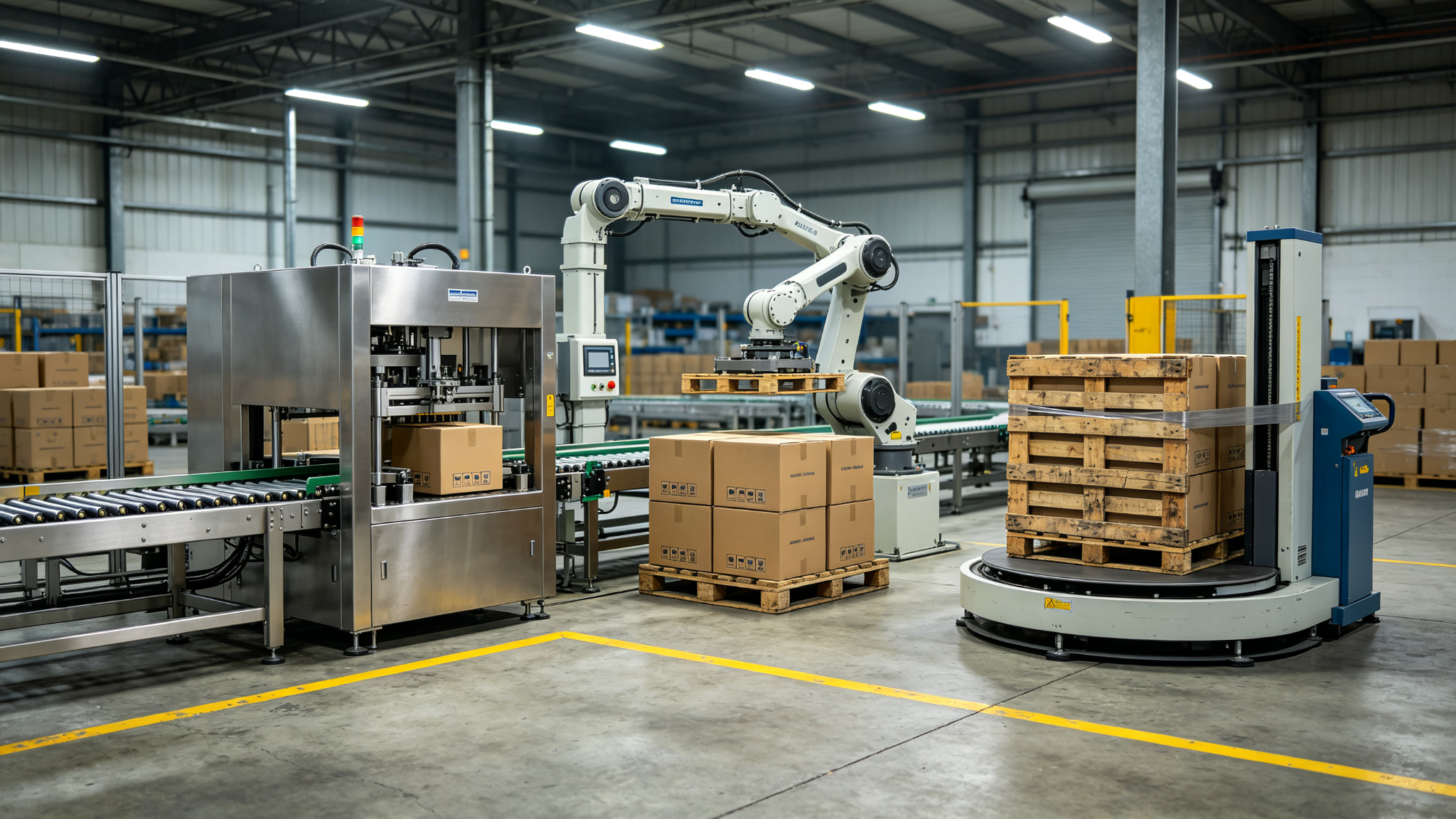
The hooder only works if the pallet arrives perfectly square and at the right height. Upstream, the producer bags product on a vertical form-fill-seal line and weighs on a multihead weigher; the bags then enter a gantry palletiser that builds a programmed layer pattern. The palletiser communicates each finished pallet to the hooder via the line PLC, so there is no manual trigger. Buyers who bolt a hooder onto a palletising cell they did not engineer together usually hit two problems: misaligned pallets that jam under the film hood, and mismatch in cycle times that leaves the hooder starved. On this installation the palletiser and hooder were matched in cycle and shared one HMI recipe, just as the producer’s thermoforming and secondary packaging equipment shares control elsewhere in the plant.
Film cost and payback
Stretch hood film costs more per pallet than spiral wrap, so the payback argument has to be built on waste. The producer previously wrote off a small but steady stream of pallets damaged in transit, plus the labour of double-wrapping outdoor storage. With hooded, weatherproof loads, transit claims dropped sharply and outdoor storage became acceptable. As a rule, hooding pays for itself when (a) you ship long distances or outdoors, (b) your load is soft or unstable (bags, bales, loose cartons), or (c) your customers already reject wrapped pallets. For rigid cartons moving short indoor distances, spiral wrap is still cheaper and a hooder would be over-spec.
Buyer checklist for a stretch hood line
- Pallet sizes and maximum load weight, including half-pallets.
- Product type and whether layers are soft (bags) or rigid (cartons).
- Required pallets-per-hour and how that matches the upstream bagging speed.
- Film thickness and grade range the hooder must stretch.
- Outdoor / long-freight exposure that justifies hooding over wrap.
- Integration to the filling and bagging line and palletiser via one PLC.
FAQ
Is stretch hood cheaper than shrink hood over time?
Yes in most operations, because there is no heat tunnel and no gas or electricity for shrinking. Film use is comparable, but energy and maintenance drop sharply, and cycle times are usually faster.
Can a stretch hooder handle varying pallet heights?
Yes. The hood pulls to a programmed height per recipe, so mixed pallet heights on the same shift are handled by selecting the recipe, not by changing hardware.
Does hooding replace strapping or corner boards?
For bagged bulk, a properly stretched hood usually replaces both, because the film clamps the whole load. For very tall, heavy carton stacks, some producers still add edge protection; ask the builder to test your load.
What if the film rolls are short on a long run?
Specify the largest roll diameter the hooder can take and an auto-splice or low-film alarm. A hooder that stops every twenty pallets costs far more than the film itself.
Stretch hood film grades and thickness
Hood film is a polyethylene tube, usually three-layer coextruded, chosen for elastic recovery and puncture resistance. Thicker film (100–150 microns) handles heavy, sharp-edged loads and cold-chain storage; thinner film (60–90 microns) suits light, clean cartons and lowers cost per pallet. The film must be matched to the hooder’s stretching percentage: over-stretching a thin film tears it, under-stretching a thick film leaves it loose. Buyers often price film by the kilogram and then discover the hooder cannot actually stretch that grade, so the load wobbles. Always specify the film thickness range your hooder is engineered for, and ask the film supplier to supply a trial roll the machine can validate. Add UV inhibitors if pallets sit outdoors for weeks — plain PE film degrades in sun and becomes brittle.
Common stretch hooding faults and fixes
| Fault | Common cause | Fix |
|---|---|---|
| Film tears during stretch | Film too thin for stretch %; sharp bag corners | Use thicker grade; check pallet corners; reduce stretch ratio |
| Film not tucked under pallet | Pallet height mis-set; jaw timing off | Re-set pallet height recipe; calibrate jaw descent |
| Top of load not sealed | Hood too short for load height | Select taller hood recipe; check film roll width |
| Pallet jams under the hooder | Off-square pallet from upstream | Align palletiser; add centering conveyor before hooder |
| Loose film on light loads | Stretch force too high for the load | Lower stretch ratio for light half-pallets |
| Film change takes too long | Small roll diameter; no auto-thread | Specify max roll diameter and auto-thread |
Site preparation and safety guarding
A hooder is a tall machine — the film carriage lifts several metres — so the install needs ceiling height and a level, reinforced floor. Before commissioning, confirm the pallet flow path: pallets must arrive centered, the hooder must know pallet height, and there must be clearance for the film roll change and the jaw service area. Because the jaws grip and stretch film, the cell is guarded with light curtains and interlocked doors so an operator cannot reach the stretch zone while it cycles. Buyers who add a hooder to an existing line should also budget for a centering conveyor and a pallet height check before the hooder; without them, misaligned pallets cause the majority of downtime. The South American line in this project was installed with those interfaces built in, so the hooder has run at target rate since FAT with no major jams.
When NOT to buy a stretch hooder
Stretch hood is a powerful tool, but it is over-spec in the wrong situation. If your pallets are rigid cartons that move a short indoor distance, a well-tuned spiral stretch wrap costs a fraction and is perfectly adequate. If your line runs fewer than a few hundred pallets a day, the capital cost is hard to justify on film savings alone. If you ship a single uniform pallet size indoors, a shrink hood tunnel can be cheaper. The hooder earns its place when loads are soft or unstable, when freight is long or outdoor, or when customers have already rejected wrapped pallets in transit. The South American producer met all three: 25 kg bags, weeks of freight, coastal humidity. If your situation is closer to rigid cartons moving across a factory floor, talk to us about a stretch wrapper instead — buying a hooder you do not need is its own cost problem.
A worked payback example
Take the South American producer: roughly 400 pallets a day, each bagged dry food previously wrapped with spiral film. Before the hooder, the allowance for transit damage and outdoor re-work was running at a small per-pallet cost, and two people spent part of each shift re-stacking and double-wrapping pallets that had shifted in the warehouse. After hooding, transit claims fell to near zero, the double-wrapping labour disappeared, and outdoor storage became viable. Even with more expensive hood film, the avoided damage and recovered labour paid back the cell inside the standard 12–18 month window. The lesson is that hooding economics are driven by waste and labour, not by film price. If your wrapped pallets arrive undamaged and never sit outdoors, do not buy a hooder; if they do, the numbers usually close themselves.
Pallet flow and centering before the hooder
A hooder expects the pallet to arrive on the same centreline every time, within a few millimetres. If the palletiser drops a pallet a little off-square, or the conveyor lets it twist, the hood grips an offset load and the film tucks crookedly — a jam or a poorly sealed top. The fix is a short centering conveyor with side guides or a pop-up centering device immediately before the hooder, plus a pallet presence and height check. This small addition prevents the majority of hooding downtime and is something buyers often omit when they buy a hooder as a standalone machine. Pair it with a pallet infeed that buffers a few pallets, and the hooder runs continuously even when the palletiser pauses for a layer change. On the South American install, centering and buffering were built into the layout from the start, which is why the cell has held its 60-bags-per-minute target through the dry season and the peak freight weeks.
Summary
For bagged bulk foods that travel far or sit outdoors, a stretch hood line converts an open, porous pallet into a weatherproof, clamped unit. The engineering risk is not the hooder itself but matching it to the upstream palletiser and bagging speed. SunAura Machinery delivered this as a matched cell with recipe-based pallet and hood size, tested on the producer’s own bags at FAT. If you are comparing stretch wrap, shrink hood and stretch hood for a bagged or unstable load, contact our packaging engineers with your pallet sizes, bags-per-hour and freight conditions for a layout and film recommendation.