

Pallet wrapping is the final step in the packaging chain — the last barrier between a stable unit load and a shipping disaster. A poorly wrapped pallet shifts in transit, collapses in the warehouse, or arrives at the customer’s dock with broken shrink film and scattered cartons. Yet in our conversations with factory managers, the pallet wrapper is often the most under-invested piece of equipment in the end-of-line process. They buy the cheapest turntable wrapper they can find and accept the consequences.
At SunAura Machinery, we build pallet wrapping machines for warehouses, distribution centers, and manufacturing plants. This guide walks you through the three main wrapper types — turntable, rotary arm, and orbital — and explains how to match the right machine to your pallet load, throughput, and floor space. Whether you wrap 50 pallets a day or 500, this guide will help you buy the right wrapper the first time.
Why Pallet Wrapping Matters More Than You Think
A well-wrapped pallet protects your product in three ways: it stabilizes the load against lateral movement during forklift transport and truck transit, it provides weather protection during outdoor storage, and it acts as a visual deterrent against tampering. A poorly wrapped pallet does the opposite — it invites load shift, product damage, and warehouse accidents.
Industry data shows that 30–40% of shipping damage claims trace back to inadequate pallet wrapping. Each damaged pallet costs you not just the product value but also the logistics cost of return shipping, replacement processing, and customer relationship damage. Investing in a proper pallet wrapper pays for itself by reducing these claims — often within the first year.
Types of Pallet Wrapping Machines
1. Turntable Stretch Wrappers
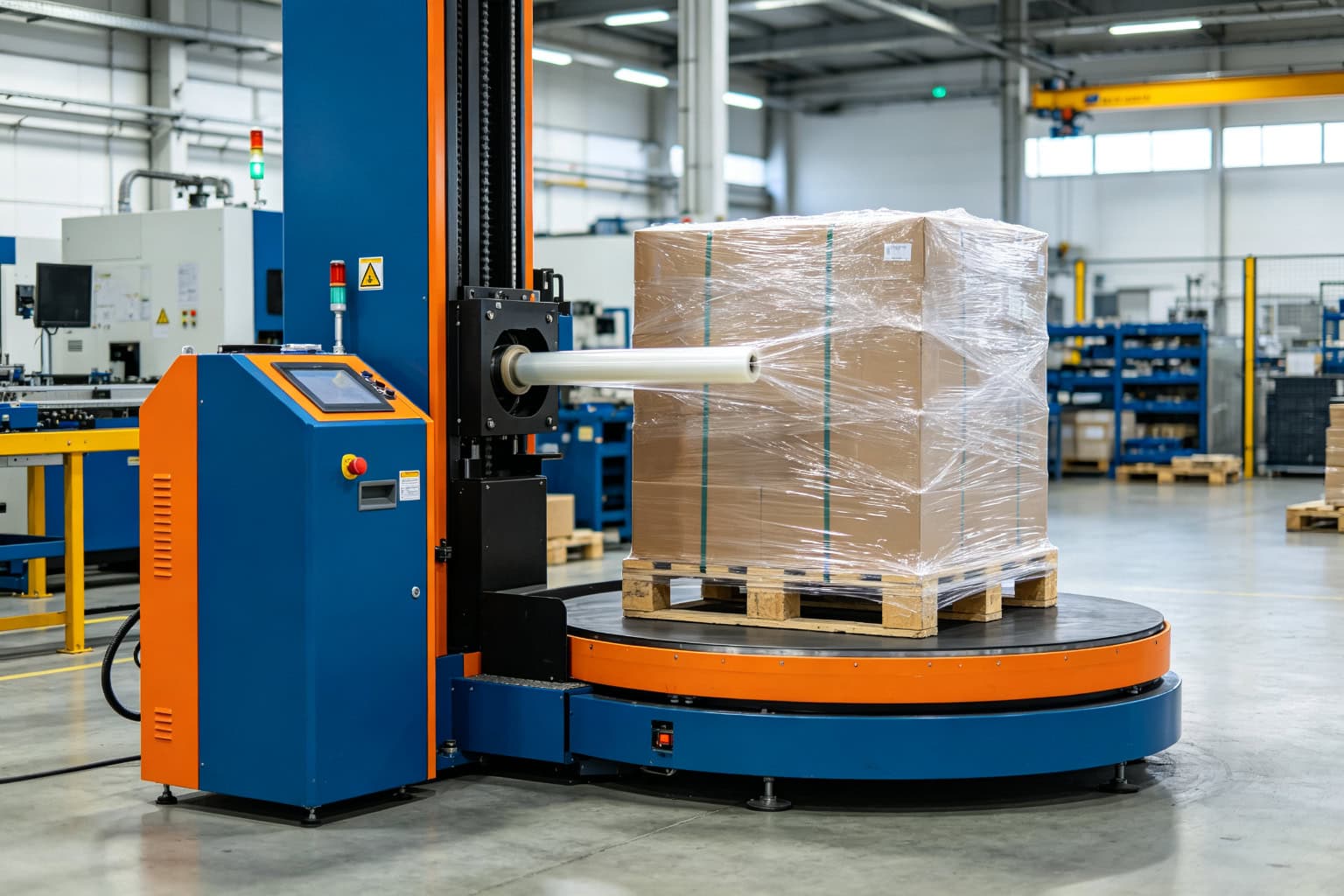
The most common and affordable type. The pallet sits on a rotating turntable while the film carriage moves up and down a vertical mast. As the turntable spins, film is stretched and applied around the pallet.
Best for:
- Stable, uniform pallet loads under 1,500 kg
- Medium throughput (20–60 pallets per day)
- Standard warehouse floor space
- Operations with consistent pallet dimensions
Turntable wrappers come in semi-automatic (operator places the pallet, starts the cycle) and fully automatic (pallet conveyed in and out automatically) variants. Our semi-automatic turntable pallet wrapper wraps 20–30 pallets per hour and is the entry-level choice for most warehouses.
2. Rotary Arm Wrappers
Instead of rotating the pallet, the film carriage travels around a stationary pallet on a rotating arm. The pallet stays still on the conveyor while the arm circles it.
Best for:
- Heavy or unstable loads over 1,500 kg (shifting during rotation)
- Tall loads over 2 meters that would wobble on a turntable
- High-throughput distribution centers (60–120 pallets per hour)
- Loads that are already on a conveyor line and cannot be lifted off
Rotary arm wrappers cost more than turntable models but handle loads that turntables cannot. They are the standard choice for high-volume e-commerce fulfillment and food distribution centers. Our rotary arm pallet wrapper processes 60–120 pallets per hour with automatic top platen option for unstable loads.
3. Orbital / Ring Wrappers
Orbital wrappers use a rotating ring to apply film horizontally around the product — ideal for long, narrow loads like lumber, pipes, carpet rolls, or bundled profiles. They wrap in a horizontal spiral rather than the vertical spiral used on standard pallets.
Best for:
- Long or cylindrical products (pipes, tubes, lumber, coils)
- Loads that need horizontal as well as vertical wrapping
- Ring-shaped or coiled products

4. In-line / Conveyorized Wrappers
Fully automatic systems integrate directly into a conveyor line. Pallets enter the wrapping station automatically, the wrapper applies film, and the wrapped pallet exits to the next conveyor — no operator intervention.
Best for:
- High-volume production lines (100+ pallets per day)
- Fully automated end-of-line systems
- Operations with continuous conveyor flow
- Integration with palletizers and stretch hood machines
In-line wrappers are part of a complete end-of-line system. They work with upstream palletizers, conveyor systems, and downstream truck loading equipment. For a complete integrated solution, see our turnkey packaging line systems.
Key Specifications to Compare
Load Capacity
The wrapper’s rated load capacity must exceed your heaviest pallet by at least 20%. A wrapper rated at 1,500 kg may struggle with a 1,500 kg load on a regular basis. Factor in the pallet weight itself — a standard wood pallet weighs 25–40 kg.
Turntable Diameter and Height Range
The turntable must accommodate your widest pallet with clearance. Standard sizes are 1,500mm, 1,650mm, and 1,800mm diameter. The mast height determines the maximum load height — standard is 2,000mm, extended to 2,400mm or 2,800mm for tall loads.
Film Carriage Type: Pre-stretch vs. Belt Stretch
This is the single most important specification for film cost. A pre-stretch carriage stretches the film 200–300% before applying it to the pallet. This means one roll of film covers 2–3 times more pallets. A non-stretch or belt-stretch carriage applies film at near-100% elongation — meaning you use 2–3 times more film per pallet.
Over a year, the film cost difference is enormous. At 50 pallets per day, 250 working days, and $15 per roll of film:
| Carriage Type | Film per Pallet | Rolls per Year | Annual Film Cost |
|---|---|---|---|
| Non-stretch (100%) | ~250g | ~1,040 rolls | ~$15,600 |
| Pre-stretch (250%) | ~100g | ~416 rolls | ~$6,240 |
| Annual savings | ~$9,360 |
A pre-stretch carriage costs $1,500–$3,000 more upfront but saves nearly $10,000 per year in film. It pays for itself in 2–4 months. This is not optional equipment — it is a critical cost-recovery component.
Wrap Cycles per Hour
A typical turntable wrap cycle (top wrap + bottom wrap + 6–8 vertical revolutions) takes about 60–90 seconds. That translates to 40–60 pallets per hour. If you need more throughput, look for a rotary arm wrapper or a dual-station turntable that lets one pallet wrap while another is being loaded.
Top Plate / Top Press
For unstable loads (light cartons, irregular stacks), a pneumatic or electric top plate presses down on the pallet during wrapping, preventing the load from shifting or tipping. This feature adds $1,500–$3,000 but is essential for loads that wobble on the turntable.
Semi-Automatic vs. Fully Automatic: Which Fits Your Operation?
Semi-Automatic Wrappers
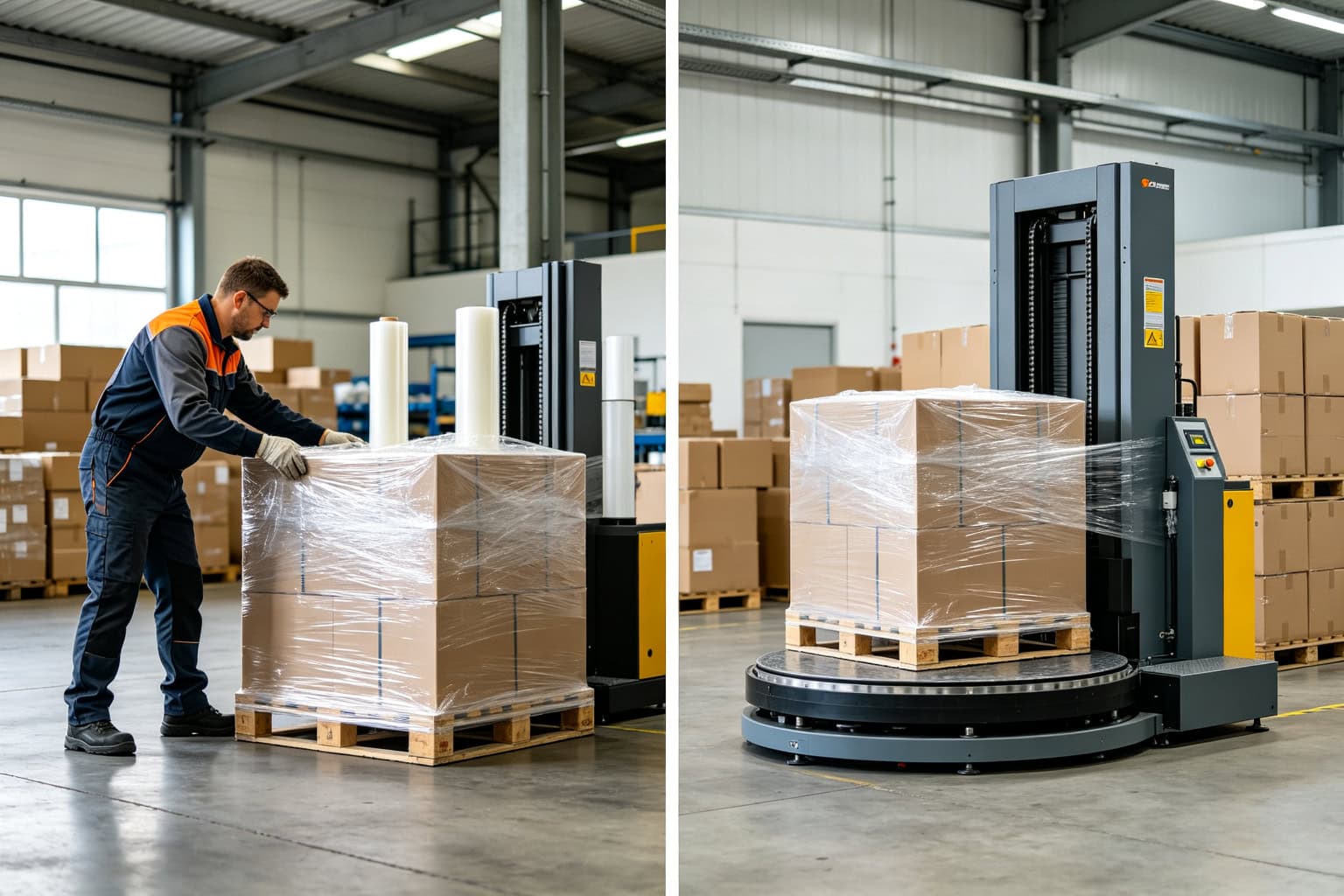
The operator places the pallet on the turntable with a forklift or pallet jack, attaches the film tail, and starts the cycle. When wrapping completes, the operator cuts the film and removes the pallet. This is the standard configuration for warehouses wrapping 20–60 pallets per day.
Pros: lower capital cost, flexible for variable pallet sizes, simple to operate. Cons: requires one operator at the wrapper station, throughput limited by operator speed.
Fully Automatic Wrappers
Pallets arrive on a conveyor, the wrapper automatically detects the pallet, wraps it without operator intervention, and exits to the next conveyor. The operator only monitors the system and reloads film rolls.
Pros: high throughput (60–120 pallets/hour), consistent wrap quality, no dedicated operator. Cons: higher capital cost, requires conveyor integration, less flexible for variable pallet sizes.
The decision comes down to throughput and labor cost. If you are wrapping fewer than 60 pallets per day, semi-automatic is the rational choice. If you are wrapping 100+ pallets per day across two shifts, the fully automatic version saves one full-time operator position within a year.
Common Mistakes When Buying a Pallet Wrapper
Mistake 1: Buying a Non-Pre-stretch Carriage to Save Money
We covered this above, but it bears repeating. A $2,000 savings on the carriage costs you $9,000 per year in film. The pre-stretch carriage is not a luxury — it is the equipment that makes the wrapper economically viable.
Mistake 2: Underestimating Load Height
A standard 2-meter mast is fine today, but if you plan to stack higher or add taller cartons next year, you will need a taller mast. Upgrading a mast after installation is costly. Buy the height you might need in 3 years, not just the height you need today.
Mistake 3: Ignoring Film Roll Size Availability
Different wrappers use different film roll cores and diameters. A wrapper designed for 500mm x 300mm rolls will not accept 400mm x 200mm rolls from another supplier. Standardize on a roll size that multiple film suppliers can provide — do not lock yourself into a proprietary roll size.
Mistake 4: No Emergency Stop and Safety Cage
A rotating turntable with a film carriage moving up and down is a pinch hazard. Every wrapper should have: a safety cage around the turntable, an emergency stop button within arm’s reach, and a safety interlock that stops the machine if the cage door opens. Cutting corners on safety features leads to workplace accidents and regulatory non-compliance.
Mistake 5: Buying a Wrapper Without Service Support
A wrapper that breaks down on Monday morning means your shipping department stops. Confirm that the supplier has local service support or can ship critical spare parts (film carriage, stretch motor, mast bearings) within 48 hours. At SunAura Machinery, we stock common wear parts in our Qingdao warehouse and ship internationally within 48 hours.
FAQ: Pallet Wrapping Machine Questions
How much stretch film do I need per pallet?
A standard 1200 x 1000 x 1500mm pallet wrapped with 6–8 vertical revolutions and top/bottom wraps uses approximately 80–120 grams of pre-stretched film. Without pre-stretch, the same pallet uses 200–280 grams. The exact amount depends on pallet height, load stability requirements, and film thickness.
What is the difference between stretch wrap and shrink wrap for pallets?
Stretch wrap uses mechanical tension to stretch film around a pallet — no heat required. Shrink wrap uses heat to contract film around the load. Stretch wrap is the industry standard for pallet loads because it is faster, cheaper, and does not require a heat tunnel. Shrink wrap is used for specialized applications like weatherproofing or extreme load stability.
How often should I replace the film carriage rollers?
The rubber rollers in a pre-stretch carriage typically last 6–12 months with daily use. Signs of wear: film slipping during stretch, inconsistent wrap tension, visible grooves on the roller surface. Keep a spare roller set on hand — replacement takes 10 minutes.
Can I wrap pallets of different sizes on the same machine?
Yes. Modern wrappers have photoeyes that detect pallet height automatically. The operator selects the wrap program (number of revolutions, top/bottom wrap) for each pallet size. Changing between sizes takes 30 seconds — just select the program on the HMI. For fully automatic lines, the conveyor system can route different pallet sizes to different wrapping stations.
What maintenance does a pallet wrapper require?
Daily: check film roll, inspect wrap quality. Weekly: lubricate turntable bearings, clean photoeyes. Monthly: check chain tension, inspect mast cable, test emergency stop. Annual: replace wear parts (rollers, belts, brushes). A well-maintained wrapper lasts 10–15 years with basic preventive care.
How much does a pallet wrapping machine cost?
Semi-automatic turntable wrappers start at $3,500–$7,000 for basic models. Mid-range wrappers with pre-stretch and top plate run $8,000–$15,000. Rotary arm wrappers start at $20,000. Fully automatic in-line systems range from $30,000 to $80,000+. Contact our SunAura Machinery sales team for a detailed quote based on your pallet specs and throughput.
Conclusion: The Right Wrapper Protects More Than Your Product
A pallet wrapper is not just a machine — it is the last line of defense between your product and the shipping environment. The right wrapper reduces damage claims, cuts film cost through pre-stretch, and frees your operators from manual wrapping. The wrong wrapper creates bottlenecks, wastes film, and causes warehouse accidents.
Start with your daily pallet count, your heaviest and tallest load, and your floor space. Choose between turntable, rotary arm, or orbital based on load characteristics. Always specify a pre-stretch carriage. And make sure the supplier can support you with spare parts and service when you need it.
Pallet wrapping is the final step after cases are sealed and stacked. Upstream equipment — including carton sealing machines and shrink wrapping systems — must be synchronized with the palletizer and wrapper. For complete line integration, see our packaging line solutions.
Ready to spec your pallet wrapping system? Send us your pallet dimensions, daily throughput, and load type, and our engineers at SunAura Machinery will recommend the optimal wrapper configuration — semi-automatic, rotary arm, or fully automatic in-line — with a transparent price and delivery timeline.
《 “Pallet Wrapping Machine Buying Guide: Turntable, Rotary Arm, and Orbital Selection” 》 有 2 条评论
[…] speed with no changeover, a gantry layer palletizer is faster. For more detail, see our guide to pallet wrapping machine selection — the partner to any […]
[…] For export facilities, load security is not a preference — it is a contract requirement. Insurers and freight forwarders increasingly inspect pallet wrapping before accepting cargo, and loose or incomplete wraps are a leading cause of transit damage claims. A machine that applies the same wrap every time converts a quality variable into a fixed process parameter. The full range of pallet wrapping options — including fully automatic turntable and rotary arm machines — is covered in our pallet wrapping machine buying guide. […]