

Strapping is the final step in securing your product for transport — and yet it is one of the most under-specified machines in the packaging line. A strap that fails in transit means a broken pallet, scattered cartons, and a customer that opens the box to find damaged goods. Yet when procurement teams shop for a strapping machine, they often compare only price, not strap tension, cycle time, or compatibility with their bundle size.
At SunAura Machinery, we design and build strapping machines for carton bundling, pallet securing, and industrial unitizing. This guide walks you through every major type of strapping equipment — semi-automatic, automatic, and fully inline — explains which strap material to use for which application, and gives you a practical decision framework to match the machine to your bundle size, material, and production volume.
Why Strapping Quality Matters
Strapping serves three critical functions:
- Bundle consolidation: holds multiple cartons, bags, or products together as a single unit
- Load stabilization: prevents lateral movement during forklift transport and truck transit
- Secondary containment: works alongside stretch wrapping for heavy or unstable loads
A strap that breaks under transit stress undoes all the work of your packaging line. Industry data shows that 15–20% of shipping damage claims trace back to inadequate strapping — either the wrong strap material, insufficient tension, or a machine that applies inconsistent tension. The right strapping machine applies the correct tension every cycle, uses the right strap width and material for your load, and runs at a speed that matches your line throughput.
Types of Strapping Machines
1. Semi-Automatic Strapping Machines
The operator places the bundle on the strapping table, threads the strap around it, and triggers the cycle. The machine automatically tensions, seals, and cuts the strap. Cycle time is 2–3 seconds per strap.
Best for:
- Low to medium volume (100–500 straps per day)
- Variable bundle sizes that change frequently
- Small shipping departments and warehouses
- Operations where one operator handles multiple tasks
Semi-automatic strappers are the entry-level choice. They cost $1,500–$4,000 and require one operator per machine. Our standard semi-automatic model handles PP strapping in 9–15mm width and bundles up to 800 × 600mm.
2. Automatic Strapping Machines (Arch Type)
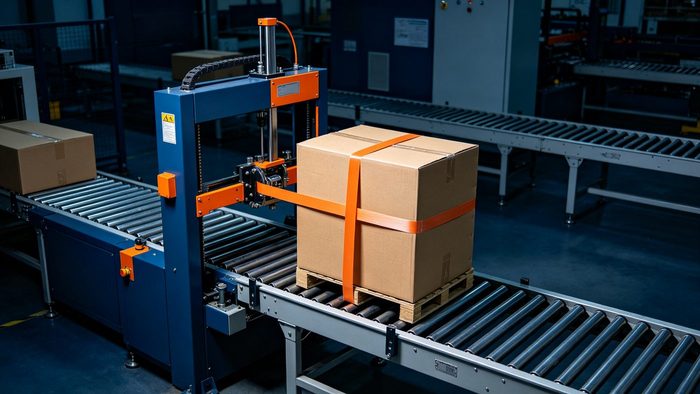
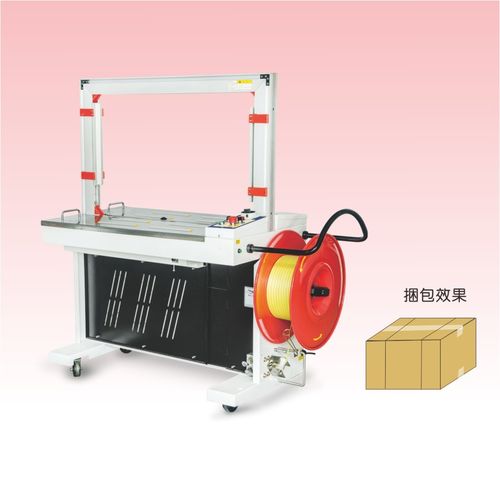
The bundle passes through a fixed arch on a conveyor. The machine automatically detects the bundle, threads the strap around the arch, tensions, seals, and cuts — all without operator intervention. Cycle time is 1.5–2.5 seconds per strap.
Best for:
- Medium to high volume (500–2,000 straps per day)
- Consistent bundle sizes that fit the arch dimensions
- Integration with upstream carton sealers and conveyors
- Single-shift or two-shift operations
Automatic arch strappers are the workhorse of end-of-line packaging. They are typically placed right after a carton sealer to strap bundles of sealed cartons. The arch size determines the maximum bundle dimensions — standard arches handle 800 × 600mm to 1,200 × 1,000mm bundles.
3. Fully Inline Strapping Systems
High-speed systems integrate directly into a conveyor line. The strapping head moves with the bundle (or the bundle stops momentarily) while the strap is applied. No operator touches the machine. Speeds range from 20 to 60 bundles per minute.
Best for:
- High-volume production (2,000+ bundles per day)
- Fixed bundle sizes with minimal changeover
- Integration with case sealers, case packers, and palletizers
- Two-shift or three-shift operations
Inline systems are part of a complete end-of-line solution. They communicate with upstream equipment and automatically adjust strap timing based on bundle position. For a complete integrated line, see our turnkey packaging line systems.
4. Pallet Strapping Machines
Heavy-duty systems designed to strap full pallet loads. Vertical strapping heads apply strap through the pallet from top to bottom. Some models apply horizontal straps around the pallet as well.
Best for:
- Pallet loads weighing 500kg+
- Industrial, building materials, and heavy goods
- Loads that need additional stabilization beyond stretch wrapping
Pallet strapping is often used alongside stretch wrapping. The strap provides vertical containment; the stretch film provides lateral load stabilization. Together they handle the heaviest and most unstable loads.
Strap Materials: PP vs PET vs Steel
| Material | Width | Breaking Strength | Best Applications | Relative Cost |
|---|---|---|---|---|
| PP (Polypropylene) | 9–15mm | 80–250kg | Cartons, light bundles, retail packaging | Lowest |
| PET (Polyester) | 12–19mm | 300–800kg | Heavy cartons, bricks, lumber, metal parts | Medium |
| Steel | 12–32mm | 500–2,000kg | Heavy industrial, steel coils, heavy lumber | Highest |
PP strap is the default for most carton and light bundling applications. It is affordable, easy to use, and sufficient for loads under 250kg. PET strap is the upgrade for heavier loads — it has the strength of steel with the safety of plastic (no sharp edges, no rust). Steel strap is reserved for the heaviest industrial loads where plastic cannot handle the tension.
Always specify the strap material and width when ordering a strapping machine. The strapping head, feed wheel, and seal mechanism must match the strap size. A machine tuned for 12mm PP strap will not handle 19mm PET strap without modification.

Key Specifications to Compare
Arch Size
The arch must accommodate your largest bundle with clearance. Standard arches are 800 × 600mm, 1,000 × 800mm, and 1,200 × 1,000mm. Measure your widest and tallest bundle before specifying arch size. A bundle that does not fit through the arch cannot be strapped.
Strap Tension Range
Tension determines how tightly the strap holds the bundle. Light cartons need low tension (5–15kg) to avoid crushing. Heavy loads need high tension (30–80kg) for stabilization. Look for a machine with adjustable tension — ideally digital control from the HMI.
Cycle Time
Cycle time includes strap feed, tension, seal, and cut. Semi-automatic machines take 2–3 seconds per strap. Automatic arch machines take 1.5–2 seconds. High-speed inline systems can do under 1 second. Match cycle time to your line speed.
Strap Roll Capacity
A standard strap roll holds 2,000–3,000 meters. At 0.5 meters per strap, that is 4,000–6,000 straps per roll. For high-volume operations, look for a machine that holds large-diameter rolls (200mm+) to reduce roll changes. Low-roll sensors alert the operator when a change is needed.
Seal Type
Most strapping machines use friction weld seals (also called hot knife seals). The strap ends are heated and pressed together. Seal strength depends on seal temperature and pressure. Better machines have adjustable seal temperature and time.
Semi-Automatic vs. Automatic: The Cost-Benefit
| Factor | Semi-Automatic | Automatic Arch |
|---|---|---|
| Typical price | $1,500–$4,000 | $5,000–$12,000 |
| Straps per hour | 30–60 | 120–200 |
| Operator required | 1 full-time | Part-time (monitoring only) |
| Best volume range | 100–500/day | 500–2,000/day |
| Bundle size flexibility | High (manual placement) | Medium (arch-limited) |
If you strap fewer than 500 bundles per day, the semi-automatic is the rational investment. If you strap 1,000+ bundles per day, the automatic version saves one full-time operator within 12–18 months through labor reduction. The break-even point is around 600 bundles per day.
Common Buying Mistakes
Mistake 1: Under-Sizing the Arch
Buying an arch that fits your current bundles but not future larger products forces you to manually strap the larger sizes. Buy an arch 20% larger than your current maximum bundle. This is one of the most common regrets we hear from customers — they saved $1,000 on a smaller arch and ended up with a machine they cannot use for their new product line.
Mistake 2: Buying for PP Strap Only
Today you strap light cartons with 12mm PP. Next year you add a product line with heavier bundles that need 16mm PET. A machine that only handles PP strap width cannot be retrofitted. Buy a machine that accommodates both PP and PET in the width range you might need. The cost premium is typically $300–$500 but saves you from buying a second machine.
Mistake 3: Ignoring Strap Quality
Not all PP strap is equal. Cheap strap stretches more, seals poorly, and breaks more often. Use strap from a consistent supplier, and specify the strap brand and width to the machine manufacturer. A good machine on bad strap still produces bad seals — and the operator will blame the machine, not the strap.
Mistake 4: No Maintenance Access
The feed wheel, seal blade, and tension arm are wear items. A machine where the seal head requires 30 minutes of disassembly to access costs you dearly in downtime. Look for quick-release seal heads and tool-free strap threading. On our automatic arch strappers, the seal head can be removed and replaced in under 5 minutes with no tools.
Mistake 5: Forgetting About Integration
An automatic strapper on a standalone conveyor is fine for small operations, but if you plan to integrate it with a carton sealer, case packer, or palletizer, you need the machine to communicate with upstream equipment. Without interlock signals, the strapper may apply a strap when no bundle is present, or miss a bundle because the timing is off. For integrated lines, see our turnkey packaging line solutions.
FAQ: Strapping Machine Questions
How much does a strapping machine cost?
Semi-automatic tabletop strappers start at $1,500–$3,000. Automatic arch strappers range from $5,000 to $12,000. Fully inline high-speed systems start at $15,000+. Pallet strapping machines range from $10,000 to $30,000+. Contact our SunAura sales team for a quote based on your bundle size and volume.
What strap width should I use?
For standard cartons under 20kg, 12mm PP strap is sufficient. For bundles weighing 20–50kg, use 15mm PP or 12mm PET. For loads over 50kg, use 16–19mm PET. Steel strap is reserved for loads over 200kg.
How often should I replace the seal blade?
The heat seal blade lasts 6–12 months with daily use. Signs of wear: inconsistent seals, strap not fusing, visible discoloration. Keep a spare seal blade on hand — replacement takes 5 minutes.
Can one machine handle both PP and PET strap?
Most modern automatic strappers handle both PP and PET by adjusting tension and seal temperature. Confirm with the manufacturer before ordering. Semi-automatic tabletop machines are usually PP-only.
How noisy is a strapping machine?
Automatic strappers produce 70–75 dB during the seal cycle — about the same as a vacuum cleaner. In an open production area this is acceptable. For office or quiet environments, specify sound-dampened models.
What maintenance does a strapper need?
Daily: inspect strap path, check seal quality. Weekly: clean feed wheel, check tension calibration. Monthly: lubricate chains, inspect seal blade. At SunAura strapping machines, every unit ships with a 6-month spare parts kit including seal blade, feed wheel, and tension spring.
Conclusion: Match the Strapper to Your Bundle and Volume
Strapping is not just about holding boxes together — it is about protecting your product in transit. The right strapping machine applies consistent tension every cycle, uses the right strap material for your load, and runs at a speed that matches your line. Start with your bundle size and daily volume, then choose between semi-automatic flexibility or automatic speed. Always specify the strap material and width, and request a sample run with your actual bundles.
Strapping works alongside other end-of-line equipment — carton sealers form the boxes, conveyors move them between machines, and pallet wrappers secure the loaded pallet. For automated end-of-line integration, see our new modular conveyor system line and robotic palletizer series.
Ready to find the right strapping machine? Send us your bundle dimensions, strap material preference, and daily throughput, and our engineers at SunAura Machinery will recommend the optimal strapping solution — semi-automatic, automatic arch, or inline — with a transparent quote and delivery timeline.