

September 29, 2026 | by Monica, SunAura Machinery Applications Engineering
Walk into any food production plant and you’ll find two schools of shelf-life extension running on the same floor. One room has a vacuum packing machine, pulling air out of a nylon pouch before sealing it flat. Two aisles over, a tray-sealing line is flushing a shallow PET tray with a nitrogen–CO&sub2; blend and slapping a peelable lid on top. Both are trying to solve the same problem — slow down oxidation, stop aerobic mold, and push the “best before” date out — but they take fundamentally different routes. If you’re specifying a new packaging line for meat, seafood, ready meals or cheese, choosing between MAP (Modified Atmosphere Packaging) and vacuum packaging is one of the first decisions that locks in your equipment budget, film cost and shelf-life claims.
After configuring more than 80 food packaging lines for export customers, we’ve put together the comparison we wish every buyer walked in with. This isn’t a “MAP is better” piece — it’s a decision framework: what each method actually does, where it wins, and where it quietly costs you more than you save.

What Each Method Actually Does
Vacuum packaging
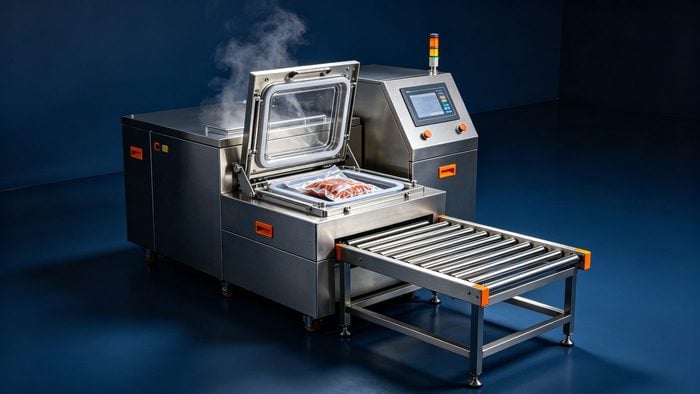
A vacuum sealer places product into a pre-formed pouch (or forms the pouch from roll stock on a thermoforming machine), evacuates the air down to roughly 1–5 mbar, and heat-seals the pouch while it’s still under vacuum. The result is a tight, conforming pack with essentially no headspace. For cured meats and cheese, that’s fine. For fresh meat, the tight pack squeezes out juices and leaves the product looking bruised — which is why fresh-meat producers moved away from straight vacuum decades ago.
Modified Atmosphere Packaging (MAP)
MAP takes the opposite approach. Instead of removing all air, it flushes the pack with a precisely calibrated gas blend — usually a mix of nitrogen (N&sub2;), carbon dioxide (CO&sub2;), and sometimes oxygen (O&sub2;) — to displace the ambient air before sealing. The pack retains headspace, the product sits loose in a clear tray, and the gas mix is chosen to suppress the specific spoilage organisms in that product. Fresh red meat, for example, needs around 70–80% O&sub2; to keep myoglobin red; bakery goods need CO&sub2; to slow mold; snacks need N&sub2; to cushion chips.
| Parameter | Vacuum Packaging | MAP (Modified Atmosphere) |
|---|---|---|
| Headspace | None — pouch conforms to product | Maintained — tray inflates slightly with gas mix |
| Typical gas environment | ~0% oxygen (deep vacuum) | Custom N&sub2;/CO&sub2;/O&sub2; blend per product |
| Shelf-life extension (chilled) | 21–90 days for cured/dry goods | 7–21 days for fresh products |
| Product appearance | Tight pack; fresh meat looks bruised | Loose tray; product looks fresh and retail-ready |
| Equipment cost (entry) | $3,000–$15,000 (chamber units) | $25,000–$80,000+ (tray sealer with gas flush) |
| Packaging material cost | High-barrier nylon pouches (medium cost) | Pre-formed trays + lidding film (higher cost) |
| Throughput range | Up to ~600 packs/hour (chamber) | 20–120 packs/min (tray sealer / thermoformer) |
Where Vacuum Wins

Vacuum packaging is the right call when your product is either shelf-stable or doesn’t need to look “fresh” at retail. The strongest use cases are:
- Cured meats, hard cheese, jerky and smoked fish. The tight pack is a feature, not a bug — it compresses the product and blocks oxygen completely. Shelf life hits 60–90 days chilled.
- Coffee, nuts, dry goods and powders. No oxygen means no rancidity, and the flat pouch stacks well on a pallet. Pair it with an auger filler for powder products.
- Industrial and electronic parts. Vacuum pouches are also a corrosion barrier for metal components — less food, more hardware.
- Low-to-medium volume producers. A double-chamber vacuum sealer costs a fraction of a MAP tray line and runs on 220V single-phase. It’s the right starting point for butcher shops, contract packers and export SMEs.
Where MAP Wins
MAP is the answer when the product needs to look alive at retail — or when the product itself emits moisture or gas that would ruin a straight-vacuum pack.
- Fresh red meat and poultry. The 70–80% oxygen mix keeps myoglobin oxygenated, so the steak stays bright red instead of turning brown. A vacuum pack on fresh beef looks like liver on the shelf.
- Ready meals and cut produce. MAP trays look like restaurant food on a shelf. The gas mix slows browning on cut vegetables and stops mold on cooked rice and pasta dishes.
- Bakery and snacks. CO&sub2; slows mold on bread; N&sub2; cushions potato chips against breakage. Neither works in a flat vacuum pouch.
- Products that weep or emit gas. Fresh meat exudes purge; produce emits CO&sub2;. A vacuum pouch just balloons or pools juice. A MAP tray handles it.
The Hidden Cost Nobody Budgets For
Both methods require high-barrier film — low-barrier PP or PE lets oxygen back in within days, no matter how good your gas flush is. But MAP has a second hidden cost: gas blend calibration. A blend that’s right for beef at 4°C is wrong for salmon at 0°C. Get it wrong — too much O&sub2; and you get rancidity and off-odors; too much CO&sub2; and the pack collapses as the gas dissolves into the product — and you’re reworking pallets of product before the retailer notices. This is why we tell buyers to budget for a few days of gas-mixture trials at commissioning, not just a one-day install.
The equipment itself also matters. A basic tray sealer with a simple gas flush (95% of the machines sold at the lower price point) typically achieves 60–70% gas replacement. A high-quality MAP system with vacuum-and-gas-flush cycles hits 98–99% replacement. That 30% gap is the difference between a 7-day shelf life and a 14-day shelf life on the same product — and it’s usually invisible on a spec sheet.
Still deciding which direction to go? Send us your product, target shelf life, production volume and retail market through the contact page, and our applications engineers will recommend whether a chamber vacuum sealer, a thermoforming vacuum line or a MAP tray sealer fits your operation. You can also browse our full vacuum packing machine range and integrated packaging line solutions to see the equipment in context.
The bottom line: vacuum packaging is cheaper, simpler and unbeatable for products that don’t need to look fresh. MAP costs more to buy and run, but it’s the only way to get retail-ready appearance on fresh meats, ready meals and bakery goods. Most plants we work with end up running both — vacuum for the SKUs that stack and ship well, MAP for the SKUs that need to look appealing on a European supermarket shelf. If you’re building a new line, the good news is that a modular packaging line can accommodate both formats as your product mix evolves.