

Band sealers are the quiet workhorses of the packaging industry. They seal plastic bags — polyethylene, polypropylene, laminated films — at speeds that hand sealers cannot match, and they do it consistently, shift after shift. Yet when procurement teams shop for a band sealer, they often discover that the market offers dozens of models with confusingly similar specifications, and that the differences between them — seal width, belt speed, film compatibility, coding options — determine whether the machine is an asset or a bottleneck.
At SunAura Machinery, we manufacture continuous band sealers for food, pharmaceutical, chemical, and industrial packaging. This guide explains how band sealers work, compares the main machine types, and gives you a practical selection framework — so you can choose the right sealer for your bag material, production speed, and sealing requirements.
How a Band Sealer Works
A band sealer seals bags by passing the bag mouth between two heated bands (sealing belts). The heat melts the film layers together, creating a continuous seal. The sealed bag exits the machine with a uniform, airtight closure.
The process has three stages:
- Bag feeding: the operator (or an automatic feeding system) places the bag mouth into the machine’s infeed. The bag is gripped between the two sealing belts.
- Sealing: the belts carry the bag past heated sealing jaws. The jaws apply heat and pressure to the film, fusing the layers. Seal temperature is adjustable (typically 80–220°C) to match the film type.
- Cooling: after the jaws, a cooling section holds the seal in compression while it cools, producing a strong, flat seal.
The belt speed determines throughput: a machine running 10 meters per minute seals about 30–40 bags per minute (for a 200mm bag mouth). Higher-speed machines reach 15–20 meters per minute. The sealing jaws come in different widths — 10mm, 20mm, or double-seal configurations — depending on the seal strength required.
Types of Band Sealers
1. Horizontal Band Sealers
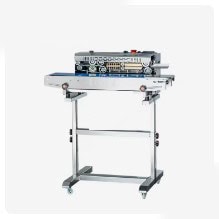
The standard configuration. Bags travel horizontally through the machine, with the bag mouth passing between the sealing belts. The operator places each bag, or an automatic infeed conveyor feeds them continuously.
Best for:
- Standard bags with a straight mouth (snack foods, frozen vegetables, hardware)
- Medium to high volume (20–80 bags per minute)
- Integration with filling machines and conveyors
- Single-shift or two-shift operations
Horizontal sealers are the most common type. They handle bag widths up to 300–450mm and film thicknesses from 40 to 200 microns. Our automatic continuous band sealer integrates directly with filling and packaging lines.
2. Vertical Band Sealers
Bags travel vertically through the machine, with the seal formed on the bag mouth as the bag hangs. Vertical sealers are used for stand-up pouches, pre-formed bags, and products that are filled and sealed in one pass.
Best for:
- Stand-up pouches and pre-made bags
- Powders, granules, and products that settle during filling
- Lines where the sealer hangs above the filling station
- Bags with liquid or semi-liquid contents that must be sealed quickly
Vertical sealers save floor space because the machine mounts above the filling point. They are common in coffee, spice, and powdered food packaging.
3. Ink-Coding Band Sealers
Band sealers with an integrated ink coding unit print date, batch, and expiry information on the film during sealing. The coder uses a hot-stamp or inkjet head that prints onto the bag before or during the sealing pass.
Best for:
- Products requiring date and batch traceability
- Food and pharmaceutical packaging with regulatory coding requirements
- Operations that want to eliminate a separate labeling step
Ink coding adds $1,500–$3,000 to the machine cost but eliminates the cost of pre-printed bags or separate labelers. Our vertical ink-coding band sealer prints on the move without slowing the sealing speed.

4. Nitrogen Flush Band Sealers
Band sealers with gas flush capability inject nitrogen into the bag before the final seal. The nitrogen displaces oxygen, extending the shelf life of oxygen-sensitive products — nuts, coffee, snacks, dried foods.
Best for:
- Oxygen-sensitive foods (coffee, nuts, dried fruit, snacks)
- Products requiring extended shelf life
- Premium food packaging where gas flushing is a differentiator
Nitrogen flush adds a gas nozzle and flow control to the standard sealer. The gas volume is adjustable per bag. For products that oxidize quickly, gas flushing can double or triple shelf life compared to air-sealed bags.
5. Hand-Held Heat Sealers
Manual heat sealers for low-volume and large-bag applications. The operator presses the heated jaws onto the bag mouth to form the seal. No belts, no conveyor.
Best for:
- Low volume (under 10 bags per minute)
- Very large bags that do not fit through a band sealer
- Field packaging, repair operations, and sample sealing
- Start-ups with minimal capital
Hand-held sealers cost $100–$500 and serve as an entry point or backup. They cannot match band sealer speed or consistency — but for occasional large-bag sealing, they are the practical choice.
Film Types: What Can a Band Sealer Seal?
| Film Type | Seal Temperature | Typical Use | Band Sealer Compatibility |
|---|---|---|---|
| LDPE (Low-density PE) | 120–160°C | Bags, liners, general packaging | Excellent — the standard film |
| HDPE (High-density PE) | 140–180°C | Heavy-duty bags, freezer bags | Good — requires higher temperature |
| PP (Polypropylene) | 150–200°C | Snack bags, transparent packaging | Good — requires precise temperature |
| Laminated films (PET/PE, foil) | 160–220°C | Coffee, snacks, premium foods | Good — requires temperature control |
| Cellulose / paper bags | Not heat-sealable | Paper packaging | Not compatible — needs adhesive or clip |
The critical specification is the seal temperature range and its control accuracy. A machine with a narrow temperature range cannot handle a mix of films. A machine with poor temperature control burns thin films or under-seals thick ones. Look for digital temperature control with ±2°C accuracy and a wide operating range (80–220°C).
Key Specifications to Compare
Belt Speed (Meters per Minute)
Belt speed determines throughput. At 10 m/min with 200mm bags, a horizontal sealer produces 30–40 bags per minute. At 15 m/min, it produces 50–60. Match belt speed to your filling line speed — the sealer should run 10–20% faster than the upstream filler to avoid bottlenecking.
Seal Width
The seal width determines seal strength. Standard seals are 10mm wide. Heavy-duty seals are 20mm or double-seal (two parallel 10mm seals). For heavy products or large bags, specify a wider seal or double-seal configuration.
Bag Length and Height Range
The sealer must handle your longest and shortest bags. Horizontal sealers have a minimum bag length (typically 100mm) below which the belts cannot grip properly. Maximum bag length is unlimited — bags feed continuously. Confirm the minimum and maximum bag dimensions against your product range.
Coding Options
If you need date/batch coding, choose a machine with integrated coder or verify the mounting interface for a third-party coder. Some machines have no coder mounting point — retrofitting requires a frame modification. Ink coding, hot-stamp coding, and inkjet coding are the three standard options.
Film Thickness Range
Different films seal at different temperatures and require different belt pressure. A machine rated for 40–200 micron film covers most applications. If you use heavy-duty 250+ micron bags, confirm the sealer handles the thickness without jamming or weak seals.
Band Sealer vs. Other Sealing Methods
Before committing to a band sealer, it is worth comparing the alternatives — each suits a different volume and bag type:
| Method | Speed | Best For | Limitations |
|---|---|---|---|
| Band sealer | 20–80 bags/min | Continuous medium-high volume | Minimum bag length, film must be heat-sealable |
| Impulse sealer | 10–20 bags/min | Low volume, thick films | Slow, each seal is a separate cycle |
| Vacuum sealer | 1–4 cycles/min | Air removal, extended shelf life | Slow, chamber-size limited |
| Heat sealer (hand-held) | 5–10 bags/min | Large bags, occasional use | Inconsistent, operator fatigue |
| Clip / fold closure | Manual | Non-heat-sealable bags | Not airtight, labor intensive |
If your operation runs more than 1,000 bags per day, a band sealer is the only method that delivers consistent seals at the required pace. If you need vacuum or gas flushing for shelf life, a vacuum sealer or gas-flush band sealer is the upgrade path — many SunAura customers start with a standard band sealer and add gas flush later when a retail customer requires extended shelf life.
Common Buying Mistakes
Mistake 1: Buying a Sealer Without Temperature Range for Your Films
A machine rated 100–180°C may handle LDPE and HDPE but not PP (needs 200°C) or laminated films. Confirm the temperature range covers every film you plan to run — now and in the next 3 years. Upgrading a heater system after purchase is costly.
Mistake 2: Ignoring Minimum Bag Length
If your product line includes small bags (under 100mm), a standard horizontal sealer may not grip them properly. Confirm the minimum bag length before ordering. Small bags may require a specialized sealer or manual sealing.
Mistake 3: Buying Without Coding Capacity
You do not need coding today — but next year your biggest customer requires batch traceability. A sealer without a coder mounting point forces a costly retrofit. Buy a machine with coding-ready construction even if you skip the coder initially.
Mistake 4: No Sample Seal Test
Seal quality depends on the exact film formulation — not just the film type. Send your actual bags to the supplier for a test run. Verify seal strength (peel test), seal appearance, and cycle speed with your real film. A 20-minute sample run prevents weeks of post-delivery troubleshooting.
FAQ: Band Sealer Questions
How much does a band sealer cost?
Hand-held heat sealers start at $100–$500. Horizontal band sealers range from $1,500 to $5,000 for standard models. Automatic continuous sealers with conveyors run $5,000–$15,000. Nitrogen flush and coding options add $1,000–$5,000. Contact our SunAura sales team for a quote based on your bag size, film, and speed requirements.
How often should I replace the sealing belts?
The Teflon-coated sealing belts last 6–12 months with daily use, depending on film type and temperature. High-temperature operation shortens belt life. Signs of wear: uneven seals, film sticking to belts, visible cracks. Keep a spare belt set — replacement takes 15 minutes.
Can a band sealer seal liquid-filled bags?
Yes, but the seal must be formed quickly to prevent liquid from reaching the seal area. Vertical sealers are preferred for liquid-filled bags because the bag hangs and the liquid settles below the seal point. Horizontal sealers require a “liquid guard” option or fast sealing speed.
What is the difference between a band sealer and an impulse sealer?
A band sealer uses continuous heat — the sealing jaws stay hot, and the film melts as it passes between the belts. An impulse sealer uses a brief electric pulse to heat the jaw, then cools — each seal is a separate cycle. Band sealers are faster and suit continuous production; impulse sealers suit low-volume or thick-film applications.
Can I run both PE and laminated film on the same machine?
Yes, with a wide temperature range and digital control. Select the temperature profile for each film from the HMI. Machines with recipe storage switch between films in seconds. Machines with manual knobs require a skilled operator to re-tune each change.
What maintenance does a band sealer require?
Daily: clean sealing jaws and belts, check film residue. Weekly: inspect belt tension and alignment. Monthly: check heater element resistance, calibrate temperature sensor. The sealing belts and heater elements are wear items — budget for annual replacement. At SunAura band sealers, every unit ships with a spare parts kit.
Conclusion: Match the Sealer to Your Bag and Speed
Band sealing is a high-volume, high-consistency process — the right machine seals thousands of bags per shift without a failed seal. Start with your bag material (confirm the temperature range), your bag length (confirm minimum and maximum), and your line speed (match belt speed to the filler). Choose between horizontal, vertical, coding, and nitrogen-flush configurations based on your product. And always request a sample seal test with your actual film.
Band sealers close bags filled by multihead weighers and formed by flow wrappers. For tray and blister packaging, see our thermoforming machine guide.
Ready to find the right band sealer? Send us your bag dimensions, film type, and required sealing speed, and our engineers at SunAura Machinery will recommend the optimal configuration — horizontal, vertical, coding, or gas-flush — with a transparent quote and delivery timeline. For complete bag packaging lines, see our turnkey packaging system solutions.