How to Configure an End-of-Line Carton Packing Line: Sizing the Erector, Conveyor and Case Sealer From a Real Brazil Project
Most of the questions we get before a quotation are not “which brand.” They are “how much automation do I actually need.” A buyer who automates too far pays for loading heads and controls that sit idle; a buyer who automates too little keeps the manual bottlenecks that prompted the purchase. This article uses the two lines we just built and tested for a Brazil customer to show how those decisions are made, station by station, and where the cut-offs sit. The companion delivery article covers the build and the customer’s sign-off; here the focus is selection, sizing and acceptance.
The first question: a line, or standalone machines
A line is worth specifying when product currently moves between machines by hand and the manual handling is what slows the room. The trigger the Brazil customer described is familiar: staff were hand-carrying boxes between separate sealing steps, and the room needed more people than the work justified. Once two or more packing steps are linked by hand and the labor between them runs to several people, joining them with a conveyor and matched infeed heights usually pays back within a defined period. If the steps are genuinely separate, run on different shifts, or sit in different areas, standalone machines keep the layout flexible and avoid over-building.
The customer chose two lines rather than one for two separate packing areas, which is itself a configuration decision. A single shared line would have meant carrying product across the floor and would stop both areas at once during a fault or a size change. Two matched lines keep each area independent and let one run while the other is adjusted. The cost is duplicated equipment; the benefit is uptime and shorter handling distance, both of which the buyer could quantify against the layout of the room.
Three automation choices that define the line
Choice 1: automatic versus semi-automatic erecting
A semi-automatic erector still needs a person to feed each blank; it forms and seals the bottom once the blank is presented. A fully automatic case erector pulls blanks from its own magazine and runs without an operator feeding it. The cut-off is the volume of boxes and the cost of the person who would otherwise stand at the machine. Below a few hundred boxes a shift, the operator feeding a semi-automatic unit is rarely a full-time cost on its own. Once erecting becomes a continuous task and the same person is needed elsewhere, the automatic magazine removes the post and feeds the line at a steady rate. The Brazil lines run a continuous shift across two areas, so automatic erecting was the consistent choice.
Choice 2: manual versus automatic loading
This is where the buyer stopped short of full automation, and the reasoning is sound. An automatic case packer that places product into the box needs a defined product, a steady single-SKU run and a loading head matched to that pack pattern. It earns its cost when the same product runs long and the volume is high. The Brazil customer runs a mix of products and pack counts and wants a person to confirm contents before the box closes. The line therefore keeps a manual loading station but is built with the conveyor and sealer already sized to accept an automatic head later, so the choice is reversible without replacing the whole line.
Choice 3: automatic versus semi-automatic sealing
A semi-automatic case sealer needs an operator to fold the top flaps by hand and push the box into the tape head. An automatic unit folds the flaps and seals the box as it passes through, with no operator action. Because the box is already arriving on a conveyor from a loading station, adding an automatic folding section keeps the line continuous and removes the second manual post. Pairing an automatic erector with a semi-automatic sealer would leave the slowest step manual at the end, so the two stations were matched at the same level of automation.
A decision framework with numeric cut-offs
The three choices above can be reduced to a sequence that follows the order a real purchase decision takes. The thresholds below are planning figures rather than universal constants, but they give a starting point to test against your own numbers.
- Count the cartons per shift. If the figure is below a few hundred, price a semi-automatic erector first; if erecting is a continuous task across the shift, specify the automatic magazine.
- Count the products and the length of a single run. One dominant SKU running long shifts points toward an automatic loading head; a mix of products with pack-count checks points to a manual station built for later upgrade.
- Match the sealer to the erector. If the erector is automatic, the sealer should fold and seal automatically, so the end of the line does not reintroduce a manual post.
- Work the shift target backwards into a per-minute pace, then size the line against roughly 70 to 80 percent of that pace to keep a buffer rather than running at the theoretical maximum.
- Confirm the site supply in writing before fabrication: voltage, phase and frequency, checked against the nameplate the machine will carry.
- Count the changeovers per shift. More than a handful of format changes argues for grouping formats or splitting the work across two lines.
Measuring the carton correctly
A surprising number of quotations start with the wrong box dimensions. A corrugated carton is measured by its inside dimensions in the order length, width, height, because the inside opening is what has to accept the product. Outside dimensions vary with board thickness and are used for pallet patterns and shipping, not for setting the machine. Length is the longer opening dimension, width the shorter, and height runs from the top edge to the bottom. When a line runs several formats, every format should be listed with the same inside-dimension convention and the board grade beside it, so the machine envelope can be checked against the full set rather than one sample.
The tolerances matter as well. A batch of real boxes will vary slightly around the nominal dimension, and the guide rails and folding arms have to accept that variation without jamming. Sizing the machine to the exact nominal figure with no allowance leaves no room for normal board variation; the practical specification adds a small clearance and confirms it against a sample of boxes rather than a single one.
Side-by-side: the configuration levels
| Dimension | Semi-automatic setup | The Brazil lines | Fully automatic case packer |
|---|---|---|---|
| Erecting | Operator feeds each blank | Automatic from magazine | Automatic from magazine |
| Loading | Manual | Manual, upgradeable later | Automatic head or robot |
| Top flap and seal | Hand folded, machine tapes | Automatic folding and tape | Automatic folding and tape |
| Operators per line | Two to three | One | One to none at the line |
| Best fit | Lower volume, varied work | Mixed product, steady shift | Single SKU, long high-volume runs |
| Main limitation | Manual posts remain | One format at a time | Higher cost, less flexible across products |
Sizing the erector to the carton and the shift
The erector is sized first by the range of carton dimensions it has to accept and second by the boxes per shift. The machine has a minimum and maximum for blank length, width and height, and the customer’s full set of formats has to fall inside that envelope before anything else is considered. A common mistake is to size against the largest box alone and then find the smallest box does not form square. The second input is the blank itself: board grade and flute profile change how much force the forming head needs, which is why we test on the real blanks rather than a substitute.
For the shift target, the erector only needs to be as fast as the manual loading station that follows it, plus a margin to maintain the buffer. Specifying a faster erector does not raise line output because the loading operator caps the pace. The sensible specification is an erector that comfortably meets the shift target and can refill the conveyor queue after a pause, rather than the highest cycle figure in the catalogue.
Reliability at the pick is protected by a double-blank check: when two blanks stick together and are lifted at once, the machine detects the extra thickness and rejects the pair rather than forcing two boxes into the forming head. This is a small feature, but it is the usual guard against the jam that stops a line when the board is slightly damp or the edges have stuck during storage, and it was included on both units.
Sizing the conveyor as the buffer
The conveyor has two jobs: move open cartons at a matched height and hold a queue. The number of cartons it can hold is the buffer that decouples the erector from the loading operator. A short conveyor passes every pause straight back to the erector; a longer one holds a ready queue and absorbs short interruptions. The guide rail width is set to the carton so boxes cannot skew, and the drive speed is matched to the station cycle so cartons index without piling into each other. On a mixed-format line the rails are part of the changeover, so the layout should leave clear access to adjust them.
The drive choice follows the load. A motorized roller section uses a geared drive sized to the weight of a filled carton, and the control logic indexes boxes at the pace of the stations rather than running continuously at a fixed speed. Sensors at the infeed and outfeed tell the drive when a box is present, so the conveyor stops and starts with the queue instead of pushing boxes into a station that is not ready. This is what lets the same conveyor act both as transport and as a controlled buffer without a separate accumulation system.
Two settings carry most of the commissioning work on this section. The first is the infeed photo-eye position: it has to detect a carton early enough that the drive indexes before the box reaches the next section, but not so early that a slow-moving box is counted twice. The second is the belt or roller speed relative to the folding section: if the conveyor runs faster than the tape head can accept, boxes close the gap and press into each other; if it runs slower, the buffer never fills and the erector waits on an empty outfeed. The practical check is to run a line of cartons and watch the gap between them, then trim the drive until the spacing stays constant through the handoff rather than tightening or opening up.
Choosing the tape and the sealer type
Carton sealing tape is part of the specification because it changes how the tape head is set. Most shipping boxes use a BOPP film tape coated with either an acrylic or a hot-melt adhesive. Acrylic adhesive tolerates a wider temperature range and is the common choice for storage in variable conditions; hot-melt builds a quicker initial bond and suits high-speed lines. Tape width is set to the box weight, with wider tape for heavier cartons, and the tape roll’s inner core has to match the machine’s holder. The tension brake on the head is then set for the specific tape, which is why changing tape grade usually means re-checking the setting.
Sealers are also distinguished by how they handle mixed box sizes. A uniform sealer is set to one format and runs it until the operator changes the setting. A random or automatic-adjust sealer senses each box and resets its belts and folding height on the fly, which suits a stream of different carton sizes arriving together, but costs more and adds moving parts. The Brazil lines run a defined format at a time with a planned changeover, so uniform sealers were the proportionate choice; a random sealer would be the answer if the line had to seal mixed sizes in a single stream rather than in batches.
Sizing the sealer and reading the electrical facts
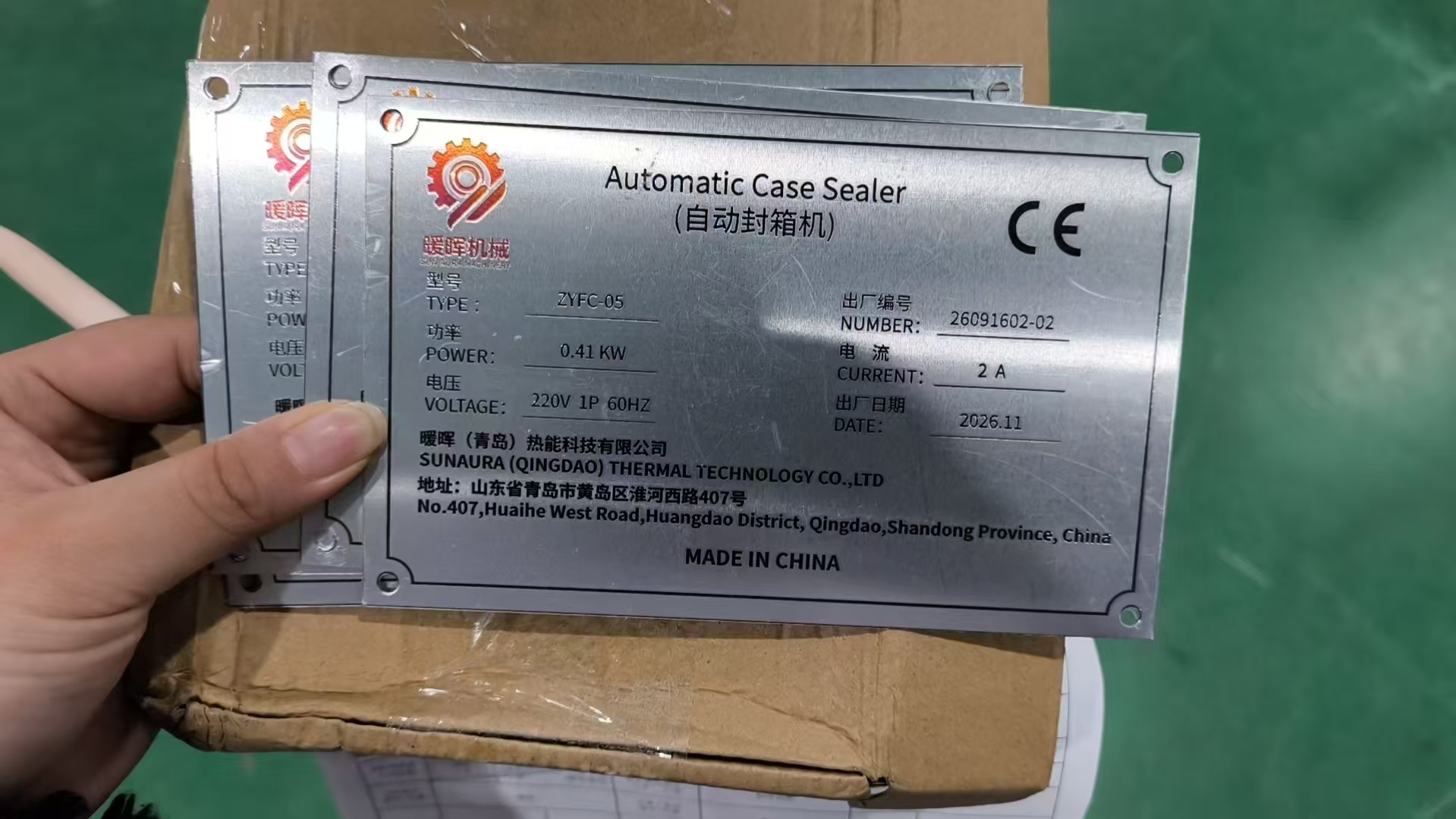
The sealer has to accept the same carton envelope as the erector, with the folding arms and tape head adjusted for box height and width. The model used here is the ZYFC-05, and its nameplate records the electrical facts rather than a marketing specification. The video below shows the running sequence that the nameplate machine is part of.
Voltage, phase and frequency: the detail that blocks installation
The single most common reason a machine cannot be commissioned on arrival is a mismatch between the nameplate supply and the site. The Brazil lines are built for 220V single-phase 60 Hz, confirmed against the customer’s site before fabrication. Frequency matters as well as voltage: a motor wound for 50 Hz run on 60 Hz behaves differently, and the reverse is worse. The decision between single-phase and three-phase depends on the motor size and the site supply; smaller stations like this sealer run on single phase, while larger drives usually need three. We lock these facts in writing at the start of the order because rewinding or converting a motor after delivery is slow and avoidable.
Using the customer’s confirmation as the acceptance standard
The factory acceptance test is where the specification on paper meets the running machine. The Brazil customer could not be present in person, so the test videos and the written confirmation served the same purpose. The points below are what a buyer should ask to see, whether attending in person or reviewing video.
- The erector running a full stack of the real blanks without double-feeding, with square boxes and centered bottom tape.
- Cartons tracking straight through the conveyor with the guide rails set to the actual width.
- A batch through the sealer, not a single box, with every top flap tucked and the tape bonded and centered.
- The interlocks and emergency stops demonstrated, and the measured draw matching the nameplate.
- A recorded changeover between formats if the line will run more than one carton size, timed rather than estimated.
Changeover and the multi-SKU penalty
Every carton format on the line means a changeover: the erector magazine and forming head, the conveyor guide rails, and the sealer folding arms and tape width are all reset. The decision is not whether changeovers are possible but how many happen per shift and how long each takes. A line that changes format once or twice a day absorbs the reset without trouble; a line that changes five or six times a day spends a meaningful share of the shift being adjusted rather than sealing boxes. Buyers in that position should either group formats to cut the number of switches or consider a second line, which is part of why the Brazil order split the work across two machines.
Total cost and the payback logic
The payback is calculated mainly against the labor the line removes. The manual process needs several people across erecting, loading and sealing; the configured line needs one operator at the loading point. Take the loaded cost of the posts removed over a year, set against the machine price, installation, tape and power, and the simple payback is the machine cost divided by the annual saving. Two further entries belong in the calculation even though they are harder to quote: the cost of rejected or reworked boxes under the inconsistent manual process, and the cost of line stoppages when a manual step falls behind. Buyers who count only the machine price and ignore the labor and rework entries tend to under-build and re-open the same problem a year later.
Line balancing and where the bottleneck sits
A linked line only moves at the speed of its slowest station, so the first step in balancing is to identify which station that is. On these lines the manual loading point is deliberately the bottleneck, with both the erector and the sealer capable of running faster. The stations in front of the bottleneck feed it, and the stations behind accept from it; the conveyor buffer keeps the bottleneck supplied and prevents it from waiting. If an automatic loading head is added later, the bottleneck moves, and the erector or sealer cycle becomes the new limit, which is why both were sized with headroom from the start.
The arithmetic is straightforward. Convert each station’s cycle into units per minute, take the smallest figure as the line rate, and then compare that to the shift target. A line is balanced when no station is dramatically over-specified relative to the bottleneck and the buffer between stations is large enough to absorb the short pauses. Over-sizing every station to the same peak figure raises the price without raising output, because the bottleneck still sets the real pace.
Comparing quotations and assessing the supplier
Two quotations for what looks like the same line are rarely built to the same specification. The comparison should be made line by line rather than on the total. Confirm the carton envelope each machine accepts, the guarding and interlock standard, whether the control panel and HMI are included, the voltage and frequency the machine is wound for, and the documentation that ships with it. A lower quotation that omits the interlocked guarding, the real blanks test or the CE declaration is not the same machine at a lower price; it transfers cost and risk to the buyer at commissioning.
The supplier assessment runs alongside the price. Ask for the factory test on the actual blanks, the parts list keyed to the serial number, and the response route for support after delivery. The written confirmation in the Brazil order, where the customer reviewed the running video before crating, is the kind of acceptance evidence that separates a supplier willing to be measured from one asking for trust on a nameplate. Spares and after-sales terms should be agreed before the order rather than negotiated after a fault, because lead time on a single part can stop a complete line.
When not to buy this configuration
A neutral list of the cases where this line is the wrong answer is part of the selection. Do not specify it if the volume is low enough that a person feeding a semi-automatic machine is not a full-time cost; the automatic erector will not earn its price. Do not specify a manual loading station if a single SKU runs at high volume all shift, because an automatic loading head is the step that actually removes the labor. Do not specify one line if formats change many times through the day, since the changeover time will dominate. And do not commit until the site voltage and frequency are confirmed, because a supply mismatch stops the project at commissioning. Stating these boundaries is how the right-sized line is distinguished from the largest one.
Questions buyers ask before committing
Can I start with the manual loading station and automate it later? Yes, if the line is built for it from the start. The conveyor and sealer have to be sized to the future head, and the control panel needs the spare capacity to add it; retrofitting a line that was not designed for the upgrade is more expensive than specifying it upfront. The Brazil lines were built this way deliberately.
Do I need a three-phase supply? It depends on the motor size. Small stations such as the ZYFC-05 run on single phase; larger drives and automatic loading heads generally require three. The supply is confirmed against the nameplate before the machine is wound, so the site electrician should be part of the early discussion rather than brought in at delivery.
How do I know the machine will work with my boxes? The factory test uses the real blanks and runs a batch, not a single box. Double-feeding at the erector, skew on the conveyor and tape quality at the sealer are all checked on that material, and the test video is the evidence. A machine tested only on a generic sample cannot be assumed to run your board.
Should I buy one faster line or two standard lines? The answer follows the floor plan and the changeover count. Two lines protect against a single fault stopping the whole operation and shorten handling distance, while one faster line suits a single area with a dominant SKU. The Brazil customer’s two areas and mixed formats made the split the lower-risk choice.
The information we need before quoting
- Carton dimensions across every format, with board grade and flute profile.
- Target sealed cartons per shift and the number of working minutes, not a peak figure.
- How many formats and how often the line changes between them.
- Site voltage, phase and frequency, and the available floor space with access clearance.
- The product being packed and whether contents must be checked before the box closes.
With those inputs we can return a dimensioned layout, a fixed station list and the acceptance points, and run the same factory test on your blanks that the Brazil customer reviewed. Send the details through the contact page, or compare the delivery detail in the companion article on the build and sign-off.