What robotic palletizer cost actually covers
Asking for a robotic palletizer cost quote without separating machine price from installation, tooling and operating expense produces a number that does not match the final invoice. This breakdown works through the full total cost of ownership over a 7–10 year horizon: the machine bands in USD, the line items that sit outside the machine price, the annual operating cost in power, air and maintenance, the manual palletizing labor baseline the robot replaces, and a worked payback calculation with the assumptions stated on the table. All figures are planning bands for comparison at budget stage; exact pricing is locked at FAT against the real carton, pallet, pattern and site data.
The cost stack has four layers. The first is the cell itself: arm, gripper, controllers, infeed and discharge conveyors, guarding and the base frame. The second is the route to site: freight, crating, rigging, site prep and installation. The third is commissioning: site acceptance tests, pattern trials, recipe setup and operator training. The fourth is the running cost across the years: electricity, compressed air, preventive maintenance, wear parts and the labor that still attends the cell. A quote that shows only the first layer understates ownership cost, and a payback built only on machine price overstates the return.
Machine price bands by cell type (USD, EXW, indicative)
The bands below group palletizer cells by the arm class and layout they use. They are machine-only EXW planning ranges, before freight, installation and SAT. Payload, reach, cycle time and cases-per-minute figures are the engineering bands the machine class typically delivers; they are matched to the product data at layout stage.
| Cell type | Machine price band (USD, EXW) | Typical fit | Rate and payload band |
|---|---|---|---|
| Entry collaborative robot cell | $35,000–$55,000 | Light cartons, low-rate lines, fenceless or light guarding | Payload 10–25 kg, common 16–20 kg; 8–12 cases/min ceiling, 6–8 cycles/min |
| Standard articulated robot cell | $55,000–$90,000 | Cartons, bags and bundles at moderate-to-high single-station rates | 120 kg class; reach 2.4–3.2 m; 700–900 picks/h, cycle 3.5–6 s |
| Dual-station articulated cell | $85,000–$130,000 | Continuous feed, two concurrent pallets, two-shift running | 120 kg or 180 kg class; two build positions; 1.6–1.9x single-station output at the same pick rate |
| Conventional layer palletizer | $70,000–$120,000 | Steady single-SKU high throughput, narrow product profile | 1–3 layers/min; high-level versions need 4.5 m+ ceiling and a mezzanine |
| Gantry / Cartesian system | $80,000–$140,000 | Fixed layout, rigid Z axis, low residual motion, simple guarding envelope | 3–4 m travel; 10–25 cases/min depending on axis count |
Within each band the price moves with payload class, reach, gripper technology and conveyor scope. A 180 kg arm with frame tool for bulk bags sits above the 120 kg carton configuration in the same family. Vacuum foam pads, clamp frames and fork-style tooling each carry their own cost, and a cell that must feed two lanes or discharge to an automatic wrapper adds conveyor and control work that a single manual-exchange cell does not carry.
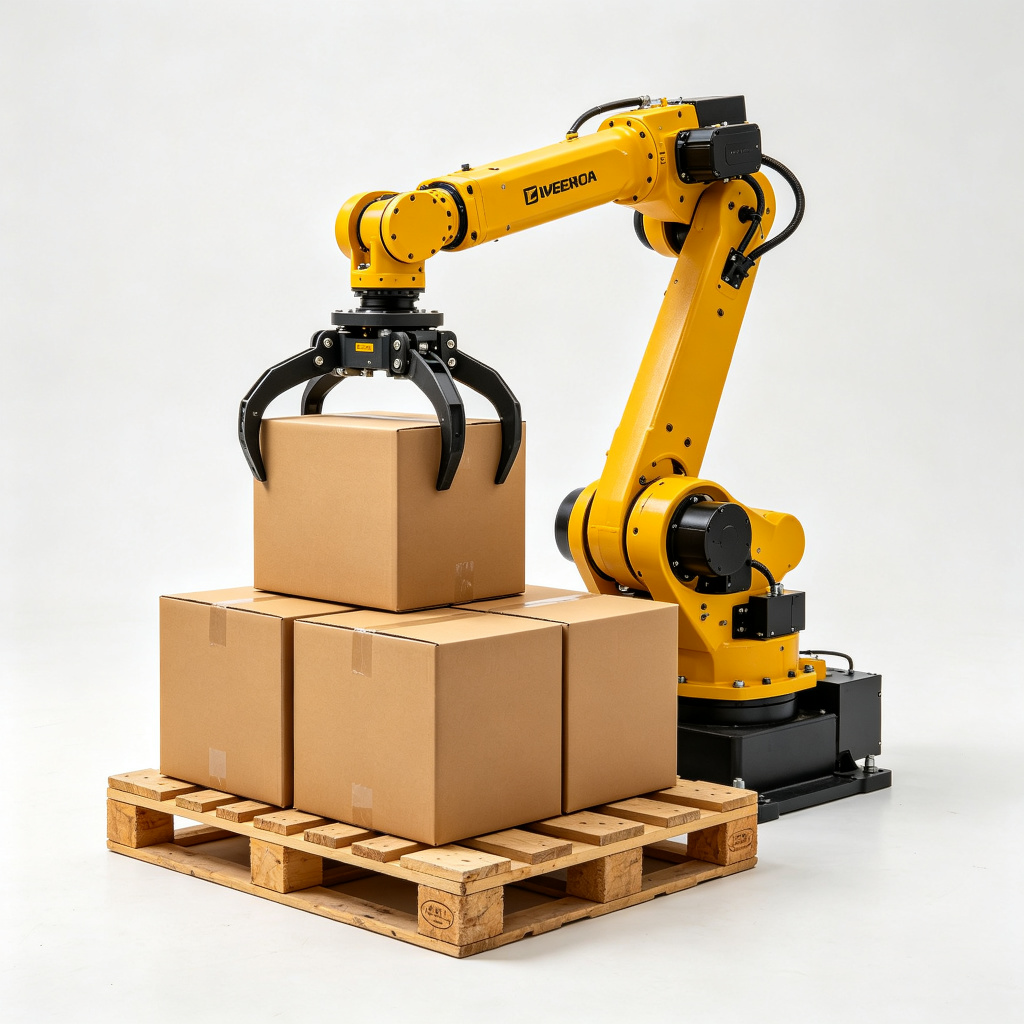
The four-axis robotic palletizer in the 120 kg class sits in the standard articulated band and covers most general carton and bag duties. The dual-station robotic palletizer moves into the higher band because it carries two build positions, a second conveyor and station fixtures, and queue logic that tracks both pallets. The collaborative robot palletizer occupies the entry band for light payloads, and the compact carton palletizer keeps a small scope for light-to-medium carton rates. The full family is listed in the palletizers product index.
Line items outside the machine price
Freight, installation and site acceptance testing typically add 12–22% on top of the machine price, depending on cell size, travel distance, site condition and how much existing conveyor and controls the line already has. The bundle breaks down into the items below. Each should appear as its own line in the budget rather than being absorbed into a single installation lump, because scope changes here are where quotes diverge most.
| Line item | What it covers | Planning note |
|---|---|---|
| Inbound freight and crating | Road or sea freight, export crating, insurance, inland drayage to the plant | Long-distance and cross-border shipments move this toward the upper share of the 12–22% bundle |
| Site prep | Electrical supply drop, compressed air connection, foundation or anchoring, floor repair, guarding footprint clearance | Older sites may need a panel upgrade or air dryer; these land before the rigging crew arrives |
| Rigging and installation | Uncrating, setting the frame, bolting down, connecting conveyors, air and electrical ties, mechanical alignment | Double-story or mezzanine cells add rigging time that floor-level cells do not |
| SAT and pattern trials | Site acceptance test, real case and pallet runs, pattern verification, cycle time measurement, discharge and wrapper interface check | Patterns that need interleaved sheets or frames take extra trial time |
| Training and handover | Operator run-through, recipe selection, basic fault response, maintenance walkthrough, documentation | Budget a second refresh session after the first production month if staffing turns over |
| Gripper and spare parts | Vacuum pads or cups, seal kit, filters, quick-change parts, first-year wear stock | Tooling is sometimes quoted separately from the machine; confirm which side of the line item it sits on |
| Guarding and safety devices | Fencing, light curtains, interlocks, e-stops, safety controller, muting as the risk assessment requires | Guard scope follows the safety assessment; cobot power-and-force cells can use light guarding, heavy arms need fenced envelopes |
| Integration | Conveyor handshakes, PLC or cell controller signals, lane divert, MES or count feedback, wrapper synchronization | A standalone cell needs fewer signals than one embedded in a pack-and-wrap line |
Read the 12–22% range as a bundle, not a fixed surcharge. A standard articulated cell shipped a short distance to a prepared concrete pad, with existing air and power and a simple conveyor tie-in, can sit near 12%. A dual-station or gantry cell going into an older building that needs panel work, air treatment, a mezzanine route and wrapper integration can reach 22% before any optional tooling. Always ask the supplier which line items are included in the EXW machine price and which are quoted separately; a low machine number with a bare commissioning scope catches up at site.
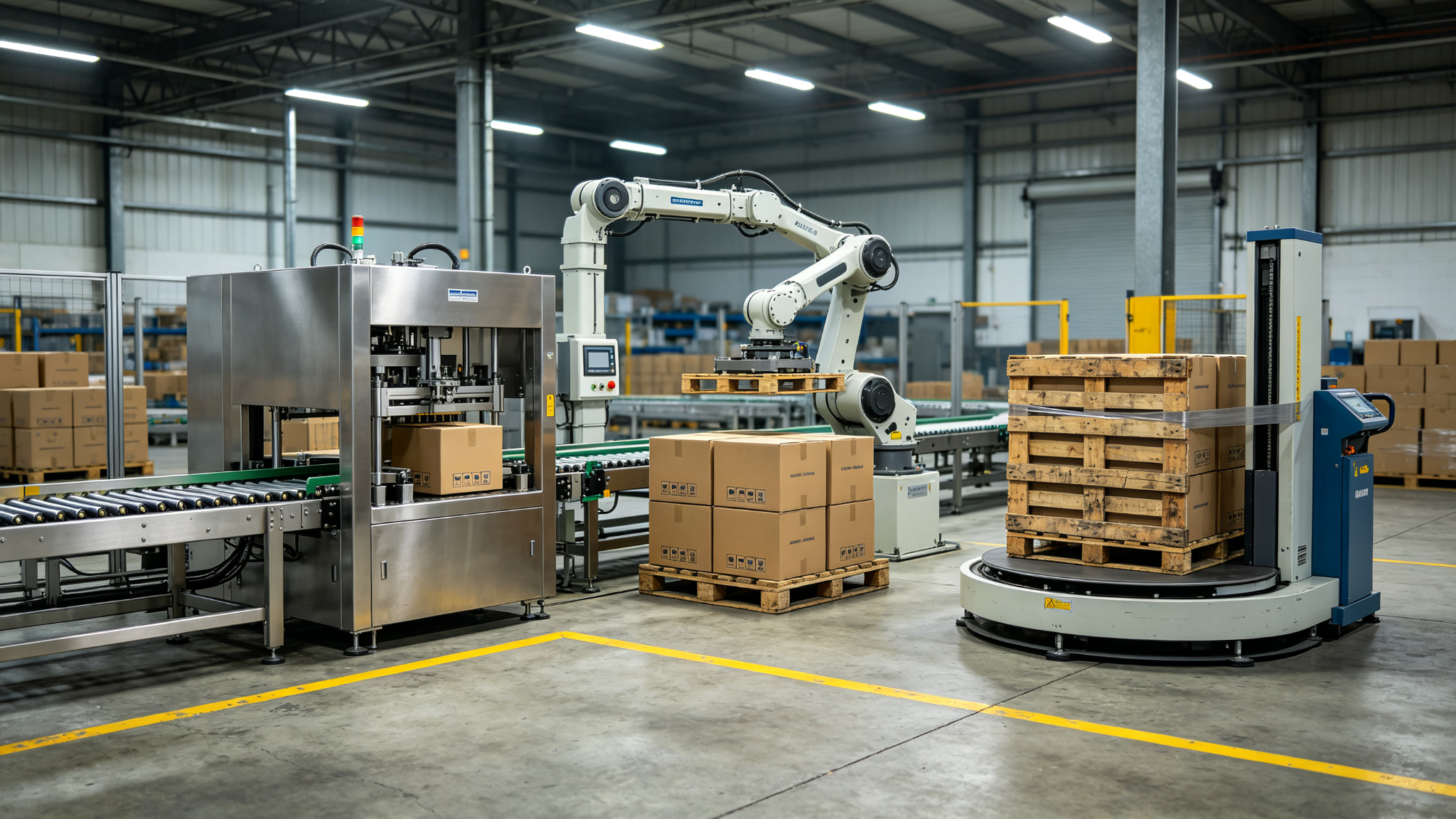
Annual operating cost: power, air, maintenance and wear
After commissioning, the cell runs on four recurring cost streams. These are small next to the labor they replace, but they belong in the TCO model because they recur every year and rise with running hours.
| Opex stream | Basis and planning figures | Annual planning note |
|---|---|---|
| Electricity | Arm and controller draw a few kWh in operation; a typical cell averages roughly 3–6 kWh depending on arm class and duty cycle | Compute kWh per hour times operating hours times local tariff; a 4 kWh cell at 8 h/day, 250 days uses about 8,000 kWh per year |
| Compressed air | Pneumatic vacuum grippers draw roughly 40–80 Nl/min average at 5–6 bar supply | Air cost follows consumed volume; leaks and worn pads raise consumption between maintenance visits |
| Preventive maintenance | Scheduled inspection, grease or lubrication per arm interval, belt and chain checks, sensor and interlock testing | Standalone cells carry a lower maintenance load than cells embedded in a two-shift line |
| Wear and consumables | Suction cups and foam pads, seals, filters, conveyor wear parts, occasional contact parts on the gripper | Volume and packaging condition drive pad life; dusty or abrasive board shortens replacement intervals |
Two further operating costs are easy to leave out. One is floor space: the cell occupies a bay that might otherwise hold staging or packing, and that space has an internal cost even when no rent invoice arrives. The other is the retained labor around the cell. A palletizer does not remove the whole end-of-line crew. Someone supplies empty pallets, wraps or checks loads, handles exceptions, refills consumables and covers breaks. The model should count that retained attendance as an ongoing labor line, not assume the cell runs fully unattended.
The manual palletizing labor baseline
Payback starts from what the manual method costs today, and the baseline deserves the same care as the robot quote. Manual palletizing runs 1–2 workers per palletizing station, stacking at roughly 150–300 cases per person-hour depending on case weight, pack style and layer pattern. Repeated lifts above the ergonomic limit of about 12–15 kg drive strain, turnover and injury claims, and those costs show up in workers’ compensation, relief coverage and training replacements rather than in the wage line alone.
- Throughput per person: 150–300 cases/person-hour; light, easy cartons sit near the top, heavy bags and awkward bundles near the bottom.
- Headcount reality: stations rarely run on one named body. Relief breaks, absences and end-of-line exceptions pull in a second pair of hands, so plan on 1.2–1.5 FTE per manual station in steady operation.
- Loaded labor cost: use the fully loaded hourly rate — wage, benefits, payroll burden, supervision and turnover cost — not the bare wage. A bare wage understates the annual saving and stretches the payback picture the wrong way.
- Ergonomic and quality costs: misstacked layers, damaged corner boards, inconsistent patterns and reworked loads are part of the manual baseline, even where they are hard to invoice.
Count the hours the line actually runs. A one-shift line spreads the manual labor across 8 hours; a two-shift line doubles both the headcount and the annual saving the robot can capture. Seasonal peaks, weekend runs and overtime shifts change the baseline sharply, and the payback model should use the recurring shift pattern rather than the holiday-week exception.
Worked payback calculations, assumptions stated
Three scenarios follow. Each lists its assumptions before the math, so the numbers can be swapped for local rates. All use a loaded labor rate of $24/h per FTE, 250 working days per year, an electricity tariff of $0.12/kWh and a compressed air cost of $0.025 per cubic meter. These are planning assumptions for the model, not supplier quotes; substitute your own plant rates and the structure still holds.
Scenario 1: entry cobot on a one-shift carton line
Assumptions: 220 cases/h, one 8-hour shift, 250 days/year. Manual baseline needs 1.5 FTE to cover the station with relief. The cobot cell displaces 1.2 FTE and retains 0.3 FTE for pallet supply and QC. Machine band $35,000–$55,000, midpoint $45,000; freight, install and SAT at 18% of machine = $8,100; gripper and first spare stock $5,000. Installed capital ≈ $58,100, planning range $43,000–$66,000 once band extremes and tooling are included.
Annual saving: displaced labor = 1.2 FTE × 8 h × 250 days × $24/h = $57,600 per year. Annual operating cost: power at 4 kWh × 8 h × 250 days = 8,000 kWh × $0.12 = $960; air at 60 Nl/min over 480 min/day × 250 days = 7,200 m³ × $0.025 = $180; maintenance and wear parts $1,800. Total annual opex ≈ $2,940. Net annual benefit = $57,600 − $2,940 = $54,660, or about $4,555 per month.
Payback: $58,100 installed ÷ $4,555 monthly net benefit ≈ 12.8 months. Across the machine and tooling band, payback lands roughly 10–15 months. If the local loaded labor rate is lower, or the line runs fewer days, each month of payback stretches; if damage and rework costs are added to the manual baseline, it shortens.
Scenario 2: dual-station cell on a two-shift line
Assumptions: 600 cases/h, two 8-hour shifts (16 h/day), 250 days/year. Manual baseline at 220 cases/person-hour needs about 3 FTE per shift, 6 FTE across the day. The dual-station cell displaces 4 FTE and retains 2 FTE (one per shift) for pallet supply, QC and exception handling. Machine band $85,000–$130,000, midpoint $107,500; freight, install and SAT at 18% = $19,350; dual gripper set, fixtures and first spare stock $12,000. Installed capital ≈ $138,850, planning range about $120,000–$155,000 across the band.
Annual saving: displaced labor = 4 FTE × 16 h × 250 days × $24/h = $384,000 per year. Annual operating cost: power at 6 kWh × 16 h × 250 days = 24,000 kWh × $0.12 = $2,880; air at 70 Nl/min over 960 min/day × 250 days = 16,800 m³ × $0.025 = $420; maintenance and wear parts $4,500. Total annual opex ≈ $7,800. Net annual benefit = $384,000 − $7,800 = $376,200, or about $31,350 per month.
Payback: $138,850 installed ÷ $31,350 monthly net benefit ≈ 4.4 months. Across the band, payback runs roughly 4–7 months. The two-shift hours are what make this work: the same cell on one shift would earn back half the annual labor saving and pay back near double the months. The positioning reasons a dual station suits this profile are laid out in the note on the SunAura dual-station robotic palletizer.
Scenario 3: low-volume line where cash payback fails
Assumptions: 120 cases/h, one 8-hour shift, 250 days/year. Manual baseline about 0.8 FTE with light relief. Even an entry cell displaces only 0.5 FTE after retained attendance. Gross labor saving = 0.5 × 8 × 250 × $24 = $24,000 per year. Annual opex ≈ $2,500, leaving a net benefit of about $21,500, or $1,790 per month. Installed entry cell $43,000–$55,000 gives a payback near 24–31 months on cash alone.
At a lower local labor rate, a shorter year or heavier retained attendance, that stretches past a 30–36 month hurdle. Ergonomic relief, reduced damaged stock or a planned labor shortage may still justify the purchase, but the cash payback alone does not clear a typical two-year threshold. This scenario is the reason the baseline headcount and shift count are collected before the machine band is chosen rather than after.
Costs buyers forget to put on the sheet
- Changeover downtime: each pattern or SKU switch pauses auto-run for recipe selection, gripper check and first-layer verification. Frequent short runs raise the lost-time share even where the picks-per-hour rating looks strong.
- Damage and rework: manual misstacks and dropped cases have a cost; conversely a poorly tuned robot pattern can crush or overhang loads. Count a trial and tuning budget at SAT.
- Utility upgrades: a power panel increase, air dryer, filter bank or floor repair can exceed the gripper price if the site was not built for automation.
- Spare parts stocking: cups, seals and filters should sit on the shelf, not be ordered when they fail; emergency downtime costs more than the consumable.
- Training turnover: if operators rotate through the role, a one-time handover fades into repeat faults and slow changeovers. Budget refresh training.
- Future relocation or line change: a fixed gantry frame moves less easily than an articulated arm; if the line may be rebalanced in three years, that flexibility carries a cost either way.
- Guarding revision: if the risk assessment calls for fencing, interlocks or light curtains that the base quote did not scope, those land as change orders after order, not before.
Reading the bands at FAT and comparing quotes
The planning bands narrow once the real data is on the table. At quote stage, request each supplier to split machine, tooling, freight, install, SAT, guarding and integration onto separate lines, and to state what is excluded. At FAT, verify cycle time against the real pattern, confirm the measured picks per hour match the budgeted rate, check air consumption on the actual gripper, and sign off the damage rate on real cases. A machine that meets its rated cycle on empty boxes but damages the production carton has not passed the acceptance test that matters for TCO.
Compare cells over the same horizon. A cheaper entry cell that cannot hold the required rate, or a dual-station layout bought for a one-shift slack line, both distort the TCO picture. Match the machine class to the load: light cartons to the cobot or compact cell, medium cartons and bags to the 120 kg articulated cell, continuous two-pallet work to the dual-station layout. The mechanical basis for those rate and payload limits is in the note on how a robotic palletizer works: axes, payload, reach and cycle time. Guarding scope and its cost follow the rules in the note on palletizer safety and CE compliance, and the placement logic for continuous mixed-pallet work is covered in the dual-station positioning note. The machine family and configurations are in the palletizers product index.
Five-year TCO: cell versus the manual method
The payback months answer the cash question; the five-year total answers the ownership question. The table below carries Scenarios 1 and 2 across five years on the same assumptions: $24/h loaded labor, 250 days, $0.12/kWh, $0.025/m³ air, and opex held flat for planning. Wage growth in the manual column is not modeled here; in most plants labor costs rise year over year while the robot’s power, air and maintenance lines move more slowly, so the five-year gap tends to widen rather than shrink after year one.
| Cost element over 5 years | Scenario 1: entry cobot, one shift | Scenario 2: dual-station, two shifts |
|---|---|---|
| Installed capital (machine + install/SAT + tooling) | $58,100 | $138,850 |
| Annual operating cost (power, air, maintenance, wear) | $2,940/year | $7,800/year |
| Five-year robot ownership cost | ≈ $72,800 | ≈ $177,850 |
| Manual labor over 5 years (baseline crew, no wage growth) | ≈ $360,000 (1.5 FTE) | ≈ $2,880,000 (6 FTE) |
| Five-year difference before quality and ergonomic factors | ≈ $287,000 lower with the cell | ≈ $2.7 million lower with the cell |
Read that difference as gross ownership delta, not profit. It does not credit reduced damaged stock, lower injury and turnover, steadier pattern quality or the ability to run peaks without overtime; those factors widen the delta further. It also does not deduct the retained FTE around the cell, which the scenarios already netted out of the displaced-labor saving. If the manual baseline carries overtime at peak season, add those overtime hours to the manual column before finalizing the comparison.
What moves the price inside a band
A band is a range, not a fixed price. The items below pull a cell toward the upper or lower end of its planning range, and each should be identified in the quote so the comparison between suppliers matches on the same scope.
- Payload class: a 180 kg arm with frame tool for bulk bags costs more than a 120 kg carton configuration in the same family, and the gripper weight comes off the net payload before the load is sized.
- Reach and layout: a reach that spans two stations or a wide infeed adds arm size and pedestal geometry; a tight single-station envelope stays toward the lower end.
- Gripper technology: a single vacuum pad is the lightest tooling; foam pads for uneven cases, clamp frames for bags and fork frames for bundles each add mechanical cost and their own wear stock.
- Conveyor scope: infeed merge, lane divert, discharge roller, chain transfer and wrapper handoff conveyors are quoted separately from the robot cell, and a full connected block carries more steel than a standalone pick-and-place.
- Guarding level: a fenced envelope with interlocks and light curtains costs more than the light guarding allowed under ISO/TS 15066 force-and-power limits on a cobot; the risk assessment sets which scope applies.
- Controls and integration: a standalone recipe controller is cheaper than a cell tied into line PLC signals, lane logic, MES counts and synchronized wrapper discharge.
- Environment rating: washdown, dust-tight or heat-rated construction for harsh packing rooms adds enclosure and seal cost over a standard dry-room cell.
- Spare parts and training: a first-year wear kit and two training days sit below the line in some quotes and inside it in others; confirm before comparing totals.
Site conditions that add cost before the robot arrives
The site walk-down catches the items a desktop quote cannot see. Check the incoming electrical supply: panel capacity, conduit route and whether the cell needs its own disconnect and safety circuit. Check the air supply: pressure held at 5–6 bar, dryer and filter condition, and whether the plant’s compressor can cover the added 40–80 Nl/min average draw without cycling at peak. Check the floor: flatness for the pedestal and conveyor rails, load capacity for a mezzanine-mounted high-level machine, and anchoring conditions. Check access: door and aisle width for rigging the arm and frame in, and ceiling height for the high-level layout that needs roughly 4.5 m or more.
Conditions that look minor on a tour become change orders at installation. A missing dryer lets moisture into vacuum cups and shortens pad life; an undersized panel delays energizing the cell; a floor that cannot take anchor loads means a plate or foundation pour the schedule did not allow for. Listing these in the budget stage keeps them inside the 12–22% install bundle rather than outside it as surprises.
Put a number on each condition before the order is signed. A dedicated disconnect and safety circuit typically lands at $800–$2,500 depending on panel distance; a compressed-air dryer with a 5-micron filter runs $600–$1,800; floor leveling or a reinforced anchor plate adds $1,000–$4,000 where the slab sits out of tolerance; rigging through a narrow aisle with a forklift or crane call-out sits at $500–$1,500 per day. On a cell quoted at $70,000, these items together rarely exceed $6,000, but they move the installed total off the brochure number and onto the number the finance committee actually approves. Ask the supplier to price the site-correction work as a separate line instead of folding it into a generic installation fee, so each item can be checked against the walk-down notes and dropped if the existing utility already covers it.
Questions to take into the quote review
- What is included in the machine price, and what is quoted separately as tooling, conveyor, guarding or integration?
- What freight, rigging, site prep, SAT and training line items make up the install bundle, and what share of machine price does that total reach?
- What measured cycle time and picks-per-hour come out of the pattern trial on real cases, not empty test boxes?
- What annual power, air, maintenance and consumables estimate does the supplier give for the selected gripper and duty cycle?
- What spare parts are stocked on site, what is the lead time for replacement cups or seals, and what does the maintenance interval schedule cover?
- What retained attendance does the line need after commissioning, and which exceptions still require a person at the cell?
- What is the warranty period, what does it cover, and what response time applies for a fault that stops the line?
Bottom line on the budget sheet
Robotic palletizer cost splits into an installed capital number and a small recurring opex number. Machine bands run $35,000–$55,000 for entry cobot cells, $55,000–$90,000 for standard articulated cells, $85,000–$130,000 for dual-station layouts, $70,000–$120,000 for conventional layer machines and $80,000–$140,000 for gantry systems, with freight, install and SAT adding 12–22% on top. Payback is driven mainly by displaced FTE across running hours, not by the machine price alone. Collect the manual baseline headcount, shift count, loaded labor rate, case weight and peak cases per hour before choosing a band; the worked scenarios above show how the same structure answers for a light one-shift line, a heavy two-shift line and a low-volume operation where the cash case does not close.