
Flow Wrapper Infeed Collation, Product Spacing and Upstream Synchronization: Keeping Products on Pitch for a Clean Seal and Steady Output
A flow wrapper can only seal between products when each item reaches the former on the correct pitch, one per cycle. When products arrive too close together, the end seal cuts through a pack or lands between two items; when they arrive too far apart or off-center, bags run loose, the jaw misses the gap, and the line stacks rejects even though the wrapper itself is set correctly. The infeed section and its synchronization with the upstream feeder, weigher or robot decide whether the wrapper runs at target speed or spends the shift clearing jams. This guide covers product pitch, the collation methods that space items onto that pitch, the timing signals that tie upstream discharge to the wrapper cycle, and the faults traced to spacing rather than to the seal unit.
The reference machines are the horizontal pillow packaging machines in the SunAura range. Pitch numbers and cycle times below are planning values; the real spacing on a line depends on product length, output target, film bag length and the upstream equipment feeding the machine.
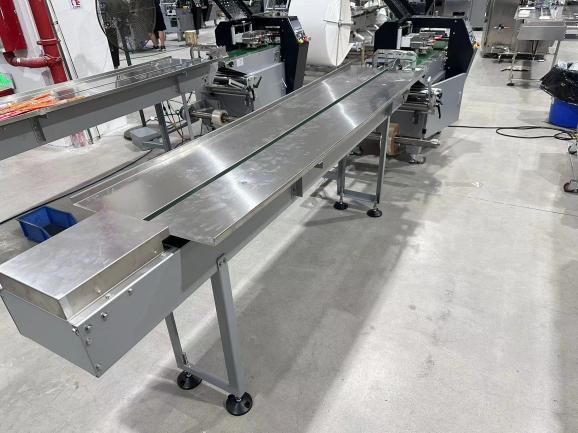
Product Pitch, Cycle Time and Belt Speed
Pitch is the centre-to-centre distance between two consecutive products on the infeed. The wrapper cycles one bag per product, so the pitch and the bag length are tied together: the feed roller advances one bag length per cycle, and the product sits in that bag with a gap of film at each end. The upstream equipment must place products at the same pitch the wrapper expects.
For a target output of R pieces per minute, the cycle time for one product is:
Cycle time per piece = 60 / R seconds.
The infeed belt speed and product pitch then relate as:
Pitch (mm) = belt speed (mm/min) / R (pcs/min).
Worked example: a line targets 100 pcs/min with a 120 mm product and a 135 mm bag length. Cycle time = 60 / 100 = 0.6 s per piece. If the infeed runs at 60 m/min (60,000 mm/min), pitch = 60,000 / 100 = 600 mm, which leaves a large product gap; the belt can slow toward the pitch matching the bag length instead. The bag length sets how much film each cycle feeds, and the infeed must hold products at a pitch that matches that rhythm so the end jaws close in the gap between packs rather than on the product.
| Output target | Cycle time per piece | Typical pitch for a 135 mm bag | What the infeed must hold |
|---|---|---|---|
| 60 pcs/min | 1.00 s | ~135–150 mm | Looser pitch, easier spacing, slower belt |
| 100 pcs/min | 0.60 s | ~135 mm | One product per 0.6 s cycle, steady gap |
| 120 pcs/min | 0.50 s | ~135 mm | Tight spacing; collation must prevent double feeds |
| 150 pcs/min | 0.40 s | ~135 mm | High-rate feed; robot or geared collation often needed |
Pitch is planned from the bag length and product length, not chosen after the machine runs. If products bunch to a pitch shorter than the bag length, two items can sit under one jaw cycle; if the pitch drifts longer, the jaw closes on empty film and leaves a half-sealed end. The bag-length and feed-ratio side of this relationship is covered in the companion guide on bag length, product pitch and feed ratio.
What the Infeed Section Does
The infeed between the upstream discharge and the former has three jobs: present the product square to the travel direction, hold it on the planned pitch, and move it into the former throat at belt speed matched to the wrapper feed. Guides along the belt center the pack; the belt carries it forward; any spacing device between discharge and belt separates items that arrive in a cluster.
- Squaring: side guides or squared wheels turn a slightly rotated pack so its length runs along the belt before the former. A tilted tray presents a tilted cross-section to the former and can rub one edge.
- Spacing: products are separated to the planned pitch so only one item occupies each cycle. This can come from the upstream feeder itself, a collation device on the infeed, or a robot placing items one by one.
- Transfer: the pack leaves the infeed belt onto the former belt at matching speed; a speed step between belts drags or pushes the product and changes the gap to the next item.
Collation Methods by Product and Output
Manual or belt feed for low and mid output
At lower output, operators place products onto an infeed belt by hand, and belt spacing keeps items apart. This suits short runs, irregular packs or lines where output sits below roughly 60–80 pcs/min. The limit is operator consistency: spacing drifts when placement speeds up or slows down, and double feeds reach the former when two items are set down close together. Side guides and a marked pitch on the belt help, but the method depends on the operator.
Feeder and weigher discharge for counted or weighed packs
Where a multihead weigher portions snacks, granules or pieces, each weigh bucket discharges one portion onto the infeed. The discharge timing is set so a portion lands on the belt on the wrapper pitch, and the belt carries it forward without stacking the next portion. Weigher-to-wrapper timing and line balancing are covered in the multihead portioning feeder integration guide. If the weigher discharges faster than the wrapper cycle, portions queue on the belt and bunch; if it discharges slower, the wrapper runs on empty cycles.
Robot loading for high output and rigid packs
At high rates or with trays that must be placed square and upright, a delta or articulated robot picks products from a feeder and places them onto the infeed at the wrapper pitch. The robot cycle is triggered from the wrapper index so each placement lands on the correct gap. The comparison between a delta robot and a six-axis arm for this loading job is documented in the delta robot vs six-axis arm loading comparison. Robot loading removes the manual spacing error and keeps trays upright, but its cycle must be matched to the wrapper output, or it becomes the line bottleneck.
Mechanical collation devices
Screw feeders, push bars or rotary collation wheels separate products that arrive in a stream. A screw feeder with a pitched spiral advances items to a set gap; a push bar lifts and releases items one per cycle; a rotary wheel indexes trays into the pitch. These devices suit regular shapes at steady rates and are sized to the product length and target pitch. Irregular or soft packs that stick or roll generally do not sort cleanly on a screw feeder and need belt or robot placement instead.
Synchronizing Upstream Discharge to the Wrapper Cycle
The wrapper runs a fixed cycle: feed roller advances a bag length, jaws close on the gap, discharge moves the bag out. Upstream equipment must discharge so each product reaches the former at the moment the cycle has a bag ready for it. This synchronization works through a trigger signal or a shared speed reference: the wrapper sends a cycle pulse or runs the infeed and upstream belt from the same encoder speed, so the pitch holds whether the line speeds up or slows down.
- Common speed reference: infeed belt, upstream belt and feed roller follow one speed signal, so changing line speed shifts all sections together and keeps pitch constant.
- Cycle trigger: the weigher or robot waits for the wrapper’s ready signal before discharging the next product, matching placement to each jaw cycle.
- Delay adjustment: the distance from discharge point to former sets a time delay; products travel that distance on the belt, so the trigger leads the former arrival by the belt travel time.
When synchronization is off, the symptom depends on the direction. Upstream discharging too early stacks products on the belt; discharging too late leaves empty cycles and loose bags. A common setup error is setting the discharge delay for the distance from weigher to former but then changing the belt speed without re-checking the travel time, which shifts the product relative to the cycle.
Line Balancing: Match the Slowest Section
Line output is set by the slowest section, not the wrapper. A high-speed wrapper fed by a weigher that portions slower than the target rate will run on empty cycles; a fast feeder into a slower wrapper will queue products into a bunch on the infeed. Balancing means sizing each section to at least the wrapper target, with a small margin, so no section backs up or starves the next. The weigher’s portions-per-minute, the robot’s pick rate, the belt capacity and the wrapper’s cycle are compared against the target output before the line is ordered.
| Section | Capacity check | If it is the bottleneck |
|---|---|---|
| Weigher / feeder | Portions per minute at target product weight | Queues portions on the belt; bunching and double feeds reach the former |
| Robot loader | Picks and places per minute, per cycle reach | Leaves gaps where no product lands; wrapper runs empty cycles |
| Infeed belt | Length enough to hold the collation buffer; speed matched | Too short to smooth discharge pulses; products cluster at the former |
| Wrapper | Jaw cycles per minute for the bag length and product height | Line tops out at wrapper rate; upstream cannot run faster than this |
| Downstream checkweigher / packer | Pieces per minute after the wrapper | Backs bags onto the discharge belt and stalls the wrapper |
Spacing Faults and Where They Lead
| Fault observed | Likely spacing cause | Check and correction |
|---|---|---|
| End seal cuts through a product | Two products on one pitch; double feed | Check collation, guide gap and upstream discharge rate; separate items before the former |
| Jaw closes on empty film, half-sealed end | Product pitch too long; item late to the former | Check discharge delay and belt speed; bring product forward to match the cycle |
| Product arrives tilted and rubs the former | Poor squaring on the infeed | Adjust side guides or squaring wheels; confirm belt carries pack square |
| Products bunch in clusters then gap | Upstream discharge pulses faster than wrapper cycle | Balance feeder/weigher rate to wrapper output; lengthen infeed buffer |
| Loose, baggy pillow with slack film | Pitch inconsistent; product sits off-centre in the bag | Check pitch hold and centering before sealing; not a film-width fault |
| Jams at the former throat | Overlapping or tipped products entering the former | Stop and clear; fix collation and squaring before restarting speed |
Several spacing faults look like seal or former problems at first inspection. Before changing seal temperature or former size, confirm products reach the former one per pitch, square and on time. The seal side of faults is covered in the seal temperature and pressure troubleshooting guide; the former and web side is in the former throat and web width sizing guide.
Infeed Belt Type, Friction and Product Transfer
The belt surface matters as much as its speed. A belt that grips too hard drags a soft pack as it turns; one that slips lets products shift on the surface and lose pitch. Flat smooth belts suit rigid, flat packs that ride on the surface; textured or cleated belts hold products that might slide, and mesh belts allow air or drainage where the product is wet or oily. The belt meets the former belt at a transfer point; if the two speeds differ even slightly, the product accelerates or decelerates at the step, changing the gap to the next item. Set the infeed and former belt speeds to match and check the transfer on a low-speed sample run before raising output.
Guide rails along the belt set the travel lane. Their gap sits slightly wider than the product width so the pack slides without being squeezed, but narrow enough to keep it centered. Rails that are too wide let the pack wander; rails that are too tight rub the sides and can jam a pack that swells between neighbors. For packs that vary in width, the rail gap is set to the widest sample, with squaring guides doing the centering rather than a tight rail.
Missing-Product Detection and Empty Cycles
A missing-product sensor on the infeed watches whether an item is present where the cycle expects one. When a product is absent, the machine can either hold the next film feed or reject the empty bag, depending on the setup. Detection prevents a full bag of film from sealing around no product, which wastes film and can jam the jaws. For weighed or counted portions, the sensor also catches a portion that failed to drop; for robot-fed trays, it catches a missed pick. Sensor position and sensitivity are set during installation so it reads the product without triggering on belt marks or guides.
Persistent missing-product alarms point upstream, not at the sensor itself. If the alarm fires repeatedly, the feeder or robot is dropping items out of pitch; the sensor is reporting the real gap. Clear the sensor window, then check the discharge timing and collation before assuming the detector is faulty.
Worked Line Balance: 120 Pcs/Min Snack Bar
A planned line targets 120 pcs/min for a 120 mm snack bar in a 135 mm bag. The wrapper cycles 120 times per minute, 0.5 s per piece. The multihead weigher must portion at least 120 portions per minute; choosing a weigher rated below that leaves it the bottleneck, while one with margin handles the pulse of drops. The infeed belt holds enough length to absorb the gap between a weigh-bucket discharge and the continuous wrapper cycle; a short belt lets discharge pulses reach the former as clusters. The discharge belt to the checkweigher after the wrapper must also clear 120 bags per minute, or bags back up at the discharge.
| Section | Required at 120 pcs/min target | Check |
|---|---|---|
| Multihead weigher | ≥130 portions/min with margin | Confirm portions per minute at the bar weight |
| Infeed belt | Length to smooth drop pulses; speed matched to 135 mm pitch | Watch for clustering at the former on a trial run |
| Wrapper | 120 jaw cycles/min for 135 mm bag, 16 mm high bar | Confirm jaw capacity for the product height and film |
| Checkweigher / downstream | ≥120 bags/min | Prevent back-up onto the discharge belt |
If any section below the target has no margin, the line cannot reach 120 steady even if the wrapper can run faster. Sizing sections to the slowest required rate with headroom avoids a line that hits target in short bursts and then queues or starves between cycles.
Changeover: Collation and Guides Between SKUs
When the line switches to another product, the infeed is part of the changeover along with former and film. Rail gap adjusts to the new product width; any collating screw, push bar or wheel is changed or re-set to the new product length and pitch; the discharge delay is checked against the new bag length and belt speed. Robot recipes change the pick position and place rate. Record the infeed settings with the SKU recipe so the next changeover repeats the guide gap, pitch and delay rather than re-adjusting from scratch.
Products that share a close width and length can often keep the same rails and collation, with only the recipe pitch and delay recalled. Products that move from a flat bar to a tall tray usually need rail changes, a former swap and a check of whether the existing collation method still holds the tray upright. Plan these steps into the changeover time estimate, since collation work adds to the former and film change.
Common Setup Mistakes on the Infeed
- Setting pitch from bag length without checking product length: the gap at each end must fit the end seal; a pitch shorter than product plus seal gap cuts the pack.
- Changing belt speed without re-checking discharge delay: travel time to the former changes with speed, so the trigger point has to be revisited.
- Over-tight guides: rails that squeeze the product mark packs and slow items on the belt.
- Short infeed buffer: too little belt between a pulsing feeder and the former lets clusters through; lengthen the infeed or smooth the discharge.
- Blaming the seal for a spacing fault: paired packs and off-gap seals trace back to collation; seal temperature will not separate two products on one pitch.
- Ignoring downstream capacity: a downstream machine slower than the wrapper stalls bags at discharge and eventually stops the cycle.
Product Shapes That Demand Careful Spacing
Regular bars and biscuits sit square on a flat belt and tolerate a looser guide. Trays with flanges, soft bundles, products that roll, and items with loose toppings need more controlled spacing: trays must stay upright and flat, rolling products need a shaped guide or cradle, and soft bundles must not be squeezed between neighbors. Where the product changes shape between SKUs, the collation method and guides are part of the changeover, not just the former and film.
Products that vary in length from pack to pack make a fixed pitch harder to hold. If the variation is small, the bag length and gap absorb it; if large, the pack should be made more uniform upstream before reaching the wrapper. A line fed by a weigher that releases uneven counts can also vary the bulk arriving at the former, which is why portion control and spacing are reviewed together at installation.
Setup Checklist for Infeed and Synchronization
- Set target output R and cycle time 60/R; plan the product pitch from bag length and product length.
- Size the infeed belt long enough to smooth upstream discharge pulses and wide enough for the product width with guide clearance.
- Choose the collation method for the product: manual/belt at low rate, weigher discharge for portions, robot for rigid high-rate trays, mechanical feeder for regular shapes.
- Match infeed and former belt speeds; set the discharge delay from the travel distance to the former.
- Check common speed reference or cycle trigger so upstream and wrapper move together when line speed changes.
- Run a low-speed sample: confirm one product per pitch, square on the belt, gap centered for the end seal.
- Ramp speed in steps; watch for bunching, double feeds or empty cycles at each step before increasing further.
- Balance each upstream and downstream section to at least the wrapper target with a small margin.
Matching the Wrapper to the Infeed Layout
The high-speed servo pillow packaging machine pairs with synchronized infeed and robot or weigher feed for high-rate regular packs; the YC600W servo reciprocating packaging machine carries taller trays where the reciprocating jaw follows the product. Mid-rate lines run the medium-speed pillow flow wrapper with belt or feeder infeed. The full model list and the combined feeder-wrapper arrangements are on the pillow packaging machine index and the packaging lines overview.
How Spacing Affects Film Giveaway and Bag Appearance
Pitch consistency shows up in the finished bag as much as in the reject count. A product that sits off-center in its bag leaves a wider film gap at one end and a narrow gap at the other; a pitch that varies bag to bag makes the end seals land unevenly along the pack row. Even when the seal holds, the bags look uneven on the discharge and the giveaway rises because extra film is fed to keep the seal clear of a wandering product. Holding a steady pitch keeps each bag the same length and lets the film run close to the nominal bag length without risking a seal on the product.
Conversely, tightening the pitch to save film is only safe up to the seal-gap minimum. The end seal needs a strip of film beyond the product at each end; if the pitch approaches the product length, the jaw cuts close to the pack edge and seals can nick the product. Set pitch from product length plus the required end gap, then let collation hold it; do not squeeze the pitch below that gap to cut film. Film giveaway and waste reduction are covered in the film waste and giveaway guide, with the spacing side kept separate from film-width and thickness choices.
Spacing Across Mixed SKUs on One Line
When the wrapper switches between pack sizes, the infeed settings change with the former and film. The rail gap widens or narrows to the new product width, the collation device resets to the new product length, and the discharge delay is checked against the new bag length and belt speed. Robot recipes change the pick position and place rate. Record these infeed settings beside the former and film notes in the SKU recipe, so the changeover repeats the guide gap, pitch and delay rather than being re-adjusted from memory. A line that shares collation equipment across several shapes should be checked after each changeover for double feeds and off-pitch bags before the run reaches full speed.
Summary
The wrapper seals cleanly only when products reach the former one per cycle, square and on the planned pitch. Pitch follows output and bag length: cycle time is 60 over pieces per minute, and pitch is belt speed divided by output. Collation holds that pitch by manual/belt placement, weigher discharge, robot loading or a mechanical feeder, chosen to product shape and rate. Upstream discharge is synchronized to the wrapper cycle by a shared speed reference or trigger, with the delay set from the belt travel distance to the former. Balance the line around the slowest section; a feeder or robot that cannot keep pace starves the wrapper, and one that runs too fast bunches products onto the infeed. Treat double feeds, tilted packs and loose bags as spacing faults first, before moving seal temperature or former settings, and review the infeed layout against the product shapes and output target on the product index.