
Flow Wrapper Former and Film Web Width Sizing: Matching Former Throat and Roll Width to Product Width, Height and Seal Allowance
The former is the part of a horizontal flow wrapper that turns a flat film web into a tube around the product, and its size decides whether the film wraps cleanly or bunches and drags. Two dimensions have to be matched before a new product runs: the former throat, the opening the product passes through, and the film web width, the width of the roll that feeds the former. A throat that is too tight rubs the product and wears the former; one that is too large lets excess film gather into wrinkles along the back seal. A web that is too narrow cannot cover the product and leave seal overlap; one that is wider than the former needs produces loose folds and film waste at every bag.
This guide sizes both from the product cross-section: width and height measured on the largest expected pack, the clearance that lets the product travel without rubbing, and the overlap required by the chosen seal style. It works through the tube-circumference calculation, the web-width addition for fin or lap seal, the former throat dimensions, and the checks that separate a former problem from a tracking or tension problem. The reference machines are the horizontal pillow packaging machines in the SunAura range; the clearance and overlap bands below are planning values to verify on trial film and a sample product.
How the Former Shapes the Web
Film comes off the roll as a flat web and passes over a former shoulder. The shoulder bends the web down on both sides until the two long edges meet underneath or behind the product, forming a tube. The product enters that tube from the infeed conveyor, travels inside it, and the longitudinal seal unit closes the meeting edges along the back. The former throat is the rectangular or shaped opening at the exit of the former where the wrapped product leaves; its width and height set the clearance around the pack.
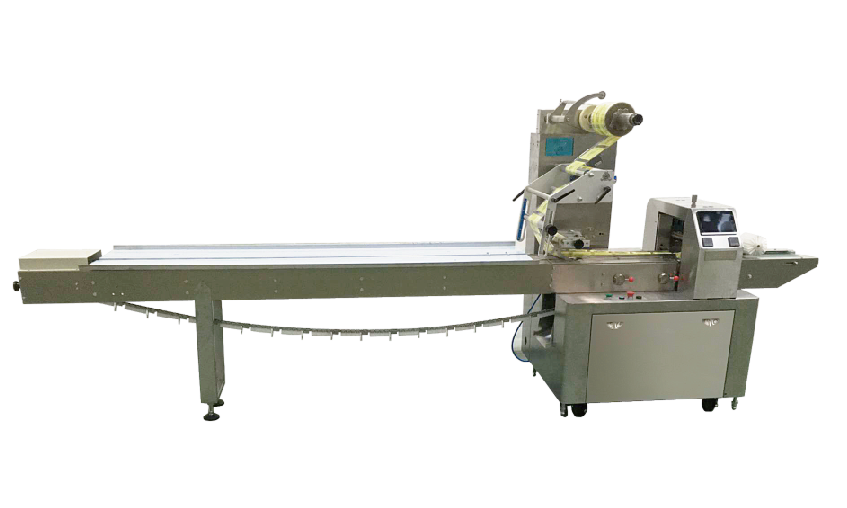
Two former constructions cover most pillow wrapping. A flat or shoulder former guides the web down around a product travelling on the belt; it suits regular bars, biscuits and trays at normal heights. An upper-film former pulls the web from above and wraps downward, used on machines arranged for certain product heights and discharge layouts. The cross-section math below applies to both; the difference is where the web meets the product and how the back seal sits.
Measure the Product Cross-Section First
Sizing starts from three measurements on the product as it travels, taken on the largest pack in the SKU range:
- Product width (W): the widest point across the product perpendicular to the flow direction, including tray flanges, toppings that protrude, or an overhanging label.
- Product height (H): the tallest point from the belt surface to the top of the product or tray.
- Product length (L): along the flow direction; it sets bag length and jaw cut, not former width or web width, but it should be noted so the full pack spec is in one recipe record.
Measure several samples rather than one nominal drawing. Products settle after filling, trays vary by moulding, and soft packs can bulge on the line. Use the maximum measured width and height for former sizing; sizing to the average leaves no headroom for the bulkiest pack, which then drags or jams at the throat. Note any protrusions that sit off-centre, because they can catch a former edge even when the average cross-section fits.
Tube Circumference: The Film Around the Product
Before the web width is chosen, work out how much film wraps around the product cross-section. The web must cover the full perimeter of the tube the product sits in. For a roughly rectangular cross-section, the tube circumference around the product is:
Tube circumference ≈ 2 × W + 2 × H + clearance allowance.
The clearance allowance leaves film slack so the tube can slide over the product without the web stretched tight against the sides. Typical added clearance runs 5–15 mm around the section, more for soft or irregular packs that need the bag to hang loose, less for rigid packs held square on the belt. The two product dimensions drive the number: a wide, flat biscuit uses width as the larger term; a tall tray uses height.
Worked cross-section: 60 × 15 mm flat bar
A coated bar measures 60 mm wide and 15 mm high, flat and regular. Tube circumference = 2 × 60 + 2 × 15 + 10 mm clearance = 120 + 30 + 10 = 160 mm around the section. This is the film that wraps over the top, down both sides and under the product. The former throat must clear 60 mm width and 15 mm height with headroom; the web width then adds the seal overlap to this circumference.
Worked cross-section: 150 × 40 mm ready-meal tray
A rigid tray measures 150 mm wide and 40 mm high, with a small flange on each side. Tube circumference = 2 × 150 + 2 × 40 + 12 mm clearance = 300 + 80 + 12 = 392 mm. The tray’s height and flange mean the former has to clear 40 mm vertically and the flange edges horizontally; a flat-bar former sized for 15 mm height will drag on this tray even if the width matches.
Worked cross-section: irregular bundled product
An irregular bundle varies in width and height pack to pack. Measure the widest and tallest sample separately, take the larger of the two envelopes, and add the upper end of the clearance band, 12–15 mm, because the bundle shifts in the bag. If the variation is large, collation or a more regular pack format should be considered upstream; forcing an irregular bundle through a tight former creates wrinkle and jam faults that the former adjustment cannot fully fix.
Web Width: Circumference Plus Seal Overlap
The web roll width is wider than the tube circumference because the two film edges must overlap under the longitudinal seal. The overlap depends on the seal style:
| Seal style | Edge overlap added to circumference | Notes |
|---|---|---|
| Fin seal (crimped back fold) | 40–60 mm total | Two edges folded together and crimped; overlap forms the standing fin on the back of the bag |
| Lap seal (edges laid flat over each other) | 20–35 mm total | Edges overlap flat instead of standing up; narrower back seal, used where a flat back matters |
| Center seal on an inverted or upper-film layout | 25–45 mm total | Allowance set by the seal bar width and film lay-flat on that machine |
The web width calculation is therefore:
Web width = tube circumference + seal overlap, rounded up to the nearest standard roll width.
Standard film rolls come in set widths rather than arbitrary millimetres, so the calculated width rounds up to the next available roll. Rounding up adds some slack film; rounding down risks an edge that cannot reach the seal. After rounding, confirm the web still tracks centered on the former and that the extra width does not bunch at the sides. The choice between fin and lap seal changes this overlap, and the two back-seal styles are compared in the fin seal vs lap seal selection guide.
Worked web width: 60 × 15 mm bar, fin seal
Tube circumference 160 mm, fin seal overlap 50 mm total. Calculated web width = 160 + 50 = 210 mm. If available rolls step in 20 mm increments, the nearest standard width above 210 mm is selected; the former shoulder is sized so the 210–220 mm web folds cleanly around the 60 × 15 mm section without side sag.
Worked web width: 150 × 40 mm tray, lap seal
Tube circumference 392 mm, lap seal overlap 30 mm total. Calculated web width = 392 + 30 = 422 mm, rounded up to the nearest standard roll above 422 mm. A tray this wide needs the wider former and seal bar that goes with a 420–450 mm web; a narrow-wrapper former sized for a 210 mm film cannot be opened to carry this width.

Former Throat Dimensions and Headroom
The throat opening is sized to the product cross-section plus headroom, not to the web width directly. Headroom is the gap between the product and the former edge on each side and above the pack, so the item travels without rubbing and the film can slide between product and former. Typical headroom runs 3–8 mm per side on width and 5–12 mm above the product on height, depending on how square the product stays on the belt.
Throat width ≈ product width W + 2 × side headroom.
Throat height ≈ product height H + top headroom.
For the 60 × 15 mm bar with 5 mm side headroom and 8 mm top headroom, throat width ≈ 60 + 10 = 70 mm, throat height ≈ 15 + 8 = 23 mm. For the 150 × 40 mm tray with 6 mm side headroom and 10 mm top headroom, throat width ≈ 150 + 12 = 162 mm, throat height ≈ 40 + 10 = 50 mm. These are planning dimensions; the former is a machined part supplied to the product envelope, and the real clearance is checked on a trial wrap.
Former size is tied to a product envelope, not to a machine model. One wrapper can carry several formers for different pack sizes; changing former between SKUs is a mechanical swap of the shoulder and throat parts, separate from the recipe recall that changes bag length and jaw settings. If a line runs several widths and heights regularly, the former inventory and changeover time should be planned alongside the SKU list.
Upper-Film and Lower-Film Layouts
On a conventional lower-feed layout the web rises from a roll beside the conveyor and folds up around the product. On an upper-film layout the web comes from a gantry above and drapes down over the product. The circumference and web-width math is the same, but the former geometry and the seal position differ. The YC420 upper-film pillow packaging machine is built for the upper-feed arrangement, where the film meets the product from above and the back seal sits accordingly. Choosing film orientation by product rigidity, speed and seal position is the subject of the top-film vs inverted-film comparison in the existing wrapper selection material.
For irregular or heavier products that push through the former, the support under the product matters as much as the throat clearance. A tray that tips on the belt presents a tilted cross-section to the former even when the nominal dimensions fit; guiding and squaring before the former are the fix, not a larger throat that lets the pack wander.
What Happens When Former or Web Is Mis-Sized
| Observed fault | Mis-size direction | Check and correction |
|---|---|---|
| Product rubs the former edge, scuff marks on the pack | Throat too narrow or too low | Re-measure max W and H, increase side/top headroom, replace or adjust former |
| Excess film gathers in folds along the sides or back seal | Former too large or web too wide | Check web width against circumference plus overlap; match former to the actual pack envelope |
| Back seal short on one edge, unsealed strip | Web too narrow for the former and seal bar | Recalculate circumference + overlap, move to the next wider standard roll |
| Wrinkles running into the crimp along the back seal | Web too wide, former too deep, or film tracking off-center | Check web width allowance, former depth and film guide alignment before changing seal heat |
| Product drags the film and pulls on the item as it feeds | Former headroom too small for the product height | Raise throat height, confirm tray or pack clears the former top |
| Loose, baggy pillow with slack film at the sides | Former oversized for a small product | Fit a former matched to the smaller section; do not compensate by tightening film tension alone |
Several of these faults overlap with film tracking and tension problems. Before blaming the former, confirm the web runs centered through the guides and the unwind tension is even; a side that drifts toward one guide can look like a former that is too wide. The film roll, threading path and unwind tension side is covered in the film roll change and unwind tension guide.

Film Thickness and Web Width Are Separate Choices
Web width and film thickness are two different specifications. Width comes from the product circumference and seal overlap; thickness, measured in microns or gauge, comes from product weight, barrier needs, sealability and machine handling. A thicker film can run on the same former and web width if the width math holds, but it changes seal temperature, jaw pressure and roller grip. Do not use a wider web to compensate for a film that seals poorly; that adds slack film without fixing the heat seal. Micron, gauge and mil selection for packaging film is laid out in the film thickness guide.
Former and Web Sizing Checklist for a New SKU
- Measure maximum product width W and height H across several samples; note protrusions and off-centre features.
- Calculate tube circumference = 2W + 2H + clearance (5–15 mm around the section).
- Choose seal style (fin or lap) and add the corresponding edge overlap, 40–60 mm fin or 20–35 mm lap.
- Calculate web width = circumference + overlap, round up to the nearest standard roll width.
- Calculate throat width = W + 2 × side headroom (3–8 mm per side) and throat height = H + top headroom (5–12 mm).
- Confirm the former on the machine matches this envelope; plan a former swap if the current throat is too small or too large.
- Run trial wraps at low speed: check the product clears the former, the back seal reaches both edges, and no side wrinkles feed into the crimp.
- Record the product dimensions, chosen web width, former part and seal style against the SKU for the next changeover.
Former Contact Surface and Product Protection
The former surface touches the film continuously, and the film touches the product on the way through. A worn, rough or sharp former edge scratches the web, leaves marks on soft packs, and can tear a thin film at speed. Food-contact formers are typically polished stainless or coated to keep the surface smooth and easy to wipe; formers for non-food packs may use steel with a hard-wearing finish. Inspect the shoulder and throat edges at changeover for nicks, burrs and film residue built up from adhesive or oil. A polished former that has picked up a rough spot should be dressed or replaced rather than run until it starts marking bags.
For delicate products, the gap between product and former matters more than the minimum headroom. A chocolate bar with a printed wrapper, a biscuit with a raised decoration, or a tray with a thin film lid can scuff against a throat that clears the dimensions on paper but sits tight in practice. Run these at the wider headroom end of the band and check the trial bags for rub marks before committing to production speed. If the product must stay centered under the seal, side guides on the infeed keep it square; the former itself should not be relied on to centre a wandering pack.
Web Centering and Film Guides Before the Former
A correctly calculated web still has to reach the former centered. Film guides, edge sensors and the unwind alignment keep the web running square across the former shoulder; if the web drifts to one side, the overlap on that side shrinks and the other side bunches, even though the roll width is right. Check centering on the first trial bags: the back seal should sit along the centre of the back of the bag, with equal edge overlap on both sides. A seal that sits off to one edge points to guide or unwind misalignment, not to a web that was cut too narrow.
When a wider standard roll was selected to round up the calculated width, the extra millimetres show up as slight slack at the sides rather than as a centered seal. That slack is acceptable up to a point, but if the side folds feed wrinkles into the crimp, the roll width was rounded up too far or the former is too deep. Re-check the circumference and the former throat before reducing seal heat to chase the wrinkle.
Typical Product Envelopes and Starting Dimensions
The table below gives starting planning dimensions for common pack shapes. Treat the W and H as representative values; measure your own samples before ordering a former or roll, because tray flanges, toppings and pack bulges shift the envelope.
| Pack type | Typical W × H | Clearance around section | Seal style | Planning web width |
|---|---|---|---|---|
| Flat biscuit / candy bar | 60 × 15 mm | 10 mm | Fin | ~210–220 mm |
| Wrapped biscuit stack | 90 × 25 mm | 10 mm | Fin | ~260–280 mm |
| Snack bar with tray | 110 × 30 mm | 12 mm | Fin | ~300–320 mm |
| Ready-meal tray | 150 × 40 mm | 12 mm | Lap | ~420–440 mm |
| Small carton or box | 100 × 50 mm | 8 mm | Fin | ~320–340 mm |
| Soft irregular bundle | 120 × 35 mm, variable | 15 mm | Fin | ~330–360 mm |
Changeover, Former Inventory and SKU Planning
Each former is matched to a product envelope. A line that wraps one regular bar all day needs one former; a line that switches between a flat biscuit, a tall tray and a small carton needs a former for each envelope that does not share a throat. Plan the former count against the SKU list before ordering the machine, because a wrapper that cannot carry the required formers becomes a bottleneck at changeover. Record the former part, its throat width and height, the web width it accepts, and the seal style in the SKU recipe so the changeover crew fits the right part rather than guessing from the last bag.
Former swaps take longer than a recipe recall: the shoulder and throat parts are removed, cleaned and replaced, and the web re-threaded through the new former. If several SKUs share a close envelope, sizing the former to the largest of the group lets the smaller packs run with a little extra slack rather than a full former change. Where packs differ in height or width beyond that overlap, a separate former is the cleaner solution than running a tight clearance that marks the product.
Soft Packs, Loose Fill and Bag Fullness
Soft products and loose-fill packs do not hold a fixed cross-section. A pillow bag for a soft bundle has to carry more slack film so the pack can settle inside; sizing the former to the soft minimum height squeezes the product and wrinkles the film as it bulges. Add the upper clearance band for soft packs and check the bag fullness on trial wraps: the film should follow the product without standing off it, but should not be stretched tight enough to mark the pack. Over-stuffing the bag with too little film around a soft product shows up as a tight, creased pillow that seals poorly at the ends.
For products that discharge unevenly from a weigher or feeder, the cross-section at the former can vary even when the nominal product is regular. Upstream collation and spacing keep the packs uniform before they reach the former; the infeed and spacing side is covered in the infeed collation and product spacing guide. If packs arrive tilted or overlapping, former and web width cannot compensate, and the line should be balanced upstream first.
Printed Film and Margin Around the Design
On printed film, the former and web width must also leave room for the print design. The artwork has a printable margin inside the web edges; the seal overlap and former folds should land on plain film outside the printed area, so the fin or lap seal does not seal across ink that interferes with the bond. Check the film layout against the calculated web width: if the design’s plain edge strip is narrower than the seal overlap, the seal runs on printed film and the bond weakens. In that case the web width or the artwork margin has to change, not the seal temperature.
Registration keeps the print aligned along the bag length, which is separate from the cross-width former and web sizing. A centered print that sits off to one edge points to web tracking rather than a wrong former width. Confirm the print margin and seal edge on the first trial bags, and keep the film artwork note with the SKU recipe so a reorder uses a film laid out for the chosen former and seal style.
Common Sizing Questions
Can one former cover two close product sizes?
If the two packs share a close width and height, a former sized to the larger can carry the smaller with some extra slack film. The smaller pack runs loose in the throat, so watch for side folds and bagginess; if the slack feeds wrinkles into the seal, a separate former for the smaller pack is the cleaner answer. A large gap between the two envelopes cannot be bridged by one former.
What if the measured web width falls between standard rolls?
Round up to the next available standard roll width rather than down. The extra millimetres show as side slack that the former and guides absorb; rounding down leaves an edge that cannot reach the seal. If the rounded-up roll leaves heavy side folds, the former may be too deep for the pack, and the fit should be rechecked before a narrower film is ordered.
Machine Match by Product Envelope
The medium-speed pillow flow wrapper covers regular bars, biscuits and trays in the mid web-width range where one or two formers cover the product mix. The YC420X pillow packaging machine handles the standard horizontal former layout for regular packs, while the upper-film YC420 upper-film machine applies where the product and line layout call for film from above. Wider trays and larger packs move to the heavy-duty or high-speed models listed in the product index.
Summary
Former and web sizing starts from the measured product width and height, not from the brochure film width. Tube circumference wraps the section with 5–15 mm clearance; web width adds the seal overlap, 40–60 mm for a fin seal or 20–35 mm for a lap seal, then rounds up to a standard roll. The former throat clears the product with 3–8 mm side headroom and 5–12 mm top headroom, and it is sized to the largest pack in the SKU range. A throat that drags scuffs the product; a former or web that is too wide gathers film into side wrinkles and a baggy pillow; a web that is too narrow leaves the back seal short. Separate former and width faults from tracking and tension faults, trial-wrap at low speed, and keep the dimensions in the SKU recipe. The full horizontal, upper-film and medium-speed machines are listed on the pillow packaging machine product index to match against your measured product envelope.