
Pillow Bag Length, Product Pitch and Feed-Ratio Setting on a Servo Flow Wrapper: Calculating Bag Size, Spacing and Cut Position With Worked Examples
A pillow packer seals a horizontal web of film around a product travelling along an infeed conveyor, closes a longitudinal back seal, then cuts the web into individual bags between two end-seal jaws. Three numbers decide whether every bag comes out the right length: the bag length the controller cuts to, the product pitch at which items arrive at the former, and the feed ratio that matches film speed to product speed. Set bag length too short and the jaw seals onto the product, crushing bars or trapping edges in the crimp. Set it too long and each bag hangs loose around the item, wasting film and making the pillow look baggy. Get the pitch wrong and products collide inside the former, bunch up under the sealing jaw, or arrive spaced farther apart than the cut, leaving empty seals.
This guide works through those three numbers with measurements in millimetres and calculations a line engineer can check on the HMI. It covers how bag length is built up from product length and end-seal allowance, how product pitch follows bag length or the upstream feeder, how the feed ratio links film feed roller speed to infeed speed, and where missing-product detection and printed-film registration sit in the same setup. The reference machines are the servo horizontal flow wrappers in the pillow packaging machine range; the figures below are planning bands to confirm against the actual product drawing and a trial run, not fixed quotations.
What a Pillow Bag Is Made Of
Before the length math, picture the bag. The film web folds around the product in the former, the two edges meet under a longitudinal seal unit that closes the back (fin seal or lap seal), and the wrapped product travels to the cross-seal jaw. The jaw comes together across the web, seals the leading end of one bag and the trailing end of the next in the same crimp, then a cutter between the seal faces separates them. One jaw cycle therefore produces one end seal on each of two adjacent bags, and the distance between two consecutive jaw cuts on the film is the bag length.
Three lengths appear in any setup, and they are easy to confuse. The product length is the measured dimension along the flow direction. The bag length is the cut distance on the film, longer than the product because each end carries a sealed crimp that must not touch the product. The product pitch is the centre-to-centre distance between two consecutive items on the infeed; on a well-tuned single-lane line the pitch equals the bag length, because one product fills one bag and the jaw cuts one bag per cycle.
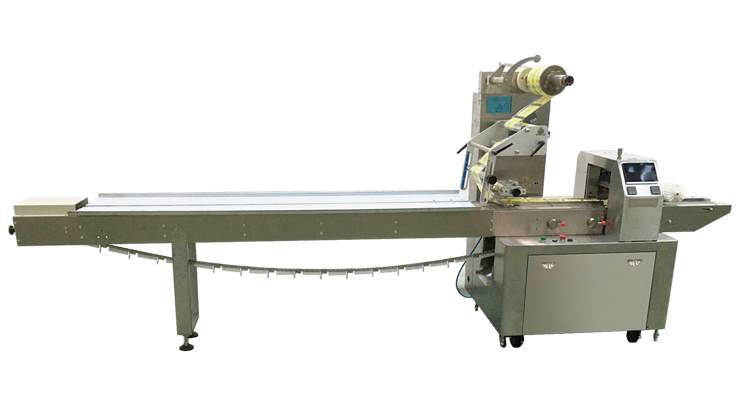
Bag Length: Product Length Plus End-Seal Allowance
The starting equation for bag length is straightforward:
Bag length = product length along the flow direction + 2 × end-seal overlap.
The end-seal overlap is the film that sits between the product end and the centre of the crimp on each side. The jaw must close on film only; if the seal face reaches the product, the heat and pressure mark or crush it, and a seal formed against a solid edge does not fuse the film properly. The overlap has to cover product tolerance, slight length variation, and the position error that comes from how squarely the item enters the former.
Typical end-seal overlap runs 12–20 mm per end for regular bars, biscuits and thin packs, and 18–30 mm per end for trays, rigid containers and products that vary in length or shift on the belt. Add the two ends, so a regular product carries roughly 24–40 mm of total end allowance, and a tray pack carries 36–60 mm. These bands depend on jaw seal width, film stiffness and how much the product can move inside the bag; confirm the allowance on trial bags before locking the recipe.
Worked bag length: 80 mm biscuit bar
A biscuit bar measures 80 mm long, fairly uniform between packs, packed in a single OPP pillow bag. Use a 15 mm overlap per end. Bag length = 80 + 2 × 15 = 110 mm. The controller cuts the web every 110 mm. If the bar arrives slightly bowed or the line runs a second recipe at 84 mm actual length, the allowance should still hold a seal clear of the product; raising the overlap to 18 mm gives 116 mm bags, with a small film penalty per pack.
Worked bag length: 120 mm chocolate bar with printed film
A chocolate bar is 120 mm long and wrapped in printed film with registration marks above and below the graphics. The bar is brittle, so the jaw must not touch the chocolate; set a 20 mm overlap per end. Bag length = 120 + 2 × 20 = 160 mm. Because the film carries print, the cut must land between registration marks, and the bag length must match the repeat length of the print layout; if the artwork repeat is 155 mm or 165 mm rather than 160, the recipe follows the print repeat, not the raw product math, and the product centring inside the bag is checked on the trial bags.
Worked bag length: 180 mm ready-meal tray
A rigid ready-meal tray measures 180 mm in the flow direction, with a flange that can catch the film if the bag is tight. Trays vary a few millimetres in moulding and can shift sideways, so use a 25 mm overlap per end. Bag length = 180 + 2 × 25 = 230 mm. The former headroom and the end-seal opening also have to clear the tray height; length is only one of the former sizing checks, covered in the companion guide on former throat and web width sizing.
Product Pitch: How Items Must Arrive at the Former
The pitch is the centre-to-centre distance between two consecutive products on the infeed. On a single-lane wrapper running one product per bag, the pitch has to match the bag length: the detector sees a product, the controller waits until the item reaches the former position, and the next product must arrive one bag-length behind the first. If products are closer together than the bag length, two items can enter the former in one bag window or collide at the jaw. If they are farther apart, the jaw closes on an empty film span between products, producing a half-empty bag or an off-cut.
Two infeed constructions set the pitch. A flat belt carries products at belt speed with spacing controlled upstream by the feeder, a timing screw or a set of belts that open a gap between items. A lug or chain infeed uses fixed flights that push each product into a taught position; the lug pitch fixes the centre-to-centre spacing, and the product must sit against the lug so the pitch cannot drift. Lug feeds suit regular rigid items that locate against a flight; flat belts suit products that should not be pushed, such as delicate bars or loose packs.
| Condition | Pitch relative to bag length | Result at the jaw |
|---|---|---|
| Pitch equals bag length | Match | One product per bag, seal clears the product, cut lands in the film span |
| Products closer together (pitch shorter) | Pitch < bag length | Two items crowd the former; risk of double pack, crushed edge or seal-on-product |
| Products farther apart (pitch longer) | Pitch > bag length | Empty film between packs; loose bag, open span sealed, film wasted on off-cuts |
| Product drifts on a flat belt | Unstable pitch | Gap varies pack to pack; intermittent jams and seal position shifts |
The upstream feeder sets this pitch more often than the wrapper does. A multihead weigher drops portions onto a feed belt that discharges them one after another; a counting belt or a lug conveyor stages them at the wrapper pitch. If the weigher discharges faster than the wrapper takes bags, products accumulate and bunch; if it discharges slower, the wrapper waits and runs under capacity. The integration timing between weigher and wrapper is laid out in the multihead portioning feeder integration guide, covering discharge timing and line balancing.
Feed Ratio: Matching Film Speed to Product Speed
The feed ratio links the film web to the product line. On a servo wrapper the film feed roller pulls film off the roll and advances it through the former; the end-seal jaw moves with the web during the seal so the film and product travel together while the crimp is made. The controller synchronizes the feed roller, the former infeed and the jaw motion to the recipe bag length, so the ratio between film feed and product travel is set by the machine rather than by an operator turning a dial.
The basic relationship is that the film advances one bag length per cycle, and the infeed advances one product pitch per cycle. When pitch equals bag length, film speed and product speed run at the same surface speed through the former; the film wraps the item without being pulled tight around it or sagging ahead. Where the bag is longer than the product because of the end allowance, the film still advances one bag length per cycle while the product sits inside it; the extra film forms the end gussets and the loose head and tail of the pillow.
On older mechanical or pneumatic wrappers the feed ratio is set by roller gearing and jaw cam tracks fixed to one product length; changing bag length means changing tracks or hand-setting dials. On a dual-servo machine the film feed roller and cross-seal jaw are separate servos, and the bag length, jaw speed and film speed are recipe parameters that follow the selected SKU. The drive-level differences between mechanical, pneumatic and servo constructions are compared in the servo vs mechanical drive comparison.
Converting bag length to packs per minute
Once bag length and line speed are known, the maximum packs per minute follow directly. The web travels at a certain film speed in metres per minute; each pack consumes one bag length of film, so:
Packs per minute = film feed speed (m/min) ÷ bag length (m).
For a 110 mm bag and a 45 m/min film feed, packs/min = 45 / 0.110 = 409 packs/min on paper; in practice the jaw cycle time, infeed capacity and settle time cap the real rate well below that, and the wrapper’s published speed band applies to its actual product. The point of the math is to catch an impossible recipe early: a 230 mm tray bag on a feeder that only delivers 30 products/min cannot be rescued by running the film faster, because the pitch, not the film, is the bottleneck.

Missing-Product Detection and Empty-Bag Control
Not every detector signal carries a product. A weigher can miss a drop, a product can be rejected upstream, or an item can fall off the infeed. The wrapper’s product sensor reports whether an item is present at the detection point before the former. When no product is detected for a cycle, the controller follows one of two strategies defined in the recipe: pull an empty seal span through without forming a bag, or run a dummy bag to keep the film path and jaw timing steady. On lines that sell every pack by weight, an empty or half-filled bag reaching the cartoner is a quality reject, so the missing-product signal should also trigger a reject downstream at the discharge or checkweigher.
Missing-product waste shows up as extra film consumed per shift. Each empty cycle on a 110 mm bag wastes roughly 110 mm of web plus the seal allowance; over a shift with, say, 20 missed drops that is about 2.2 m of film, before counting any off-cut at the splice. The recipe should log missing-product cycles so the operator can tell whether the wrapper or the upstream feeder is the source.
Printed Film: Registration and Cut Position
With plain film, the bag length comes from product math alone. With printed film, the cut also has to land on the layout: the artwork has a repeat length with eye marks, and the jaw cut must fall in the unprinted seal area between marks. An optical eye reads the registration mark as the film passes, and the controller adjusts the film feed phase so the cut position holds to the mark within roughly ±1 mm. The bag length has to equal the print repeat (or a clean divisor of it); a product-derived bag length that does not match the repeat forces the graphics to drift toward the seal until a mark is missed.
Registration errors show as graphics shifted toward one end seal, a cut through a logo, or a mark the eye stops reading after a splice. The first checks are repeat length against recipe, eye contrast against the film background, and film tracking so the mark passes under the sensor squarely. Registration and other seal and jam faults are walked through in the seal leaks, jams and registration troubleshooting guide.
Bag Length Tolerance and How to Measure Trial Bags
The recipe bag length is a target, not a guaranteed finished dimension. Film stretches a little under tension, the feed roller can slip on a glossy or low-friction web, and the product settles into the bag after the seal cools. Finished pillow bags typically hold the set length within ±1 to 2 mm on a servo line with a tracked web, and a little wider on a mechanical or pneumatic setup. Measure the first ten trial bags across the seal-to-seal length, not the crimp-to-crimp centre, and compare the average and spread against the recipe. A consistent short offset means the feed roller is pulling less web than commanded; a wide spread means the web is slipping or the product pitch is unstable.
Record the measured average against the recipe length so the operator can spot drift as film batches change. A film roll from a new supplier with a different friction coefficient can shift the feed without any machine fault, and a roller surface worn smooth after hundreds of hours pulls the web less positively. Keep the roller pressure and surface condition in the maintenance checks rather than treating a length drift as a one-off recipe error.
Feed Roller Slip and Web Tension Behind the Ratio
The feed ratio assumes the film roller grips the web and advances the commanded length each cycle. In practice, slip between roller and web breaks that assumption. Slip rises when the roller grip is worn, when the web surface is too smooth for the rubber or knurled roller, when web tension is too high and the roller drags, or when the film is cold and stiff so it resists being pulled around the former. When slip appears, the film advances less than the commanded bag length; the cut lands short, the bag length falls below target, and on printed film the registration eye chases a mark that keeps drifting.
Unwind tension and the dancer arm keep the web entering the feed roller at an even tension. An over-tight unwind pulls against the roller and encourages slip; a loose unwind lets the web sag and bunch under the former. The dancer or tension roller between roll and feed roller absorbs short tension swings so the roller sees a steady web. Setting roll change, unwind tension, dancer position and the full threading path is covered in the companion guide on film roll change, threading and unwind tension; this article treats the feed ratio as the result once the web path and tension are set correctly.
Recall Versus Re-Set When the SKU Returns
When a product comes back to the wrapper after a run on another pack, the bag length and feed ratio are recalled from the recipe rather than entered by hand. The stored recipe holds bag length, feed ratio, jaw speed and the seal settings for that SKU. Even so, a returning SKU should be checked on the first bags: film lot, product batch and machine warm-up can shift the measured length a fraction, and a small trim to the ratio may be needed before the run goes to full speed. Keep the recipe value as the starting point and adjust only what the trial bags show, rather than reworking the whole feed setup each time the pack returns.
If the same wrapper runs several products that share a bag length but differ in product length, the feed ratio stays the same while the end gap changes. The shorter product leaves a wider gap of film at each end; the longer product leaves a narrow gap. Watch the end seal on the longer product to make sure the jaw still has film beyond the pack edge, and on the shorter product to keep the bag from looking overlong. Recording both the bag length and the product length against the recipe makes this comparison quick at the next changeover.
What Changes When the Product Shape Changes
- Flat bars and biscuits: regular length, low height; the allowance stays at the lower 12–18 mm per end, and pitch can be tight on a lug feed.
- Chocolate and coated bars: brittle and surface-sensitive; keep overlap generous so the jaw cannot touch the product, and check jaw pressure and temperature separately.
- Tray and cup packs: rigid, variable height; longer end allowance, former headroom checked first, and a slower infeed to keep the tray square on the belt.
- Irregular or loose bundles: length varies pack to pack; measure the longest expected item, set pitch to the longest, and consider a collation step upstream rather than forcing an uneven pitch through the former.
- Multi-pack groups: two or three items grouped before wrapping; the group length replaces the single product length in the bag-length equation, and the group pitch follows the collation count.
Reading Faults Back to Bag Length, Pitch or Ratio
Most pack faults trace to one of the three numbers in this article, and isolating which one shortens the diagnosis.
| Fault observed | Likely cause | Check first |
|---|---|---|
| Jaw crimp marks or crushes the product end | Bag length too short; overlap too small | Measure product length, raise end-seal allowance, re-cut trial bags |
| Loose, baggy pillow with excess film at ends | Bag length too long for the product | Reduce overlap to the seal-width minimum; confirm product length in recipe |
| Two products in one bag or a seal across a product | Pitch shorter than bag length; products bunched upstream | Check feeder discharge gap, lug spacing, product sensor timing |
| Empty seal span or half-empty bag | Pitch longer than bag length; missing product not rejected | Check missing-product signal, feeder drop rate, accumulation ahead of the wrapper |
| Cut drifts off the print mark | Repeat length mismatch, eye contrast or tracking fault | Confirm print repeat in recipe, clean and align the registration eye |
| Film pulls tight or sags ahead of the product | Feed ratio off; film speed not matched to product speed | Check feed roller servo follow, belt slip on the infeed, roller diameter in recipe |
Seal quality itself — weak crimp, wrinkled seal, uneven jaw temperature — is a separate set of causes from length and pitch; the temperature, pressure and dwell side is covered in the sealing temperature, pressure and dwell guide. Do not raise the bag length to fix a weak seal; that adds film waste without changing the heat seal.

Setting Up a New SKU: The Number Sequence
- Measure the product length along the flow direction on several samples; note the longest and shortest, and any length variation.
- Choose the end-seal overlap from the product type: 12–18 mm per end for flat bars and biscuits, 18–30 mm for trays, rigid packs and variable items.
- Calculate bag length = product length + 2 × overlap; if the film is printed, round the bag length to the print repeat and check graphics centring.
- Set the product pitch to the bag length on a single-lane line; confirm the upstream feeder or lug chain can hold that spacing.
- Load the bag length, pitch and feed parameters into the recipe; confirm the feed roller and jaw follow the recipe rather than a fixed track.
- Run trial bags at low speed: measure bag length with a ruler, check the seal clears the product at both ends, and inspect print registration before raising speed.
- Record the accepted bag length, overlap and pitch against the SKU and product drawing revision, so the next changeover recalls the correct numbers.
Machine Options That Match These Setup Numbers
The high-speed servo pillow packaging machine stores bag length, pitch and jaw parameters per recipe and changes SKU from the HMI without swapping cam tracks, which matters when several product lengths run in one shift. The YC600W servo reciprocating packaging machine suits products that need a dwell at the seal, where the reciprocating jaw stops over the pack instead of chasing it on a rotary path. Slower single-SKU lines can use the medium-speed pillow flow wrapper, where a fixed bag length and simpler feed arrangement are enough for a steady product mix.
Summary
Bag length, product pitch and feed ratio are one linked setup, not three independent dials. Bag length starts from product length and adds end-seal overlap of 12–30 mm per end depending on pack rigidity; product pitch must match that bag length on a single-lane line, set by the feeder or lug chain; the feed ratio keeps film speed and product speed in step through the former, so one bag length of film advances per cycle. Missing-product detection handles drops that reach the former without an item, and printed film adds a registration check that ties bag length to the print repeat. When a fault appears, separate a length or pitch problem from a seal-temperature problem before adjusting anything. Measure the real product, set the overlap for the longest expected item, trial bags at low speed, and keep the accepted numbers in the SKU recipe. The full horizontal servo, reciprocating and medium-speed options are listed on the pillow packaging machine product index for comparison against these setup parameters.