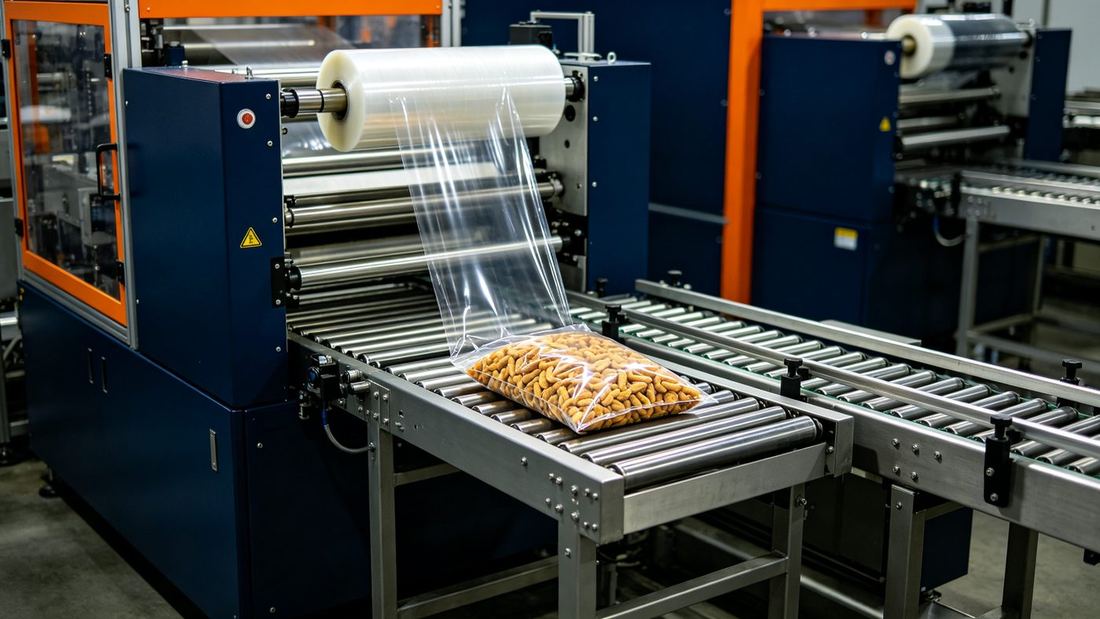
Buyers shopping for a flow wrapper or a vacuum packer often ask “which machine do I need?” before asking “what is actually spoiling my product?” The answer decides whether you need plain flow wrapping, nitrogen flush, carbon dioxide flush, vacuum packing or skin packing. This guide compares the four modified-atmosphere options and tells you which one your product actually requires.
Quick Comparison: Four Atmosphere Options
| Dimension | Plain Flow Wrap | N₂ Flush | CO₂ Flush | Vacuum / Skin |
|---|---|---|---|---|
| How it works | Seals product in ambient air | Flushes O₂ out with 99% N₂ | Flushes O₂ out with CO₂ mix | Pulls vacuum, then seals; skin forms a tight film |
| Target shelf life | 1–7 days | 30–180 days (dry goods) | 14–45 days (chilled, moist) | 30–90 days (meat, fish, cheese) |
| O₂ level in pack | ~21% | 1–3% | 0.5–2% | <0.5% |
| Best products | Biscuits, bread, candy, fast-moving snacks | Coffee, nuts, chips, dry snacks | Cooked meats, salads, fresh pasta, bakery | Red meat, fish, cheese, deli |
| Equipment cost | Baseline | +15–25% (gas flush unit) | +25–40% (gas mixer, analyser) | +60–100% (vacuum chamber or skin former) |
| Film requirement | Standard OPP | High-barrier OPP/PE | High-barrier multi-layer | EVOH high-barrier, forming film |
| Main spoilage solved | Physical damage only | Rancidity, staleness, oxidation | Bacterial / mould growth | Aerobic bacteria, oxidation, freezer burn |
| Main risk if wrong | Short shelf life | Wasted gas on non-perishable | CO₂ dissolves in product, sags pack | Film too thin for sharp bones |
How to Choose, Step by Step
1. What is actually spoiling your product? Rancidity and staleness (nuts, coffee, chips) are oxygen problems — nitrogen flush solves them. Mould and bacterial growth on chilled cooked foods (salads, cooked meats, fresh pasta) are microbial problems — CO₂ flush solves them. Color and drip loss on red meat and fish are oxygen + moisture problems — vacuum or skin packing solves them. You do not need all four; you need the one that matches your failure mode.
2. Is your product dry or moist? Dry products under vacuum get crushed. Moist products under N₂ look puffy and waste gas. Dry products (coffee, nuts, biscuits) want N₂ flush in a flow wrapper. Moist products (cooked meats, salads) want CO₂ flush. Red meat and fish want vacuum or skin because they need to stay in contact with the film to look fresh.
3. How long must the shelf life be? A biscuit sold in 3 days across a city does not need gas. A nut mix shipped to a supermarket shelf across 90 days needs N₂. A chilled cooked chicken sent to retail needs 21 days — that is CO₂. Match the gas to the distribution distance, not to the brochure.
4. Can your film hold the gas? Gas leaks out of cheap film in days. N₂- and CO₂-flushed packs need high-barrier film (EVOH or multi-layer). Buyers who put N₂-flushed coffee into standard OPP film find the pack goes flat in a week — the gas escaped, not the product went stale.

Selection Checklist Before You Ask for Quotes
- Product type, water activity, and fat/oil content.
- Actual spoilage failure mode (rancidity, mould, color, drip).
- Required shelf life in days.
- Distribution route: ambient, chilled, frozen.
- Product shape and size (does it need to lie flat?).
- Whether sharp bones or hard corners pierce the film.
- Film barrier requirement (OTR, WVTR).
- Available gas supply (N₂, CO₂, mix) on site.
- Whether a gas analyser is needed for QA records.
- Target packs per minute.
- Whether the product needs to be visible through the film.
- Regulatory: claims on pack (e.g. “fresh” must match actual gas).
Common Buying Mistakes
Putting N₂ on every product. Nitrogen flush adds 15–25% to the machine and requires high-barrier film. A biscuit that sells in 3 days does not need it; the gas and film upgrade never pay back. Use N₂ only where oxidation actually shortens shelf life.
Putting CO₂ on dry snacks. CO₂ dissolves in fats and moist products, but it gives dry snacks no benefit and can make the pack collapse as gas dissolves. N₂ is the right gas for dry goods; CO₂ is for chilled moist foods.
Buying a vacuum chamber for products that need to look puffy. Vacuum packing flattens chips, biscuits and salad leaves. Buyers who vacuum-pack dry goods crush the product and lose more in rejected packs than the longer shelf life is worth.
Ignoring the film. Gas is only as good as the film that holds it. A cheap film on a high-end gas-flush wrapper is a waste of both. Ask for OTR and WVTR numbers with the film quote, not just price per kg.
Bottom Line
Dry, fast-moving, ambient products: plain flow wrap. Dry, long-shelf-life products (coffee, nuts, chips): N₂ flush. Chilled, moist, microbial-risk products (cooked meats, salads): CO₂ flush. Red meat, fish, cheese, products needing a tight film: vacuum or skin. Match the atmosphere to the spoilage failure and the distribution route — not to the most expensive machine on the brochure.
SunAura builds flow wrappers with optional N₂ and CO₂ gas flush, vacuum chambers, and pillow packaging machines integrated into complete lines. Send us your product, required shelf life and distribution route — we will spec the atmosphere and film you actually need.
Unsure whether your product needs gas flush, vacuum or plain flow wrap? Send your product, shelf life and target market to [email protected] or on WhatsApp. We will map the spoilage failure mode to the right packaging atmosphere and film.