
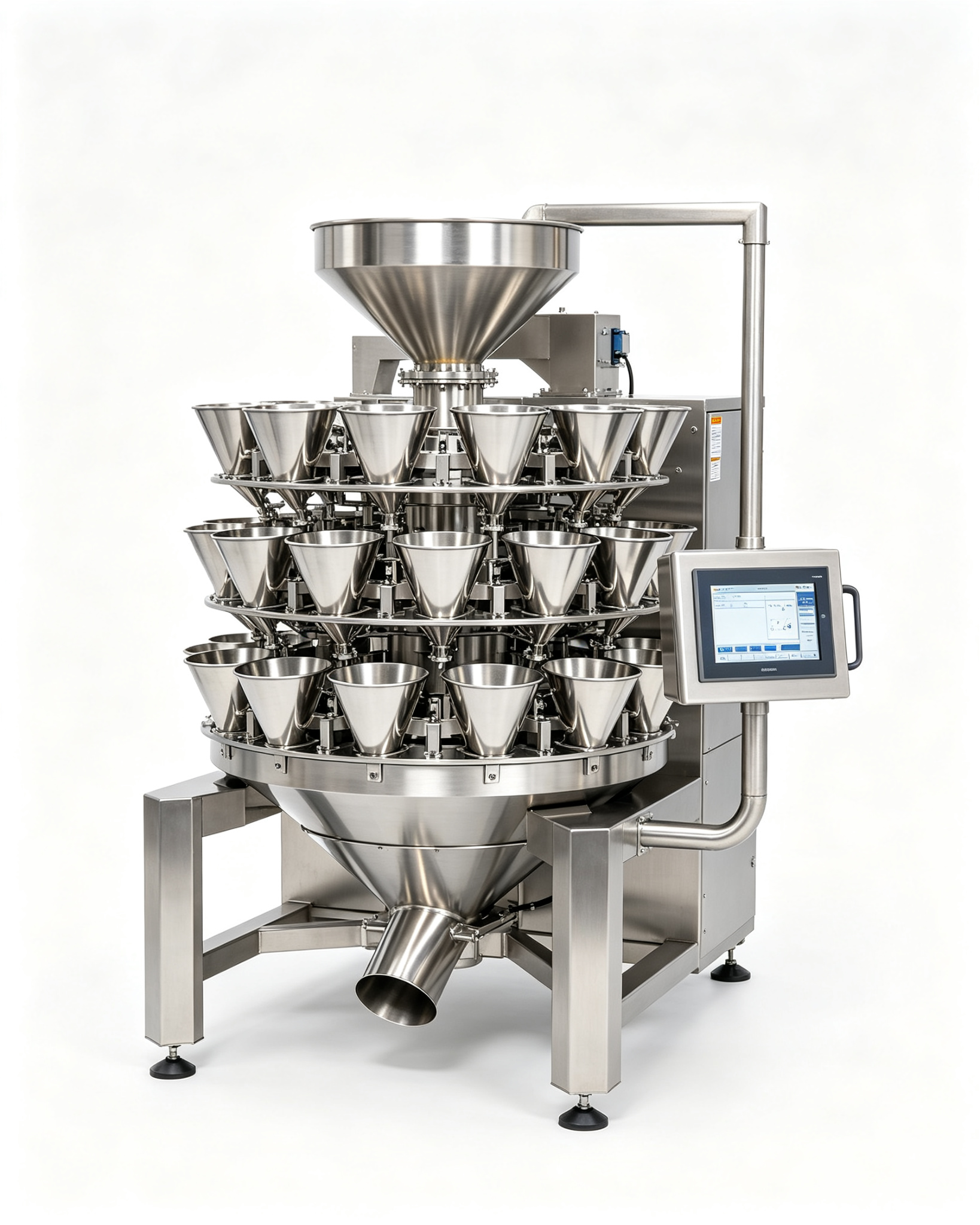
If you are specifying a multihead weigher for snacks, nuts, frozen food, confectionery, hardware, or prepared food, the first question a supplier should ask back is not “which brand do you like?” — it is “what do you weigh, at what pack weight, and at how many packs per minute?” The head count (10, 14, 16, or 18+ heads) is the single decision that sets your speed, your weigh accuracy, and roughly 40% of the machine price. Over-spec it and you spend 30-60% more on combination capacity you never exhaust. Under-spec it and you are forced into slow weigh cycles that bottleneck your flow wrapper and bleed giveaway weight into every pack.
This guide is written for production managers, plant engineers, and procurement specialists comparing quotes from Chinese multihead weigher builders. It uses neutral, numbers-based selection criteria — head count, target weight, product behavior, packs per minute, and budget — rather than a vendor pitch. By the end you should be able to tell whether your line needs a 10-head, a 14-head, or an 18-head (or higher) platform, and what to ask your supplier before you send product samples.
Quick Comparison: 10 vs 14 vs 18 Heads
| Dimension | 10-Head Weigher | 14-Head Weigher | 18-Head (or More) Weigher |
|---|---|---|---|
| Typical packs per minute | 25-50 ppm | 40-80 ppm | 70-120+ ppm |
| Best target pack weight | 50 g – 500 g | 100 g – 1 kg | 50 g – 3 kg |
| Weigh accuracy (at target pack) | ±0.5-1.5% | ±0.3-0.8% | ±0.2-0.5% |
| Combination possible per weigh | Lower (fewer combinations) | Medium | High (many combinations, tight tolerance) |
| Best product behavior | Free-flowing dry snacks, nuts, candy | Mixed: dry + light stickiness, dried fruit, frozen small items | Fragile, delicate, sticky, or high-value product where giveaway must be tight |
| Footprint | Compact, fits small lines | Medium | Larger; needs taller mezzanine/frame |
| Relative machine cost | Lowest | Medium | Highest |
| Typical partner machine | Small horizontal flow wrapper, premade bag | Medium servo flow wrapper | High-speed servo flow wrapper / VFFS, twin-lane |
How a Multihead Weigher Actually Selects Your Weight
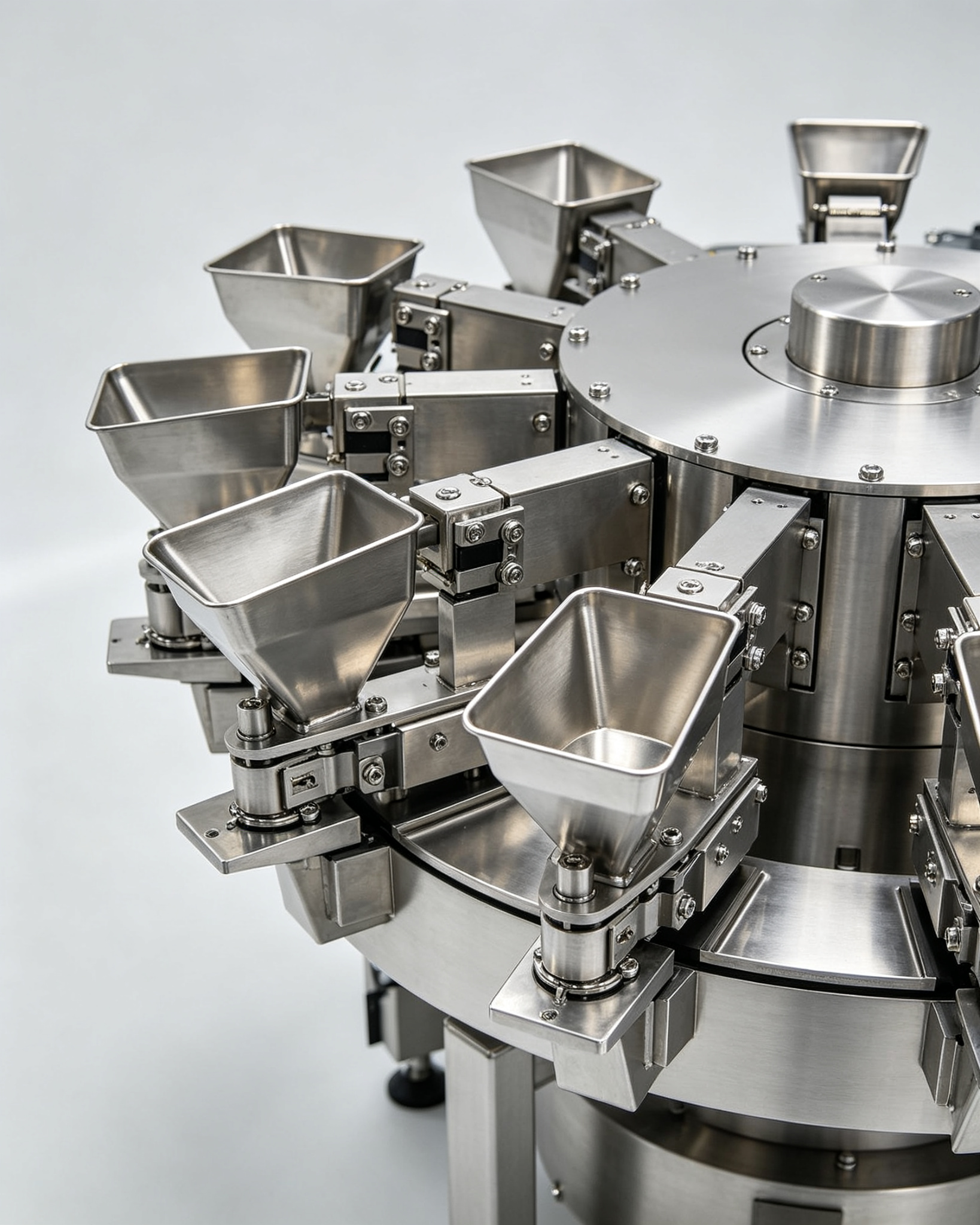
A multihead weigher does not dispense a fixed volume — it weighs small portions into a set of individual buckets (hoppers) and then, for every pack, the controller runs a combination algorithm: it sums the weights of a subset of weigh hoppers and releases the combination that lands closest to your target weight. More weigh hoppers means more possible combinations to choose from in a single cycle, which is how tighter accuracy is achieved at higher speed. This is the core reason head count matters.
On a 10-head machine there are fewer combinations available per drop, so the controller sometimes has to wait for the next bucket to refill to find a near-target combination. That wait caps the packs-per-minute ceiling and loosens average accuracy. On an 18-head machine, combinations are abundant, so the controller finds an exact match almost instantly — but you pay for the extra load cells, buckets, and drive mechanics whether your product needs that precision or not.
How to Choose: A Decision Framework
Question 1: How fast does your downstream packer run?
The weigher cannot be slower than the machine it feeds. Match the weigher to your horizontal flow wrapper or VFFS, not the other way around.
Under 50 packs per minute — a 10-head weigher is the economical right answer. If your flow wrapper tops out at 40 ppm, buying a 14-head or 18-head unit is wasted capital; the extra combinations never get used.
40-80 ppm — this is the 14-head sweet spot. It covers the large majority of snack, dried fruit, and small-frozen-goods lines feeding a medium servo flow wrapper. It is the most commonly specified configuration and the best balance of speed, accuracy, and price.
Above 70-80 ppm, or twin-lane — move to 18 heads or more. Below this range an 18-head will sit under-utilized; above it a 14-head will become the bottleneck and force slower weigh cycles that loosen giveaway.
Question 2: How tight does your pack weight really need to be?
Giveaway weight is profit you throw away every pack. If your product is high-value (nuts, coffee, freeze-dried fruit, candy), running 1-2% over target on a million packs a year costs real money — here the tighter accuracy of 14-18 heads pays back quickly. If your product is low-value, bulky, or sold by volume (pasta, pet food, large snack bags), a 10-head’s ±1% is usually acceptable and the lower purchase price wins.
Question 3: Is your product free-flowing, sticky, or fragile?
Dry, free-flowing (potato chips, nuts, candy, pasta) — standard straight buckets work. A 10 or 14 head handles it well.
Slightly sticky or coated (dried fruit, chocolate-covered snacks, fresh berries, semi-frozen) — you need faster-opening buckets, sometimes Teflon-coated or timed-vibration feed, and usually 14 heads because the combination search must compensate for uneven product flow. A 10-head with sticky product will slow down and lose accuracy fast.
Fragile (crisps, delicate cookies, aerated products) — opt for a weigher with soft-drop buckets and gentler vibration, and lean toward more heads (14-18) so the machine finds the right combination without shaking product to pieces to force throughput.
Question 4: What is your budget tier?
As a rough ordering-of-magnitude (exact pricing depends on stainless grade, contact parts, and control package), a 10-head is the entry platform, a 14-head sits in the mid budget, and an 18-head or multi-tier unit sits at the top of the range. If your target packs-per-minute and accuracy point to the mid tier, do not stretch to 18 heads for “future-proofing” — throughput upgrades are usually better solved when you actually add a second lane, and head-count future-proofing rarely gets used.
Selection Checklist Before You Send an Inquiry
Send the following to any supplier, not just SunAura. The specificity of their answers tells you how seriously they will spec the machine:
- Exact product name and a 2 kg sample (sticky, oily, frozen, fragile? particle size in mm)
- Target pack weight and allowed tolerance (e.g., 250 g ± 1.5 g), and whether there is a minimum-weight regulation to meet
- Required packs per minute at your largest and smallest pack size
- Bag/pack type: pillow flow-wrap, premade bag, tray, or jar — and the infeed geometry your downstream machine expects
- Available height for the weigher frame (multihead weighers are tall; check your ceiling and mezzanine)
- Wet/dry washdown environment (food zone washdown rating required?)
- Electrical supply, control language, and whether the weigher must talk to an existing line PLC / checkweigher / metal detector
Common Mistakes to Avoid
Buying the biggest head count “to be safe.” An 18-head on a 30-ppm line pays for itself nowhere. It costs more, cleans slower, and has more wear parts. Match head count to real throughput and accuracy need.
Specifying a 10-head for sticky or frozen product. This is the most frequent mismatch. Sticky, coated, or semi-frozen food hangs up on standard buckets; the weigher slows down, accuracy drifts, and operators start overriding the tolerance to keep the line moving — which quietly becomes giveaway. Budget for 14 heads and coated buckets instead.
Ignoring the rest of the line. The weigher is one station. Integrated lines pair the weigher with the flow wrapper, checkweigher, metal detector, and discharge conveyor. A high-accuracy weigher feeding an uncontrolled conveyor creates product buildup that destroys the very accuracy you paid for. Specify the whole line, not the bucket bank.
Judging the machine on sample-day weight alone. Ask for a sustained 30-minute run video with your product, and ask what the average giveaway weight actually was, not just the best-looking pack. Sample-day hero numbers do not reflect eight-hour-shift reality.
Not sure whether your product needs 10, 14, or 18 heads? Send us your product, target pack weight, and desired packs-per-minute. Our engineering team will recommend the right head count, send a line layout, and quote within 48 hours. Contact [email protected] or use the contact form.
Bottom Line
There is no universally “best” number of heads. Under 50 ppm on free-flowing dry product, a 10-head is the economical choice. The 40-80 ppm zone — snacks, dried fruit, small frozen goods, mixed product — is 14-head territory and the best overall balance. Above 70-80 ppm, on twin-lane, or where high-value product demands tight giveaway, step up to 18 heads or more. Start from your product behavior and your real downstream speed, and the head count usually decides itself.
SunAura builds multihead weighers across 10, 14, and 18-head platforms integrated with servo pillow flow wrappers for food and snack producers. See the full range on the multihead weigher page, compare complete systems under food and beverage packaging solutions, and review factory evidence on the workshop display.