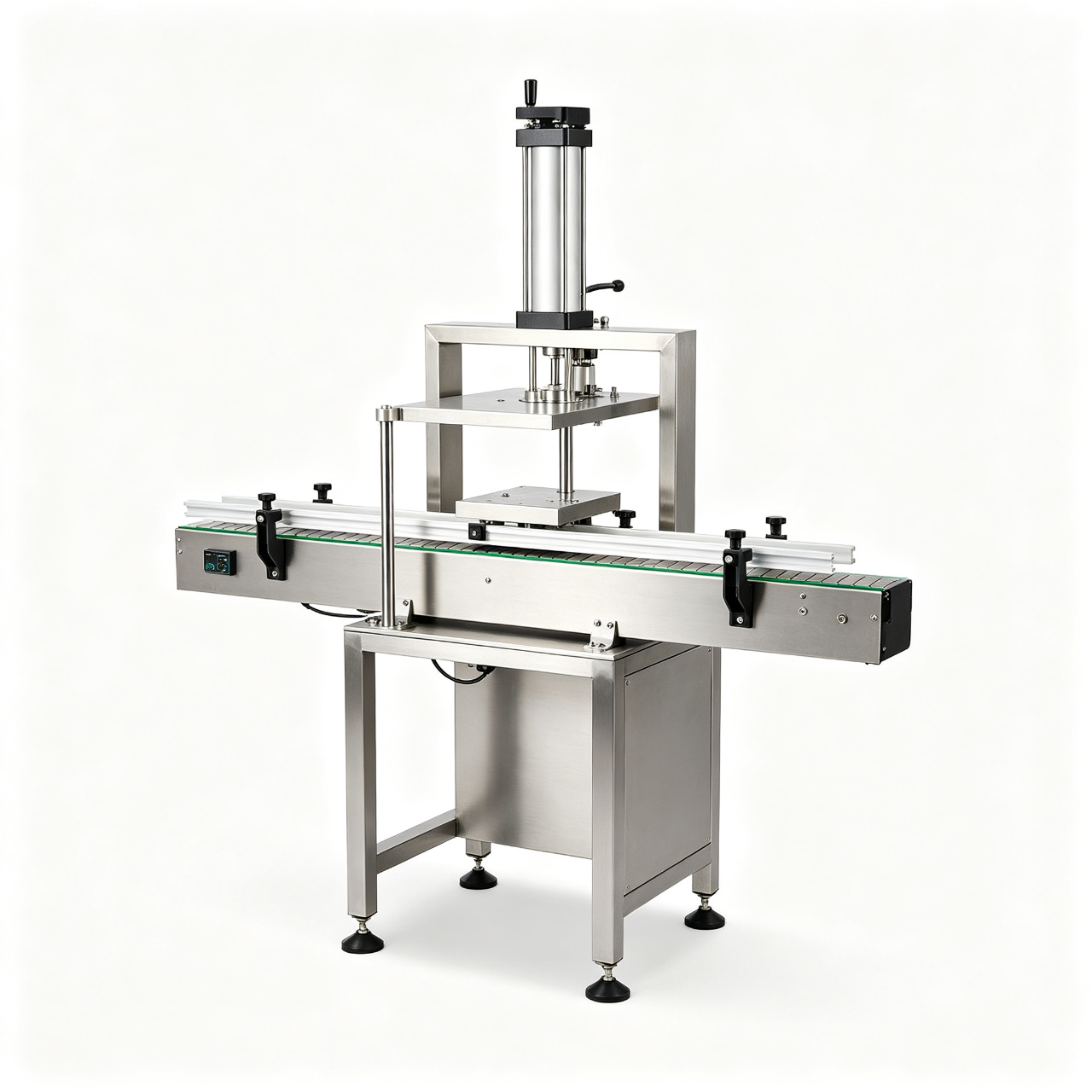
If you are specifying a capping station for a sauce, beverage, cosmetic, chemical, or condiment line, the most consequential decision is not the brand or the price — it is matching the capping mechanism to your closure. A spindle screw capper, an ROPP (roll-on pilfer-proof) capper, a press-on or snap capper, and a crown capper all sit on the conveyor and put a closure on a container, but they operate on completely different physical principles and cannot be substituted for one another. Buy the wrong type and you will live with cross-threaded caps, loose or over-tightened lids, missing tamper evidence, and rejected jars on every shift.
This guide gives production managers, plant engineers, and procurement specialists a neutral, numbers-based comparison of the four main automatic capping methods. It covers the closure and container each one fits, typical throughput and torque control, what it costs, where it wins, and where it falls short — so you can judge supplier quotes against concrete criteria rather than marketing labels.
Quick Comparison: Four Automatic Capping Methods
| Dimension | Spindle / Screw Capper | ROPP Capper | Press-On / Snap Capper | Crown Capper |
|---|---|---|---|---|
| Closure it applies | Pre-threaded screw caps, twist-off lug lids, trigger and pump caps | Plain aluminum shell (no pre-threaded cap) | Snap-on, press-on, push-fit lids and plugs | Metal crown cap (beer / carbonated) |
| Container best fit | Glass and plastic bottles, wide-mouth jars | Neck-finished glass bottles (spirits, oil, vinegar) | Plastic jars, tubs, dairy and food containers | Glass crown-finish bottles |
| Typical torque control | Adjustable spindle torque; servo models store recipe torque | Rolling-pressure controlled by ROPP head, not thread torque | Downward press force; no rotational torque | Crown crimp force; fixed by crown head |
| Typical throughput | 20–200+ containers per minute (inline spindle); rotary higher | 30–150+ bpm on rotary ROPP heads | 30–250 containers per minute | 100–1,500 bpm on high-speed rotary crowners |
| Tamper evidence | Depends on cap design (tamper band, induction seal below) | Built-in: aluminum skirt crimps into pilfer-proof band | Limited; usually paired with a separate seal | Built-in metal seal until crown is removed |
| Common applications | Sauce jars, honey, cosmetics, shampoo, chemical bottles, pump dispensers | Spirits, olive oil, vinegar, pharmaceutical bottles | Yogurt tubs, cream jars, water caps, snap-fit food lids | Beer, cider, sparkling beverages |
| Relative machine cost | Low to medium (inline); medium for servo/rotary | Medium to high | Low to medium | Medium at high speed; low at small scale |
| Main limitation | Cannot form a thread or a pilfer-proof aluminum seal | Wastes aluminum on non-pilfer-proof products; wrong for plastic screw caps | No rotational tightening; seal depends on snap geometry | Only handles standard crown finish; narrow product range |
How Each Capping Method Works
Spindle / Screw Capper
Inline spindle cappers feed the cap onto the container, then a row of rotating rubber or nylon wheels (spindles) drives the cap down the existing threads at a set rotational speed and torque. The cap already has its own thread; the machine only winds it on evenly. Torque is set by wheel pressure and rotation time; servo-driven spindle stations add closed-loop torque control and per-SKU recipe recall, which matters for fragile glass jars and child-resistant or pump closures.
Where it falls short: A spindle capper cannot create a thread, and it cannot produce an aluminum pilfer-proof seal. It works only where the closure and container are already threaded or lug-matched. Over-speed spindles can cross-thread soft plastic caps; under-adjusted spindles leave caps loose.
ROPP (Roll-On Pilfer-Proof) Capper
An ROPP capper places a plain aluminum shell over a glass bottle finish, then a set of forming rollers rolls the soft aluminum onto the bottle thread and crimps a tamper-evident skirt band around the neck. The machine forms both the thread and the seal in one head. This is why ROPP closures appear on spirits, premium oil, and vinegar: the deformed skirt proves the bottle was opened.
Where it falls short: ROPP is the wrong choice for a product that does not need pilfer-proof evidence. You pay for aluminum forming tooling and a more complex head, and you waste material on containers that could close with a cheap plastic screw cap. ROPP heads do not tighten a pre-threaded plastic cap, and they cannot handle snap lids or crowns.
Press-On / Snap Capper
A press-on (snap) capper applies a downward vertical force to seat a push-fit lid or plug into a matching groove. There is no rotation, no thread engagement, and no torque. Sealing quality depends entirely on the snap geometry, lid stiffness, and alignment of the press head to the container.
Where it falls short: Press-on lids cannot resist internal pressure or hot-fill expansion the way a threaded cap does, and they offer little tamper evidence on their own. A sauce or hot-fill product that needs a held torque should not be pushed onto a snap capper.
Crown Capper
A crown capper places a metal crown over a standard glass finish and crimps the skirt down around the bead. It is a purpose-built closure for beer, cider, and carbonated drinks; the seal is the crimped metal itself.
Where it falls short: The method covers almost nothing else. If your product uses screw caps, aluminum shells, or snap lids, a crown capper cannot be adapted, and the high-speed rotary version carries a price suited only to dedicated beverage production.
How to Choose: A Decision Framework
Question 1: What closure do you actually use?
This settles most of the decision before speed or price enter it. Pre-threaded plastic or screw caps, twist-off lug lids, pumps, and triggers go to a spindle screw capper. Plain aluminum shells that need a formed thread and tamper band go to ROPP. Push-fit snap lids and plugs go to a press-on capper. Metal crowns on glass beverage bottles go to a crown capper. If you are still deciding the closure, choose the container and cap together with the capping mechanism in mind — the three cannot be optimized independently.
Question 2: Glass or plastic, narrow or wide mouth?
Glass jars and bottles need controlled torque to avoid cracking the neck, and a servo or indexed chuck station protects fragile finishes. Plastic bottles tolerate higher inline spindle speeds but cross-thread easily if cap placement drifts. Wide-mouth sauce and preserve jars use lug or twist-off closures on spindle cappers; narrow-neck spirits and oil bottles are ROPP territory. Unstable or odd-shaped containers may need an indexing star-wheel rather than a free-flow inline spindle.
Question 3: What torque and seal integrity do you require?
Hot-fill sauce, syrup, honey, and viscous products need a defined closing torque that prevents lid back-off as product cools and creates partial vacuum — servo spindle torque control and recipe memory matter here. Carbonated or pressurized products need a seal that holds internal pressure, which points to crown or pressure-rated closures. If tamper evidence is a market-entry requirement, ROPP forms it directly; for screw and snap closures you will layer an induction foil seal under the cap instead.
Question 4: What throughput do you need?
Under 40 containers per minute — an inline spindle capper or semi-automatic chuck capper covers the range with the lowest capital outlay. 40–120 per minute — multi-spindle inline screw capper, or rotary ROPP head for aluminum closures. Above 120 bpm — rotary capping turret; below this range a rotary machine is a costly under-used option. Always size the capper to the real bottleneck of the complete packaging line, not to an ideal filler speed.
Question 5: How many SKUs and how often do you change over?
Multi-SKU plants switching between cap diameters, jar sizes, and torque settings need servo recipe recall, tool-less changeover parts, and adjustable cap feeders. A fixed dedicated capper is cheaper for a single high-volume format but loses that flexibility. Record your largest and smallest cap and container, and the changeover time your operations team can accept, before comparing machine prices.
Selection Checklist Before You Request a Quote
Send these details to any supplier, not only SunAura. The specificity of their questions tells you how seriously they will match the machine to your closure:
- Exact closure: cap or lid type, material, diameter, thread or lug profile, whether it carries a tamper band
- Container: material (glass / PET / HDPE), neck or mouth diameter, height range, shape and stability on the conveyor
- Product state at capping: ambient, hot fill, cooled, foamy; internal pressure or vacuum after sealing
- Required closing torque range and removal torque tolerance, with any regulated seal requirement
- Target containers per minute at both largest and smallest SKU, plus expected growth
- Number of SKUs, cap sizes, and accepted changeover time between formats
- Whether tamper evidence must come from the closure itself or from a separate induction seal
- Existing filler, conveyor, and downstream labeller speeds, so the capper can be balanced into the line
Common Mistakes to Avoid
Choosing ROPP for a product that does not need it. If your closure is an ordinary plastic screw cap, an ROPP head buys aluminum-forming capability and tamper evidence you will not use, at higher machine cost and per-bottle material waste. Match the mechanism to the closure, not the other way around.
Specifying a press-on capper for hot-fill sauce. Press-on lids seat by snap force alone and back off under cooling vacuum and thermal movement. Hot-fill viscous products need a threaded, torque-controlled closure.
Buying speed beyond the rest of the line. A 150-bpm rotary capper behind a 40-bpm filler is an expensive queue. State the combined line throughput you intend to run, and have the supplier confirm the capper, filler, and conveyor are balanced.
Ignoring torque measurement and changeover. Ask for the actual torque repeatability the machine delivers on your cap, and the measured changeover time between two of your SKUs — not the theoretical best case on a clean single format. For multi-SKU production, recipe memory and tool-less parts are worth more than a slightly lower list price.
Not sure which capping mechanism matches your closure? Send us your cap and container samples, product temperature, target containers-per-minute, and torque requirement. Our engineering team will recommend the right capping method, send a line layout, and quote within 48 hours. Contact [email protected] or use the contact form.
Bottom Line
There is no universal “best” capping machine — there is the right mechanism for your closure. Pre-threaded screw and twist-off caps, pumps, and triggers go to a spindle screw capper; plain aluminum shells that must form thread and tamper band go to ROPP; push-fit lids go to a press-on capper; crowns go to a crown capper. Once the closure type is settled, choose the inline or rotary platform by your real throughput, torque requirement, and number of SKUs. Start from the cap and container before you look at machine price, and the choice usually makes itself.
SunAura supplies torque-controlled spindle capping stations integrated with servo filling machines and complete packaging lines for food, condiment, cosmetic, and chemical producers. Compare available equipment under products, review food and beverage configurations in solutions, and read more buying guidance in the help center.