
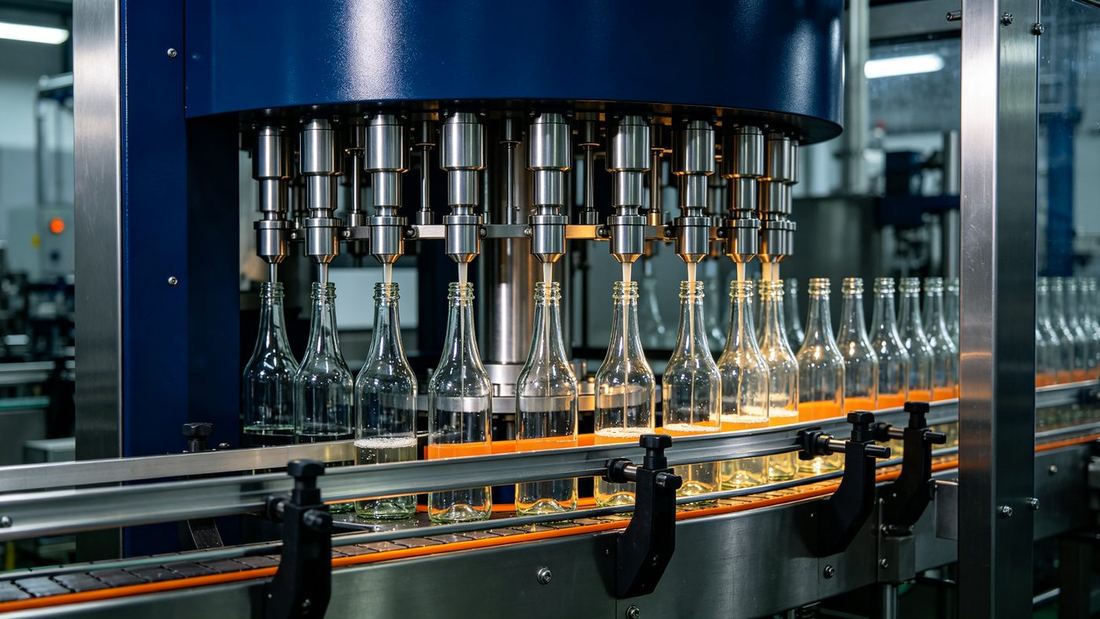
If you are specifying a liquid filling machine for a food, cosmetic, chemical, or pharmaceutical line, the first and most consequential decision is not the brand or the price — it is the filling principle. Overflow fillers, piston fillers, and gravity fillers look superficially similar (all three sit on a conveyor and squirt liquid into bottles), but they are optimized for completely different products, container types, and throughput expectations. Pick the wrong one and you will live with mis-fills, foam overflow, product waste, and bottlenecked downstream equipment for the life of the line.
This guide walks through how each filling principle works, where it fits on the viscosity and throughput matrix, what it costs, and when to choose one over the others. It is written for production managers, plant engineers, and procurement specialists who are comparing quotes and need a neutral, numbers-based framework rather than a vendor pitch.
Quick Comparison at a Glance
| Dimension | Overflow Filler | Piston Filler | Gravity Filler |
|---|---|---|---|
| Best product viscosity | Thin liquids (< 50 cP) | Thin to very viscous (1-100,000 cP) | Thin, non-particulate (< 20 cP) |
| Typical accuracy | ±0.5% (level fill) | ±0.5% (volumetric) | ±1-2% (volumetric) |
| Throughput range | Up to 300+ bpm | 20-160 bpm | 30-200 bpm |
| Foam handling | Excellent | Moderate | Poor |
| Particulates | No | Yes (up to ~12mm chunks) | No |
| Typical applications | Water, juice, spirits, oils, glass cleaner | Sauces, honey, shampoo, lotion, gels | Wine, oil, chemicals, low-cost water |
| Relative machine cost | Medium | Medium-High | Low |
How an Overflow Filler Works
An overflow filler dispenses liquid through a nozzle that descends into the bottle and opens a flow valve. Liquid keeps pouring in past the bottle’s target level; excess liquid drains back through a return tube in the nozzle to the supply tank. Once the liquid reaches the nozzle tip — which sits at the desired fill height — the bottle is “full” and the excess returns to the tank.
The critical insight is that overflow fillers fill to a level, not a volume. Every bottle ends up with the liquid at the same height, regardless of small variations in bottle volume. This is why overflow fillers dominate the clear-bottle market: water, juice, spirits, and cooking oil in glass or PET bottles where every bottle must look identical on the shelf.
Because the nozzle is submerged and the flow is relatively gentle, overflow fillers also handle foam well. Carbonated drinks, beer, and foamy juices can be filled without the headspace foam that plagues other filling methods. Modern servo-controlled overflow fillers can run 200-300+ bottles per minute on 500ml containers.
Where overflow fillers fall short: They only work on thin, free-flowing liquids. Anything thicker than roughly 50 cP (think light shampoo, thin sauce) does not drain back fast enough, and the fill cycle stretches out. They also cannot handle particulates — chunks of fruit, pulp, or seeds clog the return tube. And because they fill to a level rather than a measured volume, they are a poor choice when net weight or exact fill volume is regulated (e.g., pharmaceutical liquids, chemical reagents).
How a Piston Filler Works
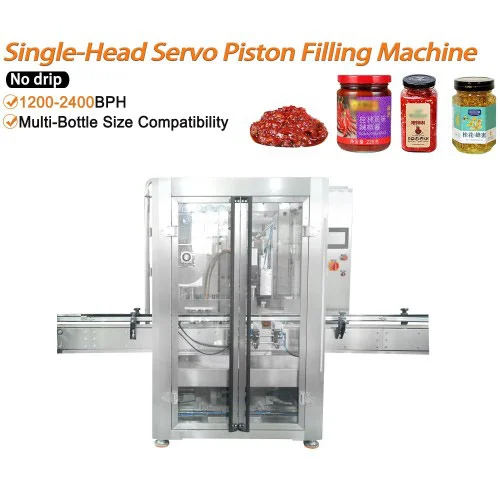
A piston filler uses a precision-bore cylinder and a reciprocating piston to draw a measured volume of product from the supply hopper and push it out through the nozzle into the bottle. The piston stroke length sets the fill volume; the speed of the piston sets the fill time. Modern servo-driven piston fillers control both stroke and speed independently for each head.
Piston fillers are the most versatile of the three principles. They handle everything from thin water (1 cP) up to very viscous products like peanut butter, toothpaste, and heavy cream (100,000 cP+). Because the product is drawn and pushed by the piston rather than relying on gravity or tank pressure, viscosity is not a constraint — it just changes the cycle time. Piston fillers also handle particulates well: a properly designed cylinder and valve can pass chunks up to 10-12mm, which makes them the default choice for salsa, fruit jam, soup with vegetables, and pet food pouches.
Fill accuracy on a well-tuned servo piston filler is typically ±0.5% of the target volume, which meets most net-weight regulations. The trade-off is speed: because each piston must complete a full draw-and-dispense cycle per fill, piston fillers top out around 120-160 bottles per minute on a 12-head rotary platform, and 40-60 bpm on a linear 4-6 head machine. They are also more expensive than gravity fillers because of the precision cylinders, valves, and servo drives.
Where piston fillers fall short: They are overkill for thin, non-viscous, non-particulate products. Filling water or light oil with a piston filler works, but you pay a premium for accuracy and speed you do not need, and the clean-in-place cycle is more complex. Piston fillers also require more maintenance — the seals and valves are wear parts and need periodic replacement, especially with abrasive or acidic products.
How a Gravity Filler Works
A gravity filler is the simplest of the three. Product sits in an overhead tank, and each nozzle opens a valve for a set time. Liquid flows into the bottle by gravity. Fill volume is controlled by the valve open time, with the assumption that the flow rate is constant.
Gravity fillers are cheap, simple, and easy to maintain. They work well for thin, non-foamy, non-particulate products where ±1-2% accuracy is acceptable: wine, bulk oil, household chemicals, and low-cost water bottling. Because there are no pistons or pumps in the product path, gravity fillers are easy to strip down and clean, and they handle corrosive chemicals without exotic materials.
Where gravity fillers fall short: Accuracy drifts as the overhead tank drains (flow rate drops as head pressure drops), unless the machine has a constant-level tank or level control. They do not handle foam well — the free-falling stream agitates the liquid and creates headspace foam. They cannot handle viscous products at all (anything above ~20 cP flows too slowly). And they are a poor choice for carbonated or oxygen-sensitive products, because the free-fall aerates the liquid.
How to Choose: A Decision Framework
Start with three questions about your product, then match to the filling principle.
Question 1: How viscous is your product?
Thin (under 50 cP) — water, juice, wine, oil, thin chemicals. You have a choice between overflow and gravity. Choose overflow if you need level fills in clear bottles, high speed, or foam handling. Choose gravity if accuracy can be ±1-2% and cost is the priority.
Medium (50-5,000 cP) — shampoo, lotion, sauce, cream. This is piston filler territory. Overflow cannot drain back fast enough; gravity cannot push the product. A servo piston filler handles this range across its full stroke.
Thick (5,000+ cP) — honey, peanut butter, toothpaste, gel. Piston filler is the only realistic option. Some producers use pressure-tank overflow fillers for thick creams, but the accuracy and cleanability are worse than a properly specified piston filler.
Question 2: Does your product have particulates or foam?
Particulates (fruit chunks, pulp, vegetable pieces) — piston filler only. Overflow return tubes and gravity valves will clog. Make sure the supplier specifies a particulate-compatible valve and cylinder bore sized for your largest chunk.
Foam (carbonated, beer, foamy juice, dish soap) — overflow filler with submerged nozzles, or a piston filler with slow-start dispense. Gravity filler will create foam. A piston filler can dispense slowly at the start and speed up once the nozzle is submerged, which controls foam on moderately foamy products.
Question 3: What throughput do you need?
Under 60 bottles per minute — any of the three will work. Choose based on product and budget. A linear 4-6 head piston filler handles this range cleanly.
60-160 bpm — servo piston filler (rotary or linear) or overflow filler. At this range the servo control and bottle handling become as important as the filling principle itself.
Over 160 bpm — overflow filler for thin liquids, or a high-head rotary piston filler for viscous products. Above 300 bpm, the decision is usually made for you: only overflow fillers for thin liquids can run that fast on a practical footprint.
Common Mistakes to Avoid
Buying a piston filler for water. It works, but you pay 30-50% more for accuracy you do not need and take on maintenance you do not want. For thin non-particulate products, an overflow or gravity filler is the right tool.
Specifying an overflow filler for shampoo. Shampoo at 1,000-3,000 cP does not drain back through the overflow nozzle at the required rate, and the fill cycle stretches out. By the time the product drains back, the next bottle is waiting. This is the most common mis-application we see.
Ignoring the CIP and cleanability. A filler that looks cheap on the quote can become expensive if it takes 45 minutes to strip down between batches. Ask suppliers for the actual strip-down and CIP cycle time, not just the fill speed.
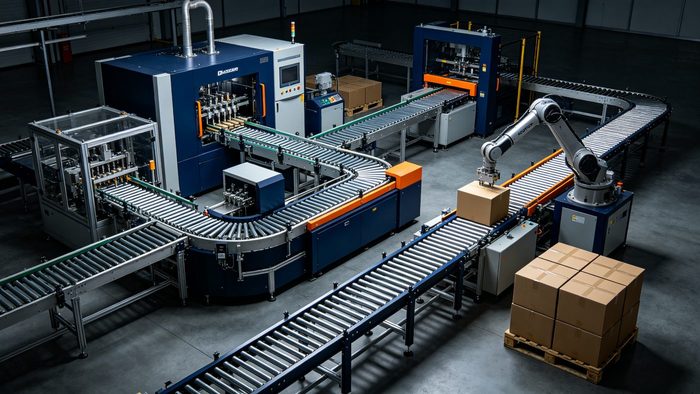
Forgetting the rest of the line. The filler is the bottleneck only if the upstream unscrambler and downstream capper/labeler can keep up. Specify the whole line together — a 200-bpm filler feeding a 60-bpm capper is just an expensive queue. Integrated lines are specified as a system, not as individual machines.
Not sure which filling principle fits your product? Send us your product viscosity, container type, target fill volume, and desired throughput. Our engineering team will recommend the right filler type, send a line layout, and quote within 48 hours. Contact [email protected] or use the contact form.
Bottom Line
There is no universally “best” filling machine — there is only the right filling principle for your product and your throughput. Thin clear-bottle products go overflow. Viscous, particulate, or regulated-volume products go piston. Low-cost thin products where ±1-2% accuracy is acceptable go gravity. If you start with the product rather than the price, the decision usually makes itself.
SunAura builds servo piston fillers across single-head, multi-head linear, and rotary configurations, and supports customers in choosing the right platform for their application. More detail on available models is on the liquid filling machines page, and our broader equipment range is listed under products. For more buying guidance, see our help center and after-sales documentation.