


October 2, 2026 | by Monica, SunAura Machinery Applications Engineering
Every production manager we meet wants the same answer: “How long until this packaging line pays for itself?” The honest answer is that most people calculate it wrong. They take the purchase price, divide by the number of workers they think they’ll replace, and call it a day. That approach misses three-quarters of the real savings — and often overstates the labor reduction, which is the first thing finance teams challenge.
After helping customers build business cases for more than 200 packaging line investments, we’ve standardized the calculation we walk every buyer through. This is the spreadsheet we use on the first sales call — the one that tells you whether the project is a slam-dunk, a maybe, or a hard pass.
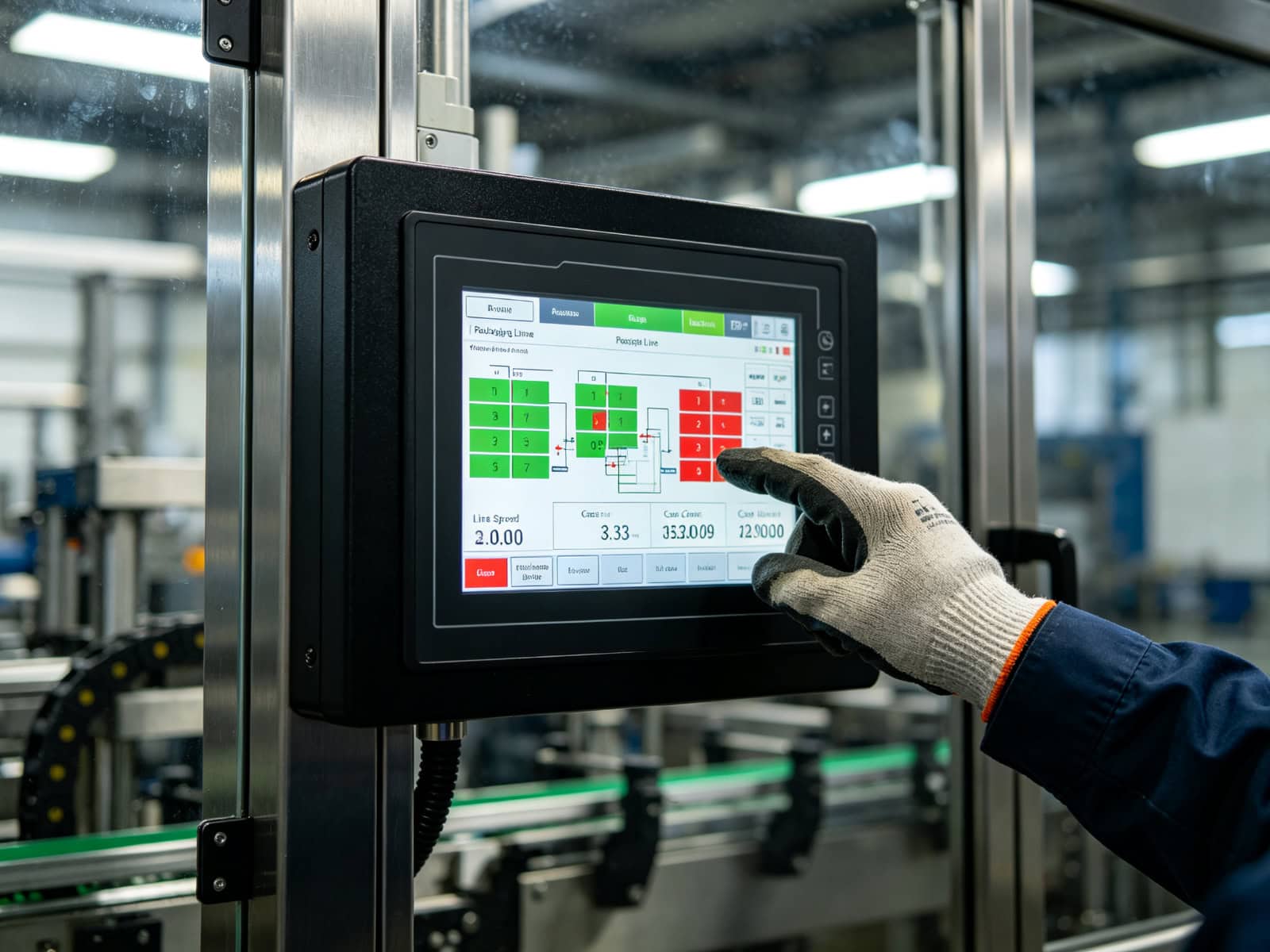
For a worked example of this method in practice, SunAura recently published the full payback breakdown of its upgraded semi-automatic pallet wrapper series — film savings, labor savings, and the payback window for a mid-size export facility, calculated line by line.
The ROI Formula
It’s simpler than finance teams make it sound:
Payback Period = Total Investment ÷ Annual Net Savings
Total investment is the machine price plus installation, training, spare parts and shipping. Annual net savings is the annual benefit minus the extra operating costs (electricity, maintenance, film scrap during ramp-up). Most packaging machines have a 10–15 year service life, so a payback under 3 years is strong, under 2 years is excellent, and under 12 months is rare outside of high-volume bottleneck relief.
Step 1: Calculate Your True Labor Cost
The biggest line item — and the one people get wrong. A worker who earns $18/hour doesn’t actually cost $18/hour. The loaded labor cost — wages, payroll taxes, benefits, training, turnover — typically runs 1.45 to 1.8 times the base wage. So that $18/hour operator is really costing you $26–$32/hour.
| Cost Component | Multiplier on Base Wage |
|---|---|
| Base wage | 1.0× |
| Payroll taxes and statutory benefits | +12–15% |
| Health insurance / pension | +15–25% |
| Turnover and recruiting (at 20% annual turnover) | +10–15% |
| Training and supervision | +5–10% |
| Total loaded labor cost | 1.45–1.8× base wage |
Then count how many workers the line actually removes or redeploys. Be conservative: automation rarely eliminates headcount entirely. A realistic target is 40–60% labor reduction on the packaging floor — not 100%. If you currently run 5 people per shift on manual packing, a line might free up 2–3, not all 5.
Example: 3 operators per shift, 2 shifts, at $30/hour loaded cost. Annual labor savings = 3 × 2 × $30 × 2,000 hours = $360,000. Apply the realistic 50% reduction: $180,000/year.
Step 2: Add the Savings You’re Not Counting
Labor is the biggest line, but it’s not the only one. The four savings below often add another 20–40% on top of labor — and they’re the ones finance teams forget to challenge.
Material waste reduction
Manual packing means torn film, mis-sealed bags, and product dropped on the floor. An automatic flow wrapper seals consistently, so film scrap drops from 3–5% to under 1%. For a line spending $500,000/year on film, that’s $100,000–$200,000/year in waste savings alone.
Throughput increase
If your current line runs at 60% OEE and the new one runs at 85%, you’re getting 40% more output from the same floor space — without adding a shift. The margin on that extra product is nearly pure profit. We worked with a biscuit producer who added two hours of production per day after installing a servo wrapper, generating $240,000/year in incremental revenue.
Reduced rework and chargebacks
Mis-sealed bags leak. Overfilled packages get rejected. Retailers charge back for non-conforming packs. An automatic line with integrated checkweighing and vision inspection catches these before they ship. For food exporters selling to European or US retailers, chargeback avoidance alone can justify a six-figure machine.
Avoided overtime and temp labor
Seasonal peaks mean overtime at 1.5× or temp agency fees at 1.3×. An automatic line runs at the same speed in July as in December — you don’t need to hire 12 temp workers for three months. This is a real and recurring saving, especially for seasonal food producers.
Step 3: Subtract the Costs You’re Forgetting
A line isn’t free to run. Add these back in:
- Electricity: A servo packaging line draws 15–40 kW. At $0.10/kWh, that’s $12,000–$32,000/year on a two-shift line.
- Maintenance: Budget 3–5% of the machine purchase price annually for planned maintenance, spares and consumables.
- Film and consumables: Better film control usually reduces film cost, but don’t assume it’s zero.
- Operator training: Budget one week of training time at commissioning, plus annual refreshers.
Worked Example
A mid-size food producer installs a turnkey packaging line (flow wrapper + case erector + strapping machine + palletizer) at a total delivered cost of $280,000.
| Line Item | Annual Amount |
|---|---|
| Labor savings (3 FTE at $30/hr loaded, 50% reduction) | +$180,000 |
| Film waste reduction | +$60,000 |
| Incremental throughput margin | +$80,000 |
| Chargeback and rework reduction | +$25,000 |
| Electricity and maintenance | −$22,000 |
| Annual net savings | $323,000 |
| Payback period | $280,000 ÷ $323,000 = 10.4 months |
That’s an exceptional result — but it’s the kind we see when labor is expensive, waste is high, and the line removes a genuine bottleneck. For more typical operations, expect payback between 12 and 24 months. Beyond 36 months, you’re usually better off making incremental improvements to existing equipment rather than buying a whole new line.
Want us to run your numbers? Send us your current headcount per shift, annual film spend, and your target throughput through the contact page, and we’ll build a tailored ROI model for your plant. We’ll also tell you honestly whether your case is strong or weak — we’d rather lose a sale than install a line that doesn’t pay back. Browse our turnkey packaging lines and individual machines to see the equipment levels that drive the fastest returns.
The bottom line: build the business case on all five savings lines — labor, waste, throughput, chargebacks and overtime — not just headcount. Be conservative on how many workers you actually remove. And if the payback comes in under 24 months on realistic numbers, the project is almost always worth doing.