
Air-Cooled Continuous Induction Sealer: What the New Model Covers
SunAura has expanded its induction sealing range with a continuous air-cooled sealer built for high-volume PET and glass bottle lines in beverages, edible oils, sauces, supplements and chemical liquids. The model sits alongside our existing water-cooled and bench-top sealers, so buyers do not have to over-specify a water-cooled cabinet for a line that does not need it, and do not under-specify a bench-top unit for continuous production.
How the Air-Cooled Unit Differs from a Water-Cooled Sealer
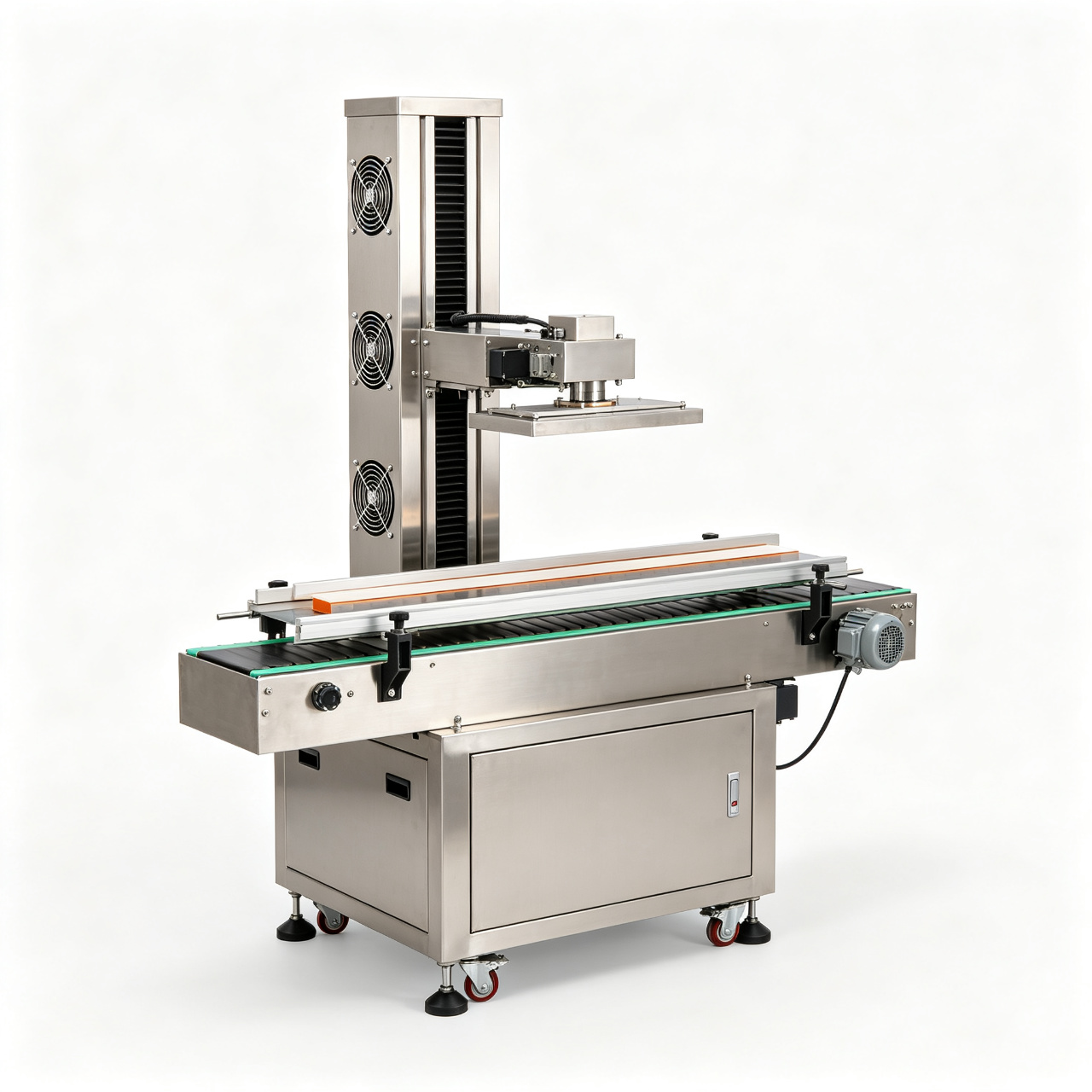
Induction sealers work by passing the cap through an electromagnetic field that heats an aluminum foil liner bonded to the bottle neck, fusing it to the rim. The sealing head itself heats up during operation, and the cooling method separates the machine families.
An air-cooled sealer uses a fan and heatsink to dissipate head heat. It needs no water supply, drainage, water treatment or chiller, which lowers installation cost and makes it easier to place beside an existing filler and capper. A water-cooled sealer circulates deionized water through the head to hold temperature steady during long runs at higher output; it costs more to install but sustains continuous duty where air cooling would push head temperature to its limit.
| Option | Cooling method | Typical speed range | Installation needs | Best fit | Limitations |
|---|---|---|---|---|---|
| Air-cooled continuous sealer | Fan + heatsink | Up to roughly 3,000–6,000 bottles/hour, depending on neck diameter | Power and conveyor only; no water or drain | Beverages, sauces, edible oils, supplements, chemical liquids; lines that want a simple inline install | Not ideal for sustained runs above its rated duty cycle; very wide or tall necks may need the water-cooled head |
| Water-cooled continuous sealer | Deionized water circulation | Higher sustained output, wider neck range | Water supply, drain, deionized water or treatment | 24/7 high-speed lines, large necks, heavy-duty packaging | Higher install cost, water maintenance, more utilities on site |
| Bench-top / tabletop sealer | Air-cooled, manual feed | Low volume, hand-fed bottles | Bench space and power | Lab batches, sample runs, small production | Not for an inline continuous line; no conveyor integration |
What the Air-Cooled Model Covers in Practice
The continuous air-cooled unit runs inline after the capper on a conveyor, so sealed bottles move through the field without stopping. It handles standard screw-capped PET, HDPE and glass bottles and jars across common neck diameters used for still water, juice, edible oil, dressings, shampoo, capsules and liquid supplements. The head height and conveyor speed are adjustable for different bottle heights, and the coil can be matched to the neck diameter rather than forcing one coil across every product.
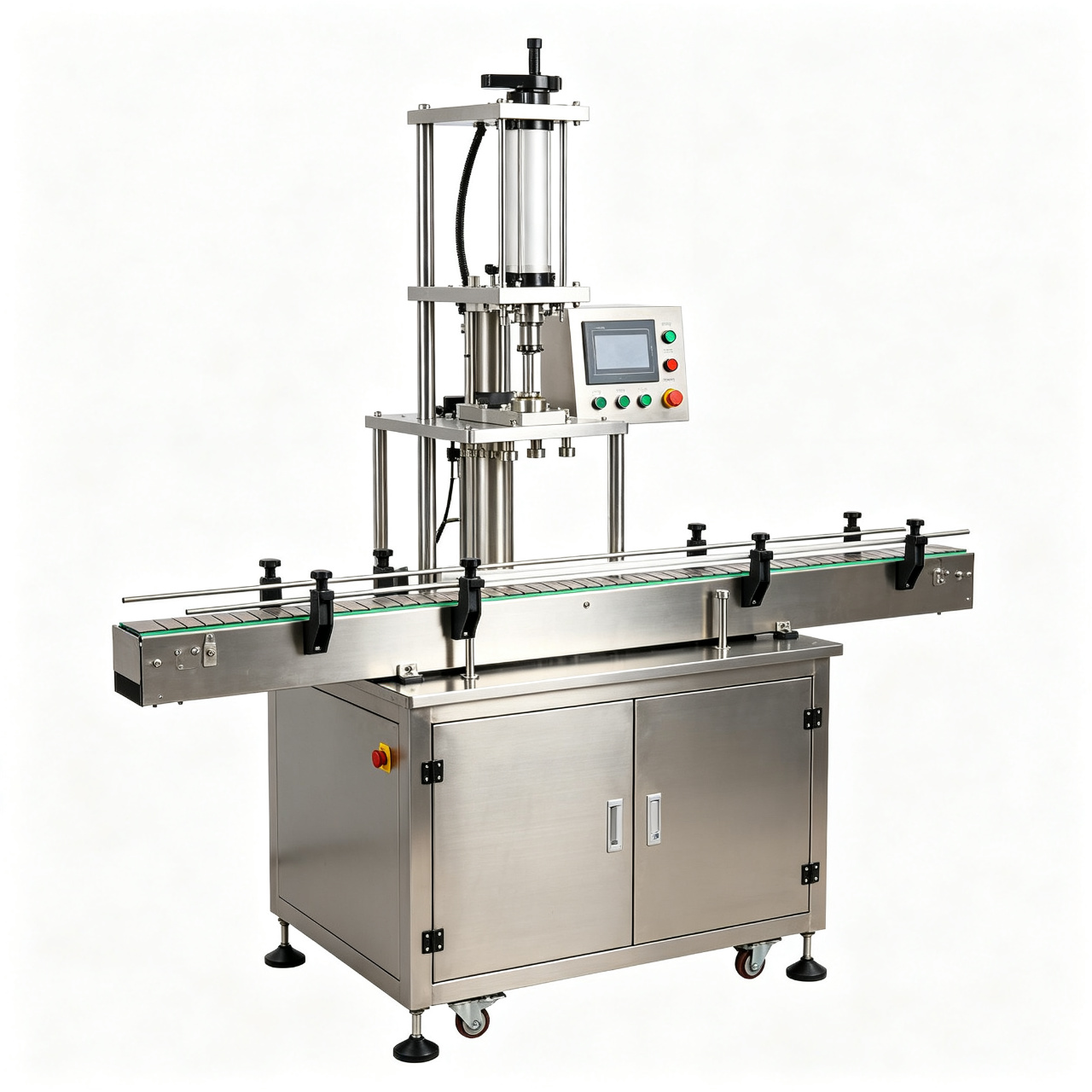
Seal quality is checked the same way across the range: after sealing, the foil liner should bond evenly around the full neck circumference, with no wrinkling, partial fusion or loose edges. On the line this is verified with visual inspection and, where the product demands it, a leak or seal-integrity check downstream. The coil diameter and head gap are matched to the neck so the field concentrates on the foil rather than heating the cap body or the product below. Bottles with tall or narrow necks, foamy fills, or products sensitive to heat transfer need the head positioned and tuned during commissioning rather than set to a generic gap.
For buyers comparing sealers, the decision usually comes down to three inputs: target bottles per hour, neck diameter range, and whether the line runs single shifts or nearly continuous duty. A single- or two-shift line under roughly the air-cooled rating rarely needs the water circuit; a 24/7 high-speed line or an unusually wide neck should go water-cooled. We recommend sending bottle drawings, fill volume, cap type and target speed so the coil and head can be sized before the quotation is finalized.
Who This Model Suits, and Where to Look Elsewhere
This air-cooled continuous sealer fits buyers adding tamper-evident, leak-proof foil sealing to an existing filler–capper line, and buyers who want to avoid plumbing a water circuit into the machine room. It pairs naturally with our liquid filling machines, capping machines and turnkey packaging lines, so the conveyor spacing and line speed can be balanced in one project rather than matched machine by machine.
If your line runs round-the-clock at the top of the speed range, seals very large necks, or packages products that demand water-cooled thermal stability, our water-cooled continuous range is the more appropriate base machine. If you are sealing only lab batches or a few hundred bottles a day, a bench-top sealer costs less and is faster to set up.
Next Step
Send us your bottle or jar drawing, neck diameter, cap and liner type, target output per hour and shift pattern. Our engineers will size the coil, confirm cooling method and quote the inline unit to match your existing conveyor and line speed. You can review our certifications and build standards, see the workshop and equipment on site, or reach our sales team directly.
Request a sizing check for your bottle and speed. Email [email protected] or WhatsApp +86 136 4542 9121 with your bottle drawing and target output.