
A second build position, one arm: how the SunAura dual-station robotic palletizer sits in our lineup
This note describes the SunAura dual-station robotic palletizer as a positioning and engineering exercise, not a product announcement. It explains where the machine belongs against a single-station robot cell, a conventional layer palletizer and a gantry frame; it states the payload, reach and throughput limits the design was built around; and it lists the operations where buying this machine would be the wrong call. The machine runs one articulated arm over two pallet build positions, arranged on opposing or adjacent conveyors. While the arm builds layer after layer on position one, the finished pallet on position two can be removed and replaced without stopping the incoming case flow.
That second position is the whole point of the design. In a single-station cell, every pallet change is a stop: the arm finishes the top layer, lifts away, the fork truck or pallet dispenser swaps the load, and the arm stands idle until a fresh empty pallet is clamped and located. At high feed rates those gaps stack up quickly, and the nominal picks-per-hour rating of the robot never reaches the floor. The dual-station layout moves pallet exchange off the critical path so the arm keeps picking while the downstream station is serviced. The trade-off is a larger floor envelope, a second set of conveyors and fixtures, and a control program that tracks two pallets, two layer counts and two discharge states at the same time.
We write this the way we would brief an engineering review: what the machine does, what it costs in footprint and complexity, where its envelope ends, and which line profiles should look elsewhere in the range. The companion notes on how a robotic palletizer works, robotic palletizer cost and palletizer safety cover the mechanics, the money and the guarding rules; this note stays on placement and boundary conditions.
What the dual-station layout contains
The cell is built around an articulated four-axis palletizing robot in the 120 kg or 180 kg payload class, with a horizontal reach in the 2.4–3.2 m band selected to span two build positions plus the infeed conveyor. The arm carries a pneumatic gripper — vacuum pad for corrugated cartons, clamp or fork frame for bags and bulk containers — mounted through a quick-change plate. Two build positions sit within that reach, each with its own pallet location, datum stops and sensor set that confirms pallet presence, squareness and layer count before the arm commits to the next pick.
The control layer manages four states per station: empty pallet ready, building, layer complete, and load ready for discharge. A queue logic decides which station receives the next layer based on feed order, mix and discharge availability. Pallet exchange can be manual, using a pallet dispenser and a fork truck or walkie rider working behind a light curtain, or automatic with a powered discharge conveyor that carries the finished load to a stretch wrapper. Case infeed feeds from one conveyor; diverts or lanes can split mixed cases toward the correct pallet pattern where the line runs two SKUs at once.
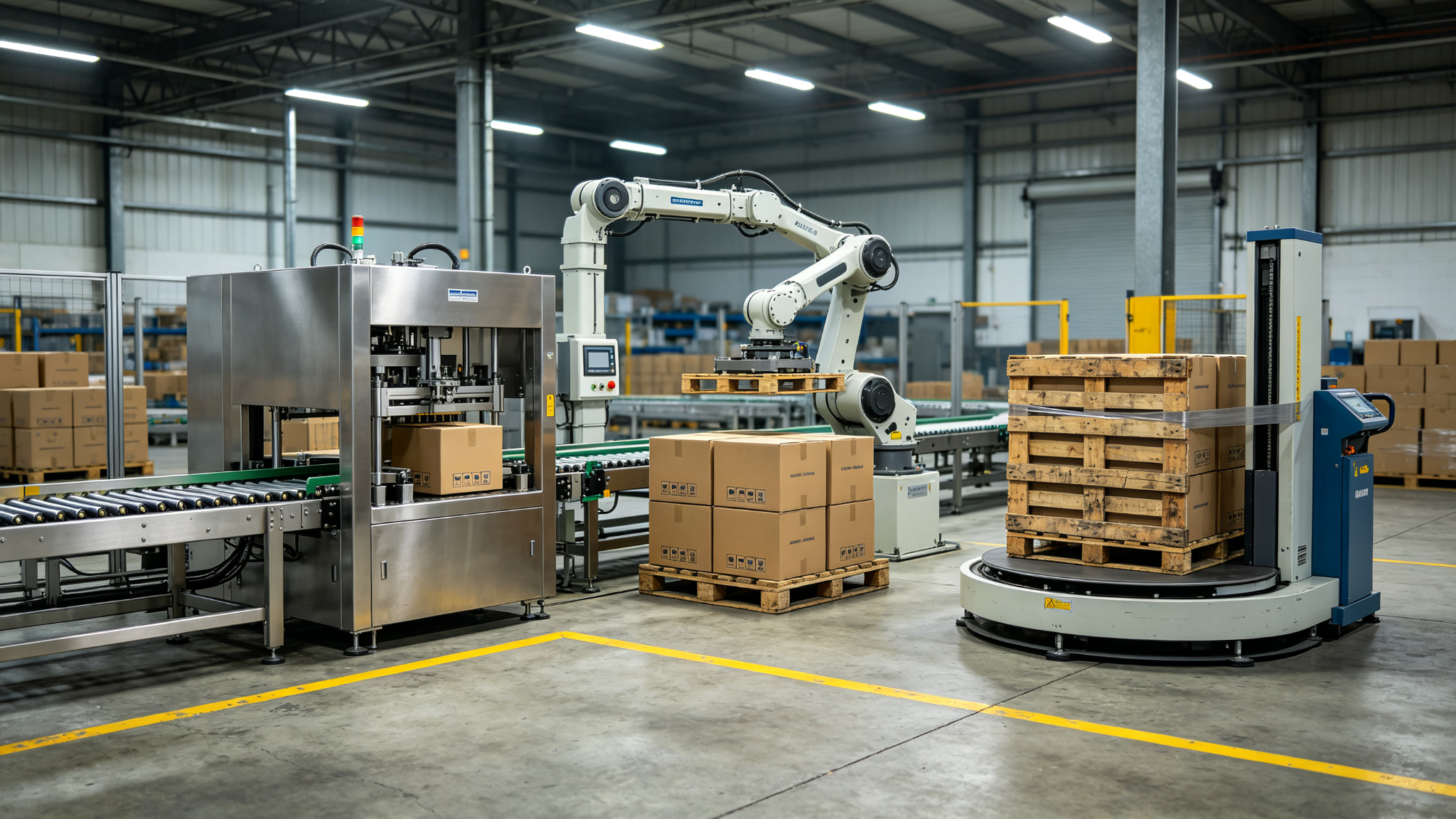
Pneumatics follow the standard palletizing profile: vacuum grippers draw roughly 40–80 Nl/min of average air at 5–6 bar supply, with one suction cup per case face or a full foam pad for uneven cartons. Porous corrugated, open-top cases or shrink-wrapped bundles change the gripper selection, and that decision happens before layout, not after the cell arrives on site.
Single station, dual station, layer machine: the positioning comparison
Before sizing a dual-station cell it helps to set the three main alternatives side by side. The table below uses the engineering bands we quote for planning; exact figures are verified at FAT against the actual case, pallet and pattern data.
| Dimension | Single-station robot cell | Dual-station robot cell | Conventional layer palletizer |
|---|---|---|---|
| Build positions | One pallet at a time | Two pallets, one arm serving both | One or two lanes, layer-by-layer stacking |
| Nominal pick rate | 700–900 picks/h single pick, up to ~1200 picks/h with optimized motion | Same arm pick rate; exchange time removed from cycle | 1–3 layers/min, not picks per minute |
| Realized output | Reduced by every pallet-change gap | Approaches 1.6–1.9x the single-station output at the same pick rate | High for one steady SKU; drops when patterns change |
| SKU mix | Good for one to two patterns, moderate changeover | Handles two concurrent pallets and mixed lanes | Best at steady single-SKU high throughput |
| Floor envelope | Smallest robot footprint | Larger; two stations plus discharge | Tall; high-level versions need 4.5 m+ ceiling and a mezzanine |
| Pallet exchange | Stops the arm each swap | Off-cycle on the free station | Integrated magazine and discharge conveyor |
| Best fit | Low-to-moderate rate, slack in the schedule | Continuous feed, two shifts, mixed or heavy loads | Single-product run at sustained layer rates |
The conventional high-level layer palletizer remains the right answer for a narrow, steady run: one product, one pallet spec, one pattern, running for shifts on end at 1–3 layers per minute. Its mechanical layer plate and hoist are simple to service and its guarding envelope is easier to define. Where it loses ground is mix. A pattern change on a layer machine means lane guides, platen settings and sometimes a program change, and the machine does not split its attention between two pallets. The dual-station robot exists for the opposite profile: more than one SKU, loads that arrive in uneven bursts, and a dispatch cycle that does not wait for the palletizer.
The operating boundary: when the second station pays off
A dual-station cell spends money on a second conveyor, second fixtures, second sensor set and extra control logic. That spend pays back only when the single-station wait would otherwise be real and repeated. We look for four conditions before we recommend the dual layout.
- Feed rate above single-station available cycle. If cases arrive faster than the arm can pick plus exchange in the same window, the infeed backs up. The trigger is measurable: compare required picks per hour against the arm rating after exchange losses, not against the brochure figure.
- Pallet exchange takes long enough to matter. A swap that consumes 60–90 seconds on a single station, repeated every pallet, removes several picks per hour. At 200–300 cases per pallet that gap shows up as missed cases by the end of a shift.
- Two shifts or continuous running. The idle time that a dual station removes compounds over hours. A one-shift line with slack between lots can often carry the exchange gap without a second station.
- Concurrent pallets or mixed SKUs. When two products build at once, or when one pallet must wait for a labeling or QC step, the second station holds that load without blocking the arm.
The 1.6–1.9x multiplier, and where it comes from
The dual station does not make the arm move faster. Its cycle per pick stays in the 3.5–6 s band for a 120 kg-class arm, and the 700–900 picks/h single-pick rating does not rise. What changes is the share of elapsed time the arm spends actually picking. In a single station, each pallet change inserts a stop: locate empty pallet, confirm datum, resume pattern. In a dual station that stop happens on the station the arm is not using, so arm utilization climbs. The realized output lands in the 1.6–1.9x band relative to the same arm on one station, with the lower end for short pallets and frequent exchanges, the upper end for tall pallets where exchange happens less often per case.
Work the boundary with real numbers before sizing. Suppose an infeed delivers 480 cases per hour, each pallet holds 240 cases, so a pallet completes every 30 minutes. A single-station arm that loses 75 seconds per exchange loses 2.5% of the hour to swaps; that may be tolerable. If the line delivers 720 cases per hour and pallets hold 180 cases, an exchange every 15 minutes with a 90-second swap removes closer to 10% of available arm time, and the backup appears at the case packer exit. That second profile is where the dual layout starts to earn its floor space.
Payload, reach and throughput limits
The dual-station cell does not change the arm’s physical envelope. The numbers below are the planning bands we work inside; a specific order locks to the selected arm at FAT.
| Parameter | Band or limit | Notes |
|---|---|---|
| Payload class | 120 kg or 180 kg arm | Payload includes gripper weight; deduct the gripper before declaring case-plus-layer capacity |
| Horizontal reach | 2.4–3.2 m | Must span infeed plus two build positions; reach drops at the edge of the envelope |
| Cycle per pick | 3.5–6 s | Depends on pattern height, lift height and whether the arm returns to a home position |
| Pick rate | 700–900 picks/h single pick; up to ~1200 picks/h optimized | Pattern-heavy layers with repositioning sit nearer the lower figure |
| Vacuum air | 40–80 Nl/min average, 5–6 bar | Verify supply at the cell; porous board and foam pads draw more |
| Load size | Standard euro or GMA pallet envelopes within reach | Oversized pallets, wide bags or double-stacked bulk bags are checked against the 180 kg arm and frame tool |
Three limits come up most often in reviews. First, payload is arm plus tool: a 120 kg arm carrying a 25 kg clamp frame has 95 kg left for the case or bag, and a layer of several units handled together must stay under that net. Second, reach is not a flat circle at full load; the farthest corner of either build position can sit at a reduced payload rating, so the layout must be drawn to the actual pallet corner coordinates, not the rated reach headline. Third, throughput ratings assume a steady pattern. Layer patterns with mixed orientation, interleaved sheets or top-sheet placement add motion and sit below the optimized pick rate.
Where this machine sits against the rest of the range
Compared with the dual-station robotic palletizer itself, the rest of our palletizer range covers the cases on either side of it. The single-station articulated cells in the 120 kg class are the starting point for carton and bag handling; they share arm mechanics with the dual cell but serve one build position, which keeps footprint and purchase price down where exchange gaps are tolerable. When the load stays light and the envelope small, the compact carton palletizer drops the second conveyor and guards the floor plan.
The high-level layer palletizer competes on tall, single-product runs where 1–3 layers per minute and a steady pattern matter more than mix. It needs ceiling height above roughly 4.5 m and a mezzanine for operator access, and it earns that structure only when the product profile stays narrow. If the line rotates among cartons, trays and shrink bundles through the week, the layer machine’s changeover cost dominates.
The gantry palletizer system trades an articulated arm for a Cartesian frame with a rigid Z axis and 3–4 m of travel. Its fixed envelope gives low residual motion and a simpler guarding layout, and it lands in the 10–25 cases/min band depending on axis count. Where it loses flexibility is layout: the frame is tied to one geometry, and adding a second build position means extending beams and rail rather than rotating the arm. For a line that will not change its footprint, the gantry’s rigidity is useful; for a line that may rebalance lanes later, the articulated arm is easier to reposition.
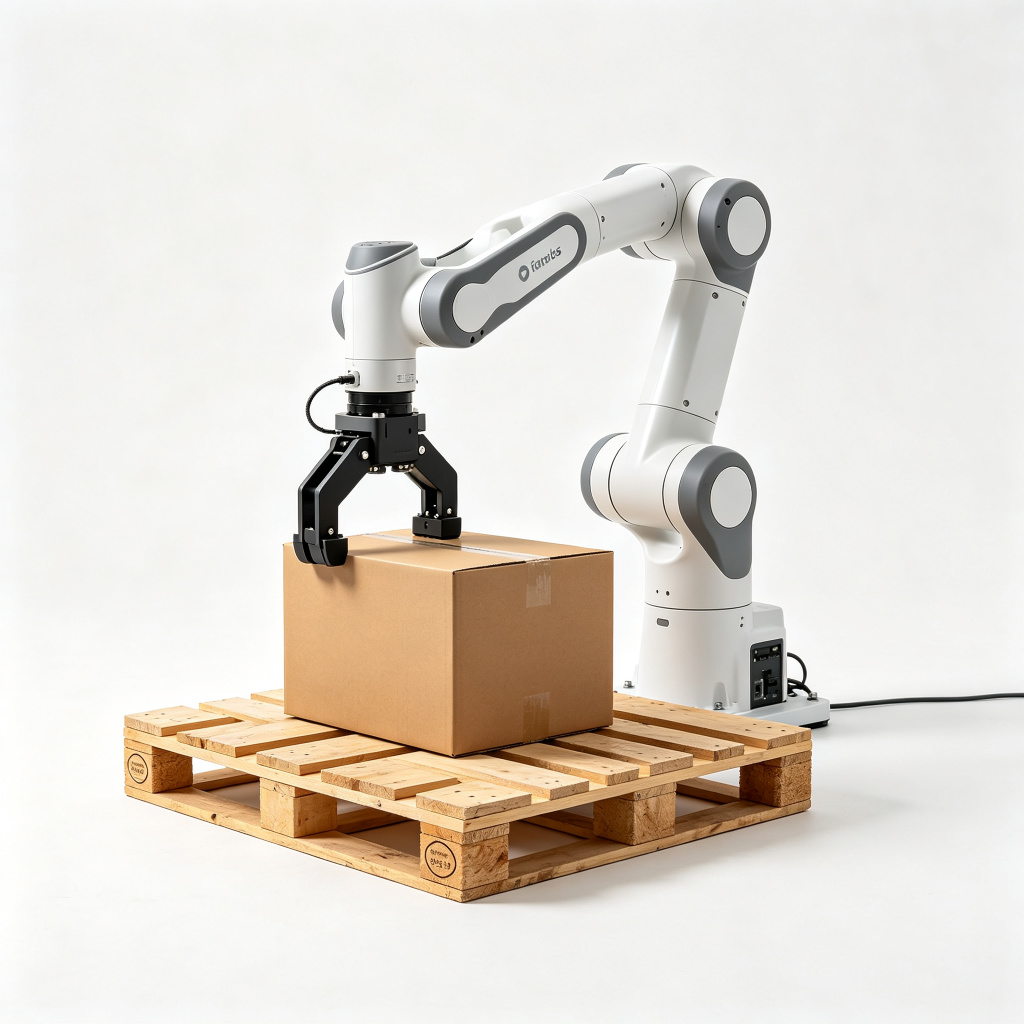
The collaborative robot palletizer occupies the light end of the range: payload around 10–25 kg, commonly 16–20 kg, a ceiling of 8–12 cases per minute and 6–8 cycles per minute, running power- and force-limited under ISO/TS 15066 without a full fence. It does not belong in a dual-station comparison for heavy or high-rate loads. A cobot can serve two pallets in a small cell, but its speed ceiling means the second station rarely removes the kind of bottleneck a dual-station articulated cell targets.
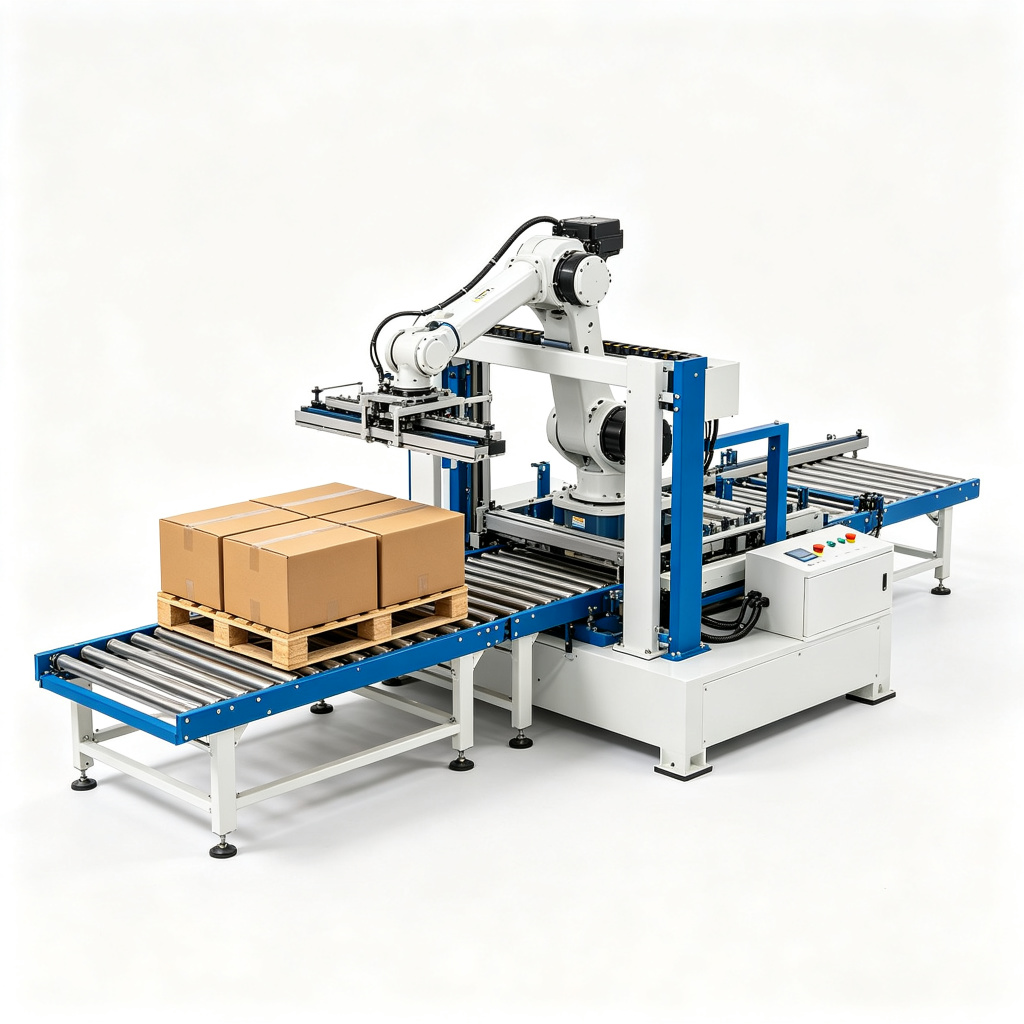
The compact carton palletizer covers light-to-medium carton rates in a small envelope, with roller conveyors feeding a short robot cell. It is the answer when floor space is tight and the rate stays modest; adding a second build position there would buy floor area the line never uses. The full family sits in the palletizers product index for side-by-side review.
Cases where the dual-station cell is the wrong purchase
The second station is capital, steel and control logic. It should be skipped in the following profiles, and we say so in the review rather than sizing the larger machine by default.
- Low volume with slack. A line running one shift, finishing pallets well under the shift, with waiting time between lots, will not use the second station. A single-station cell covers it at a smaller envelope.
- Very light, very slow loads. Cobot-range payload and 6–8 cycles per minute do not generate the exchange bottleneck that a second position removes; the collaborative cell is the better fit.
- Oversized or out-of-envelope loads. Pallets wider than the reach band, bulk bags requiring frame tool beyond the 180 kg class, or loads that need a four-point lift should be checked against a heavy-duty machine before the dual layout is even considered.
- Steady single-SKU high throughput. One product, one pattern, all day: a conventional layer palletizer at 1–3 layers/min does the job with simpler mechanics, and a high-level layout may suit the ceiling better.
- Floor space that cannot expand. Two stations plus discharge conveyor need a wider envelope than a single cell. If the available bay cannot hold the second position and the exchange route, the layout fails on day one.
- Dirty or abrasive product better served by a dedicated machine. Dusty bags, wet bundles or sharp packaging call for gripper and guarding choices that belong to a bag or heavy-duty design; the dual carton cell is not the place to improvise those conditions.
Three worked placement scenarios
Scenario A: two-shift carton line with a visible backup
A food plant runs two shifts, 16 hours a day, packing 520 cartons per hour into two pallet patterns on GMA pallets of 260 cases each. The infeed backs up near the case packer for ten minutes around every pallet change. Measured exchange time is 80 seconds, and the single-station arm already sits near 85% utilization during building periods. The dual-station layout fits: the second position absorbs the swap, the arm holds its 3.5–6 s cycle, and the two concurrent pallets match the two patterns on the line. Reach spans infeed plus both stations on a 120 kg arm; payload per carton plus gripper stays inside the net. This is the profile the machine was drawn for.
Scenario B: mixed bundles waiting on QC
A distribution center builds mixed-SKU pallets where every load waits for a QC label before dispatch. The arm cannot discharge into the wrapper until QC clears the pallet, and holding that load at the single station blocks the next build. A dual station separates the two duties: one pallet builds, the other sits through the QC window, and the arm keeps feeding whichever station is released first. The queue logic tracks both layer counts and states. Where the operation runs only one SKU and no QC hold, that second station would sit idle, and the same center would be better served by the compact cell.
Scenario C: the line that should not buy one
A small manufacturing site runs one shift, 180 cases per hour, cartons at 8–10 kg, finishing four pallets a day. The current manual crew keeps up, there is open floor space but no second lane, and payback on any robot cell is already long. The measured exchange gap in a hypothetical single station would be small because pallets complete slowly. Here the right move is either a collaborative cell at the light payload range or no automation yet; the dual-station articulated cell adds a second conveyor and control layer the volume never recovers. The cost reasoning behind that call is laid out in our note on robotic palletizer cost and payback.
Integration, guarding and pre-FAT checks
The dual cell integrates with the line around three interfaces: case infeed and lane diversion, pallet supply and discharge, and wrapper or dispatch conveyor on the exit side. Each interface needs its own interlock and signal set. Guarding follows the palletizer safety rules: fenced envelope with access interlocks, light curtains at the exchange opening, e-stops at the cell and at each station, and a risk assessment that sets minimum guard distances per approach speed. For the compliance basis behind fencing, interlocks and cobot force limits, see the palletizer safety and CE compliance note.
Before FAT we want a fixed data set: actual carton dimensions and weight, pallet footprint and height loaded, layer pattern drawings, cases per pallet, required picks per hour across the peak hour, shift count, SKU list and changeover frequency, available floor envelope and ceiling height, compressed air supply at the cell, and the state of the downstream wrapper or dispatch. Without that set the reach, payload and gripper choices are estimates. The mechanics behind axes, cycle time and layer-pattern math are detailed in the note on how a robotic palletizer works.
Sizing checklist for the review
- Peak cases per hour and picks per hour, not the average over the week
- Cases per pallet and pallet dimensions, loaded height, and pattern drawings per SKU
- Case or bag weight plus gripper weight, checked against the 120 kg or 180 kg net payload
- Reach geometry: infeed center to each pallet corner, drawn to coordinate positions
- Measured or estimated pallet exchange time, and how often an exchange repeats per shift
- Number of concurrent pallets, QC holds and lane splits the line runs
- Shift count and uptime target, since exchange savings compound with running hours
- Air supply: pressure 5–6 bar, average Nl/min for the selected gripper, dryer and filter condition
- Floor envelope, ceiling height, discharge route and wrapper interface
Changeover, patterns and mixed loads
A dual-station cell holds two patterns in memory at once, and changeover between patterns is a program selection plus a gripper check rather than a mechanical rebuild. Where a layer machine needs lane guides and platen adjustments matched to each case size, the robot re-plans its layer geometry from the pattern file. That matters on lines that rotate among carton dimensions through the day: the operator calls up the saved recipe, the arm confirms the gripper and vacuum setting, and the first layer is checked against the drawing before auto-run resumes. Typical recipe changeover sits in the tens of minutes for a new pattern, with teach offsets stored against the pallet datum so a repeat run returns to the same coordinates.
Mixed-SKU pallets are a separate question from concurrent single-SKU pallets. The dual station can build two single-product loads side by side, and it can sequence picks toward one mixed load when the infeed delivers sorted lanes. What it cannot do is sort unsorted product arriving on one conveyor; that problem sits upstream in picking, kitting or a divert lane, and promising the robot to untangle a random mix is a layout mistake. Layer counts, interlayer sheets and top frames are all part of the recipe: sheet placement adds a pick cycle, frame or board placement adds another, and each extra motion trims the picks-per-hour figure toward the lower end of the 700–900 band.
We also pattern-check load stability before committing the cell. Overhang, unstable top-heavy stacks, cases that deform under vacuum, and pallets that rack during discharge all show up in a pattern trial, not in the brochure. A trial run with the real case, real board and real pallet catches these before the cell is bolted to the floor, and it gives the cycle time a measured basis instead of an assumed one.
Service posture: what wears first, and what the spare parts list should hold
The dual station adds a second set of conveyors, stops, sensors and fixtures to maintain, and those extras should be priced into the operating picture from the start. The wear items are predictable: suction cups and foam pads on the vacuum gripper, gripper seals and filter elements, conveyor belts or chains, pallet location rollers, and the light curtains and interlock switches that guard the exchange opening. Arm gearboxes, motors and cables follow the robot manufacturer’s interval schedule; the cell’s own service points are the tooling and the two station fixtures, not the arm itself.
Because the second station only earns its keep when it is ready, each station’s sensors and datum stops need the same inspection attention as the first. A mis-located empty pallet on the idle station delays the handoff the moment the active station finishes, which is exactly the wait the layout was meant to remove. Planned checks cover vacuum pressure and cup condition, pallet-present and squareness sensors, discharge conveyor tracking, and the queue logic’s state tracking across both stations. Tracking those items on a fixed interval keeps the idle station ready the moment the active station finishes its load.
Reading the boundary against your own line data
The placement decision rests on four measured numbers, and they are worth collecting before anyone quotes a cell. First, peak picks per hour at the infeed, taken from the busiest hour of the week rather than the average. Second, cases per pallet and the resulting exchange frequency: a pallet completed every 10 minutes exchanges six times an hour; one completed every 30 minutes exchanges twice. Third, exchange duration observed on the current manual or single-station method, including locate, confirm and resume. Fourth, the share of time the line runs concurrent pallets, QC holds or lane splits that would keep a second build position occupied.
Run those four against the arm band: if peak picks sit below the single-station rating after exchange losses, one station is enough. If the arm already spends measurable time waiting for an exchange, and the line runs enough hours for that wait to repeat daily, the dual layout closes the gap. If the load or pallet size pushes against payload or reach, the answer is a heavier-duty arm or a different machine class before the second station is argued. This boundary logic stays deliberately plain: the machine is a fit for continuous, mixed or two-pallet work, and a poor fit for slack, light, oversized or narrow single-product profiles.
Where to read next
For the mechanics behind the arm we describe here, see how a robotic palletizer works: axes, payload, reach, cycle time and layer-pattern math. For the money side — machine bands, installation line items and payback — read the note on robotic palletizer cost and TCO. Guarding, interlock distances and compliance basis are covered in palletizer safety and CE compliance. The full machine family, including the dual-station design, is listed in the palletizers product index, and our team can review the line data against these boundary conditions before a layout is drawn.