
SunAura adds a nitrogen gas-flush continuous band sealer for coffee, snacks, nuts and dried goods
SunAura has expanded its continuous band sealer range with a nitrogen gas-flush frame: a constant-motion bag sealer that purges the pouch headspace with inert gas before the heat seal closes the seam, then carries the bag through the same heated blocks, cooling section and embossing or coding station as the standard band sealer. The machine targets food packers who seal roasted coffee, snack mixes, nuts and seeds, dried fruit, spices and dry pet food into laminated pouches, where residual oxygen in the headspace drives rancidity, staleness and shorter shelf life. The gas-flush station mounts ahead of the heat seal on a horizontal band frame, with bag widths up to roughly 400 mm and fills from about 50 g to 2 kg depending on pouch format.
This note covers what the gas-flush station does, where it sits in the sealing path, the configuration numbers buyers should compare, the products it suits and the film and supply conditions the pack needs. It focuses on the machine and the sealing process. The choice of nitrogen supply — cylinder, dewar, bulk tank or on-site generation — is a separate plant utility decision and is only outlined here; the band sealer itself connects to whichever gas source the plant already runs, through a regulator and flow valve at the machine inlet.
The reference figures are the standard bands on the SunAura gas-flush band sealer: belt speed 0–12 m/min, seal width 8–12 mm (10 mm typical), block temperature 0–300 °C dial with sealing set 120–200 °C, heater load 0.6–1.0 kW, drive motor 60–120 W, gas consumption 8–25 L/min depending on pouch size and purge setting, residual oxygen target 1–3% in the sealed headspace, film 60–120 µm laminated pouches. Price band for the gas-flush frame sits in the upper continuous-sealer range, roughly $6,500–$12,000 depending on orientation, coding and line integration; confirm the configuration against your own pouch during a trial seal.
Why flush the headspace with inert gas
When a dry food pouch is sealed in ordinary air, the headspace holds about 20.9% oxygen. That oxygen reacts with oils and fats in nuts, seeds, coffee and snack coatings: oils oxidize and turn rancid, crisp snacks absorb moisture and go soft, dried fruit darkens and loses aroma, and mold or insect activity has the oxygen it needs to develop. Nitrogen is an inert dry gas that does not react with the food; flushing the pouch replaces most of that oxygen-rich air with nitrogen, so the sealed headspace sits at a low residual oxygen level instead of open air.
The practical shelf-life difference shows on oily and aromatic products. Plain-sealed nut and seed pouches often go through rancidity in 4–6 weeks at room temperature; a nitrogen-flushed, barrier-laminate pouch can hold 3–6 months under the same storage. Roasted coffee keeps its roast notes longer when oxygen is displaced, and snack mixes stay crisp past the retailer’s shelf window. Some products use a nitrogen and carbon dioxide mix — CO2 is heavier and works against mold on certain baked goods — but the standard SunAura gas-flush frame is plumbed for nitrogen, with gas type and flow set to the product specification.
Gas flushing is not the same as vacuum packing. A vacuum chamber pulls air out of the pouch before sealing, which compresses soft or crush-sensitive product; a gas-flush band sealer does not pull a deep vacuum. It blows inert gas through the headspace to displace air, then seals the bag with a slight positive gas cushion inside. That cushion protects delicate shapes — puffed snacks, roasted beans, fragile dried fruit — that would crush under vacuum, and it keeps the pouch expanded enough to stand on the shelf. Where the product truly needs oxygen-free storage with minimal headspace, a vacuum or modified-atmosphere chamber line is the separate equipment choice; the band sealer addresses continuous, high-speed pouch sealing with a gas purge.
Where the gas station sits in the sealing path
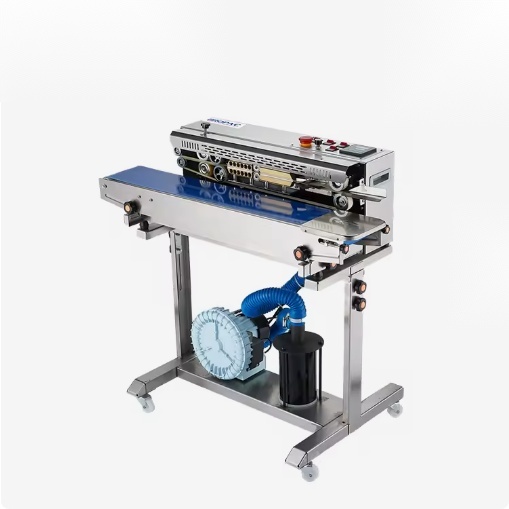
The sealing path on a gas-flush band sealer adds one station before the standard heat seal. The filled pouch enters at the inlet, and the operator or a feed conveyor centers the open seam between the two PTFE belts. Before the bag reaches the heated blocks, it passes under or through a gas manifold: a slotted nozzle or hood that discharges nitrogen across the open headspace, displacing the air that sits above the product. The belt carries the partly purged pouch into the heat station, where a second short purge or a continuous gas curtain keeps oxygen from re-entering while the seam closes. The heated blocks melt the inner sealant layer, the cooling section sets the joint, and the embossing or coding wheel marks the finished seal.
Flow rate and purge timing are the two gas-side adjustments. The regulator and flow valve set nitrogen delivery in L/min; a small snack pouch needs a lower flow than a wide coffee or nut bag, and a two-stage purge on larger packs displaces more air than a single curtain. Belt speed sets how long the pouch sits under the manifold: slower speed gives more purge exposure but lowers bags/min, so the setting trades residual oxygen against throughput. The target is the lowest gas flow that still holds the measured residual oxygen in spec, because excess flow wastes nitrogen and does not improve the seal.
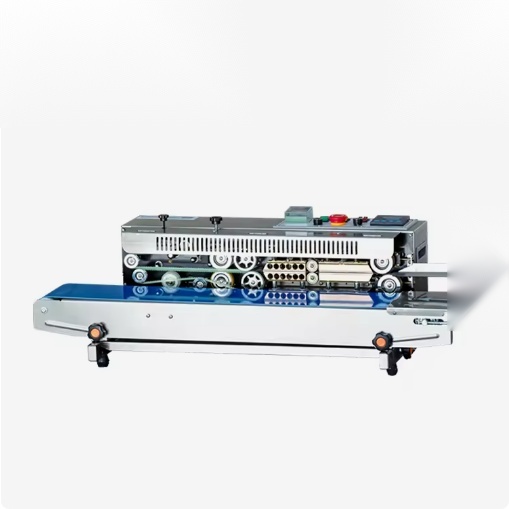
The heat and cooling subsystems work the same as on the standard band sealer. Heated blocks hold 120–200 °C against the film sealant, the cooling section sets the joint under pressure before discharge, and the embossing wheel or ink unit marks date and batch after cooling. The gas station adds the blower or manifold hardware and the gas connection; it does not change how the seam itself forms. For the full mechanics of the belt, blocks and cooler, see the technical walkthrough of how a continuous band sealer works.
Configuration and specification numbers
| Parameter | Gas-flush band sealer band | Note for the specification |
|---|---|---|
| Belt speed | 0–12 m/min, variable | Slower speed extends purge and heat contact; plan sustained rate at 70–80% of peak across a shift |
| Seal width | 8–12 mm, 10 mm typical | Set by block and belt contact; check the bond band on a trial strip after cooling |
| Block temperature | 120–200 °C working range, 0–300 °C dial | Match to film sealant; do not compensate for slow purge by raising heat alone |
| Heater load | 0.6–1.0 kW | Plus 60–120 W drive motor and 20–40 W cooling fan; check circuit rating at install |
| Gas consumption | 8–25 L/min nitrogen | Small pouches 8–12 L/min; wide coffee or nut bags 15–25 L/min; flow set to residual oxygen target |
| Residual oxygen target | 1–3% headspace | Sensitive nuts and oils often specified below 2%; verify with an oxygen meter on sealed samples |
| Pouch range | Width to roughly 400 mm, fill 50 g–2 kg | Heavy or bulging bags evaluate a vertical frame; send samples for feed trial |
| Film requirement | 60–120 µm barrier laminate | PET/AL/PE, metallized PET/PE or high-barrier OPP/PE; plain PE does not retain the gas |
| Coding | Embossing wheel standard; ink coding option | Date and batch marked after cooling; ink grade matched to film surface |
| Machine price band | Approx. $6,500–$12,000+ USD | Depends on orientation, coding, gas hardware and line integration; gas supply utility quoted separately |
Products the gas-flush frame suits
Roasted coffee beans and ground coffee. Coffee releases CO2 after roasting and oxidizes quickly once ground; nitrogen flushing lowers the oxygen that drives stale flavor, and a barrier laminate keeps the gas in. Fresh-roast packs often pair the flush with a one-way degassing valve on the pouch, which lets post-roast CO2 escape without letting oxygen back in. The coffee bag sealing machine in the range covers coffee-specific pouch formats; the gas-flush frame adds the inert purge ahead of the seal.
Nuts, seeds and nut mixes. Walnuts, almonds, cashews, peanuts and seed blends carry high oil content that turns rancid in oxygen. A flushed, barrier pouch holds the oils and aroma for months instead of weeks. Crush-sensitive halves and whole kernels benefit from the gas cushion rather than a vacuum pull; the pack stays expanded and the nuts do not grind against each other in the bag.
Snacks and snack mixes. Potato sticks, corn snacks, trail mixes, coated peanuts and puffed snacks lose crispness when headspace oxygen and moisture migrate through the film. Nitrogen flushing slows staleness and keeps the pouch padded so fragile pieces do not break in transit. For snack lines running high bag counts, the purge flow and belt speed are tuned together so the gas station does not become the bottleneck on the filler.
Dried fruit, spices and dry pet food. Dried fruit and spices retain aroma and color under low oxygen; dry pet food keeps fats from going rancid through the bag’s shelf life. These products are dry and free-flowing, which feeds well on a horizontal band frame; moist or semi-moist fills belong on a different sealing evaluation. Where the pouch stands upright and holds several kilograms, the vertical frame orientation should be checked rather than forcing a horizontal throat.
Whole spices, loose-leaf tea and seed blends. Aromatic spices and tea leaves lose volatile oils to oxidation and absorb off-odors from the air around them; a nitrogen-flushed barrier pouch keeps the headspace neutral and limits aroma transfer through the film. Seed blends for baking or snacking carry the same oil-rancidity risk as nuts. These packs are usually small, 50–500 g, so the gas flow stays in the lower 8–12 L/min band and the sealer runs at the faster end of the speed range; the main setup check is that the fine spice or tea dust does not sit on the sealant line, which would block the bond.
Film and barrier conditions the pack must meet
Gas flushing only holds if the pouch itself is a barrier. A plain polyethylene bag lets nitrogen and oxygen pass through the film wall within days, so the flushed headspace equalizes with the air outside and the shelf-life benefit disappears. Barrier structures in the 60–120 µm range are required: PET/PE with an aluminum foil layer (PET/AL/PE), metallized PET/PE for a lighter barrier, or high-barrier OPP/PE for clear snack packs. Film thickness, sealant layer and print side should be confirmed with the film supplier before the sealer configuration is locked, because the seal temperature and speed window depend on the inner sealant, and the gas retention depends on the outer barrier.
Seal quality on a flushed pouch has to hold both the food and the gas cushion. A sound laminate seal shows a uniform 8–10 mm bond band, no wrinkles and no open corners, with peel strength around 4–6 N/15 mm after cooling. A seal that looks bonded but lets gas leak at a corner shortens the shelf life even when the purge itself was set correctly. Check corner seals on gusseted bags first; gusset folds and film thickness at the side seam are the usual leak points, and the trial seal should include a few filled, weighed packs left under observation for headspace loss.
Nitrogen supply: connecting the machine to the plant gas source
The band sealer needs a regulated nitrogen supply at the machine inlet, with a pressure gauge, flow valve and particulate filter upstream. Common sources are high-pressure cylinders manifolded for small or intermittent lines, liquid nitrogen dewars for medium volume, and bulk tank or on-site generation for high-consumption plants. Supply purity typically runs 99.0–99.9% nitrogen; lower purity leaves too much oxygen in the source gas to reach the 1–3% headspace target. The machine’s gas connection, regulator and flow meter are sized to the consumption band above; the supply vessel, piping and purification sit outside the sealer and are planned as plant utility work.
Estimate gas use before choosing the source: multiply flow rate in L/min by run minutes per shift, then by shifts and days per month. A 15 L/min purge on an 8-hour shift uses about 7,200 L (7.2 m³) of nitrogen; two shifts push that to 14.4 m³ per day. Cylinder pressure and volume labels should be converted to free gas volume before comparing cost per cubic meter. On-site generation, cylinder exchange and dewar delivery each suit a different consumption level, and that comparison is a separate utility decision from selecting the sealer frame. The supplier can quote the machine’s gas connection and consumption without locking the plant’s supply route.
Gas flush versus vacuum and modified-atmosphere packing
Three methods lower oxygen in a sealed pack, and they are often confused. A vacuum chamber evacuates air from the pouch, seals it, and optionally back-fills with gas in a second cycle; the pouch collapses against the product. A modified-atmosphere packing line flushes a rigid tray or flexible bag with a gas mix, then seals under a gas hood, often on a form-fill-seal machine. A gas-flush band sealer is the continuous middle case: it purges the open pouch headspace with nitrogen through a manifold, then seals on a moving belt, without a chamber cycle and without collapsing the bag.
The trade-offs follow from that difference. Vacuum sealing compresses the pack, which suits rigid or resilient goods but crushes puffed snacks, whole roasted beans and fragile dried fruit; it also pulls loose particles into the seal area. A chamber cycle is batch-paced, so throughput per station is lower than a continuous belt line. MAP tray lines give precise gas mixes and long shelf life on ready meals and baked goods, but they run on dedicated tray or film-forming equipment at a higher capital level. The gas-flush band sealer trades the lowest possible residual oxygen for continuous speed, a padded pouch and a lower machine entry point; residual oxygen lands in the 1–3% band rather than the under-1% levels a good chamber can reach.
Choose the method against the product’s crush sensitivity, shelf-life target and pack format. Dry, free-flowing goods that keep a padded shape — coffee, nuts, snacks, seeds, dried fruit — fit the band-sealer flush. Products that must sit tight to the pack, that hold liquids, or that need oxygen below 1% should be evaluated on chamber vacuum or MAP equipment instead. Mixing the two requirements on one machine usually means buying the wrong frame; a gas-flush band sealer cannot pull a deep vacuum, and a chamber line cannot match the continuous belt rate on high-volume pouch sealing.
Setup sequence for a gas-flushed pouch
- Confirm the pouch film is a barrier laminate in the 60–120 µm range, with sealant type and thickness recorded. Plain PE or thin OPP will not hold the gas, and the seal window will not match the sealer settings.
- Check the nitrogen supply: cylinder, dewar or bulk line connected, regulator and filter fitted, source purity at 99.0% or above, and the supply pressure within the machine’s inlet range.
- Set the belt guides to the pouch width and the nip pressure so the seam feeds flat. Warm the heater to the starting temperature for the film, 120–200 °C depending on sealant, and hold at set point for a few minutes.
- Open the gas valve to the starting flow for the pouch size: 8–12 L/min for small snack bags, 15–25 L/min for wide coffee or nut bags. Confirm the manifold slots align with the open headspace.
- Run three to five trial pouches. Seal, then measure residual oxygen on a sample with an oxygen meter, inspect the seam band and corners, and peel a 15 mm test strip after full cooling.
- Adjust one variable at a time: raise flow or slow the belt if residual oxygen stays above target; lower flow once the oxygen reading holds in spec to save gas. Re-check the seal after any speed change, because slower belt speed also lengthens heat contact.
- Set the embossing or ink code to the batch and date, record temperature, speed, gas flow and residual oxygen against the film lot, and keep the sheet with the machine for the next run.
Common gas-flush mistakes and how they show up
Sealing a non-barrier pouch and expecting shelf life. The flush displaces oxygen at seal time, but a plain or thin film lets gas migrate through the wall within days. If the pack goes soft or the oxygen reading climbs after storage, check the film barrier before blaming the purge. Specify PET/AL/PE, metallized PET/PE or a high-barrier OPP/PE structure with the film supplier, and confirm the oxygen and moisture barrier ratings for the shelf-life target.
Running gas flow higher than the product needs. Excess nitrogen does not improve the seal or the shelf life once residual oxygen is in spec; it only wastes gas and raises the per-pack cost. Set the flow to the lowest value that holds the measured oxygen target, and re-check after film or pouch-size changes. A high flow can also billow the open pouch and push product particles into the seal area, which weakens the bond.
Letting the sealer outrun the filler. If the belt moves faster than bags arrive, empty or partly filled pouches pass through the purge station, burning gas on air, and the operator rushes feed placement so seams enter off-center. Match belt speed to the filler output and use a short accumulation buffer between the two stations; the sealer’s peak rate is not the line’s working rate.
Ignoring seal leaks at gussets and corners. A good purge on a pouch that leaks at a gusset fold or side corner loses its gas within days. Trial packs should be filled, sealed and left under observation, with a repeat oxygen reading after the storage interval, and corner seals inspected on every gusset format. Film wrinkles at the seal line, product dust on the sealant and an uneven belt nip are the usual leak sources; the troubleshooting guide linked below covers the seal-side checks in order.
Line integration, quality checks and compliance
On a continuous line, the gas-flush sealer sits after the filler and before labeling and packing. Filler outlet height must match the sealer inlet so pouches feed without a drop or a twist; an accumulation conveyor between filler and sealer absorbs short pauses so the sealer does not starve or back up. For manual feed, one operator centers bags at the inlet while packed, flushed pouches discharge to a packing bench. Match belt speed to the filler’s output rather than running the sealer at peak, because a sealer that outruns the filler creates empty purge cycles that waste gas.
Quality checks on flushed packs include a residual oxygen reading on sealed samples, a peel-strength strip from the seam, a visual inspection of the bond band and corner seals, and a headspace retention check on packs stored for the shelf-life window. Record temperature, speed, gas flow and residual oxygen with each film lot so the setting can be repeated across runs. Guarding around the hot blocks and belt nip, emergency stop and food-contact materials follow the same compliance requirements as other band sealers; the band sealer safety and CE compliance guide covers hot-block guarding, belt covers and e-stop layout.
Day-to-day faults on the gas-flush frame split into seal-side faults and gas-side faults. Weak, wrinkled or reopened seals follow the standard band-sealer fault tree; high residual oxygen traces to low flow, a misaligned manifold, film that leaks at the seal or a supply purity problem. The band sealer troubleshooting and changeover guide walks through belt tracking, temperature faults, seal defects and the maintenance schedule, including belt cleaning and PTFE inspection. For the five-year outlay across machine, gas, consumables and labor, read the band sealer cost and TCO breakdown.
Available configurations and next steps
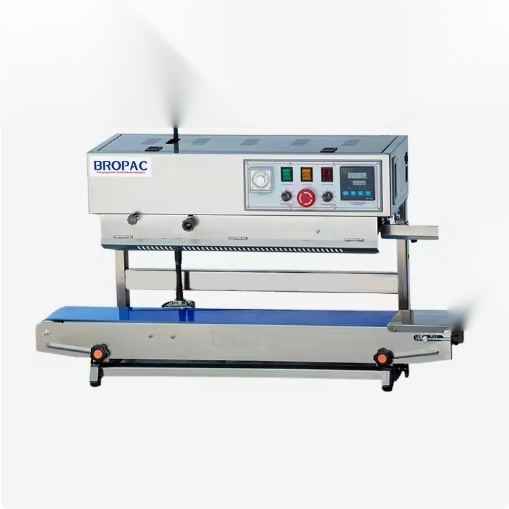
The gas-flush option can be configured on the standard horizontal band frame for flat pouches, on a stand frame at operator working height, or on a vertical frame for heavy upright bags. Coding choices cover embossed date and batch on the sealing wheel or ink printing after cooling. The nitrogen gas-flush band sealer product page lists the configured frame, and the wider continuous band sealer family covers the standard, stand, vertical and coding models without the gas station. Related frames include the automatic continuous band sealer for line-fed pouches, the stand-mounted heat band sealer, the horizontal ink-printing band sealer, the vertical ink-coding band sealer, and the 2-in-1 stand band sealer with digital temperature readouts.
To compare the gas-flush frame against a manual or standard machine, the band sealer versus impulse sealer comparison sets constant-motion sealing against manual jaw sealing by material, throughput and consistency. Packers evaluating whether gas flushing pays back for their product should weigh shelf-life extension against gas consumption and the barrier film premium; the TCO note linked above works those lines over a five-year horizon.
Send pouch samples, film specification, target bags/min and fill weight through the contact desk for a trial seal with residual oxygen measurement. The certifications and patents section lists compliance documentation available with the machine, and the company profile summarizes the packaging equipment range. Additional machine notes and product updates appear in the news section.