
SunAura Adds Compact Rotary Monoblock Filler-Capper for Small-Batch Vials, Dropper Bottles and E-Liquid Lines
SunAura Machinery has added a compact rotary monoblock filler-capper to its front-of-line range, built for small containers that are awkward to handle on separate, conveyor-linked machines. The unit combines filling, cap placement and torque-controlled tightening on a single starwheel-indexed frame, aimed at contract fillers and brand owners running 10–60 ml vials, dropper bottles, serum containers and e-liquid bottles across frequent SKU changes. The launch is not a faster version of an existing inline machine; it is a different architecture, and the buyers it suits are not the buyers who should specify a high-speed separate line. This note sets out where the monoblock sits against the alternatives and which production conditions justify choosing it.
What the monoblock actually is
On a conventional layout, a filler and a capper are two standalone machines joined by a conveyor, each with its own frame, controls and timing. A bottle leaves the filler, travels along the belt and is re-stabilised before it reaches the capping head. The rotary monoblock removes the transfer between the two: a starwheel picks the container up once and carries it through filling and capping stations on the same indexed pitch. Because the bottle is held in a pocket rather than moving freely on a belt, light vials cannot tip, spin or drift out of alignment, and the fill and torque stations are mechanically synchronised to the same index.
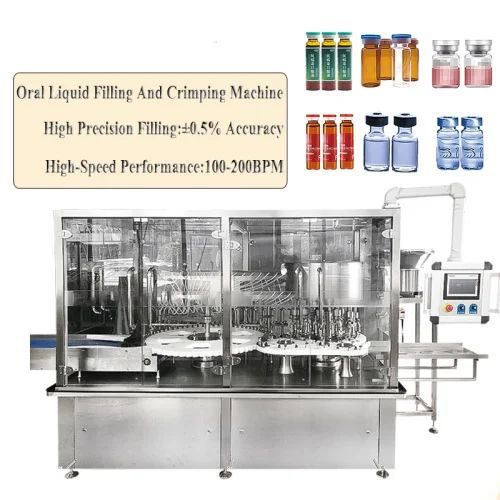
Monoblock vs separate inline filler and capper: the positioning difference
| Criterion | Rotary monoblock filler-capper | Separate inline filler + capper |
|---|---|---|
| Container transfer | Starwheel holds the bottle through both stations | Free conveyor between two standalone machines |
| Light and unstable vials | Held in pockets; no tipping or spinning | Need stabilisers and neck guides to stay square |
| Typical working range | 10–60 ml small containers, roughly 30–120 bottles/min by head count | Broad container range; high-speed models well above 150 bottles/min |
| Footprint | One frame, shorter line length | Two frames plus conveyor and transfer space |
| Timing and synchronisation | Fill and cap share one index, no inter-machine timing | Two controls that must be balanced and interlocked |
| Changeover | Starwheel and change parts per bottle; recipe recall on HMI | Adjust both machines and the conveyor separately |
| Large containers and high volume | Limited by starwheel pocket size and index | Better suited; scales with head and disc count |
| Entry cost position | Lower total for a small-container line than two machines | Higher combined cost, but more flexible across formats |
| Best-fit buyer | High-mix, small-batch fillers of vials and droppers | High-volume producers running standardised bottles |
Who should specify it, and who should not
The monoblock is the right call when three conditions hold together. First, the containers are small and light enough that free-belt handling is unreliable — typically 10–60 ml vials and dropper bottles. Second, the catalogue is high-mix rather than a single long-run product, so quick changeover and recipe recall matter more than absolute peak speed. Third, floor space is constrained, which makes one indexed frame more practical than two machines and a connecting conveyor. Contract packers serving cosmetics, e-liquid, tincture and small pharma accounts fit this profile directly.
It is the wrong call for two buyer types. A high-volume producer running one standardised bottle at 150 bottles per minute or more gets more headroom and easier access from a separate inline filler and capper, which scale independently. A plant that needs to run large jugs alongside small vials cannot do so on one starwheel, because pocket size is bottle-specific; a flexible inline layout handles that spread better. The monoblock is purpose-built for small-container, frequent-change work, not as a universal replacement for a full line.
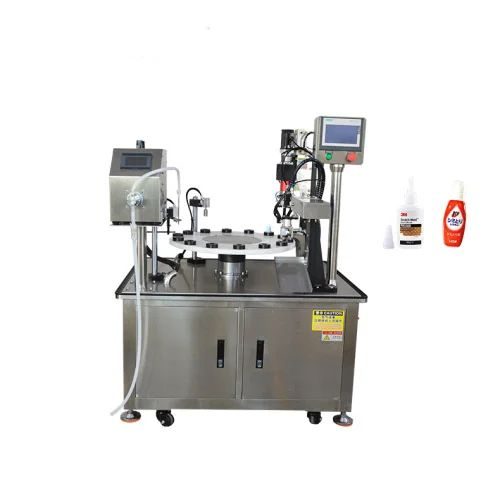
What to confirm at the inquiry stage
Because the starwheel is bottle-specific, the first quotation inputs are the full container drawing set and the cap or closure range, not just the fill volume. Buyers should confirm the dosing technology against product viscosity — piston dosing for thicker serums and creams, pump or flow-meter dosing for thin free-flowing liquids — and whether the same machine must run more than one bottle diameter, which requires a change of starwheel and guide parts. Also confirm the sustained, not peak, throughput for the slowest SKU, the torque or crimp specification required for the closure, and whether cap feeding and placement are included. As with any front-of-line purchase, require the supplier to run the actual bottles and caps during the factory acceptance test and record the fill accuracy and torque results rather than demonstrating on a favourable sample.
The compact rotary monoblock fills a specific gap: a single, space-efficient machine that holds small containers accurately through fill and cap for high-mix, small-batch production. Buyers running that profile can compare it against the broader liquid filling machines and capping machines, and see how the same stations are arranged on a complete packaging line. Send container drawings, viscosity data and the target SKU list through the contact desk for an application-matched configuration; FAT and compliance documentation is outlined under certifications and patents, with installation and spare-parts planning covered by after-sales service.