
QINGDAO, China — October 10, 2026 — SunAura Machinery has delivered an automatic linear filling machine to a household chemical producer in Latin America, running shampoo, liquid soap, and detergent on one line at up to 40 bottles per minute. The machine replaces three semi-automatic gravity fillers and one manual capping station, cutting the filling crew from six operators to two across two shifts.
The project began with a production problem rather than an equipment purchase. The customer ran three gravity fillers feeding one manual capping station, and every SKU change meant re-measuring fill levels and re-adjusting nozzles. Fill accuracy varied with operator attention, spillage on the bottle neck caused cap leakage complaints, and the line could not keep up with a growing private-label contract. The producer needed a filling machine that held accuracy across four SKUs without re-tuning between runs — the classic multi-SKU, mid-speed filling challenge.
Machine Configuration
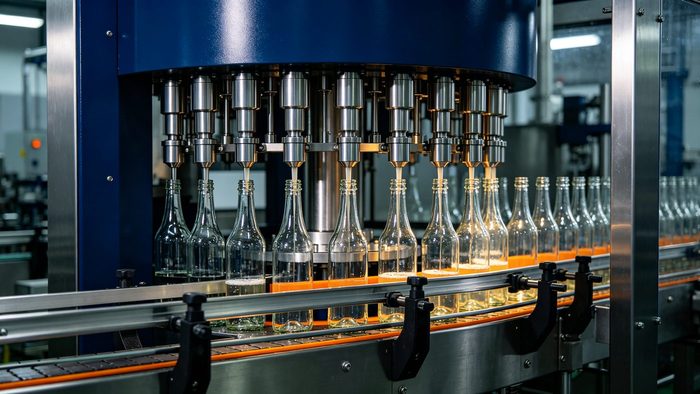
The delivered linear filling machine is a servo-driven piston filler with four filling nozzles and a multi-stage filling profile:
| Parameter | Configuration |
|---|---|
| Filling method | Servo piston, 4 nozzles, linear configuration |
| Throughput | Up to 40 bottles/min (250ml–1L) |
| Fill accuracy | ±1.5g across all four SKUs |
| Products | Shampoo, liquid soap, detergent — viscosities up to 8,000 cps |
| Changeover | Recipe-driven, under 10 minutes between SKUs |
| Nozzles | Anti-drip, bottom-fill option for foaming products |
| Infeed | Automatic bottle infeed with star wheel |
The servo piston drive is the key specification for multi-SKU filling. Each nozzle is driven by its own servo, and the fill volume is set in the recipe — no mechanical adjusters, no re-measuring between SKUs. The customer’s four products range from thin liquid soap to thick shampoo, and the multi-stage fill profile slows the nozzle near the end of fill to prevent splashing on foaming products. The same machine platform, covering piston and linear configurations for liquids, is documented on the automatic linear filling machine page and the liquid filling machines range.
Why Servo Piston Filling Beat the Alternatives for This Line
Before specifying, the SunAura applications team compared three filling technologies against the customer’s four-SKU profile. The comparison is worth sharing because it is the same decision most household chemical producers face:
| Technology | Accuracy | Multi-SKU Changeover | Viscosity Range | Price Range |
|---|---|---|---|---|
| Gravity / volumetric | ±3–5g, operator-dependent | Mechanical adjustment, 30–60 min | Thin liquids only | $5,000–$15,000 |
| Peristaltic | ±2–3g | Good, recipe-based | Thin to medium | $8,000–$25,000 |
| Servo piston | ±1.5g, verified | Recipe-based, under 10 min | Thin to high (8,000+ cps) | $18,000–$45,000 |
Gravity filling is the cheapest option and the wrong choice for four SKUs of varying viscosity — the accuracy drift between products costs more than the machine saves. Peristaltic filling handles changeover well but is limited on thick products and on hose wear. The servo piston machine carries the accuracy and viscosity range the customer needed, and the changeover time became a measurable cost saving: at 12 SKU changes per week, the difference between a 10-minute recipe changeover and a 45-minute mechanical changeover is roughly 7 hours of line time per week — the equivalent of a full shift.
Commissioning Results and Line Savings
The commissioning data from the Latin America installation shows what the upgrade delivered:
- Labor: filling crew reduced from six operators to two across two shifts — four positions freed for packing and quality tasks.
- Accuracy: fill accuracy verified at ±1.5g across all four SKUs at the 40 BPM target, against the previous ±5g operator-dependent variation. Overfill giveaway reduced by roughly 60%.
- Changeover: SKU change under 10 minutes including nozzle purge, versus the previous 30–60 minutes of mechanical adjustment.
- Cap leakage: eliminated the spillage-on-neck cause of cap leaks by adding a nozzle anti-drip system and an air wipe before capping.
The payback projection from the customer’s own numbers landed at 14 months, driven mostly by the labor saving — before counting the giveaway reduction. Producers comparing their own upgrade should run the same three-line math: labor positions removed, giveaway percentage on annual volume, and changeover hours per week.
Specification Points for Household Chemical Filling Lines
Four specification points decide whether a household chemical filling line performs — and they apply beyond this one installation:
Foaming control: shampoo and liquid soap foam when they splash, and foam traps air in the bottle. The multi-stage fill profile — slow start, fast middle, slow end — plus the bottom-fill nozzle option for high-foaming products, is the specification that prevents foam-related fill inaccuracy. Buyers should confirm the filler’s foaming-control features in writing, not assume them.
Wetted parts material: household chemicals vary from neutral to corrosive. Confirm the wetted parts — piston, valves, nozzles, seals — are 304/316 stainless with seals compatible with the product range. The material decision is the same one covered in the 304 vs 316 stainless steel guide, which applies to chemical as much as food lines.
Purge and flush between SKUs: changing between shampoo and detergent without flushing leaves residual product in the manifold, contaminating the next batch. The machine’s recipe should include a purge cycle — a defined flush volume and time per SKU change. The <10-minute changeover the customer achieved includes the purge, which is the honest way to quote changeover time.
Spare parts for nozzles and seals: nozzle tips and seals wear with chemical products, and they are the parts that determine accuracy. Stock them before the line starts — the ordering approach for consumables is covered in the packaging machine spare parts strategy guide, and consumables ship under the 48-hour spare parts dispatch program.
Operating the Line: The Daily Routine That Protects Accuracy
Fill accuracy is set by the machine and protected by the routine around it. Three daily practices from the Latin America line are worth copying:
First-bottle check every batch and shift: the operator weighs the first bottle of each new batch and each shift start, and compares it against the target. The check takes 30 seconds and catches drift while it is still a recipe adjustment instead of a giveaway problem. The customer posts the target weight per SKU at the line, and the check is part of the shift handover — it is now the line’s first quality gate.
Nozzle drip inspection at changeover: the anti-drip system keeps the nozzle clean between fills, but a worn nozzle tip drips and spoils the next bottle. The operator inspects all four nozzles during every SKU change — a 30-second visual check that prevents the intermittent overfill complaint that is hard to trace after the fact.
Recipe backup after every tuning: when a new SKU is added or a product reformulation changes viscosity, the tuned recipe is saved and backed up. The customer’s original complaint — re-tuning between runs — returns the moment a recipe is lost or overwritten. The HMI stores 30 recipes; the discipline is naming them consistently and backing up the recipe file to a PC monthly.
These are not machine features — they are the operating habits that the commissioning training establishes. Producers who follow them report stable accuracy for years; producers who skip them blame the machine for drift that started in the routine.
Frequently Asked Questions
Can the same filler handle both thin and thick products?
Yes, within the servo piston platform’s viscosity range — typically up to 8,000–10,000 cps. Thin liquids need a smaller piston displacement or a faster stroke; thick products need the larger nozzle option and a slower final fill stage. The recipe stores the stroke profile per product, so switching between thin liquid soap and thick shampoo is a recipe recall, not a mechanical change. Products above the viscosity range — pastes and creams — need a different filling technology, typically a piston filler with a wider nozzle or an auger filler.
How do you clean a servo piston filler between products?
With a purge cycle: the recipe runs a defined flush volume through the manifold and nozzles, followed by an air purge to clear residual liquid. Full cleaning — disassembly of nozzles and seals — is a weekly or product-change task, typically 30–45 minutes. The machine’s design for cleaning access (tool-free nozzle removal, accessible manifold) determines how long this takes; it is worth confirming before purchase because it is a weekly recurring cost.
What is the difference between linear and rotary filling machines?
A linear filler moves bottles in a straight line past fixed nozzles; a rotary filler carries bottles on a rotating carousel. Linear machines are simpler, cheaper, and easier to change over — the right choice for mid speeds (up to about 60 BPM) and multi-SKU lines. Rotary machines fill more bottles per minute at high speed and suit single-product, high-volume production. The Latin America line runs linear because the customer’s four SKUs and 40 BPM target favor changeover flexibility over raw speed.
Is the filler suitable for products with particles or fibers?
No — servo piston fillers are not designed for particulate products. Particles in the product pack into the piston seals and damage them, and they block nozzle tips. For products with particles — exfoliating scrubs, suspensions, gels with inclusions — the correct approach is a specific particulate filler or a recirculating system with larger clearances. If particles are in the future product plan, raise it in the specification conversation before purchase.
What after-sales support is included for overseas installations?
Every SunAura filling line ships with commissioning support — installation supervision and operator training on site — plus remote PLC diagnostics after commissioning and an 18-month warranty on servo and mechanical components. The Latin America installation followed the same package: two engineers on site for commissioning, training on all four SKU recipes, and remote access for the first month of production.
Extending the Filler Into a Complete Bottling Line
The Latin America customer started with the filler and is already planning the next two stations, which is the normal growth path for household chemical producers. The filler sits between the bottle infeed and the capping station, and each neighbor opens a further automation step:
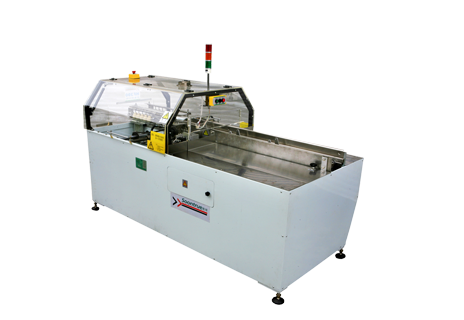
Automatic capping: a capping station after the filler removes the manual capping labor that still existed on this line. For screw caps, a spindle or chuck capper with torque control handles the range of cap sizes across the four SKUs. The same logic that justified the filler — consistency and changeover speed — applies to capping, and the two stations share the PLC program.
Labeling: a self-adhesive labeler downstream adds the SKU label, batch code, and barcode in one pass. For household chemicals sold through retail, the label is the product identity — label position and adhesion are checked at the same quality gate as fill weight.
Case packing: once bottles are filled, capped, and labeled, they need to reach the case packer without manual handling. The conveyor between the labeling and case packing stations is where the line either flows or jams — the conveyor selection method in our conveyor selection guide and the conveyor systems range applies directly here. For bag-based household products — detergent sachets, refill pouches — the same integration logic applies to the continuous band sealer series launched this month.
The growth path matters for the specification conversation: a filler bought with PLC spare capacity and conveyor provisions for future stations upgrades into a complete line without re-engineering. SunAura builds the complete bottling line configuration — rinser, filler, capper, labeler, and case packing — as one integrated system, which is the configuration the customer is now planning.
Availability and Support
The automatic linear filling machine is available for order with 4–6 week lead time, including factory acceptance testing with the customer’s bottles and product. SunAura Machinery delivers the machine with installation, training, and the full documentation set — CE certification, wiring diagrams, and maintenance manuals. To discuss your bottle formats, product viscosities, and target throughput with the applications engineering team, contact SunAura Machinery.
About SunAura Machinery
SunAura Machinery is a packaging equipment manufacturer based in Qingdao, China, exporting to more than 100 countries. The company’s liquid filling range covers servo piston, linear, and rotary filling machines for food, beverage, household chemical, and industrial products, all CE certified.
Editorial note: Specifications and payback figures reflect the referenced installation and are subject to change. Contact SunAura Machinery for current configuration options.