
Vacuum skin packaging (VSP) has moved from a premium meat-tray gimmick to a mainstream way to extend shelf life and lift perceived quality on red meat, seafood, cheese and ready meals. Yet buyers still confuse it with ordinary vacuum skin film on a thermoformer, and many specify a MAP tray when VSP would have paid for itself in shelf life and reduced discounting. SunAura Machinery has launched a vacuum skin packaging tray line built around a servo thermoforming platform, and the questions buyers ask before ordering are exactly the ones this article answers: what VSP actually is, how it differs from MAP and chamber vacuum, what films and trays it needs, and where the real operating pitfalls live.

What is vacuum skin packaging (VSP)?
Related: read how we engineered an auger powder filling, capping and labelling line for spice producers, and the guide to checkweigher and metal detector integration.
In VSP, the product sits on a rigid or semi-rigid tray. A heated, flexible top web of high-clarity film is drawn down over the product like a second skin: it vacuums tightly around the contours of the steak, fillet or cheese block, then seals to the tray flange around it. The product is held in place, oxygen is pulled out, and the film clings so closely that consumers see the product itself rather than a loose bag. It is visually premium and mechanically protective – the product cannot slide around and bruise in the pack. This is distinct from thermoforming MAP lines, where gas flushes a headspace above a flat tray and the product moves freely inside the package.
VSP vs MAP vs chamber vacuum: which one for your product?
Buyers ask us to compare the three constantly. The right choice depends on how much product movement you can tolerate, how long shelf life must be, and how much you will pay for film. VSP is the most film-hungry but gives the longest retail presentation and the best protection against juice purge.
| Criterion | Vacuum skin packaging (VSP) | MAP tray sealing | Chamber vacuum bag |
|---|---|---|---|
| Product presentation | Premium, film clings to product | Good, flat lid over headspace | Crinkled bag, commodity look |
| Shelf life (red meat) | Long, 14–21 days typical with skin film | 7–14 days with gas mix | 10–21 days, colour darkens |
| Juice purge / leak | Contained, film holds purge | Pooled in headspace | Bag holds liquid, can weep |
| Product movement | None, locked in place | Free, can slide and bruise | Free inside bag |
| Film cost per pack | Highest (formed tray + skin web) | Medium | Lowest |
| Best for | Premium meat, seafood, cheese, ready meals | High-volume trays, produce, deli | Bulk primals, frozen, industrial packs |
How the VSP skin film actually seals
The process is more demanding than a standard tray seal. The top skin film is heated to its draping temperature, so it becomes flexible enough to vacuum-form itself around the highest point of the product without bridging. The tray is loaded, the chamber closes, air is drawn out, and the hot film is pulled over the product, touching it before it reaches the flange. Because the film contacts the cold meat immediately, it must be a co-extruded, high-clarity, heat-resistant skin material – usually a PE/EVA or PA/PE structure with a high-gloss print-receptive outer layer. Too hot and the film sags into the cavity and thin-stretches; too cold and it bridges over the steak and never touches it. Servo control of web temperature, vacuum time and film pitch is what makes the process repeatable across three or four tray formats.
What buyers get wrong when they specify VSP
- Using ordinary lidding film as skin film. Standard MAP lid film will not drape and shrink around the product; it bridges. Budget for dedicated skin-stock film from a matched converter.
- Ignoring tray flatness. A warped or dished tray flange leaks because the skin film cannot seal over an uneven surface. Tray flatness tolerance matters more in VSP than in MAP.
- Overfilling. The film must drape over the product and still land on a clean flange. Product that rises above the flange reduces the seal width and causes leaks.
- Forgetting purge channel. Wet products need the film to pull purge away from the product surface; a skin film with the wrong oxygen barrier lets liquid pool under the film and cloud the view.
- Cold-chain shock. Skin film sealed on warm product then blast-frozen can delaminate. Specify the film for the downstream freezing step if you freeze after sealing.
Meat, seafood and cheese: different settings, one line
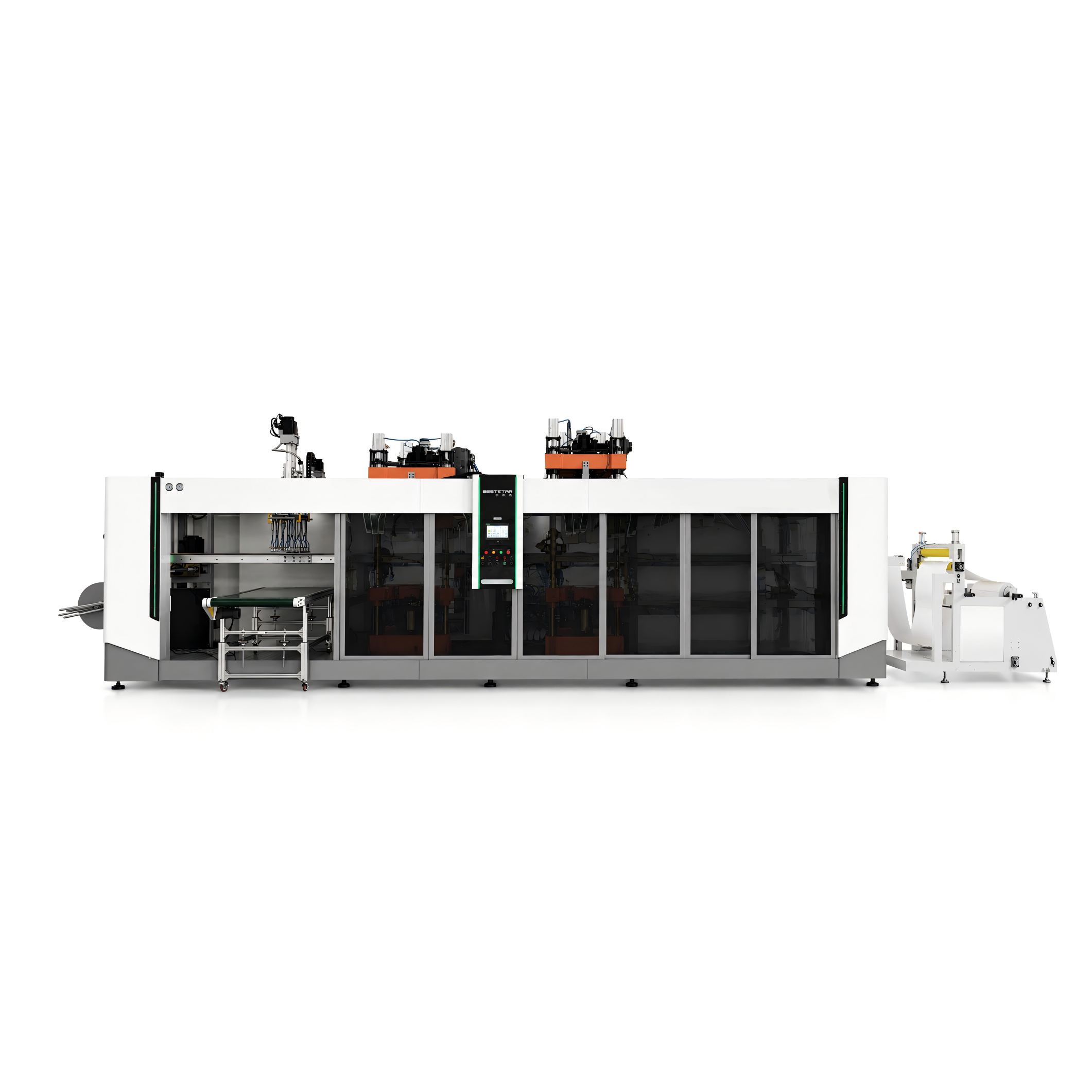
Red meat benefits most from VSP: the cling film eliminates slab movement, reduces purge in the pack, and the high-barrier skin film slows oxidation so bloom holds longer. Seafood sits flatter and shows less visual damage, but fish oils attack certain films, so ask the converter for a fish-fat-resistant skin structure. Cheese breathes and sweats; a skin film with the correct moisture and oxygen balance stops mould without sweating the block into a puddle. On a multi-product line, each family gets a stored recipe for film temperature, vacuum time and tray format, so the line can move from a steak tray to a cheese block in minutes rather than hours. For producers who also form trays in-house, the VSP platform can share tooling with a standard servo thermoforming machine line, which is where SunAura typically scopes the project.
Cost and payback: does VSP actually save money?
VSP spends more on film per pack, but it earns back on three lines. First, reduced discounting: packs that look fresh two days later move at full price instead of markdown. Second, reduced giveaway: VSP locks purge in, so net weight stays on the product rather than drained and refunded. Third, freight efficiency: a skin-packed tray stacks tightly and does not bulge like a gas-flushed MAP pack, so more trays fit a pallet. For premium protein where pack appearance drives the price premium, VSP typically pays back inside a year on markdown reduction alone. Ask the supplier to validate film on your actual product at the factory acceptance test; skin film that looks right on a tomato tray can fail on an irregular steak.
Frequently asked questions
Is vacuum skin packaging the same as vacuum packing?
No. Standard vacuum packing pulls product into a bag and the bag crinkles around it. VSP uses a rigid tray and a heated top film that drapes and vacuums tightly over the product, leaving a clear, premium display surface. VSP is for retail-facing packs; bag vacuum is for bulk or industrial.
Can I run VSP on my existing tray sealer?
Only if the machine has heated film draping and enough vacuum draw to form the skin around the product. A flat MAP tray sealer without a heated forming station will bridge, not skin. Confirm with the builder before buying skin film.
What shelf life does VSP give fresh red meat?
With a matched high-barrier skin film and correct gas mix, 14–21 days under refrigeration is typical, versus 7–14 days for standard MAP. Exact life depends on kill step, film barrier and cold chain, and must be validated per product.
Does VSP work for frozen products?
Yes, but the skin film must be specified to survive blast-freezing thermal shock without delaminating, and the tray must handle freezer brittleness. Tell the builder if you seal-then-freeze rather than pack chilled.
Tray materials for VSP: PET, CPET and PP
The tray is half the VSP system, and buyers who specify the wrong tray material pay for it in delamination and seal failures. APET trays are clear, cheap and widely used for chilled retail, but they warp near the skin-film sealing temperature and crack in freezer conditions. CPET trays are ovenable and freezer-safe but are usually opaque black, which reduces the premium “see-through” effect. PP trays handle both heat and cold and seal well to most skin films, at a small premium. If your product moves from a sealed tray into a microwave or an oven, CPET or PP is required; if it is chilled retail display, APET is usually the value choice. Whatever you choose, the tray flange must be flat within a tight tolerance and compatible with the skin film’s sealant layer – a tray and skin film from different converters are the number-one cause of intermittent seals. Ask both suppliers to test the tray and film together, and keep a qualified pair listed in the line’s recipe.
Line speed, cycle time and labor on VSP
VSP cycles are slower than standard tray sealing because the film must heat and drape around the product before sealing. A typical VSP cycle runs 6–10 seconds per tray versus 3–5 for MAP, and the line needs a servo film-draw and a heated sealing station rather than a flat seal bar. That means a VSP line is not usually bought for the fastest commodity protein; it is bought where the pack commands a price. On a four- to six-lane servo thermoformer, realistic VSP output lands in the 15–40 trays-per-minute range depending on tray size, product height and vacuum time. Plan upstream product loading to match: hand-placed steaks on a VSP line often need two operators loading trays, whereas bulk cheese blocks can be auto-fed. For producers who already run a thermoforming line, the VSP upgrade usually means adding a heated skin-web station and changing tooling, rather than buying an entirely separate machine – which is where SunAura typically scopes the project.
Food safety, labeling and cold-chain reality
VSP does not make a product safe by itself. It extends shelf life only when the kill step, raw material quality and cold chain are already in control: a skin pack cannot rescue a product that was loaded warm or temperature-abused in the truck. Buyers should also note that VSP trays carry a net-weight and labelling obligation because purge is trapped in the film, not drained – declare drained weight consistently across the range. For export markets, check that the tray and skin film are food-contact compliant to the destination (EU 10/2011, FDA), and that the skin film’s oxygen transmission rate matches the product’s required shelf life rather than the cheapest barrier. Over-specifying barrier on a short-life product wastes film money; under-specifying it shortens shelf life and defeats the whole investment.
Who should not buy VSP
VSP is not the right tool for every product. High-volume, low-margin commodity proteins sold on price do not recover the film premium, and producers who ship in bulk to food service rather than retail do not need the display pack. If your product is a heavy primal that will be portioned later, a chamber vacuum bag is cheaper and perfectly adequate. If your packs move through a rough distribution chain where trays are stacked deep under weight, the skin film may puncture against hard product edges. And if you cannot yet guarantee a consistent cold chain, the extra shelf life VSP buys is wasted on a product that spends two hours on a loading dock. Be honest about where the pack ends up: VSP earns its keep on retail shelves where the consumer sees and pays for the pack, not on bulk food-service boxes. SunAura helps producers decide whether VSP, MAP or chamber vacuum actually fits the margin before quoting, because over-specifying the pack is as common a mistake as under-specifying it.
Summary
VSP is not MAP with prettier film: it is a different thermal process that rewards correct skin film, flat trays and servo-controlled vacuum drape. For premium protein, seafood and cheese producers, the extra film cost is recovered through shelf life, reduced markdown and tighter freight, while commodity food-service packs are usually better served by chamber vacuum. Match the tray material, skin film and cycle speed to your product and cold chain, and validate the pair before you commit. SunAura Machinery builds VSP-capable servo thermoforming lines and validates the process on your product and your trays before shipment. If you are comparing VSP, MAP and vacuum for a new protein or cheese range, contact our packaging engineers with your tray sizes, product shape and target shelf life for a line layout and film recommendation.