
Metal detection and checkweighing are the two gates that stop a packaging line from shipping a contaminated or underweight product – and they are also the two stations most often bolted on as an afterthought, then blamed when product is recalled. A metal detector placed after a belt joint, a checkweigher sitting on a vibrating conveyor, or a reject arm that never actually reaches the bin will fail audit and cost a recall. This guide walks plant engineers and quality managers through how to place, size, calibrate and integrate a metal detector and checkweigher on a packaging line, what reject methods actually work, the sensitivity numbers HACCP buyers should ask for, and how to avoid the five integration mistakes that show up in every supplier audit.

Why these two gates belong together
Related: inspect our project delivering an auger powder filling machine line to South Asia, and our launch of the vacuum skin packaging (VSP) line for meat and seafood.
A metal detector catches physical contamination – ferrous, non-ferrous and stainless fragments from worn machinery, broken screen mesh, and loose fasteners. A checkweigher catches the other regulatory failure: underweight packs that breach declared net weight and trigger market-weight regulation. They are usually placed together on the discharge conveyor after the primary packer, because that is where the product is a finished, sealed unit and the line can reject it cheaply. Where you put them on the packaging line conveyor decides whether they actually work: a checkweigher sitting after a heavy-pressure side guide reads wrong, and a metal detector over a belt with a corrugated metal carcass reads noise forever.
Metal detector sensitivity: what the numbers mean
Sensitivity is quoted as the diameter of test spheres the detector will reliably find, measured in millimetres. A detector advertised as “8 mm” means it reliably detects an 8 mm ferrous ball. The real number depends on aperture size: the larger the tunnel opening, the lower the sensitivity at the same coil. Buyers should always ask for the sensitivity at their actual product and aperture, not on the smallest test sample. The table below is a realistic starting point.
| Product type | Ferrous ball | Non-ferrous (Al) | Stainless 316 | Notes |
|---|---|---|---|---|
| Dry snacks, biscuits | 1.5 mm | 2.0 mm | 2.5 mm | Dry, non-conductive product; best sensitivity |
| Fresh meat, dairy (wet) | 2.0 mm | 2.5 mm | 3.5 mm | Wet product “product effect” reduces sensitivity |
| Ready meals, MAP trays | 2.5 mm | 3.0 mm | 4.0 mm | Large aperture; salt brine worsens effect |
| Frozen blocks | 2.5 mm | 3.5 mm | 4.5 mm | Frost and salt reduce sensitivity |
| Powdered, metalized film | 3.0 mm | 3.5 mm | 5.0 mm | Metalized film shields; consider x-ray if critical |
Checkweigher accuracy: read the spec correctly
Checkweigher specs quote both accuracy (e.g. ±0.2 g) and repeatability (e.g. ±0.5 g at 2 sigma). Accuracy is how close it reads a known weight; repeatability is how tightly repeated readings scatter. For net-weight compliance you care about repeatability, because a consistent 0.3 g offset can be tared out, while scatter cannot. The scale must sit on a rigid section of conveyor, isolated from the vibration of fillers, sealers and vibrating feeders, and the belt must be tensioned so the pack does not bounce. Under-speed belts read noisy; over-speed belts cut the window and miss off-weight packs. Ask the builder to size the weigh bed to your largest pack plus a hand’s clearance on each end.
Reject methods: pick one that actually removes the pack
The most common audit failure is not the detector – it is a reject arm that deflects the pack into a gap beside the good line instead of into a locked reject bin. Choose the reject to match pack weight and speed.
- Pusher arm for rigid trays and cartons up to ~2 kg; reliable, needs room on the side.
- Air blast for lightweight, flat packs (snack bags, sachets); cheap, fails on heavy or wet packs.
- Drop-down / lift belt for unstable or fragile products that must not be pushed sideways.
- Reject conveyor to a locked bin; always include a bin-full and bin-open interlock so rejected product cannot re-enter the good line.
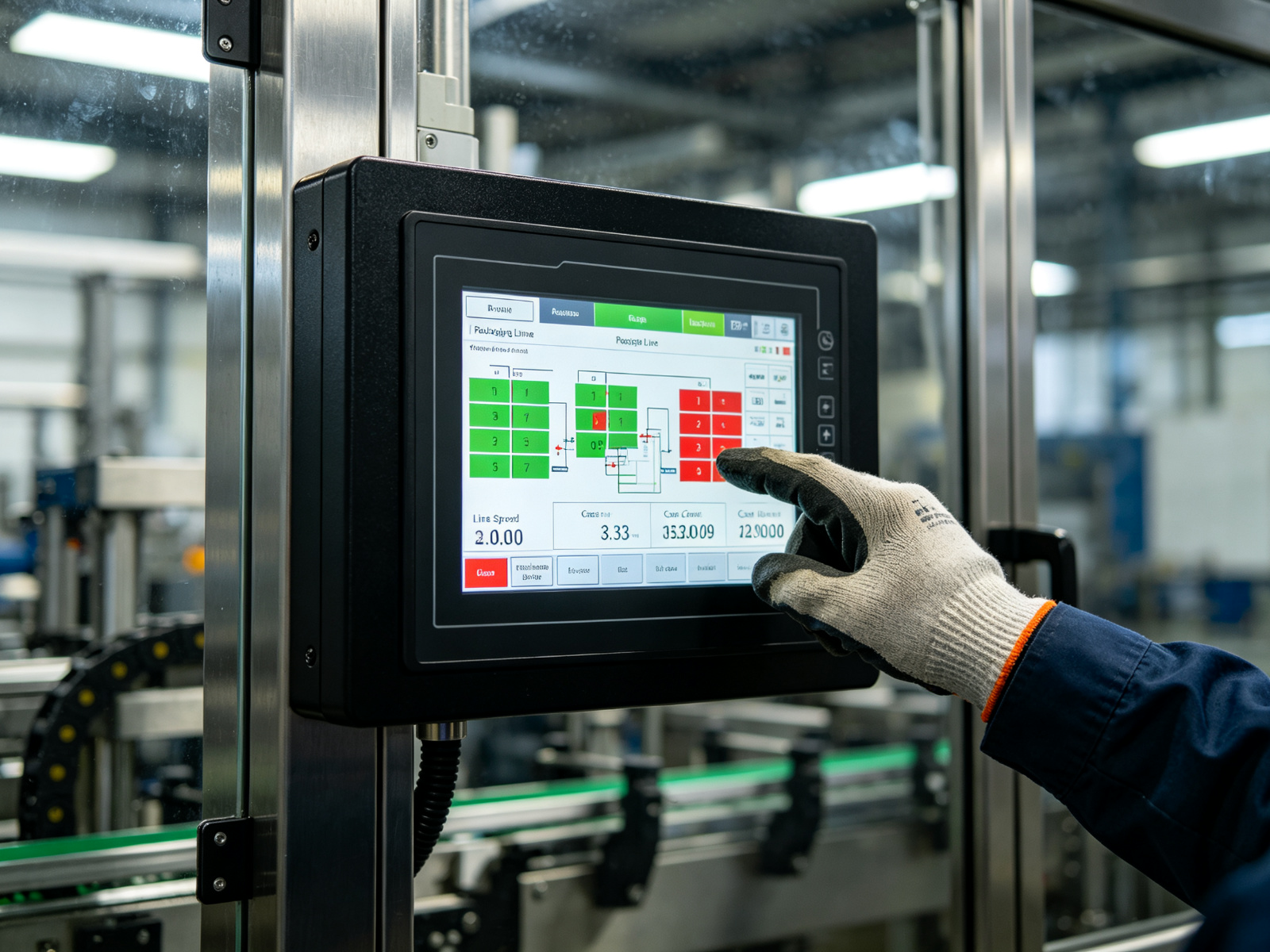
Whatever the method, the reject bin must be lockable and logged: an audit asks who opened the reject bin and what they did with the packs. The HMI should timestamp every reject with the pack weight and the metal-detector result, because that is the record the customer audit wants. For lines feeding a bag palletizer or case packer downstream, the reject must happen before collation, so a contaminated pack never reaches the case.
Five integration mistakes that fail audits
1. Mounting the metal detector on a vibrating conveyor
Metal detector coils are sensitive to mechanical vibration and to nearby ferrous structure. It needs its own rigid section, with the conveyor bed built from non-ferrous materials (UHMW, stainless 304/316) around the aperture, and a safe distance from drive motors and servo cables.
2. Not testing with challenge sticks every shift
HACCP requires a documented challenge test: run ferrous, non-ferrous and stainless test spheres through the detector at start-up and after every changeover. If the reject does not fire, the line stops. A detector that is not challenged every shift is not a control.
3. Checkweigher sharing power or frame with a sealer
Heat and vibration from a flow wrapper or sealer drift the load cell. Isolate the weigh section mechanically and electrically; a few centimetres of flexible conveyor between sealer and scale removes most of the error.
4. Ignoring product effect on wet or salty products
Salt brine, sauce and wet meat conduct and look like metal to the coil. These products need a product-effect learning routine (running a known-good pack to teach the detector the baseline) and a lower sensitivity setting chosen with the customer’s retail spec, not a generic number.
5. No data export for audit
Modern checkweighers and metal detectors log weight, rejects and test results internally. Buy the Ethernet/OPC-UA option and export to the line data system. Hand-written reject logs are exactly what a customer audit will write up.

Metal detector vs x-ray: when to pay more
Metal detectors miss non-metallic threats: bone, glass, stone, dense plastic clumps. If your product has a bone-in risk (meat) or could contain glass or stone, an x-ray system sees those in addition to metal, but costs two to four times more and needs its own safety guarding. For most snack, bakery and dry-goods lines a metal detector plus checkweigher is the right level; for bone-in meat, glass-jar or multi-component ready meals, specify x-ray. This decision should be driven by the hazard analysis, not by budget. When you build the rest of the line around thermoforming or band sealing, leave the aperture width and reject clearances in the layout from day one – retrofitting a tunnel through an existing conveyor is far more expensive than planning it in.
Frequently asked questions
Where should the metal detector sit on the line?
After the primary pack is sealed and before case packing or collation, on a rigid, isolated conveyor. Putting it before sealing means a rejected open pack wastes product; putting it after palletizing means you must break a pallet to remove one pack.
How often must we challenge the metal detector?
At every start-up, after every product changeover, and at fixed intervals during long runs (commonly every 4 hours, or per your customer’s BRC/IFS schedule). Three test spheres – ferrous, non-ferrous, stainless – each must trigger the reject, and the result is logged.
Why does my detector alarm on salty or wet products?
Salt and wet meat conduct electricity, creating a “product effect” that the coil reads as metal. Run the product-effect learning routine and set sensitivity to your agreed retail level; never just turn the sensitivity down without a documented reason.
What checkweigher tolerance do retailers expect?
Typical target is repeatability within ±0.5–1.0 g on packs up to 500 g, set so the average sits slightly above declared weight to stay inside local net-weight regulation. Confirm against your customer’s audit standard.
Calibration, commissioning and FAT for inspection
An inspection line should be challenged during factory acceptance, not after it reaches your plant. At FAT, run your own actual product (not the builder’s test biscuit) through the metal detector at the agreed sensitivity, confirm all three challenge spheres trigger the reject arm into the locked bin, and weigh a set of known underweight, correct and overweight packs to prove the checkweigher rejects the right ones. This is also where you confirm the HMI logs every event to a USB or network export. Buyers who skip FAT on inspection stations usually discover six months later that the detector was set to the wrong product-effect routine, and by then the audit trail is meaningless. If your customer audit standard is BRC, IFS or FSSC 22000, hand that document to the builder before FAT so the challenge procedure and logging match what the auditor will ask for.
Daily startup and shift checklist
- Warm up the metal detector for its recommended stabilization time before the first challenge test.
- Run ferrous, non-ferrous and stainless challenge spheres through the running conveyor; confirm the reject fires and the pack reaches the locked bin.
- Calibrate the checkweigher with a certified test weight, then run a handful of production packs and confirm the average sits on target.
- Verify the reject bin is empty, closed and the bin-full interlock is armed.
- Confirm the HMI is logging to the network and the shift’s first test result is recorded with operator name and time.
- After every product changeover, re-run the challenge test; different product effect needs a fresh learning cycle.
False rejects: the hidden efficiency killer
Over-sensitive settings create a false reject rate that quietly destroys line efficiency and erodes trust in the system. A detector that rejects 2% of packs for “metal” that turns out to be salt brine, a folded film edge or a foil seal will be turned down by operators within a week – and then it genuinely misses a fragment. Treat false-reject rate as a monitored number, not an annoyance: if it climbs, retune the product-effect learning rather than lowering sensitivity. The same applies to checkweighers: a scale that rejects every pack at upper tolerance because it is drifting will either be bypassed or re-tared by hand, both of which break the audit record. A well-set inspection station should reject under 0.5% of packs; if you are rejecting more, the integration, not the product, is the problem.
Standards and documentation you will be audited against
Most export food buyers audit to BRCGS, IFS or FSSC 22000, and each expects the same basic evidence: a validated hazard analysis that names metal and underweight as significant, a written procedure for challenge tests, a log of every test result and reject, records of calibration weights, and a procedure for what happens to product between a detected failure and the last good test. That last point trips up many plants: if the metal detector alarms at 11:02, the auditor will ask you what you did with every pack produced since 10:00 when the detector was last challenged. A properly wired system marks those packs automatically; a manual one forces a quarantine decision you cannot reverse. When you specify the inspection station, ask the builder how the line handles a failed test – which packs are flagged, how they are held, and how the HMI records the recovery – because that answer is what the auditor will read first.
Summary
Metal detection and checkweighing are not add-ons; they are the line’s last regulatory and food-safety gate. Place them on isolated, rigid conveyors, choose a reject that actually reaches a locked bin, challenge them every shift, and log the data for audit. Done right, they quietly pass thousands of packs a shift; done as a bolt-on, they fail on the first customer visit. SunAura Machinery integrates metal detection, checkweighing and reject into the discharge of its filling, sealing and packaging lines, and FATs the reject and challenge routine on your own packs. If you are specifying an inspection and reject station, talk to our line engineers with your pack sizes, speeds and product hazard list for a layout that will pass audit.