

QINGDAO, China — September 26, 2026 — SunAura Machinery has launched a new multihead weigher series designed to bring accurate, high-speed portioning to snack food, confectionery, frozen food, and hardware packaging lines. The new series includes 10-head, 14-head, and 18-head configurations with weighing speeds from 40 to 120 weighments per minute — giving producers a range of options for weighing and filling bags, jars, and trays.
The multihead weigher is the machine that sits upstream of the bag sealer or pillow wrapper — it weighs exact portions of product and feeds them to the packaging machine. Accuracy matters enormously: overfilling by 1 gram on a 100g bag costs 1% of product value; underfilling violates weight regulations and triggers customer complaints. A good multihead weigher holds weight accuracy to ±0.5–1.5 grams while running at production speed.
New Model Range
| Model | Heads | Speed | Weigh Range | Best Application |
|---|---|---|---|---|
| MH-10 | 10-head | 40–60 weigh/min | 5–500g | Small snacks, confectionery, hardware |
| MH-14 | 14-head | 60–90 weigh/min | 10–1,000g | Snack foods, frozen vegetables, nuts |
| MH-18 | 18-head | 90–120 weigh/min | 20–2,000g | High-speed snacks, pasta, dried fruits |
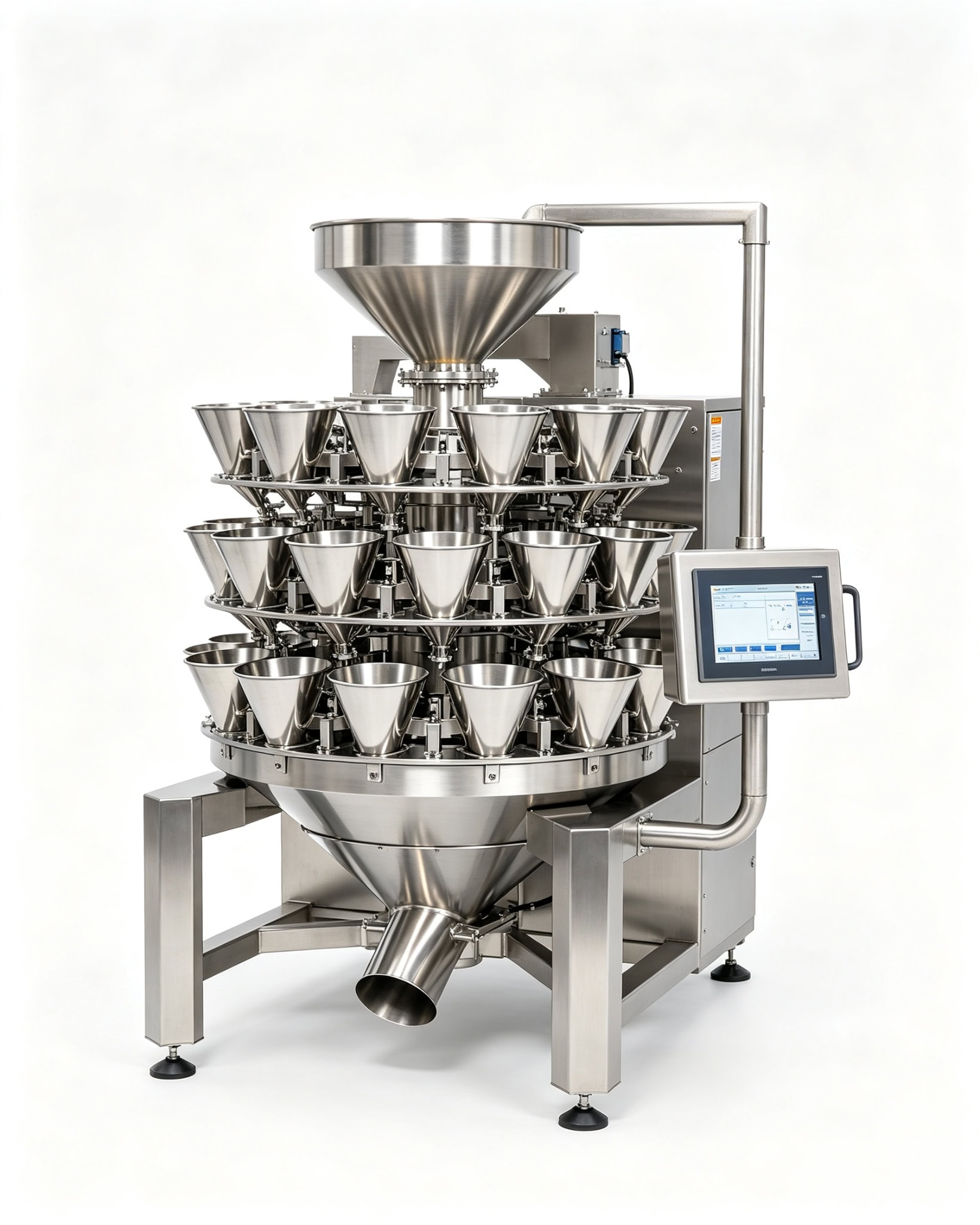
How a Multihead Weigher Works
The multihead weigher uses a “combination weighing” principle that is both simple and ingenious. Product flows into a top funnel, which distributes it across 10, 14, or 18 weighing hoppers. Each hopper holds a random portion of product. The computer scans all hoppers and selects the combination of hoppers whose total weight is closest to the target weight — typically using 2–5 hoppers per weighment. The selected hoppers discharge into the packaging machine; the remaining hoppers refill for the next cycle.
This combination logic is why multihead weighers are so accurate: instead of trying to weigh an exact portion in one hopper, the computer combines several random portions to hit the target. With 18 heads, there are thousands of possible combinations, and the computer evaluates them all in milliseconds. The result is accuracy within ±1 gram on most products.
Key Features
All three models share a common platform with these features:
- Stainless steel contact parts: all product-contact surfaces are 304 stainless steel, meeting food-grade hygiene standards and allowing full washdown cleaning.
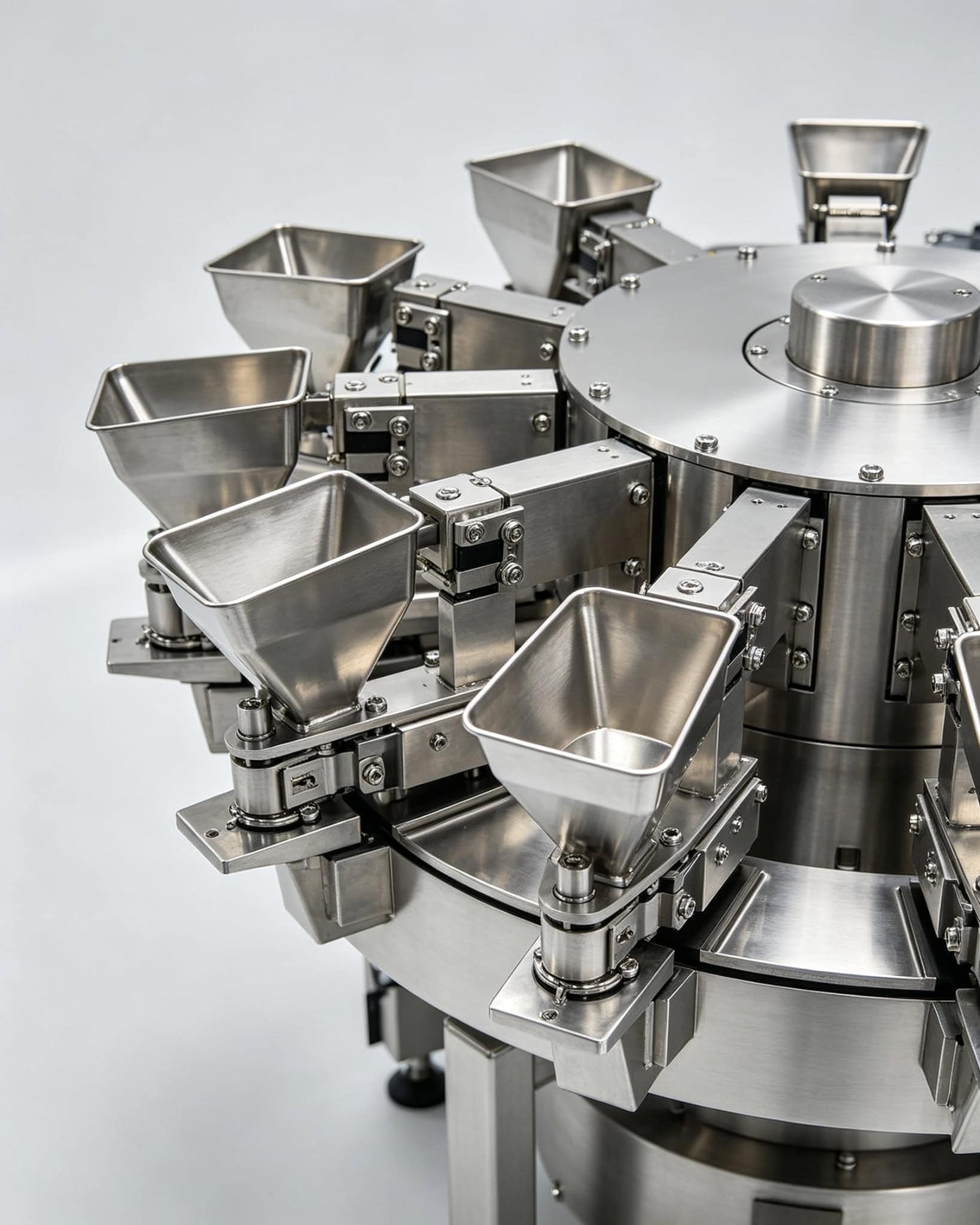
- High-frequency vibration feeders: linear feeders with adjustable vibration control product flow into each hopper, handling fragile products (chips, cookies) without breakage.
- Digital load cells: 3kg capacity load cells with 0.1g resolution deliver the weighing accuracy the combination logic needs.
- Recipe memory: up to 100 product recipes stored on the HMI — target weight, feeder vibration, and discharge timing recalled in seconds.
- Integration with bag sealers and pillow wrappers: the weigher signals the packaging machine when a weighment is complete, and the wrapper signals back when it is ready. This two-way handshake prevents product jams and empty bags.
- Anti-dribble hoppers: special hopper design prevents product from dribbling after discharge — critical for accuracy and for powders that cling.
“Customers kept asking us for a complete bag packaging line — weigher, bag former, and band sealer from one supplier,” says the SunAura product manager. “We had the sealers and the pillow wrappers. The multihead weigher was the missing link. Now we can deliver the complete weighing and packaging system with one interface, one warranty, and one service contact.”
Why Weight Accuracy Matters
Weight accuracy is a direct profit driver for snack and food producers. Consider a snack factory running 60 bags per minute, 16 hours per day: that is 57,600 bags per day, or roughly 15 million bags per year. If each bag overfills by 1.5 grams of product worth $2 per kilogram, the annual giveaway cost exceeds $45,000. Conversely, underfilling by 1 gram on a regulated product risks legal penalties and customer trust.
Multihead weighers reduce giveaway to near zero while keeping every bag above the legal minimum. The payback calculation is straightforward: a factory with meaningful volume recovers the weigher’s cost through reduced giveaway within 12–24 months.
Applications Across Industries
The new multihead weigher series serves several customer segments:
Snack foods: chips, crackers, nuts, and popcorn are weighed into bags at 60–120 weighments per minute. The high-frequency feeders handle fragile chips without breakage — a critical requirement for snack producers.
Confectionery: candies, chocolates, and gummies are weighed by count or weight. The MH-10 handles small confectionery portions; the MH-18 handles high-speed hard candy lines.
Frozen foods: frozen vegetables, french fries, and prepared foods are weighed while frozen. The stainless steel construction tolerates cold and condensation; recipe memory handles different frozen products on the same line.
Hardware and small parts: screws, bolts, washers, and fittings are weighed into bags for retail packaging. The weigher handles metallic parts without damage, and the anti-dribble hoppers prevent small parts from jamming the discharge.
Pet food and dried goods: kibble, seeds, grains, and dried fruit are weighed into bags at high speed. The MH-14 and MH-18 handle the large portion sizes typical of pet food packaging.
Integration with Packaging Lines
The multihead weigher is designed to work with SunAura packaging equipment — band sealers for bag sealing and pillow packaging machines for flow-wrap packaging. A typical integrated snack line includes:
- Multihead weigher (MH-14 or MH-18)
- Bag former or pillow wrapper (ZW series)
- Band sealer or integrated sealing jaws
- Checkweigher (optional, downstream verification)
- Metal detector (optional, for food safety)
- Conveyor and packing table
Weighers pair with band sealers for bag closure and flow wrappers for complete wrap packaging. All machines communicate over the same control network — the weigher, wrapper, and sealer are synchronized from a single HMI. For complete bag packaging lines, see our turnkey packaging system solutions.
Market Context: Why Multihead Weighing Is Growing
The launch comes at a time when multihead weighing demand is accelerating across food and non-food packaging. Three trends drive the growth:
Regulatory weight enforcement: many export markets enforce average weight regulations with fines for underweight packages. Exporting snack producers must hold every bag above the legal minimum — a task that hand-weighing or auger filling cannot reliably achieve at speed.
Premium product economics: as commodity snacks shift to premium positioning, the product cost per kilogram rises — and so does the cost of giveaway. A 1-gram overfill on a premium chocolate product is far more expensive than the same overfill on bulk rice.
Labor shortage: manual weighing and filling is difficult to staff in most markets. A multihead weigher replaces 3–4 manual workers on a bagging line and runs two or three shifts without fatigue.
For contract packers, the multihead weigher is now a competitive requirement — customers select packers partly on accuracy performance, and giveaway levels are written into packaging service contracts.
Technical Deep Dive: Combination Weighing in Practice
Understanding the combination logic helps buyers specify the right machine. The computer’s task is to find the subset of hoppers whose combined weight is closest to the target — and to do it within milliseconds, every cycle. Two factors determine the achievable accuracy:
Number of heads: with 10 heads, the computer evaluates a few hundred combinations. With 18 heads, it evaluates several thousand. More combinations mean the selected total is closer to the target. This is why the 18-head model achieves better accuracy than the 10-head on the same product.
Portion size relative to target: if each hopper holds roughly 1/4 of the target weight, the computer combines 2–4 hoppers per weighment. If hoppers hold very small portions (1/8 of target), the computer combines 4–6 hoppers — finer granularity, better accuracy, but slower because more hoppers discharge per cycle. The feeder vibration is tuned so hoppers receive the right portion size for the target weight.
Operators should understand that accuracy varies by product — uniform products (rice, peas) weigh to ±0.5 gram; irregular products (chips, cookies) run at ±1.5 grams. The HMI displays the actual giveaway statistics per batch, allowing operators to tune the target weight to the legal minimum without risking underweight bags.
Customer Applications and Early Adopters
Three pilot customers in Vietnam, Saudi Arabia, and Poland have been running pre-production versions of the new weighers:
A snack producer in Vietnam uses the MH-14 with a ZW-500S pillow wrapper on a shrimp chip line. They report giveaway dropped from 2.8 grams per 100g bag (auger filler) to 0.9 grams — a product cost saving of nearly 2% at 60 bags per minute. The payback period for the weigher upgrade was under 10 months.
A date and nut processor in Saudi Arabia uses the MH-18 with a bag former and band sealer. They run 12 SKUs across two shifts, switching recipes in seconds from the HMI. The stainless steel construction handles the dusty product environment, and the anti-dribble hoppers eliminated the powder build-up that jammed their previous weighing system.
A frozen vegetable packer in Poland runs the MH-14 with a vertical bagger. The weigher handles frozen product at -18°C without condensation issues, and the recipe memory handles the switch between peas, corn, and mixed vegetables in under a minute.
Buying Advice: Choosing the Right Multihead Weigher
When comparing multihead weigher quotes, focus on these factors:
Packaging machine speed: the weigher should run 10–20% faster than your wrapper or bagger. A weigher rated at exactly your line speed will bottleneck every time the product flow hiccups. Match head count to speed: 40–60 bags/min needs 10 heads; 60–90 needs 14; 90–120 needs 18.
Hopper volume: hopper capacity determines the maximum weighment. Standard hoppers handle 500–1,000g; large hoppers handle 2kg+ portions. Match hopper size to your largest bag weight, with 20% margin.
Product contact material: all product contact surfaces must match your hygiene requirements. 304 stainless is standard for food; 316 stainless is available for acidic products; food-grade plastics are used for products that stick to metal.
Integration interface: confirm the weigher communicates with your existing packaging machine. The standard handshake — “weighment ready” / “machine ready” — prevents product jams. Proprietary interfaces lock you into one supplier; open protocols (PROFINET, EtherNet/IP, or simple I/O) preserve flexibility.
Sample test: send 5–10kg of your actual product for a weighing test. Measure accuracy, speed, and product breakage at your target portion size. A 30-minute test with your product prevents months of post-delivery tuning.
Frequently Asked Questions
How accurate is a multihead weigher?
On most products, the combination weighing logic achieves ±0.5–1.5 grams accuracy at full speed. Accuracy depends on product size and uniformity — small uniform products (peas, rice) weigh most accurately; large irregular products (chips, cookies) have slightly higher variance. The 18-head model is more accurate than the 10-head because more heads mean more combination options.
What is the difference between a 10-head and an 18-head weigher?
More heads mean faster speed and better accuracy. The 10-head runs 40–60 weighments per minute; the 14-head runs 60–90; the 18-head runs 90–120. More heads also improve accuracy because the computer has more portion combinations to choose from. Choose the head count based on your packaging machine speed — the weigher should run 10–20% faster than the wrapper.
Can the weigher handle fragile products like potato chips?
Yes. The high-frequency vibration feeders are adjustable — reduce the vibration amplitude for fragile products so chips do not break during feeding. The 14-head and 18-head models distribute product across more hoppers, reducing the volume per hopper and further protecting fragile items.
What maintenance does a multihead weigher require?
Daily: clean hoppers and feeders, check for product residue. Weekly: calibrate load cells with a test weight, inspect vibration feeders. Monthly: check discharge timing, clean the control panel touchscreen. The load cells are precision instruments — avoid impact during cleaning. Annual calibration by a certified technician is recommended.
How much does a multihead weigher cost?
10-head models start at $15,000–$25,000. 14-head models range from $25,000 to $40,000. 18-head high-speed models start at $35,000–$55,000. Prices vary with hopper size, product contact materials, and integration requirements. Contact our SunAura sales team for a quote based on your product and packaging speed.
Availability and Support
All three multihead weigher models are available for ordering. Standard configurations ship in 3–4 weeks. Integration with bag formers, sealers, and conveyors has 5–6 week lead times. Each system includes:
- Factory acceptance testing with customer product samples
- On-site installation and operator training
- 12-month parts warranty
- Remote diagnostics capability
- CE certification documentation
For complete weighing and packaging systems, see our turnkey packaging line solutions. To request a quote or schedule a product demonstration, contact the SunAura sales team.
About SunAura Machinery
SunAura Machinery is a packaging equipment manufacturer based in Qingdao, China. The company’s product range includes carton sealers, case erectors, strapping machines, vacuum packers, shrink wrappers, pallet wrappers, liquid fillers, pillow packaging machines, band sealers, thermoforming machines, and now multihead weighers. All equipment is CE certified and exported to 100+ countries.
Editorial note: Specifications are subject to change without notice. Contact SunAura Machinery for current configuration options.
《 “SunAura Machinery Launches Multihead Weigher Series for High-Speed Snack and Food Packaging” 》 有 2 条评论
[…] complete flow-wrap packaging lines, the wrappers integrate with multihead weighers, band sealers, and downstream case packing equipment. To request a quote, contact the SunAura sales […]
[…] sealers close bags filled by multihead weighers and formed by flow wrappers. For tray and blister packaging, see our thermoforming machine […]