

QINGDAO, China — October 2, 2026 — SunAura Machinery has launched an upgraded semi-automatic pallet wrapper series designed for mid-size production facilities that ship palletized goods internationally. The new series — covering turntable and rotary arm configurations with pre-stretch film systems — targets exporters who have outgrown manual stretch wrapping but are not yet ready for a fully automated palletizing and wrapping line.
The launch responds to a pattern the SunAura sales engineering team sees weekly: a factory produces 30 to 80 pallets per shift, workers wrap each pallet by hand with a film roll, and the labor cost plus film waste quietly erodes export margins. Between manual wrapping and a robotic end-of-line system sits the semi-automatic pallet wrapper — a machine that wraps a pallet in 30 to 60 seconds, cuts film consumption roughly in half, and costs a fraction of a fully automated station.
What the New Semi-Automatic Pallet Wrapper Series Offers
The expanded semi-automatic series includes three configurations, each engineered for a specific floor plan and throughput range:
| Configuration | Pallet Capacity | Max Load Height | Max Load Weight | Wrapping Speed | Best Fit |
|---|---|---|---|---|---|
| Turntable, 1.5m platform | Up to 1,200 × 1,200mm | 2,200mm | 1,500 kg | 30–45 sec/pallet | Standard export pallets, ≤60 pallets/shift |
| Turntable, 2.0m platform | Up to 1,500 × 1,500mm | 2,400mm | 2,000 kg | 35–50 sec/pallet | Oversized loads, drums, coils |
| Rotary arm wrapper | Up to 1,200 × 1,200mm | 2,400mm | 2,000 kg | 25–40 sec/pallet | Heavy or unstable loads on a fixed base |
All three share the same control platform: a PLC with a 7-inch HMI, adjustable top and bottom wrap counts, film tension control, and an emergency stop system with light curtains on the load zone. Standard features include a 250% pre-stretch carriage, an automatic film cutter, and an anti-skid film lock — the features export packers actually need, without the automation modules they do not.
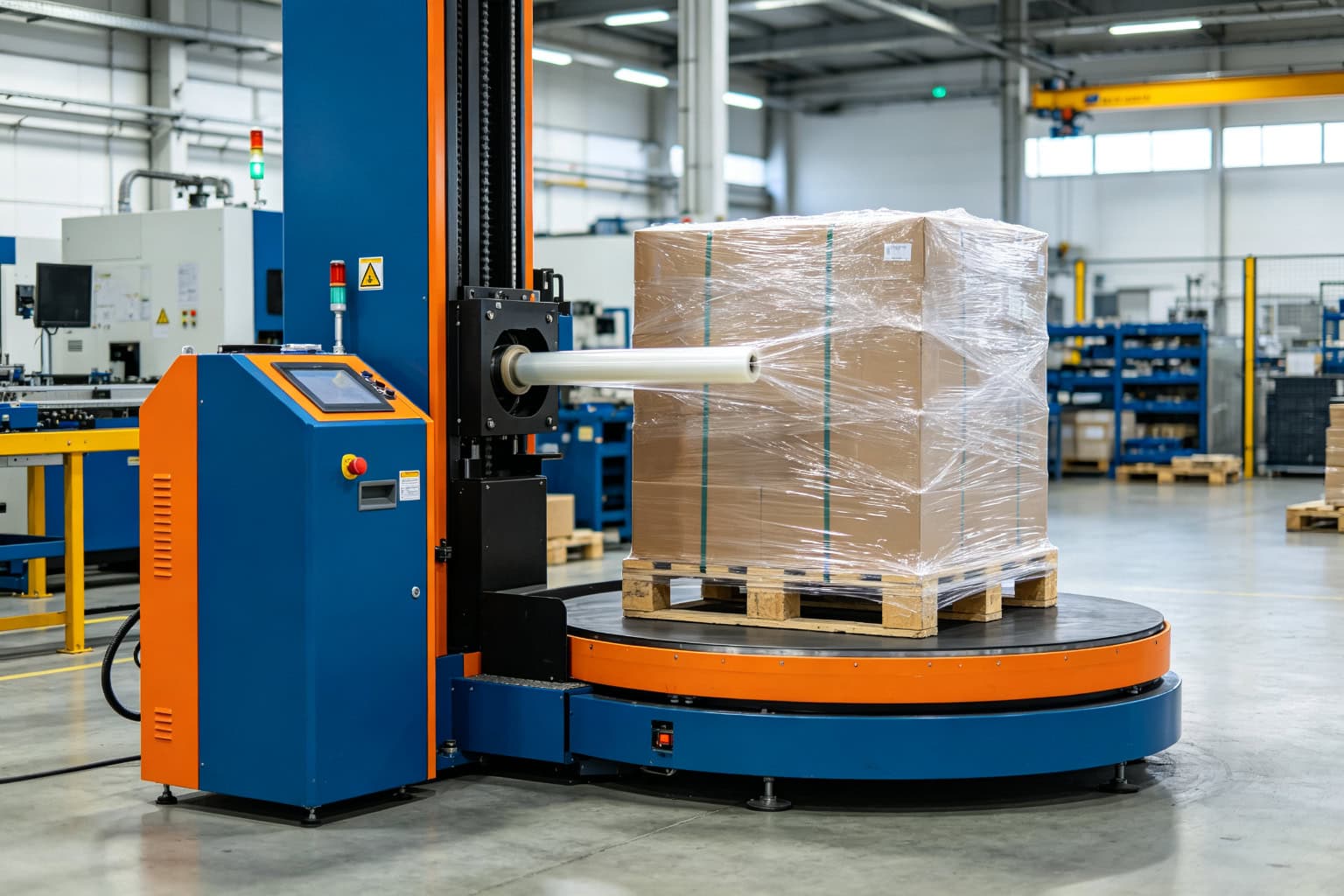
Why Semi-Automatic Wrapping Is the Right Step for Many Exporters
The upgrade path from manual to fully automatic pallet wrapping is rarely a single jump. Most mid-size facilities sit in a throughput band where full automation does not pay back. The semi-automatic wrapper fills that band:
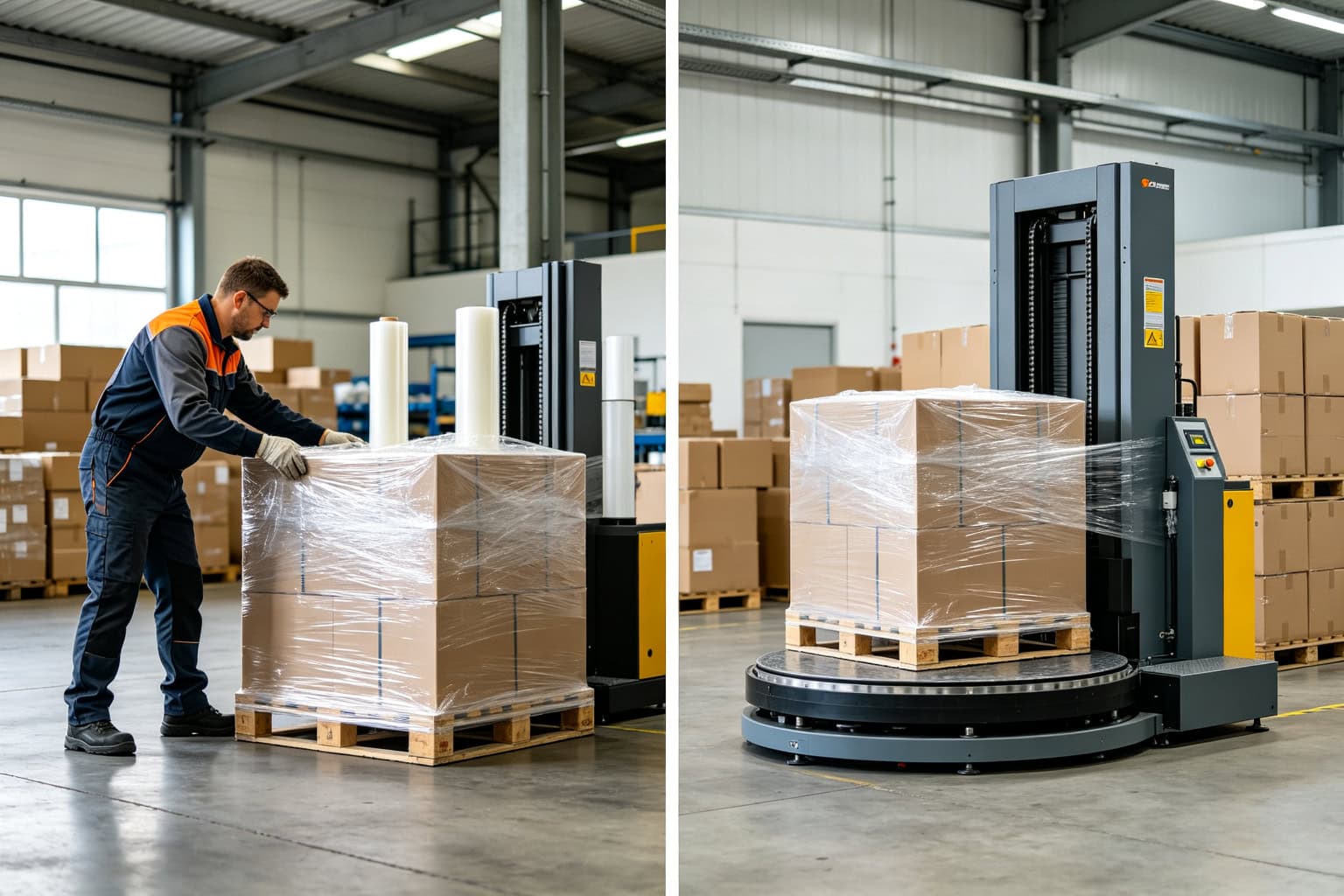
- Labor reduction: one operator can run the wrapper and stage the next pallet. Manual wrapping typically needs one worker per 20–30 pallets per shift; a semi-automatic wrapper with one loader handles 60–100 pallets per shift.
- Film savings: a 250% pre-stretch system stretches the film before it contacts the load, so one meter of film covers roughly 2.5 meters of wrap. Typical users report film consumption falling 40–55% versus hand wrapping.
- Consistent load security: manual wrapping depends on the worker’s skill and fatigue level. The machine applies the same wrap count and tension to every pallet — fewer damaged loads, fewer claims from freight forwarders.
- No re-engineering: the wrapper drops into an existing production area. It needs floor space, a standard 220V/380V supply, and compressed air for the film cutter. No conveyor changes, no control integration.
For export facilities, load security is not a preference — it is a contract requirement. Insurers and freight forwarders increasingly inspect pallet wrapping before accepting cargo, and loose or incomplete wraps are a leading cause of transit damage claims. A machine that applies the same wrap every time converts a quality variable into a fixed process parameter. The full range of pallet wrapping options — including fully automatic turntable and rotary arm machines — is covered in our pallet wrapping machine buying guide.
Configuration Options and How to Choose
The new series is configurable around five decision points. Working through them before requesting a quote prevents the two most common mistakes: buying too much machine or buying a wrapper that cannot handle the actual load profile.
1. Turntable or rotary arm? A turntable rotates the pallet while the film carriage moves up and down. It suits standard pallets and stable loads, and it is the lower-cost option. A rotary arm keeps the load stationary and rotates the film carriage around it. Choose the rotary arm when the load is heavy, unstable, or too large to rotate safely — for example, drums, tall stacks, or loads on custom pallets.
2. Load weight and height: measure the heaviest pallet your line will wrap, not the average. The machine’s rated capacity should exceed that weight by at least 20%. Check the height clearance in your building — a 2,400mm wrap height machine needs roughly 3,000mm of free ceiling above the load zone.
3. Film width and type: standard stretch film is 500mm wide; some regions use 450mm. Confirm the carriage accepts your film width and that the pre-stretch system handles the film gauge you buy. Cast film stretches more consistently than blown film; if you currently buy blown film, the pre-stretch setting may need adjustment.
4. Wrap program requirements: if different products need different wrap counts — for example, light cartons need two top wraps while heavy bags need four — choose the PLC model with programmable recipes. The entry-level relay model runs a single program and saves roughly 15% on purchase price, but it cannot switch wrap patterns without manual adjustment.
5. Future automation: if there is any chance the line will later connect to a conveyor and automatic wrapper, specify the PLC model with a conveyor interface port. Retrofitting a relay machine with an interface later is significantly more expensive than specifying it from the start.
Payback Reality: What Mid-Size Facilities Should Expect
Payback math for a semi-automatic pallet wrapper is straightforward and should be done before purchase, not after. A typical export facility in the 40–80 pallets-per-shift range:
- Manual wrapping labor: 1–2 workers at roughly 30–40 minutes per 10 pallets
- Manual film consumption: approximately 1.8–2.2 kg of film per pallet for standard export wrapping
- Semi-automatic wrapper film consumption: approximately 0.9–1.2 kg per pallet at 250% pre-stretch
At typical export film prices, the film saving alone on 50 pallets per shift, 25 days per month, pays a meaningful share of the machine’s price within 12–18 months. Add the labor saved by freeing one worker for other tasks, and most SunAura customers report full payback between 10 and 16 months. If you are running a full cost model for a packaging line investment, our packaging line ROI and payback calculation guide walks through the complete method — including labor, film, downtime, and maintenance inputs.
Semi-Automatic vs. Fully Automatic: Where to Draw the Line
The most common sizing question SunAura engineers hear is whether to buy a semi-automatic wrapper now or save for a fully automatic one. The decision is a throughput and labor question, not a budget question alone:
| Factor | Semi-Automatic Wrapper | Fully Automatic Wrapper |
|---|---|---|
| Operator requirement | 1 operator loads/unloads by fork truck | No operator — conveyor-fed, PLC-triggered |
| Practical throughput | 8–14 pallets/hour | 20–40 pallets/hour |
| Film savings | 40–55% vs. manual (250% pre-stretch) | 45–60% vs. manual, plus precise wrap programming |
| Floor space | Wrapper + staging area | Wrapper + conveyor infeed/outfeed + guarding |
| Price range | $4,500–$15,000 | $25,000–$80,000+ |
| Best fit | ≤100 pallets/shift, fork truck operation | ≥150 pallets/shift, integrated end-of-line |
Facilities in the 100–150 pallets-per-shift range should model both options against their labor availability and shift pattern. If the wrapper operator is also needed for other line tasks, the semi-automatic option often wins because it frees the operator between cycles. If the plant already runs a conveyorized end-of-line with a case erector and robotic palletizer, the automatic wrapper completes the line and the marginal cost is justified by removing the last manual touchpoint.
Supplier Checklist Before You Buy
Comparing quotes from multiple suppliers is standard practice, but several evaluation points are frequently overlooked. Add these to your checklist:
- Pre-stretch ratio verification: ask for the pre-stretch ratio in the technical specification and confirm the film carriage achieves it with your film gauge. Some suppliers quote 250% but deliver 200% in practice.
- Load capacity derating: confirm whether the rated load weight is for centered or off-center loads. Off-center loads reduce effective capacity by 20–30% on turntable models.
- Spare parts availability: ask for the lead time on the film carriage assembly and turntable drive motor. A wrapper that waits six weeks for a part costs more than the part itself.
- Safety certification: confirm CE documentation and the safety package — emergency stop, light curtains on the load zone, and interlocked guarding. This matters for insurance and for plant safety audits.
- Sample wrap test: send a pallet or load dimensions and film samples to the supplier. A short test confirms the wrap program and film tension before you commit to the purchase.
Integration with the Rest of the Line
The semi-automatic series is designed to stand alone today and integrate tomorrow. Every PLC model includes:
- A conveyor-ready frame with bolt-on mounting points
- An I/O interface for downstream conveyor signals
- Optional photo-eye load detection to start the wrap cycle automatically
This means a facility that starts with manual fork truck loading can later add a powered conveyor, a case erector, or a robotic palletizer upstream and convert the wrapper to automatic operation without replacing it. The end-of-line systems SunAura builds around this approach — case erector, robotic palletizer, and stretch wrapper in one synchronized line — are shown on our turnkey packaging line solutions page.

Operational Advice from the Factory Floor
Three practical lessons from SunAura installations are worth passing along to plant engineers planning the upgrade:
Stage the loading zone correctly: the wrapper’s throughput depends on how fast a fork truck can place and remove pallets, not on the machine’s wrap speed. Plan a staging area for at least two pallets in and two out. Facilities that skip staging find the machine idle while the fork truck catches up.
Check the film shelf life and storage: stretch film degrades with heat and UV exposure. Storing film rolls near a window or a heat source causes inconsistent stretch and tears. Store film in the original cartons in a cool, dry area and rotate stock by delivery date.
Calibrate the wrap program to the freight requirement: different destinations need different wrap specs. Sea freight to tropical ports demands more top wraps and a water-repellent film; domestic trucking needs less. Program the PLC recipes by destination so operators select the right program instead of improvising.
These details matter because they are the difference between a wrapper that saves money and one that simply moves the problem. The same discipline applies to every machine in the line — from the semi-automatic pallet wrapper to the case erector and carton sealer upstream. The complete pallet wrapping machine range at SunAura Machinery covers semi-automatic turntable, rotary arm, and fully automatic models, so facilities can size the equipment to the actual throughput rather than over-buying automation.
Frequently Asked Questions
How much does a semi-automatic pallet wrapper cost?
Entry-level turntable models with a 1.5m platform and manual film carriage typically range from $4,500 to $7,500. PLC-controlled models with 250% pre-stretch, automatic film cutter, and programmable recipes range from $8,000 to $14,000. Rotary arm configurations start around $15,000. The exact price depends on platform size, load capacity, and options such as conveyor interfaces and safety light curtains.
How many pallets per hour can a semi-automatic wrapper handle?
With one operator loading and unloading, a turntable wrapper handles 60 to 100 pallets per shift — roughly 8 to 14 pallets per hour in practice, depending on wrap counts and film type. This covers the vast majority of mid-size export facilities. Facilities above 150 pallets per shift should evaluate a fully automatic wrapper with conveyor feed.
Can the semi-automatic wrapper handle irregular loads like drums or coils?
Yes, with the right configuration. Drums, coils, and irregular loads are typically wrapped on a rotary arm model so the load does not rotate. Loads must be stable on their pallet and within the rated weight and height limits. For loads over 2,000 kg or above 2,400mm, SunAura recommends evaluating the heavy-duty gantry configuration.
What maintenance does a semi-automatic pallet wrapper need?
Routine maintenance is modest: monthly inspection of the film carriage bearings and chain tension, quarterly lubrication of the turntable drive, and an annual check of the pre-stretch rollers and electrical cabinet. Most facilities budget 2–4 hours of maintenance per month. The film cutter blade should be replaced when cuts become ragged — roughly every 3–6 months depending on throughput.
Does SunAura Machinery provide installation and training?
Yes. Every pallet wrapper ships with factory acceptance test documentation, and installation plus operator training are included for export deliveries. SunAura’s remote diagnostics team can access the PLC for troubleshooting, and spare parts for the film carriage and turntable drive are stocked for fast dispatch.
Availability
The new semi-automatic pallet wrapper series is available for order with 3–5 week lead times. Machine sizes and configurations can be matched to your pallet dimensions, load weights, and shift throughput — the SunAura sales engineering team will confirm the specification against your actual load profile before production. To request a quote or a film-consumption comparison for your pallets, contact the SunAura Machinery sales team.
About SunAura Machinery
SunAura Machinery is a packaging equipment manufacturer based in Qingdao, China, serving food, beverage, chemical, and consumer goods producers in more than 100 countries. The company’s end-of-line range covers case erectors, carton sealers, strapping machines, pallet wrapping machines, robotic palletizers, and turnkey packaging lines, all CE certified.
Editorial note: Specifications are subject to change without notice. Contact SunAura Machinery for current configuration options.
《“SunAura Machinery Launches Upgraded Semi-Automatic Pallet Wrapper Series for Mid-Size Export Facilities”》 有 1 条评论
[…] the machines displayed in Shanghai, SunAura also launched its upgraded semi-automatic pallet wrapper series for mid-size export facilities — available for sample testing at the […]