

A case erector is the machine that takes flat, corrugated cardboard blanks and turns them into open, bottom-sealed boxes — ready to be filled with product and then sealed. It is the first machine in the end-of-line packaging process, and if it fails, everything downstream stops. Yet in our experience, case erectors are often the most under-specified machine in the packaging line. Procurement teams compare prices without understanding that the wrong erector creates constant jams, wasted boxes, and lost production time.
At SunAura Machinery, we manufacture automatic case erectors for food, beverage, pharmaceutical, and consumer goods factories. This guide explains the different types of case erectors, how to match the machine to your box sizes and production speed, and what specifications matter most when comparing quotes. Whether you run 50 cases per hour or 500, this guide will help you select the right case erection system.
Why Case Erector Selection Matters
A case erector performs four critical functions in a few seconds: it picks a flat blank from a magazine, folds it into a rectangular shape, applies tape to the bottom flaps, and discharges the sealed case onto the conveyor. If any step fails — the blank sticks in the magazine, the box does not square up, the tape does not seal — the entire downstream line stops.
Industry experience shows that case erectors are the cause of 30–40% of end-of-line unplanned downtime. A jammed case that takes 15 minutes to clear might seem minor, but three jams per shift means 45 minutes of lost production. Over a year, that is 23 working days of lost output. The right erector eliminates these jams — the wrong one becomes a constant source of frustration.
Types of Case Erectors
1. Top-Down Case Erectors
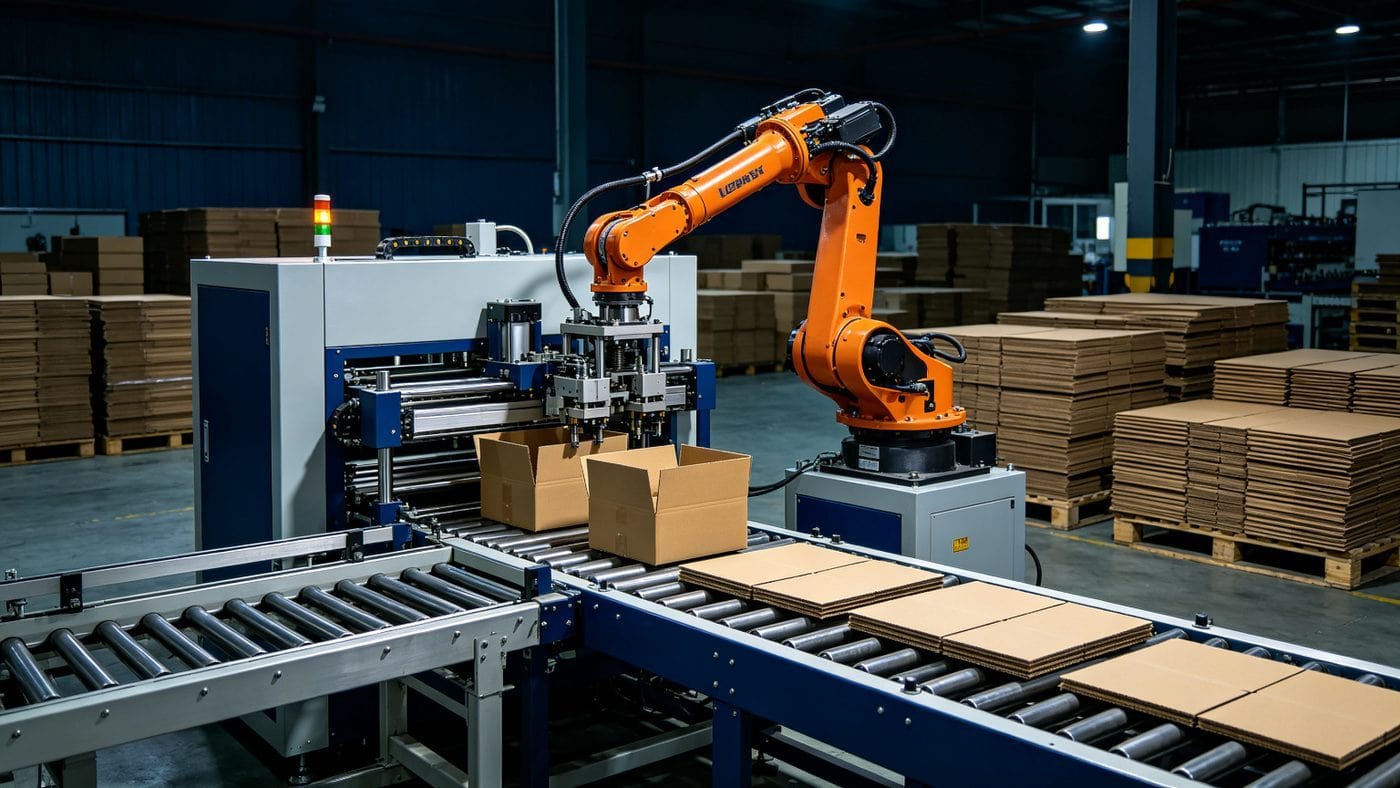
The most common type. Flat blanks are stacked in a vertical magazine. A suction cup picks the bottom blank, pulls it down into the forming station, folds it into a square, and applies tape to the bottom. The erected case exits the bottom of the machine.
Best for:
- Standard RSC (Regular Slotted Container) boxes
- Medium speed (10–30 cases per minute)
- Box sizes from 150 × 150mm to 600 × 500mm
- General-purpose packaging lines
Top-down erectors are reliable, affordable, and handle the widest range of box sizes. They are the standard choice for most factories. Our case erector range covers top-down models from compact tabletop units to high-speed floor-standing systems.
2. Bottom-Up Case Erectors
Flat blanks are stacked in a horizontal magazine at the top. The machine picks the blank, folds it downward into a box shape, and tapes the bottom. This design is more compact than top-down models and easier to access for box size changes.
Best for:
- Limited floor space
- Frequent size changes (easy access to forming belts)
- Box sizes similar to top-down range
- Operations where operator ergonomics matter
3. Side-Load / Continuous Case Erectors
High-speed systems that form cases in a continuous motion rather than a stop-and-go cycle. The blank is fed from the side, formed on a moving conveyor, taped, and discharged — all without stopping.
Best for:
- High-speed lines (30–60 cases per minute)
- Fixed box sizes with minimal changeover
- Integration with high-speed case packers and palletizers
- Two-shift or three-shift operations
Side-load erectors are faster than top-down models but require dedicated tooling for each box size. Changing from one box size to another takes 20–30 minutes on a side-load machine, compared to 5–10 minutes on a top-down model.
4. Semi-Automatic Case Erectors
The operator manually folds the box into shape and places it on a taping station. The machine applies tape to the bottom flaps automatically. No automatic blank feeding.
Best for:
- Low volume (under 10 cases per minute)
- Very wide or irregular box sizes that automatic machines cannot handle
- Start-up operations with limited capital
- Variable box sizes with frequent changes
Semi-automatic erectors cost $2,000–$5,000 compared to $15,000–$40,000 for automatic models. They are the right choice for low-volume operations where the labor cost of manual folding is acceptable.

Key Specifications to Compare
Case Size Range
The erector must handle your smallest and largest box with adjustment room. Measure your current and planned box dimensions (length × width × height). The machine’s forming belts and tape head must accommodate the full range. If you run 10 different box sizes, look for a machine with quick-change tooling and recipe memory.
Speed (Cases per Minute)
Match the erector speed to your line speed. If your case packer fills 30 cases per minute, the erector must produce at least 35 cases per minute (20% headroom). An erector that runs exactly at line speed will bottleneck the line every time it needs a box change or a minor adjustment.
Tape Type and Tape Head
Most case erectors use pressure-sensitive tape (BOPP or PVC, 48–75mm wide). Some use hot-melt glue. Tape head quality matters: a cheap tape head causes uneven tape application, tape wrinkling, and frequent tape changes. Look for a tape head with easy roll replacement and adjustable tension.
Blank Magazine Capacity
The magazine holds flat box blanks. A small magazine holds 30–50 blanks and requires refilling every 15–30 minutes. A large magazine holds 150–200 blanks and only needs refilling once per shift. For unattended operation, specify a large magazine with low-blank sensor that alerts the operator when it needs refilling.
Box Material Compatibility
Not all corrugated board is the same. Double-wall board (BC flute) is thicker and stiffer than single-wall (B or C flute). A machine tuned for single-wall may struggle with double-wall blanks. If you use recycled board or lightweight e-commerce boxes, confirm that the suction cups and forming belts handle these materials without crushing or jamming.

Top-Down vs. Side-Load: The Decision
The choice between top-down and side-load comes down to two factors: how many different box sizes you run, and how fast the line needs to be. A factory that ships 8 different SKUs in 8 different box sizes on a single line will change over constantly — and a 20-minute side-load changeover will consume hours of lost production per week. In that scenario, a top-down erector with 5-minute changeover is clearly better.
Conversely, a warehouse that ships a single product in one standardized carton at high volume does not benefit from changeover flexibility. The side-load machine’s 50-cases-per-minute throughput wins out. The break-even is typically around 35 cases per minute and 2–3 box size changes per day. Below that, top-down; above that, side-load.
| Factor | Top-Down Erector | Side-Load Erector |
|---|---|---|
| Speed range | 10–30 cases/min | 30–60 cases/min |
| Box size flexibility | High (quick adjustment) | Medium (tooling change) |
| Changeover time | 5–10 minutes | 20–30 minutes |
| Typical price | $12,000–$25,000 | $30,000–$60,000 |
| Best for | Multi-size, medium speed | Single-size, high speed |
If your line runs fewer than 30 cases per minute and changes box sizes more than twice per day, a top-down erector is the rational choice. If you run a fixed box size at 40+ cases per minute across two shifts, a side-load machine’s speed advantage justifies its higher cost.
Common Buying Mistakes
Mistake 1: Under-Sizing the Magazine
A 50-blank magazine means the operator must stop every 20 minutes to reload. Over an 8-hour shift, that is 24 reloads. A 200-blank magazine reduces this to 6 reloads. The extra $1,000–$2,000 for a larger magazine saves hours of operator time per month.
Mistake 2: Ignoring Box Quality Variation
Not all box blanks are manufactured to exact tolerances. If your box supplier provides blanks that vary ±3mm in dimension, a precision erector may jam. Ask the supplier how the machine handles out-of-tolerance blanks — does it fault and stop, or does it continue and produce a poorly formed box?
Mistake 3: Buying Without Spare Parts
Suction cups, forming belts, and tape heads wear out. A machine that runs without suction cups for a day because you are waiting for a spare part costs you dearly. Every case erector purchase should include a starter spare parts kit: suction cups, belts, fuses, and tape blades.
Mistake 4: No Integration With Downstream Equipment
The erector must communicate with the case packer and conveyor. If the packer has no cases to fill, the erector should pause. If the erector runs out of blanks, the packer should stop before it runs empty. Without this interlock, operators spend their time manually coordinating the line. For integrated solutions, see our complete packaging line systems.
FAQ: Case Erector Questions
How long does it take to change box sizes?
On a top-down erector with quick-change tooling, 5–10 minutes: adjust the forming belts, set the tape head position, and load the new blank size. On a side-load machine, 20–30 minutes requires changing forming blades and guides. Machines with recipe memory reduce this to 2–3 minutes by recalling all settings from the HMI.
What corrugated board types does a case erector handle?
Most automatic erectors handle single-wall B, C, or E flute board from 3mm to 7mm thickness. Double-wall BC flute (7–10mm) requires a heavy-duty model with stronger suction and forming belts. Lightweight e-commerce boxes (E or F flute, 1.5–3mm) work on most modern machines but may require softer suction cups to avoid crushing.
Can a case erector use glue instead of tape?
Yes. Hot-melt glue sealing is available on most case erectors as an option. Glue provides a stronger, cleaner seal than tape and is common in food and pharmaceutical packaging. The glue head adds $3,000–$5,000 to the machine cost but eliminates tape purchase costs and provides a more professional appearance.
How tall a box can a case erector handle?
Standard top-down erectors handle box heights from 100mm to 500mm. Extended-height models handle up to 700mm. Boxes taller than 700mm require custom equipment. Box width and length are typically limited by the forming station dimensions — standard range is 150mm to 600mm length and 150mm to 500mm width.
What maintenance does a case erector need?
Daily: clean forming belts and tape head. Weekly: inspect suction cups, check belt tension. Monthly: lubricate chains and bearings, test photoelectric sensors. Suction cups last 3–6 months; forming belts last 6–12 months. Keep spares on hand. At SunAura case erectors, every machine ships with a 6-month spare parts kit.
How much does a case erector cost?
Semi-automatic case formers start at $2,000–$5,000. Automatic top-down erectors range from $12,000 to $25,000. High-speed side-load systems start at $30,000+. Fully integrated end-of-line systems (erector + packer + sealer + palletizer) range from $100,000 to $300,000+. Contact our SunAura sales team for a detailed quote.
Conclusion: The Erector Sets the Pace
The case erector is the first machine in the end-of-line process — and its reliability determines how smoothly the entire line runs. A well-matched erector produces consistent, square, well-taped boxes with minimal operator intervention. A poorly matched one creates jams, wasted material, and constant line stops.
Start with your case size range and target speed. Choose between top-down flexibility or side-load speed. Compare magazine capacity, tape system, and box material compatibility. Request a sample run with your actual box blanks. And make sure the supplier can support you with spare parts and service when you need it.
Case erection is the first step in end-of-line packaging. Upstream may include liquid filling equipment or vacuum packing machines. Downstream, cases move to carton sealers and pallet wrappers.
Ready to spec your case erector? Send us your box dimensions, hourly output, and box material, and our engineers at SunAura Machinery will recommend the optimal erector — semi-automatic, top-down, or side-load — with a transparent quote and delivery timeline. For downstream box sealing, see our carton sealer buying guide. For complete end-of-line integration, explore our turnkey packaging line solutions.
《“Case Erector Selection Guide: Top-Down, Side-Load and Semi-Automatic Compared”》 有 1 条评论
[…] connect every piece of end-of-line equipment — from case erectors and carton sealers to strapping machines and robotic […]