
October 19, 2026 | by Ethan, SunAura Machinery Applications Engineering
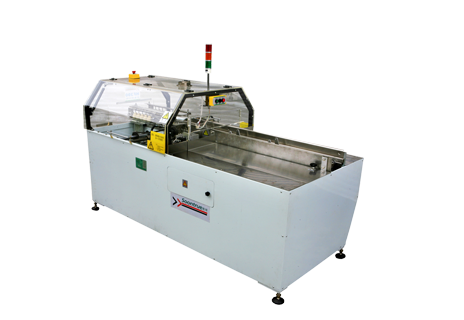
The single most expensive mistake in buying a liquid filling machine is choosing the filling principle first and the product second. A piston filler that doses a thick sauce beautifully will foam a thin shampoo into a bottle that looks half-empty; an overflow filler that fills a cosmetic bottle to a perfect level will leave chunks in a salsa jammed in its valve; a gravity filler that handles free-flowing water-like products cheaply will stall completely on a shear-thinning gel. At SunAura Machinery we receive the same enquiry every week — “a filling machine for bottles” — with no viscosity, no bottle drawing and no throughput target. This guide explains how gravity, overflow, piston and flow-meter filling actually work, what each does well and badly, and the exact sequence of questions a buyer should answer before asking for a price. The machine follows the product. Always.
Start With the Product, Not the Bottle
Before you choose a filling principle, characterize the liquid. The numbers that decide the machine are viscosity, whether the product foams, whether it contains particles or chunks, whether it must be kept hot or chilled, and whether it changes thickness under shear or as it sits in a tank. Free-flowing water, alcohol, thin juice and solvents run at the consistency of water; oils, light sauces and thin creams are thicker but still pourable; pastes, gels, honey, peanut butter and dense creams hold their shape; and chunky products like salsa, fruit pieces and pet food with chunks demand a valve that can pass solids without shearing them.
Record the temperature at which the product is filled and whether it is filled hot, because viscosity changes dramatically with heat and because hot-filled products need different nozzles and seals. Note whether the product foams on agitation (soaps, detergents, thin agrochemicals, some beverages are notorious) and whether it is abrasive or corrosive, which decides the wetted material and the valve type. A five-minute product specification at the start prevents a five-week re-engineering later.
The Four Main Filling Principles
Gravity fillers
A gravity filler opens a valve and lets the product flow under its own weight, usually from a raised tank. It is the simplest, cheapest and easiest-to-clean principle, and it is excellent for genuinely free-flowing, non-foaming liquids such as water, thin solvents, alcohol, light vinegar and some beverages. Its weakness is that it cannot accurately control a slow or variable product, and it is sensitive to fill pressure changing as the tank level drops. Gravity is the right answer for a thin, low-foam product on a budget; it is the wrong answer for anything that pours slowly or foams.
Overflow fillers
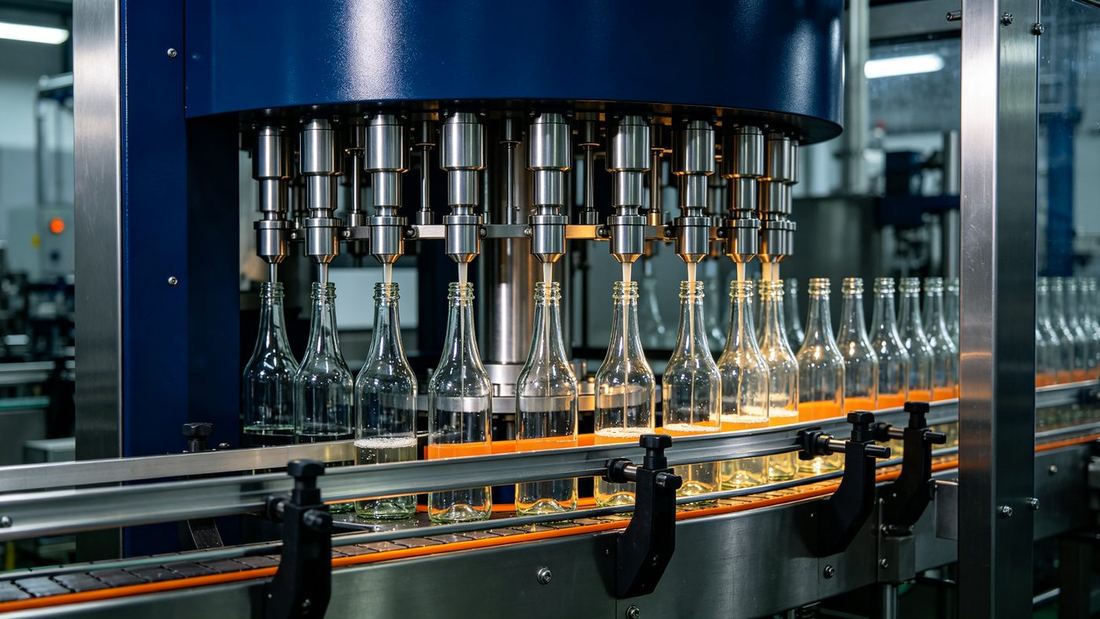
An overflow filler fills to a level rather than to a precise volume: each nozzle seals over the bottle mouth, fills until the liquid reaches the return port, and the excess flows back to the tank. This makes it the standard for clear-glass and PET bottles that must look identical on a shelf — still water, juice, cosmetics, window cleaners, sauces in transparent containers. Because the fill line is the same regardless of the small variations in bottle volume, the shelf appearance is perfectly even. Its limits are foaming and particulates: an overflow filler can aerate a foaming product and its return path cannot handle chunks or sticky residue without frequent cleaning.
Piston fillers
A piston filler draws a fixed volume of product into a cylinder and pushes it out with a plunger, giving highly accurate volumetric dosing for thick, viscous and even chunky products such as creams, pastes, honey, sauces, shampoo, detergents and food with pieces (with the correct rotor and valve). It is the most versatile and the most common choice for the mid-viscosity range, and it handles the hot-filled products that need a big nozzle. Its trade-off is complexity: there are more wetted and moving parts, changeover between very different products takes longer, and for very thin products it is over-engineered compared with a simple gravity or flow-meter line.
Flow-meter (and servo pump) fillers
A flow-meter filler measures the product as it passes through a meter — a magnetic meter for conductive liquids, a mass meter or gear/pump metering for non-conductive or viscous products — and closes the valve at the exact dose. There is no measuring cylinder, so it is easy to clean and CIP-friendly and handles large containers, hazardous products and lines with many bottle sizes very well. It is the premium choice for high-speed, high-accuracy and frequent-changeover lines, especially for chemicals, oils, edible oils and pharma, but the meters are sensitive to product type, aeration and conductivity, and the initial cost is higher.
Side by Side: Which Principle Fits Which Product
| Principle | Best for | Accuracy | Foaming / chunks | Cost / CIP |
|---|---|---|---|---|
| Gravity | Thin, free-flowing, non-foaming: water, solvents, vinegar, alcohol | Good for low viscosity; level-dependent | Poor with foam; no chunks | Lowest; simplest to clean |
| Overflow | Clear bottles needing an even visual level: water, juice, cosmetics, cleaner | Level-based; volume follows bottle | Foams easily; no chunks | Low; return path needs cleaning |
| Piston | Thick/viscous/chunky: creams, sauces, honey, paste, shampoo | Very high volumetric accuracy | Handles chunks with right valve; foam managed by nozzle | Mid; more parts and changeover |
| Flow-meter / servo pump | High-speed, multi-SKU, hazardous, oils, pharma, large containers | High; direct measured dose | Depends on meter/pump; sensitive to aeration | Highest; easy CIP, no cylinder |
Accuracy, Fill Method and the Diving-Nozzle Detail
Fill accuracy is quoted as a plus/minus percentage of the target dose, but the figure is meaningless without stating the product and the bottle size. A piston filler on a thick cream can hold to roughly ±0.5% of volume; a gravity filler on a thin product at speed may be closer to ±1%. For legal or “declared net content” markets, consistent underfilling is a compliance risk and overfilling is a direct giveaway cost, so the financial case for accuracy is concrete: on a 500 ml bottle filled at 50 million units a year, an average of 0.4% overfill is roughly 200,000 bottles of product given away.
Nozzle technique matters as much as the principle. Foaming and thin products are best filled with a diving nozzle that follows the rising liquid surface, or a nozzle that starts below the surface and rises, which dramatically reduces air entrainment and foam. Thick products and containers with small necks need a large-bore, fast-acting nozzle that cuts the product cleanly without dripping or stringing. A sauce that drips between bottles contaminates the thread and stops the cap from sealing, which is why fill and cap must be considered together.
Throughput, Head Count and the Whole Line
The machine brochure speed and the line speed are different numbers. Calculate the required output from the shift pattern, not the peak: bottles per minute equals daily target divided by available minutes after accounting for changeover, breaks, start-up and stoppage allowance. A common error is to divide by the full 480 minutes; using 360 effective minutes is closer to reality. The head count then follows from the fill time per bottle — a six-head inline machine can fill slower products at the same line speed as a twelve-head on a fast one, so adding heads is how you buy throughput for a thick product rather than running it too fast.
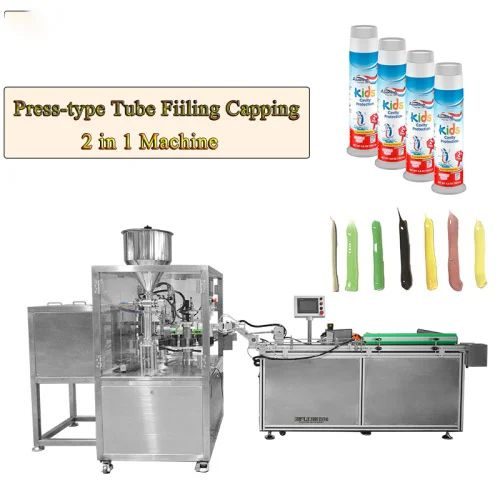
A filler never runs alone. Upstream there is rinsing and bottle handling; downstream the bottle goes to a capper, often an induction foil sealer, then labeling and case packing. The sealing station after filling is covered by our induction sealing machines, including a high-speed conveyor induction sealer for high-speed lines; choosing a fast filler with a slow capper simply moves the bottleneck downstream. The most popular configuration SunAura Machinery ships is the automatic linear filling machine for liquids, which accepts from two to many heads and is the flexible platform for plants running several bottle sizes; the full family is shown in the liquid filling machines hub.
Wetted Materials, Seals and Cleanability
The product also dictates the materials that touch it. For food, dairy, beverage and most pharmaceutical products, the product-contact frame and fill heads are 304 or 316 stainless steel; 316 is worth the premium where the product is acidic, salty, chloride-bearing or strongly chemical, because 304 will pit and corrode over time and the contamination shows up in the seal face and the valves. Elastomers are chosen per product: standard nitrile or silicone handles many foods, but aggressive chemicals, oils and high-temperature fills can demand Viton or PTFE gaskets. A buyer who specifies the wrong seal does not see it on day one; it appears as swelling, hardening or a slow drip after a few months, which is why the product data sheet must be sent to the machine builder rather than only the bottle dimensions.
Cleanability is a capacity decision disguised as a hygiene decision. A plant that fills the same product for weeks can tolerate a machine with more enclosed parts and manual teardown; a plant that runs three flavors, a shampoo and a conditioner in one day needs a line that drains fully, opens without tools, and accepts a validated clean-in-place cycle. The fill heads, the manifold and the tank should be designed so that product cannot pool in a dead leg that contaminates the next batch, and the detergent and water temperature of the cleaning cycle must be compatible with the seals. Under-estimating cleaning time is a frequent cause of an otherwise capable line missing its daily output.
Sizing Mistakes Buyers Make Repeatedly
- Specifying the machine on the smallest bottle only. Future SKUs are usually larger or more viscous. Confirm the head and pump range covers the biggest, thickest product on your roadmap, not just today’s launch.
- Ignoring cleanability. A food, dairy or pharma plant that changes products several times a shift needs fast CIP and few crevices; a piston cylinder with many seals is harder to break down than a flow-meter path. Size the cleaning, not just the filling.
- Forgetting the fill temperature. A hot-filled product or a wax that sets at room temperature needs heated hoppers and nozzles; a machine bought cold will seize.
- Buying the cheapest accuracy for a declared-weight product. Giveaway and legal underfill risk dwarf the price difference between a gravity and a piston or metered line.
- Decoupling filler and capper/sealer speeds. The whole line is as fast as the slowest station after the bottle is full.
A Decision Path in Five Steps
- Write the product spec: viscosity, particles, temperature, foaming, abrasiveness and chemical compatibility.
- Define the bottles: neck finish, volume range, glass or plastic, and how even the shelf level must look.
- Set the real throughput: daily and shift targets using effective minutes, then the required bottles per minute.
- Pick the principle: free-flowing non-foam to gravity, even-level clear bottles to overflow, thick or chunky to piston, high-speed multi-SKU or hazardous to flow-meter.
- Balance the line: confirm the rinser, capper, induction sealer and labeler can meet the same speed, and specify wetted materials (304/316 stainless, food-grade seals) for the product.
Frequently Asked Questions
Can one filling machine handle both thin and very thick products?
Not across the full range with one principle. A piston line with interchangeable cylinders and nozzles can cover a surprisingly wide viscosity band, but a free-flowing solvent and a peanut-butter-grade paste do not share a clean, accurate configuration. If you genuinely run both, expect two machines or two fill heads and a validated changeover and cleaning process.
Gravity or flow-meter for water-like products?
For a single, thin, non-foaming product at modest speed and budget, gravity is hard to beat. For multiple bottle sizes, high throughput, declared-accuracy requirements or chemicals, a flow-meter (or servo-controlled) line gives better accuracy, less giveaway and faster changeover for a higher upfront price.
Why do my bottles foam and short-fill?
Usually the nozzle fills from above the surface, entraining air, or the product is being agitated too hard in the tank, or the head is too fast. A diving nozzle, a slower start of the fill stroke, reduced tank agitation and an overflow or piston profile suited to the product solve most foaming short-fills.
What seals the bottle after it is filled?
A screw cap is applied on a capper, and where a tamper-evident hermetic seal is required — food, beverage, pharma, agrochemical — an induction foil liner is sealed after the cap. Our commissioning of an inline induction cap sealing line for a Brazilian agrochemical producer shows how the filler, capper and induction head are timed as one line.
Next Step
If you can send the product data sheet or a viscosity range, the bottle drawing or neck size, the SKU list and your target bottles per minute, the SunAura Machinery applications team will recommend the filling principle, head count and line balance and quote the correct configuration rather than the most expensive one. For dry, solid, flow-wrapped products the machine family is entirely different; see how a servo pillow packaging line was configured for a Thai snack producer for the comparison. Contact us with your product and bottle specifications for a layout and quotation.