When buyers specify a liquid filling line, the first decision most people make is the dosing method — piston, gravity, overflow, pump or flow meter. That choice matters, but it sits on top of an earlier layout decision: should the filler be an inline (linear) machine or a rotary carousel? The layout decides how many bottles per minute the line can hold, how easily it changes between formats, how much floor space it needs, and how much you pay for a given output. A dosing method that suits your viscosity can still land on the wrong layout, and the wrong layout is expensive to change after purchase. This guide compares inline and rotary fillers on the factors that drive a purchasing decision, and sets out when each one fits.
How Each Layout Works
Inline (linear) filler
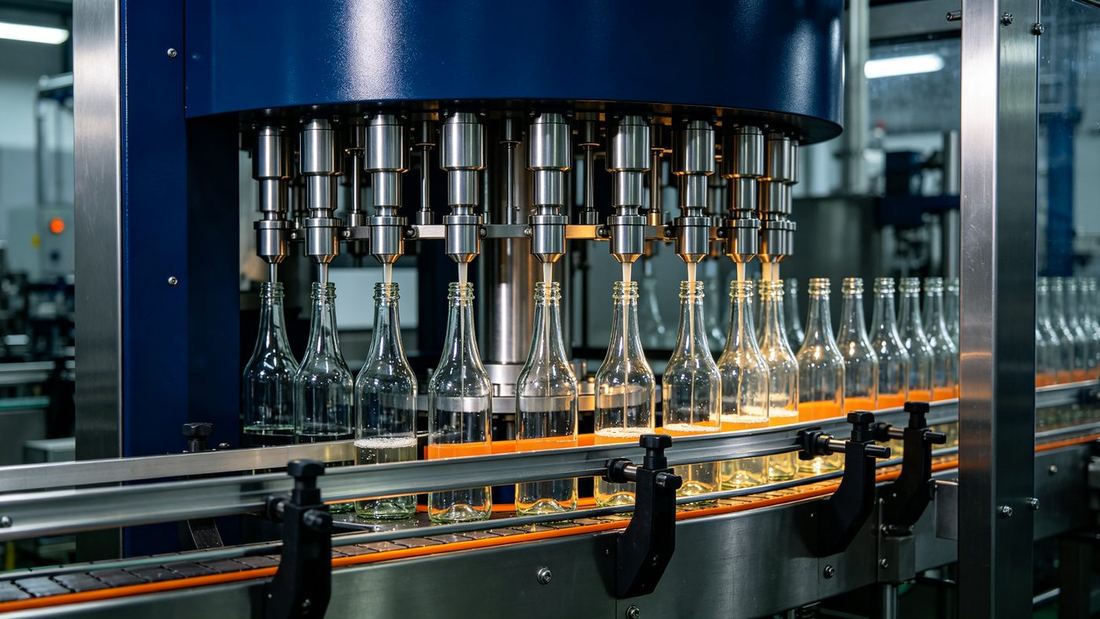
On an inline filler, bottles travel single file along a conveyor and pass under a row of filling heads. The machine typically indexes the bottles into position, fills, and releases them; adding output means adding more heads in the row or speeding the index cycle. Because bottles stay on a straight conveyor, the machine is easy to access from the front, and format changes usually mean adjusting guides, spacers and nozzle positions rather than swapping dedicated handling parts.
Rotary filler
On a rotary filler, bottles enter a rotating turret (carousel) and are held by a starwheel or gripper while the table turns. Each bottle passes under its own filling valve during the rotation, so filling happens in continuous motion rather than in stop-start index cycles. Output scales with the number of valves on the carousel and the turret speed, which is why rotary machines carry many more valves than an inline machine of comparable cost and reach high sustained throughput in a compact footprint. The trade-off is that bottle handling on the turret depends on format-specific starwheels, guides and neck grips.
Inline vs Rotary Filler Compared
| Factor | Inline (linear) filler | Rotary carousel filler |
|---|---|---|
| Motion | Intermittent; bottles index into position, fill, release | Continuous; bottles ride the turret under valves while rotating |
| Typical output | Low to moderate volume; thousands of bottles per hour, scaled by head count and index cycle | Medium to high sustained volume; tens of thousands of bottles per hour on large carousels |
| Container fit | Adapts more readily to a range of bottle sizes and shapes; stable round and slightly irregular containers | Best with a standardized, stable container range; turret handling is tuned to a defined bottle geometry |
| Changeover | Usually simpler; adjust conveyor guides, spacers and nozzle positions; fewer dedicated parts | Needs starwheels, neck grips and format guides per bottle size; changeover time and spare parts should be quoted |
| Floor space | Longer straight footprint for a given head count; shallow depth | More compact for high output; carousel footprint concentrates many valves in one area |
| Capital cost | Lower entry cost for moderate output; easier to stage in phases | Higher upfront cost, justified at high sustained throughput; dedicated handling tooling adds to the price |
| Strengths | Flexible across formats, accessible for cleaning and maintenance, lower investment, straightforward to integrate | High continuous speed, compact high-output footprint, steady fill cycle time per bottle |
| Limitations | Output bounded by index cycle and head count; less efficient at very high volume | Less flexible across irregular formats; format parts and turret setup raise changeover cost and complexity |
Decision Framework: Match the Layout to Your Line
By target output
The clearest split is sustained bottles per hour. If your plan is moderate volume with room to grow head by head, an inline filler usually covers the range at a lower investment. If you are targeting high, steady output where every cycle counts, a rotary carousel protects fill cycle time per bottle and keeps the machine compact; pushing an inline machine past its comfortable index range leads to rushed fills, bottle handling issues and lower reliability. Quote both layouts against your actual bottles-per-hour target, not against a single rated speed.
By bottle shape, stability and weight
Round, stable bottles of consistent diameter and height suit either layout. Irregular, tapered, tall, light or easily tipped containers are generally easier to manage on an inline conveyor, where guides support the bottle along its travel; a rotary turret grips each bottle by geometry, so an irregular shape needs dedicated starwheel or gripper design that may not pay off unless volume justifies it. Heavy or wide-mouth containers also tend to sit more comfortably on an inline arrangement.
By product, viscosity and foam
The dosing method is chosen by viscosity, foam and accuracy, and that dosing head can be mounted on either layout. Thin free-flowing liquids, viscous pastes, foamy products and particulate suspensions each call for a specific valve or cylinder; confirm the dosing technology separately, then ask how it performs on the chosen inline or rotary frame. Foam-sensitive or slow-fill products need enough dwell time under the nozzle, which can constrain how fast either layout runs.
By format variety and changeover
Multi-SKU plants that swap bottle sizes and shapes often favor an inline filler, where guides and nozzle settings change faster and fewer dedicated parts are stored. A rotary line is reasonable when the container range is narrow and stable, or when each format’s starwheels are stocked as planned change parts. Count how many bottle formats you run per shift and the acceptable changeover time before deciding; a high-speed rotary that takes long to retool can lose more time on changeovers than a slower inline that switches quickly.
By floor space and future expansion
Measure the available machine length and depth. Inline machines run along a straight conveyor, so they need length but little depth; rotary machines concentrate valves in a carousel, saving length at high output but needing clear space around the turret for loading and unloading. Plan expansion honestly: an inline line can add heads or stations in phases, while a rotary carousel is sized largely for its target output at purchase.
What to Confirm Before You Request a Filler Quote
- Target output: bottles per hour and per shift, peak demand, and whether the run is steady or seasonal.
- Container: bottle material, diameter, height, weight, shape (round, square, irregular), mouth finish, and stability on the conveyor.
- Product: viscosity at filling temperature, foam tendency, particles or chunks, temperature, and any product compatibility limits.
- Fill accuracy: target fill volume and acceptable fill tolerance per bottle.
- Format range: how many bottle sizes and shapes run on the line, and acceptable changeover time between them.
- Floor space: available length and depth, aisle clearance, and how the filler connects to rinsing, capping and labeling.
- Budget and phasing: initial investment, whether the line will be expanded later, and expected runtime or shifts per day.
Common Selection Mistakes
Choosing layout before confirming the dosing method. Viscosity, foam and accuracy drive the valve choice; layout drives speed and bottle handling. Specify both separately and check that the chosen dosing head works on the frame you select.
Buying speed on paper rather than tested output. A rated bottles-per-hour figure usually assumes clean, uniform bottles and ideal product. Ask for tested output with your actual containers and product, and a realistic efficiency factor for the line.
Underestimating rotary format parts. Starwheels, neck grips and guides are bottle-specific and must be stocked or ordered for each format. If you run many bottle shapes, count these parts and their changeover time into the total cost.
Over-sizing an inline line for future growth that does not arrive. An inline machine can grow head by head within limits, but forcing very high volume onto an intermittent layout raises bottle handling problems. If sustained high output is likely soon, compare a rotary option at the design stage rather than re-buying later.
Ignoring line balance. The filler must match the speed and handling of the rinser, capper and labeler. A high-output filler feeding a slower capper leaves accumulation and bottlenecks; the whole front-end line should be balanced together.
What to Choose, in Short
Choose an inline filler for low to moderate volume, a changing mix of bottle sizes and shapes, frequent changeover, a tighter initial budget, and a plant that may add stations in phases. Choose a rotary carousel filler for high sustained throughput, a stable standardized container range, and a compact high-output footprint where dedicated format parts are acceptable. If your product and bottle range sit between the two, ask the supplier to trial both layouts with your actual containers and quote realistic output, changeover time and spare-part needs.
Our liquid filling machines are built on inline and rotary frames matched to the dosing method, and can be paired with small-bottle and vial units such as the small-bottle fill-cap 2-in-1, the reagent testing-tube unit and the oral-liquid filling and crimping machine within a full front-end packaging line.
Not sure whether your output calls for an inline or rotary filler? Send bottle dimensions, closure, product viscosity, target bottles per hour and format variety to [email protected] or WhatsApp +86 136 4542 9121. Our application engineers can recommend the layout and dosing method, and you can review our industry solutions, after-sales support and help center.