Linear Weigher vs Multihead Weigher: Choosing a Weighing System by Speed, Accuracy, Giveaway and Product Behaviour
When a packing line is specified by the piece, the weighing system is often reduced to a line item and a price, yet it controls the two numbers that quietly decide profitability: how fast the line runs and how much product is given away in every pack. A linear weigher fills from a single bucket in one discharge and is a simple, lower-cost machine suited to free-flowing, uniform products at moderate speed. A multihead weigher runs a ring of independent weigh buckets and a computer selects the combination that lands closest to the target, which is faster and far more accurate and handles fragile, mixed and irregular products that a single discharge cannot. The two are routinely compared on price alone, and the cheaper machine can end up costing more in giveaway and the more expensive one can sit under-used. This guide compares linear and multihead weighers, where each earns its place, and why the product and the target weight should drive the decision.
At SunAura Machinery we supply both weighing families and integrate them with filling and wrapping lines, and the honest framing is that the machine is set by the product’s behaviour, the target weight and the value of the material being weighed. A uniform, free-flowing product at a steady, moderate pace is a linear job. A high-value, fragile, mixed or irregular product at high speed, or one where giveaway has to be held to a fraction, is a multihead job. The rest of this guide works through the two weighing logics, where the accuracy and cost actually sit, and how to avoid paying for combination capability you do not need or starving a fast line with a single-bucket machine.
The Core Difference: One Discharge Versus a Best Combination
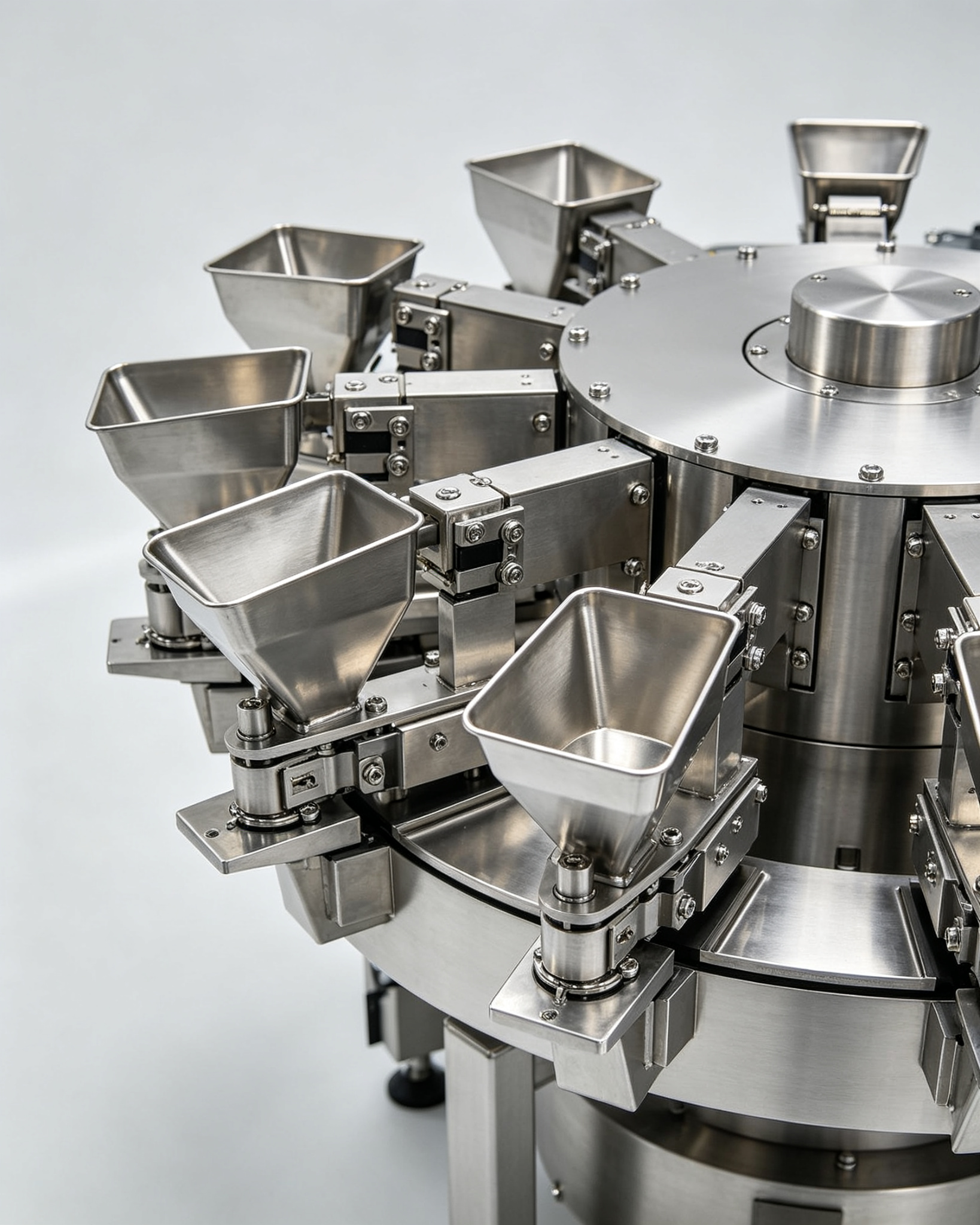
Both machines receive product from a top feed, hold it in buckets mounted on load cells and discharge a weighed portion into the pack below. The difference is how that portion is built. A linear weigher works on a single, direct path: product is fed into one bucket, the load cell weighs it as it fills, and when the target is reached the feed stops and the whole bucket is discharged in one shot. The portion is whatever that single bucket holds, so the accuracy depends on how finely the feed can be stopped and how evenly the product flows. A multihead weigher runs a ring of many buckets, each on its own load cell, and fills them with smaller portions; the controller then runs the combinations of buckets and selects the set whose combined weight is closest to the target, discharging those buckets together. Because it is choosing the best of many possible combinations rather than accepting a single fill, it can land very close to the target on every cycle, even when individual pieces are large or uneven.
Linear Weighers: Simple, Low-Cost Work for Free-Flowing Products
The linear weigher’s strength is its simplicity. With one weighing path and a single discharge, there are fewer moving parts, fewer buckets to clean and a lower purchase price, and the machine is straightforward to operate and maintain. It is built for products that flow consistently and predictably, where the single bucket can be filled to a repeatable target: free-flowing granules, grains, seeds, beans, rice, sugar, salt, uniform snacks, pet food in regular pieces, detergents and similar dry, even products. On a steady, moderate-speed line it is a reliable, easy-to-clean machine and the natural choice where the target weight is not extremely tight and the product is uniform enough that the single fill lands close enough. Published supplier ranges place linear machines at the lower end of the capital scale and at moderate outputs, with accuracy that is good for general packing but wider than a combination system.
The boundaries are set by the single-discharge logic. Because the portion is one fill, a product that flows unevenly, clumps, breaks or varies in piece size is hard to hold to a tight target, and the machine cannot compensate the way a combination of buckets can. The single path also limits speed, since each bucket has to fill, weigh and discharge before the next cycle, and large target weights or large pieces leave few options for trimming the portion close. On a high-value product the wider tolerance shows up as giveaway, the extra product packed above the declared weight to stay above the legal minimum, and on a fragile product the direct handling can cause breakage. The linear machine is over-run when the product or the target demands combination accuracy that one bucket structurally cannot provide.
Multihead Weighers: Combination Accuracy, Speed and Low Giveaway
The multihead weigher’s strength is the combination math, and it changes both the accuracy and the range of products the line can handle. With many buckets weighed at once and the best combination selected, the machine can discharge a portion very close to the target cycle after cycle, which holds the declared weight with a small safety margin and cuts giveaway sharply. The ring of buckets also runs in parallel, so while one combination is discharging, others are already being filled, which supports high speeds and large target weights. This is the family for fragile products handled with timed, gentle drops, sticky products with specialised surfaces, mixed products and blends, irregular and large-piece items, and high-value goods where every fraction of giveaway is money. Published supplier and industry material describes combination machines holding tight tolerances, lifting output well above linear lines and reducing giveaway from the several percent a loose single fill can carry down to a small fraction, with the capital recovered over a stated period when product value and volume are high.
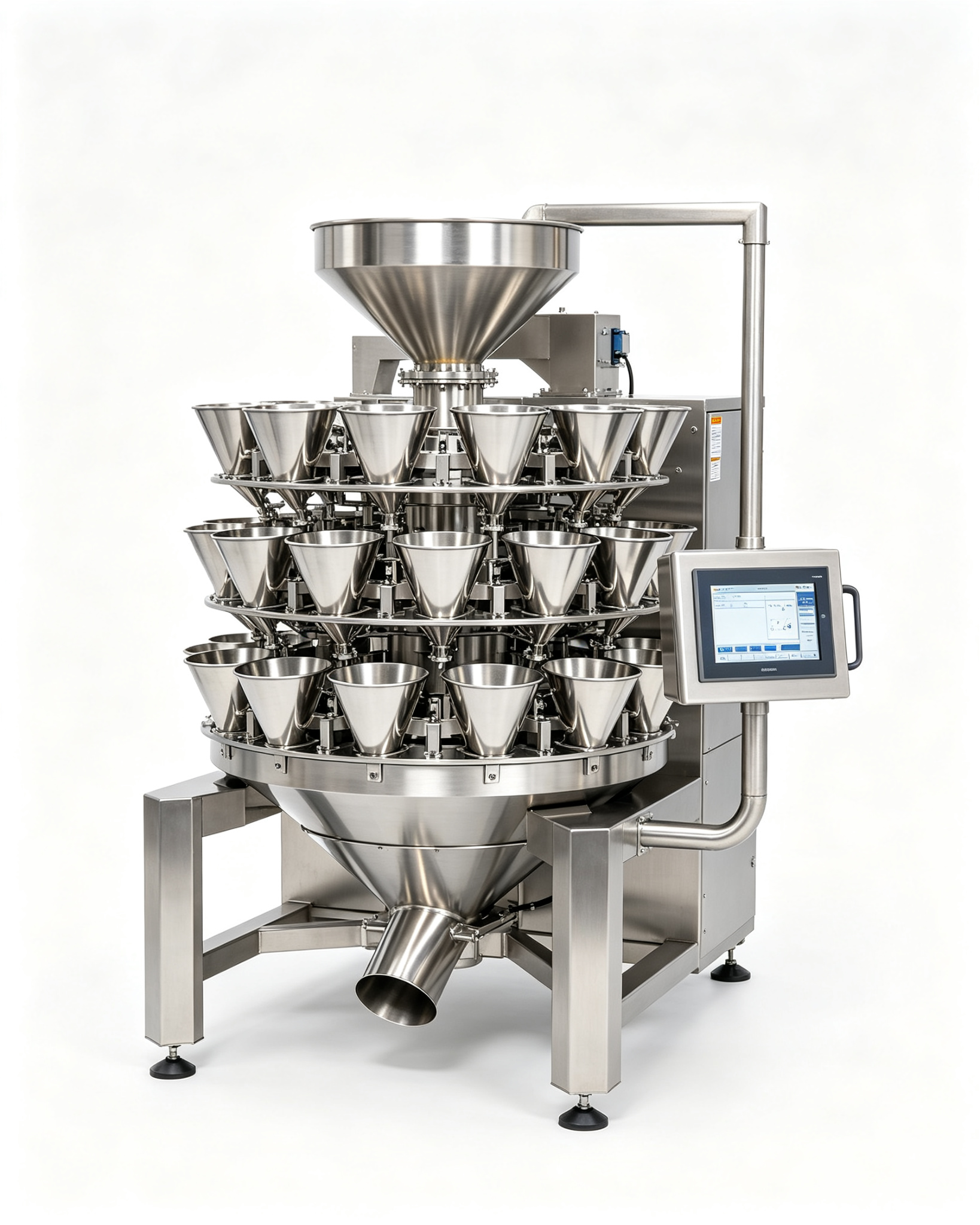
The trade-off is capital, complexity and cleaning. A multihead machine carries a much higher purchase price, more buckets and load cells, and a more involved control system, and it needs more setup and a larger number of parts to maintain and clean, especially on a multi-product site. The capability is real but only earns its return where the volume, the product value or the giveaway saving justifies it, which is why a combination machine on a low-volume, uniform, low-value product can be over-specified. The multihead weighers span the range, and the 18-head combination weigher is the high-speed, high-accuracy configuration. The weighed portion then feeds a downstream pack, and the pillow packaging machines and the thermoforming lines take the portion into a flexible bag or a rigid tray respectively.
Selection Table: Linear Weigher vs Multihead Weigher
| Dimension | Linear weigher | Multihead weigher |
|---|---|---|
| Weighing logic | Single bucket, one discharge | Best combination of many buckets |
| Speed | Lower, sequential cycle | High, parallel filling |
| Accuracy | Moderate, wider tolerance | Tight, close to target |
| Giveaway | Higher safety margin | Minimal, small margin |
| Product handling | Direct, free-flowing best | Gentle, timed drops |
| Product range | Uniform, dry, even | Fragile, sticky, mixed, irregular |
| Price range | Lower capital | Higher capital |
| Changeover | Simple, few parts | More buckets and recipes |
| Maintenance cost | Low, simple path | Higher, many load cells |
| Cleaning | Quick, few buckets | More parts to clean |
| Typical products | Rice, grains, seeds, granules | Snacks, mixes, fragile, large piece |
| Typical industries | Staples, bulk, uniform goods | High-value, high-speed packing |
When Not to Choose Each Machine
Do not rely on a linear weigher for a high-value product at a tight target weight, a fragile or irregular item, or a high-speed line, because the single discharge cannot hold the tolerance, the giveaway and breakage will rise, and the sequential cycle will not keep up with the rest of the line. Do not pay for a multihead weigher for a low-volume, uniform, low-value product where a single bucket already holds an acceptable weight, because the higher capital, the many buckets and the cleaning and maintenance burden will not earn a return. Do not treat the quoted accuracy as a universal constant, since the real tolerance depends on the product, the target weight and the piece size, and should be confirmed on the actual material. Do not assume either machine handles every product out of the box, since sticky, fragile and mixed products need specialised surfaces and timing. Finally, do not choose the weigher in isolation from the downstream pack, because the discharge timing and the bag or tray machine have to be matched or the line will wait on the weighing step.
Giveaway, Compliance and the Return on the Extra Capital
The financial case for a combination machine is built mostly on giveaway and compliance rather than on speed alone. A pack sold at a declared weight has to stay at or above that weight, and a single-fill machine with a wider tolerance needs a larger safety margin, so product is repeatedly given away. Published supplier and industry material frames this as giveaway falling from the several percent a loose fill can carry to a small fraction under combination weighing, with the extra capital recovered over a stated period when the product value and the volume are high. The same accuracy matters for average-weight and e-mark style rules, where the packer has to demonstrate that the average and the proportion below target stay within defined limits; a machine that can be calibrated and logged accurately makes that compliance straightforward, while a wide-tolerance single fill is harder to defend. The practical risk is buying on capital price and ignoring the product given away across a year, which can exceed the price difference many times over.
Calibration and setup deserve the same scrutiny. The load cells have to be calibrated, the feed and the bucket timing tuned to the piece size, and the target weight set with a realistic margin, because even a combination machine will not rescue a badly tuned or over-filled line. On multihead machines the number of heads and the bucket shape matter, with more heads giving more combinations and specialised buckets handling sticky or fragile products, while on linear machines the feed control and the flow consistency are the critical settings. A supplier that can explain the realistic tolerance, the giveaway assumption and the compliance logging for the specific product, and that will run a trial on the actual material, is demonstrating the engineering support that separates a reliable line from one that only performs at ideal conditions.
How This Connects to the Rest of the Line
The weigher sits at the front of the packing sequence and its output has to match the forming and wrapping downstream. Where the portion goes into a rigid formed tray, the upstream machine choice is covered in the guide to thin-gauge versus heavy-gauge thermoforming. Where it goes into a flexible film pack, the way that film is handled and the product’s handling characteristics are set out in the comparison of top-film versus bottom-film flow wrappers. Keeping the order right, product and target weight first, then weighing logic, then the pack machine, prevents a fast wrapper being held back by a single-bucket weigher.
Frequently Asked Questions
What is the difference between a linear and a multihead weigher?
A linear weigher fills one bucket and discharges it in a single shot, which is simple and low-cost for uniform free-flowing products, while a multihead weigher weighs many buckets and selects the best combination, giving tighter accuracy, higher speed and lower giveaway for fragile or irregular products.
Is a multihead weigher worth the extra cost?
It earns its return on high-value or high-volume products where the giveaway saving, the speed and the compliance accuracy justify the capital, often within a stated payback period. On a low-volume, uniform, low-value product a linear machine is the more economical choice.
Which weigher is better for fragile or mixed products?
A multihead weigher is the better fit because the timed, gentle drops and the combination logic handle fragile pieces and blends without the direct single discharge, and the many buckets can build a portion from uneven pieces while staying close to the target.
How does weighing accuracy affect legal compliance?
Under average-weight and e-mark style rules, packs have to meet limits on the average fill and the share below target. A tight, calibratable combination weigher holds a small safety margin and produces the records needed, while a wider single-fill tolerance needs more giveaway to stay compliant.
Sources and Further Reading
The weighing logic, accuracy and giveaway descriptions draw on published supplier and industry material, including the Fill & Package comparison of linear and multihead weighers, the Wolf Packing guide to weighing and filling machine types with its speed, tolerance and payback ranges, and the SCAYR comparison of multihead versus linear weighing and its notes on average-quantity compliance. The figures are presented as supplier and industry estimates rather than universal guarantees, and the real tolerance and output should be confirmed on the actual product.
Conclusion: Let the Product, Target Weight and Giveaway Set the Weigher
The decision is clear once the product and the economics are described honestly. If the product is uniform and free-flowing, the target is moderate and the volume and value do not justify combination capability, a linear weigher is the simple, low-cost and reliable choice. If the product is high-value, fragile, sticky, mixed or irregular, the line runs at high speed, or giveaway and average-weight compliance have to be held to a fraction, a multihead weigher pays back through tight accuracy, low giveaway and parallel speed. Match the weighing logic to the product, count the giveaway across a year rather than just the capital, and integrate the discharge with the downstream pack. To confirm the weighing logic, tolerance and giveaway for your product, contact SunAura Machinery and we will size the system against the actual material and target weight.