
October 10, 2026 | by David Chen, SunAura Machinery Applications Engineering
Most packaging line problems that get blamed on the filler or the wrapper actually start on the conveyor. The conveyor is the line’s transport backbone, and when it is undersized, mis-specified, or poorly positioned, every machine upstream and downstream suffers — jams at transfer points, product back-up, bottles tipping on curves, and operators spending half their shift clearing stoppages. Yet the conveyor is usually the last machine specified in a line project, and often the first place budgets get cut. That ordering is backwards.
This guide lays out the conveyor selection method we use with packaging line buyers — how to choose the drive type, the conveying medium, the width and speed, and the layout geometry, so the line runs at its rated throughput instead of fighting its own transport.
Step 1: Define the Product, the Load and the Handling Task
Conveyor selection starts with the unit being carried, not with a catalogue. Before looking at any conveyor type, write down four numbers:
- Product dimensions and weight: the longest and widest unit, and the heaviest unit — not the average. The conveyor must handle the worst case.
- Unit stability: does the product stand on its own base, or does it tip on incline, curves, or stops? Bottles with small footprints, pouches, and flexible bags are the stability problem cases.
- Throughput: units per minute at the bottleneck machine, plus a margin. The conveyor should be rated for 15–20% above the bottleneck speed so it never becomes the constraint.
- Handling requirement: straight transport only, or accumulation, turning, elevating, merging, and dividing? Each function adds a conveyor decision.
These four answers point to the conveying medium. The two most common categories are roller conveyors and belt conveyors, and the choice between them is the first fork in the decision tree.
Roller vs Belt: The First Fork
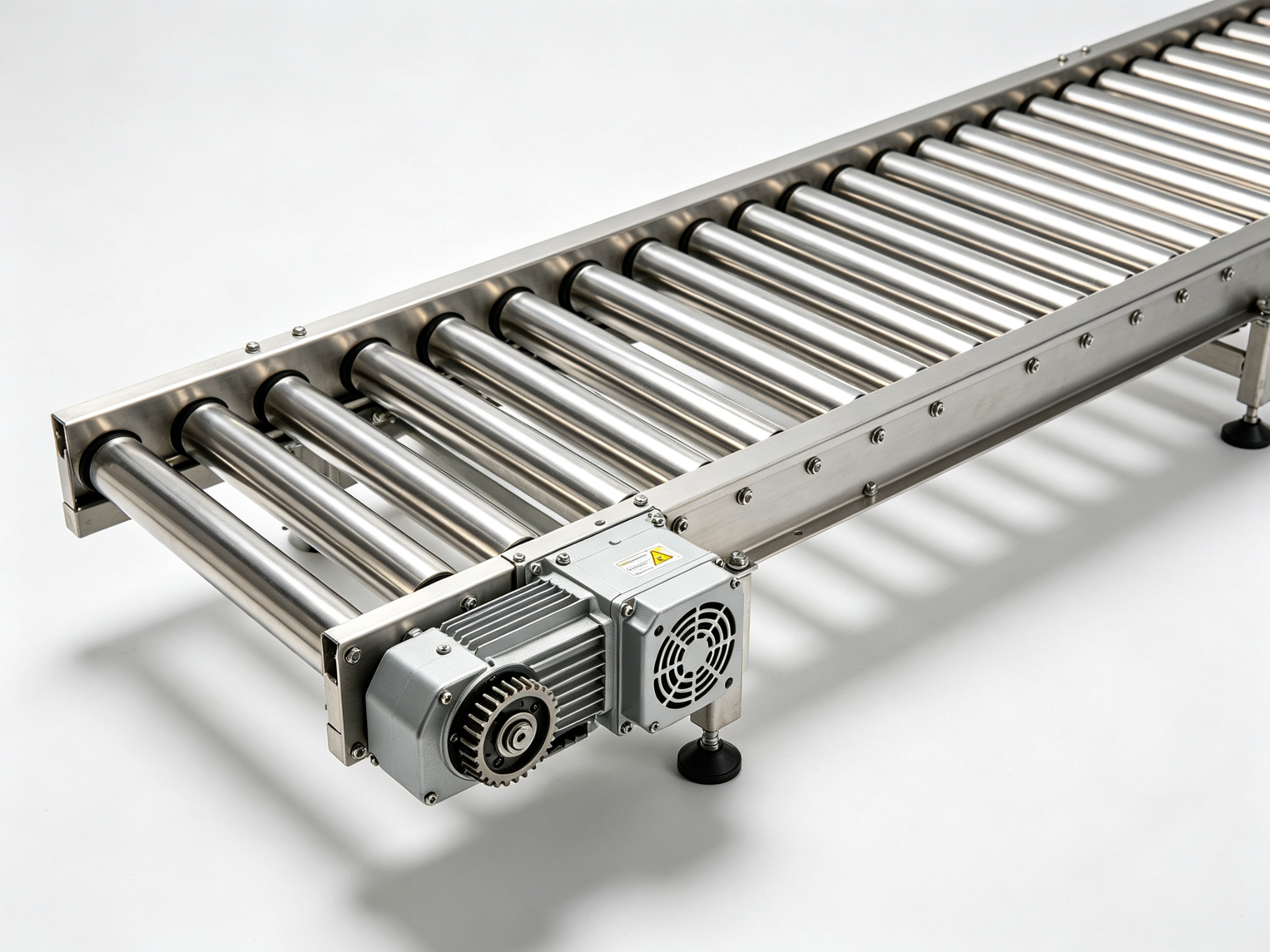
Roller conveyors carry the product on rollers — driven (motorized) or gravity — and are the right choice for rigid, flat-bottomed units like cartons, cases, and rigid containers. Belt conveyors carry the product on a continuous belt and are the right choice for flexible units like bags and pouches, products that need a stable surface, and products that must not slide.
| Factor | Motorized Roller Conveyor | Belt Conveyor |
|---|---|---|
| Best for | Cases, cartons, rigid containers | Bags, pouches, flexible products |
| Unit stability on stop | Good on flat-bottom units | Excellent — belt supports full base |
| Accumulation | Natural — units slide on rollers (with zone control) | Needs special accumulating belt design |
| Slope handling | Good with brake rollers | Good on incline with cleats |
| Fragile products | Risk of marking on rollers | Softer handling |
| Cost per meter | Higher (motors per zone) | Lower for simple straight runs |
| Maintenance | More moving parts per zone | Belt tracking and wear |
A common mistake is putting cases on a belt conveyor or bags on rollers. Cases on belt work, but you pay for belt area you do not need; bags on rollers misalign and jam at transfer points because the bag base flexes between rollers. Matching the medium to the unit geometry eliminates most transfer-point problems before they start. The full conveyor range, including both drive types, is listed on the conveyor systems page, with the modular units that let a line be reconfigured as the product range changes.
Step 2: Width, Speed and Capacity Math
Conveyor width should be 50–100mm wider than the widest unit on each side — enough clearance for guidance rails, but not so much that the product drifts. The standard widths in packaging lines are 400, 500, 650 and 800mm; choose the next standard size above the product plus clearance.
Speed is set by throughput, not by the machine’s maximum. The formula that matters is simple: units per minute × spacing (meters between units) = conveyor speed in meters per minute. If a line runs 60 cases per minute with 0.5m spacing, the conveyor must move at 30 m/min — and should be rated for 35–40 m/min with margin. Over-speeding a conveyor creates jams at transfer; under-speeding creates back-up into the previous machine.
Capacity math applies to accumulation zones: an accumulating conveyor must hold the buffer volume the line needs — typically 1.5–3 minutes of production at the bottleneck. A 30-case-per-minute line needs a 45–90 case buffer between machines. Buyers who skip the buffer calculation get lines where one machine’s 10-minute stoppage stops the entire line.
Step 3: Layout Geometry — Turns, Elevations and Merges
Line layout determines how many turns, inclines and merges the conveyor must handle, and each one has a specification implication:
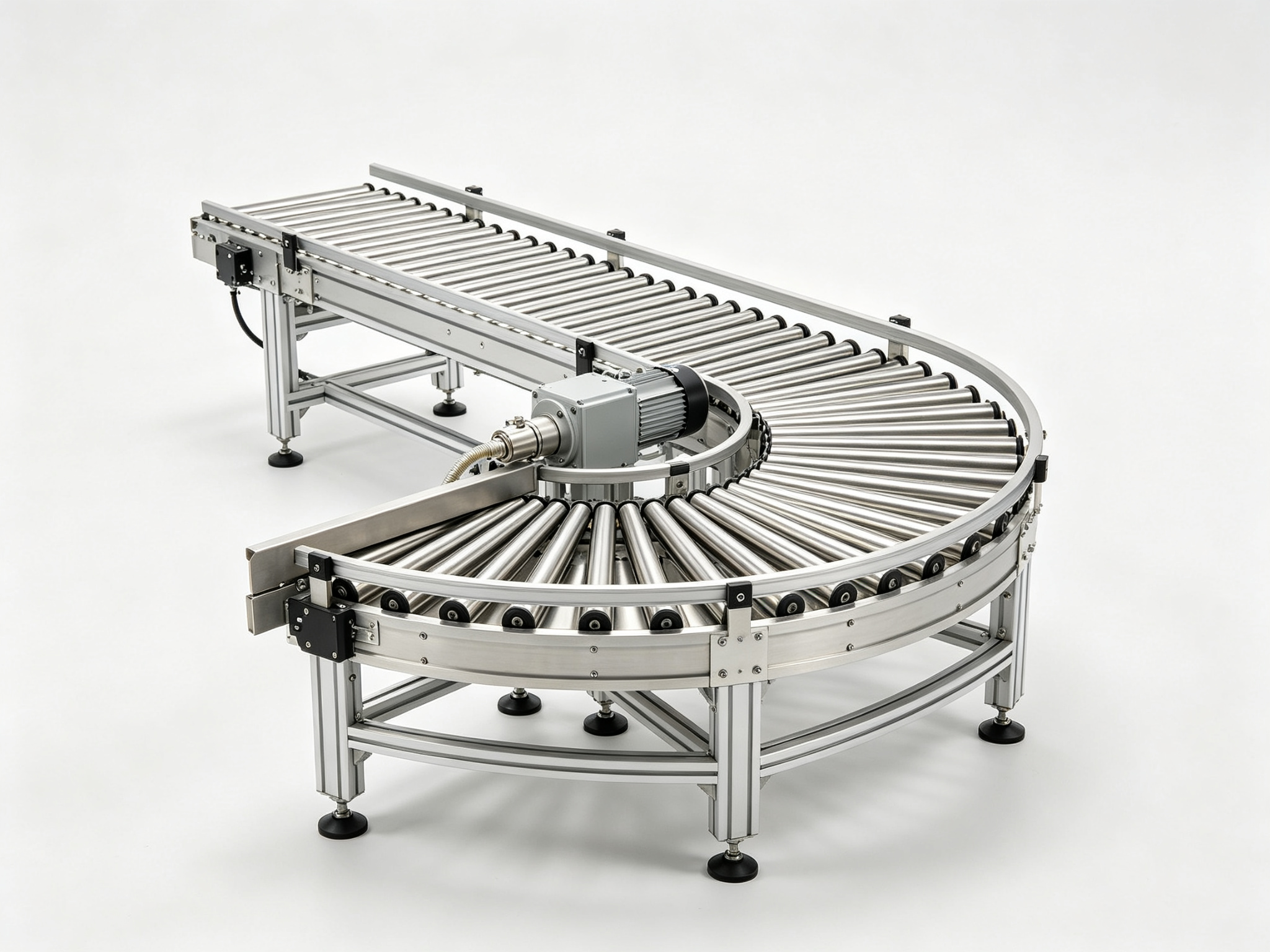
Turns: 90-degree turns on roller conveyor need either a turning section (tapered rollers) or a lift-and-transfer unit. The radius must match the product length — long products need a larger turning radius or they hang off the outside edge. The 90-degree turning conveyor configuration is a standard module in the SunAura range, sized to the product footprint.
Inclines and declines: belt conveyors handle inclines up to about 15 degrees for most products, and steeper with cleats. Roller conveyors on decline need brake rollers to prevent product run-away. Elevating a line by a full floor level is usually cheaper done once at the case level than at the primary packaging level, because the units are more stable.
Merges and divides: merging two lanes into one, or dividing one lane into two, is where conveyor design most often fails. Merges need a traffic-control zone — either a stop-and-release logic or a combining wheel — to prevent product collision. Divides need a diverter with a timing sensor, not a manual switch. The merge/divide decision is really a control-logic decision, and it belongs in the PLC program, not in a mechanical guess.
Layout planning — footprint, aisles and service clearance — is covered in detail in our packaging line layout design guide, which includes the aisle widths and access rules that conveyor runs must respect.
Step 4: Accumulation and Buffering
Accumulation is the conveyor function that buys line resilience. Between the filling machine and the labeler, or between the wrapper and the case packer, an accumulating section lets the downstream machine keep running when the upstream stops for a changeover or a jam clear.
Three accumulation levels exist, and the price rises with the level:
- Zero-pressure accumulation: each zone starts and stops with its own sensor and brake, so units do not touch. The most expensive, and the right choice for fragile or pressure-sensitive products.
- Pressure accumulation: units touch and slide against each other on a running conveyor. Cheaper, and acceptable for cartons and cases where marking is not a concern.
- No accumulation: conveyor simply transports. Fine for a straight line with matched machine speeds, and the wrong choice for any line with a speed mismatch between machines.
The rule of thumb: any place in the line where two machines run at different speeds needs accumulation between them. Most real lines have at least two such places — after primary packaging and before palletizing. The modular conveyor expansion SunAura delivered for a beverage plant, documented in the modular conveyor system expansion case, is a working example of adding buffer zones without rebuilding the line.
Step 5: Specialized Conveying — What the Standard Range Does Not Cover
Most packaging lines use standard straight, turning, and elevating conveyors. But three specialized needs come up often enough to plan for:
Hygienic open-frame conveyors: food plants running wet processes or requiring wash-down need open-frame stainless conveyors with sealed bearings and tool-free disassembly. The frame must drain, not trap water. This is a specification point, not an option list — confirm the frame material, bearing seals, and wash-down rating in writing.
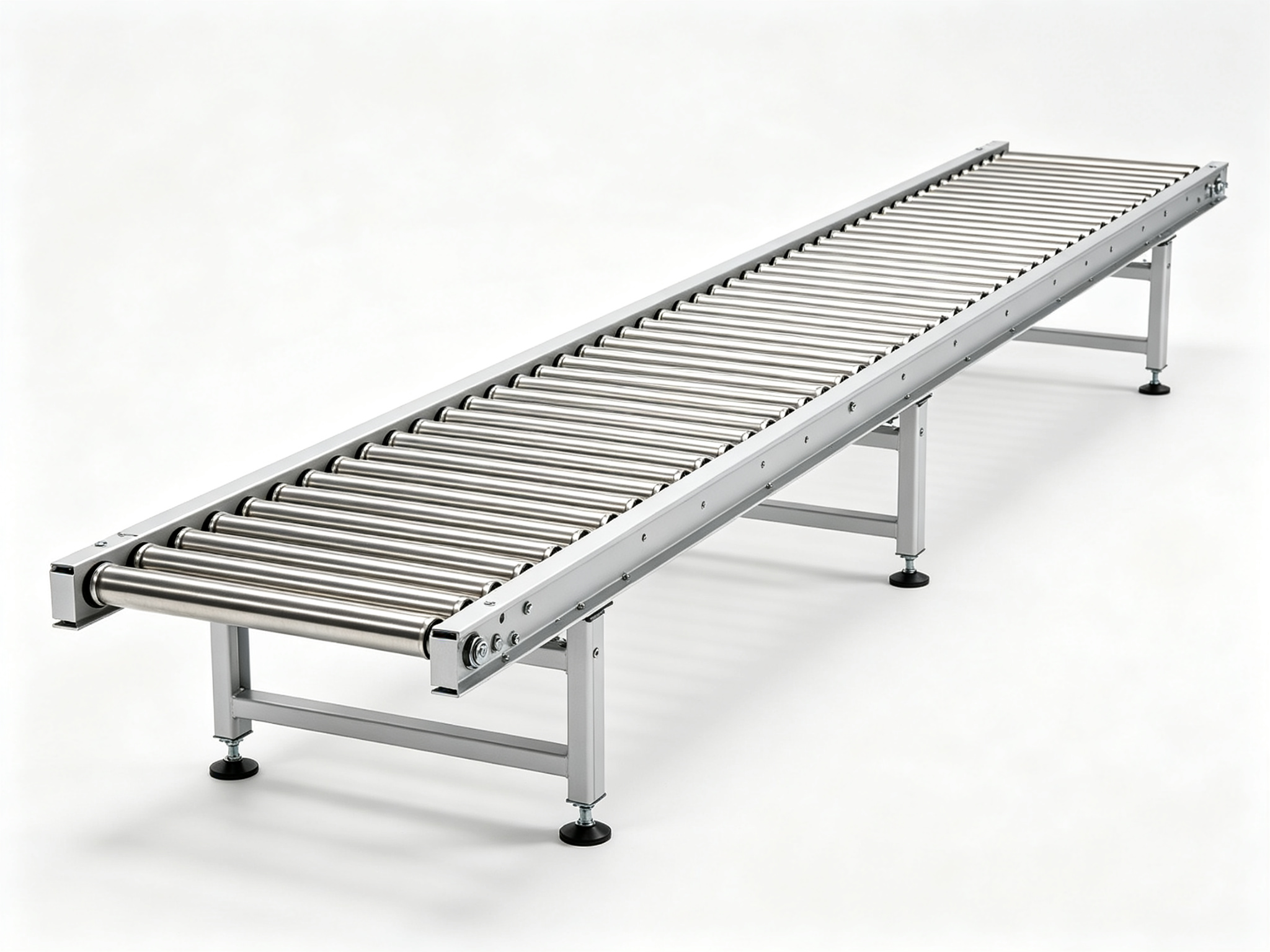
Gravity sections: gravity roller sections are the cheapest way to move cases between workstations and are often the right choice for manual packing stations — the operator pulls cases from a gravity feed instead of stopping a powered line. The belt conveyor and gravity modules in the range cover this mixed configuration.
The conveyor’s neighbors decide the transfer points, which is why the machine feeding the conveyor and the machine it feeds are specified together. The automatic linear filling machine delivery and the new continuous band sealer series both show the same principle: the conveyor between stations is engineered as part of the line, not added after the machines arrive.
Pallet-level transport: once cases are palletized, the pallet moves on heavy-duty roller or chain conveyors rated for pallet weight. Mixing pallet conveyors and case conveyors in one line is common and must be engineered as two separate conveyor sections with a transfer point, not one continuous run.
Budget Reality: Conveyor Cost and What It Buys
Conveyor pricing is linear with length and type, which makes it the most predictable part of a line budget. As a planning reference from recent SunAura projects:
| Conveyor Type | Typical Price Range (per meter) |
|---|---|
| Gravity roller | $120–$250 |
| Belt conveyor, fixed speed | $250–$450 |
| Motorized roller, single zone | $300–$550 |
| Accumulating (zero-pressure), with controls | $600–$1,200 |
| 90-degree turning or lift-transfer unit | $1,500–$4,000 (per unit) |
These are planning figures, not quotes — final pricing depends on length, framing material, drive type, and control integration. The point of the table is the ratio: accumulation and turning hardware cost several times more per meter than straight transport, so a line layout that minimizes turns and buffer length saves real money before a single motor is ordered.
Frequently Asked Questions
Can a packaging line run without conveyors between machines?
Physically yes — machines can be placed close enough to hand-transfer product — but economically it fails above about 20 units per minute. Manual transfer at that rate ties up an operator on a task that adds no value, and the transfer point becomes the source of jams and product damage. Above roughly 30 units per minute, a conveyor between machines is not optional; it is the cheapest reliability investment in the line.
How do I know if I need zero-pressure accumulation?
Ask whether product marking or damage is acceptable at the contact point. Cases and cartons with printed outer surfaces generally tolerate pressure accumulation. Bottles, pouches, and labeled products do not — label scuffing at the accumulation point is a common quality complaint, and zero-pressure zones eliminate it. If the product carries a barcode or label that must survive retail inspection, budget for zero-pressure at the buffers before the packer and the palletizer.
Should conveyors be bought from the same supplier as the machines?
For a new line, yes — one supplier for machines plus conveyor plus controls avoids the interface problem where the machine builder blames the conveyor builder for jams, and vice versa. SunAura supplies the conveyor and the machines as one integrated line, with a single PLC program and a single service contact. For an existing line, adding conveyor sections from a specialist is fine, provided the control interfaces are specified before purchase.
How fast can a conveyor run?
Conveyors can run far faster than most packaging lines need — the limit is not the conveyor but the product and the downstream machine. Belt conveyors run comfortably at 60–120 m/min; roller conveyors similar. The practical limit is set by unit stability: a tall bottle at high speed tips on stops, and a light pouch at high speed slides on the belt. Set the conveyor speed from the bottleneck machine’s throughput and the required spacing, not from the conveyor’s maximum.
What maintenance does a conveyor need?
Conveyors are low-maintenance but not no-maintenance. Weekly: check belt tracking and tension, inspect rollers for seized bearings, and clean product debris from transfer points. Monthly: lubricate drive chains and check sensor alignment on accumulation zones. Quarterly: inspect belts for edge wear and check motor/gearbox condition. The largest conveyor failure cause is debris buildup at transfer points — the 10-minute daily clean that gets skipped is the one that causes the jam.
Summary and Next Steps
Conveyor selection is a five-step decision: define the product and load, choose the medium (roller vs belt), do the width/speed/capacity math, plan the layout geometry, and decide the accumulation level. Getting these five decisions right removes the majority of line stoppages that get blamed on other machines. SunAura Machinery supplies conveyor systems as part of complete packaging lines — from a single transfer conveyor to full zero-pressure buffering systems — with the same CE certification, FAT testing, and commissioning support as the machines they connect. To review your line layout and conveyor requirements with the applications engineering team, contact SunAura Machinery.
About SunAura Machinery
SunAura Machinery is a packaging equipment manufacturer based in Qingdao, China, exporting to more than 100 countries. The company’s conveyor range covers belt, roller, gravity, turning, and accumulating conveyors, integrated with filling, wrapping, carton sealing, and palletizing equipment for complete lines, all CE certified.
Editorial note: Price ranges are planning references and are subject to change. Contact SunAura Machinery for current specifications.