
October 10, 2026 | by Lily Zhao, SunAura Machinery Applications Engineering
A multihead weigher looks simple — product falls in, target weight comes out. But the machine that looks identical in two quotes can deliver a 0.5% or a 2.5% giveaway on the same product, and that difference is a six-figure annual cost on a busy snack line. The weigher is the highest-value precision machine in most bag packing operations, and the selection decisions that decide its performance are made long before it arrives on the floor.
This guide covers the weigher selection method we use with snack, frozen food, and dried food producers — how many heads you actually need, which discharge configuration fits your bagging machine, what the accuracy numbers really mean, and the specification points that separate a weigher that pays for itself from one that gives product away.
How a Multihead Weigher Works — and Why Head Count Matters
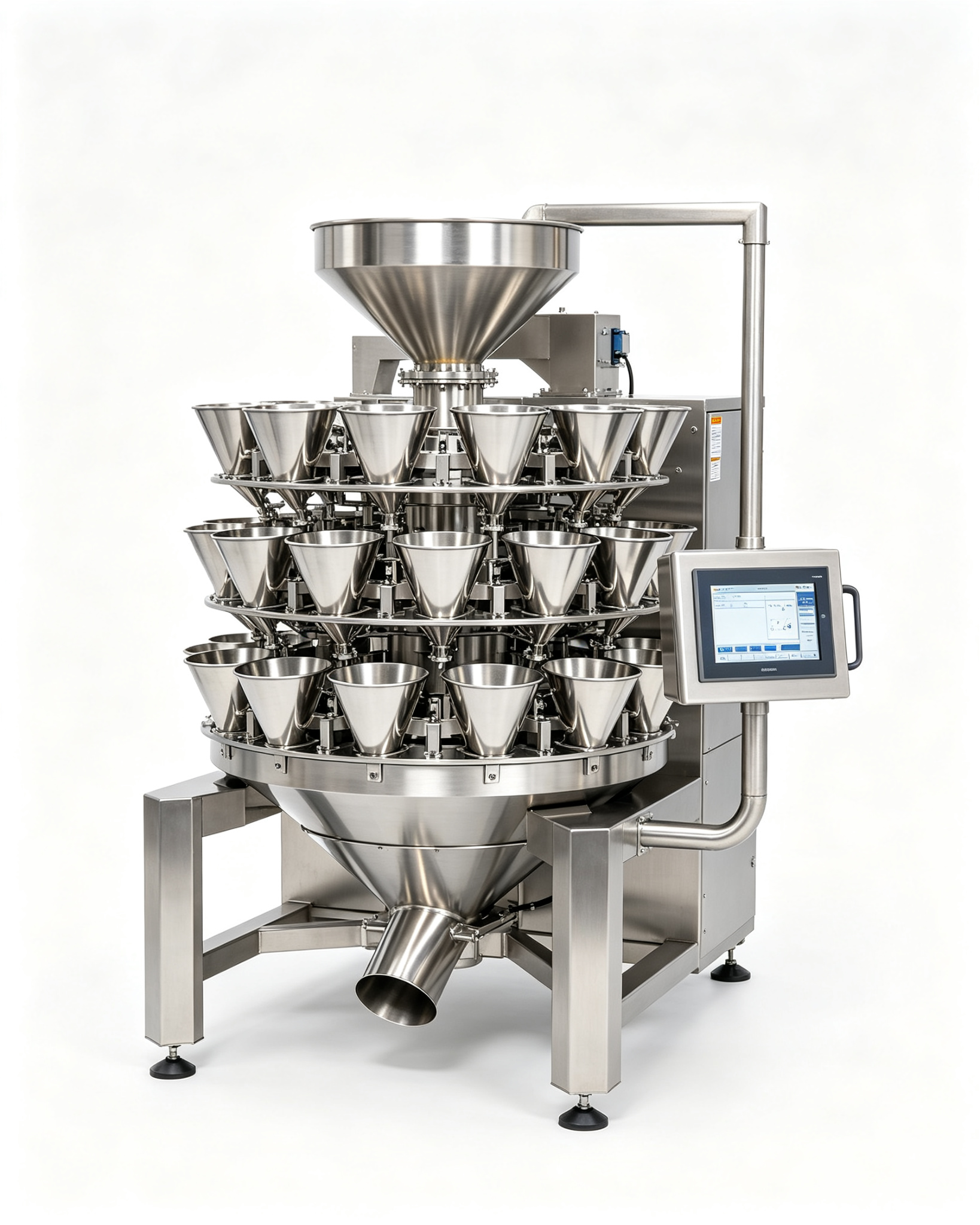
The multihead weigher works on combinatorial weighing. Product flows into a ring of hoppers, each head holds a small portion, and the computer selects the combination of hoppers whose total weight comes closest to the target without going under. The more heads available, the more combinations the computer can try, and the closer the selected total lands to the target — which is why head count is the first specification, not a marketing number.
The practical rule: 10-head machines suit simple products with uniform piece size; 14-head machines handle standard snack and frozen products; 18-head and 20-head machines earn their price on irregular products, high-value products, and high line speeds where even a gram of giveaway multiplies fast. The current 18-head machine in the SunAura range, documented on the 18-head multihead weigher page, is the configuration we most often recommend for mid-to-high-speed snack and frozen lines.
| Head Count | Best For | Typical Accuracy | Speed Range |
|---|---|---|---|
| 10-head | Uniform pieces, simple products, low speed | ±2–4g on 100g target | 30–50 weighments/min |
| 14-head | Standard snacks, nuts, dried foods | ±1.5–3g on 100g target | 50–90 weighments/min |
| 18-head | Irregular products, frozen foods, high value | ±1–2g on 100g target | 80–130 weighments/min |
| 20-head (twin-discharge) | Very high speed, twin baggers | ±1–2g on 100g target | 120–200 weighments/min |
The accuracy figures are planning references, not guarantees — the real number depends on piece size distribution, moisture, and the target weight. What the table shows is the direction: every four heads added roughly halves the achievable deviation. That is the return you are buying with the head count.
Discharge Configuration: Matching the Weigher to the Bagging Machine
The weigher’s discharge is where it meets the bagging machine, and the interface is a frequent source of mis-specification. Three configurations cover most lines:
Single discharge: one collection funnel feeds one bagging machine. The standard configuration, right for a single line with 30–130 weighments per minute. Simple, lowest cost, easiest to clean.
Twin discharge: two funnels alternate feeding one or two baggers, letting the weigher run continuously while one bagger indexes. Right for high-speed lines above about 100 bags per minute, and for dual-lane baggers.
Double (twin) weigher on one bagger: two weigher rings feeding one bagger alternately, doubling the effective weighment rate on a single bagging line. This is the configuration for very high-speed single-lane lines where one weigher ring cannot keep up.
The discharge height and funnel geometry also matter: the drop from weigher to bagger must be short enough that the product does not shatter or bounce out of the bag. Fragile products — potato chips, crackers, freeze-dried items — need a low-discharge weigher or a soft-drop funnel. This is a mechanical detail worth confirming in the proposal, because it cannot be fixed after installation without re-engineering the frame.
Reading the Accuracy Numbers Honestly
Every weigher supplier quotes an accuracy figure, and the figures are not comparable unless the test conditions are the same. Three questions expose the difference:
What target weight was the figure measured at? Accuracy is a percentage or grams figure at a specific target. A ±1.5g claim at 500g is a very different machine from ±1.5g at 100g. Always ask for the accuracy at your target weight, measured with your product.
What piece size was the product? Uniform granules weigh far more accurately than irregular snack pieces. A quote tested with free-flowing material overstates performance on your product. The honest test is the factory acceptance test with your actual product, in the piece-size distribution your line produces.
Is the figure average deviation or maximum deviation? Average deviation can hide occasional large misses that trigger giveaway. Ask for the distribution — or better, run the FAT with a reject-count target.
Giveaway math is the number that decides the purchase: if a line runs 60 bags per minute for 20 hours per day, each 1g of average giveaway costs roughly 72kg of product per day. At a product value of $3/kg, that is $216 per day — about $65,000 per year — per gram of giveaway. A weigher that holds accuracy 1g tighter than the alternative pays for a significant price difference within a year. The calculation is the same one applied to film savings in our film thickness and packaging material guide — both are recurring cost lines that a machine decision locks in for years.
Specification Points That Decide Performance
Beyond head count, five specification points separate weighers that perform from weighers that frustrate:
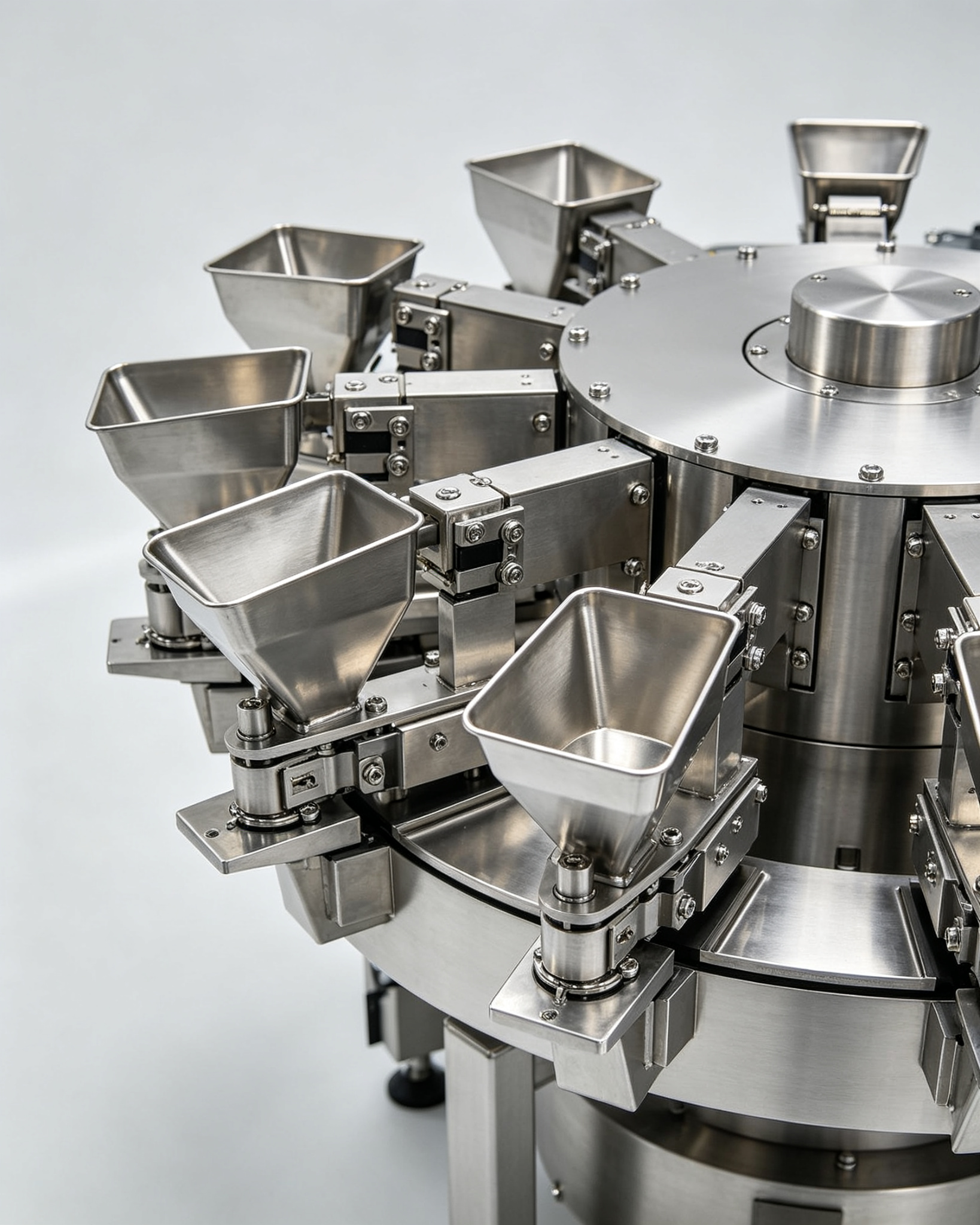
- Hopper size and product volume: the hoppers must hold enough product for the piece size without bridging. Coarse or sticky products need larger hoppers or a specific hopper finish; the spec is matched to your product, not chosen from a catalogue.
- Wetted materials: confirm the hoppers, funnels, and chutes are food-grade stainless, with quick-release clamps for cleaning. Frozen food lines that run wet product need drainable hoppers and wash-down-rated seals.
- Cleaning access: the weigher is disassembled for cleaning — daily on wet or sticky products. Tool-free hopper release and accessible interior surfaces determine how long cleaning takes, which is a daily cost.
- Interface to the bagger: confirm the weigher’s control protocol matches the bagging machine’s PLC — the interface failure is one of the most common commissioning problems on weigher-bagger lines.
- Vibration isolation: the weigh cells read microgram changes; vibration from nearby machines or the bagger itself corrupts the reading. The weigher frame’s isolation spec is a real performance parameter, not a footnote.
The full weigher range, including the 18-head machine and the interface options, is listed on the multihead weighers page.
Integrating the Weigher Into a Complete Bagging Line
The weigher sits at the center of a bagging line: product feeder above, bagging machine below, and the conveying and sealing equipment around it. Three integration decisions matter:
The product feeder: the linear or vibratory feeder above the weigher must supply product at a controlled rate that matches the weigher’s demand. A feeder that surges starves the weighment and drops accuracy; a feeder that lags slows the line. The feeder-weigher pairing is usually specified together, and the controls are integrated in one PLC program.
The bagger below: the weigher’s discharge cycle must synchronize with the bagger’s index cycle. On a vertical form-fill-seal bagger, the weigher drops into the forming tube between seal cycles. The sync is a control function, and it is where third-party integrations fail — the reason complete lines from one supplier run at rated speed and bolted-together lines spend a month debugging the interface.
The downstream sealer and conveyor: once the bag is filled, the band sealer and the conveying section complete the line. The bag transfer from weigher-bagger to sealer is the same transport problem covered in the conveyor selection guide — the bags need stable support and gentle transfer to protect both the product and the seal.
SunAura supplies the complete line — weigher, bagger, sealer, and conveyor — as one integrated system with a single PLC and single warranty. The same integration principle applies to the case packing side of the line, where the filled bags move into case erecting and packing equipment — including the automatic carton forming and case packing line delivered this month, and the high-level layer palletizer that finishes the pallet load.
Budget Reality: Weigher Cost and Payback
Multihead weigher pricing follows head count and options, and the budget range from recent SunAura projects gives a planning reference:
| Configuration | Typical Price Range |
|---|---|
| 10-head, standard discharge | $12,000–$22,000 |
| 14-head, standard discharge | $18,000–$32,000 |
| 18-head, standard or twin discharge | $28,000–$48,000 |
| 20-head twin discharge, high speed | $45,000–$75,000 |
The payback on the head-count upgrade is usually under 12 months on giveaway savings alone for products above $2/kg. For high-value products — dried fruits, nuts, coffee, frozen seafood — the payback can be under six months, because the giveaway reduction is worth more per gram. Buyers should run the giveaway math with their own product value and line hours before comparing quotes; the weigher is one of the few purchases where the machine price is genuinely secondary to the operating economics.
Frequently Asked Questions
Do I need a multihead weigher, or is a linear weigher enough?
A linear weigher fills a target weight by timing the flow — accurate for uniform, free-flowing products like rice and seeds, but weak on irregular pieces where the flow rate varies. The multihead weigher’s combinatorial selection handles irregular pieces far more accurately. The crossover is product-dependent: if your pieces are uniform and your giveaway tolerance is generous, a linear weigher at a fraction of the price may be sufficient. If your product is irregular — snacks, frozen pieces, dried fruit — or your tolerance is tight, the multihead weigher pays for itself.
What maintenance does a multihead weigher need?
The weigh cells and hoppers need scheduled attention. Daily: clean hoppers and funnels, especially on sticky or wet products. Weekly: check hopper release and damper wear, and verify the weigh cell zero. Monthly: run a calibration check with a test weight, and inspect the vibration isolation mounts. The weigh cells are the precision component — they should be handled by trained operators, and the calibration procedure documented at the machine. Spare hopper release parts and weigh cell spares are stocked under SunAura’s 48-hour spare parts dispatch program.
Can one weigher handle multiple products?
Yes, with recipe settings — the weigher stores target weights, discharge parameters, and feeder speeds per product. Changing products is a recipe recall, not a mechanical change, provided the hopper size suits the range of piece sizes. The practical limit is piece size: one weigher cannot handle both fine powder and large frozen pieces without a hopper change. Product ranges with very different piece sizes need either two weighers or a weigher with interchangeable hoppers.
How do I verify the accuracy claim before buying?
Run a factory acceptance test with your product, your target weight, and your line speed. The FAT procedure: run a production batch, weigh the actual filled bags against the target, and record the distribution — average deviation, maximum deviation, and the reject rate. Ask the supplier to commit to the acceptance criteria in the contract. A supplier who cannot run your product at the FAT has no basis for the accuracy claim.
What is the lead time for a multihead weigher?
Standard configurations run 3–5 weeks lead time. Custom hopper sizes, special materials, or a twin-discharge configuration can extend it to 6–8 weeks. The weigher is often the longest-lead machine on a bagging line after the bagger itself, so it should be ordered early in the line project — the full integration plan is worth reviewing before the purchase order, so the weigher, bagger, and sealer arrive as a matched set.
Summary and Next Steps
Multihead weigher selection is a five-step decision: head count for the accuracy ceiling, discharge configuration for the bagger interface, honest accuracy verification at your product and target, specification details that decide daily performance, and integration with the feeder and bagger as one line. Getting these five right removes giveaway from the recurring cost line and keeps the line running at rated speed. SunAura Machinery supplies multihead weighers as part of complete bagging lines — with FAT testing on your product, CE certification, and commissioning support. To discuss your products, target weights, and line speed with the applications engineering team, contact SunAura Machinery.
About SunAura Machinery
SunAura Machinery is a packaging equipment manufacturer based in Qingdao, China, exporting to more than 100 countries. The company’s range covers multihead weighers, pillow and flow wrapping machines, band sealers, case erectors, conveyors, and palletizing equipment for complete packaging lines, all CE certified.
Editorial note: Price ranges and accuracy figures are planning references and are subject to change. Contact SunAura Machinery for current specifications.