
October 13, 2026 | by Ethan, SunAuraura Machinery Application Engineering
If you’ve ever sent out an RFQ for packaging equipment and gotten back five wildly different quotes that you can’t compare side by side, the problem isn’t the suppliers — it’s the RFQ. A vague RFQ (“we need a flow wrapper for snacks”) invites a vague quote. A detailed RFQ that specifies your product, packaging format, throughput and site conditions gets you back five comparable proposals that you can actually evaluate.
After responding to thousands of RFQs on both sides — as buyers comparing suppliers and as engineers writing proposals — we’ve put together the exact specification structure we wish every customer would send. This is what we send to our customers when they ask us “what information do you need from us to quote a machine?” Use it as a template.
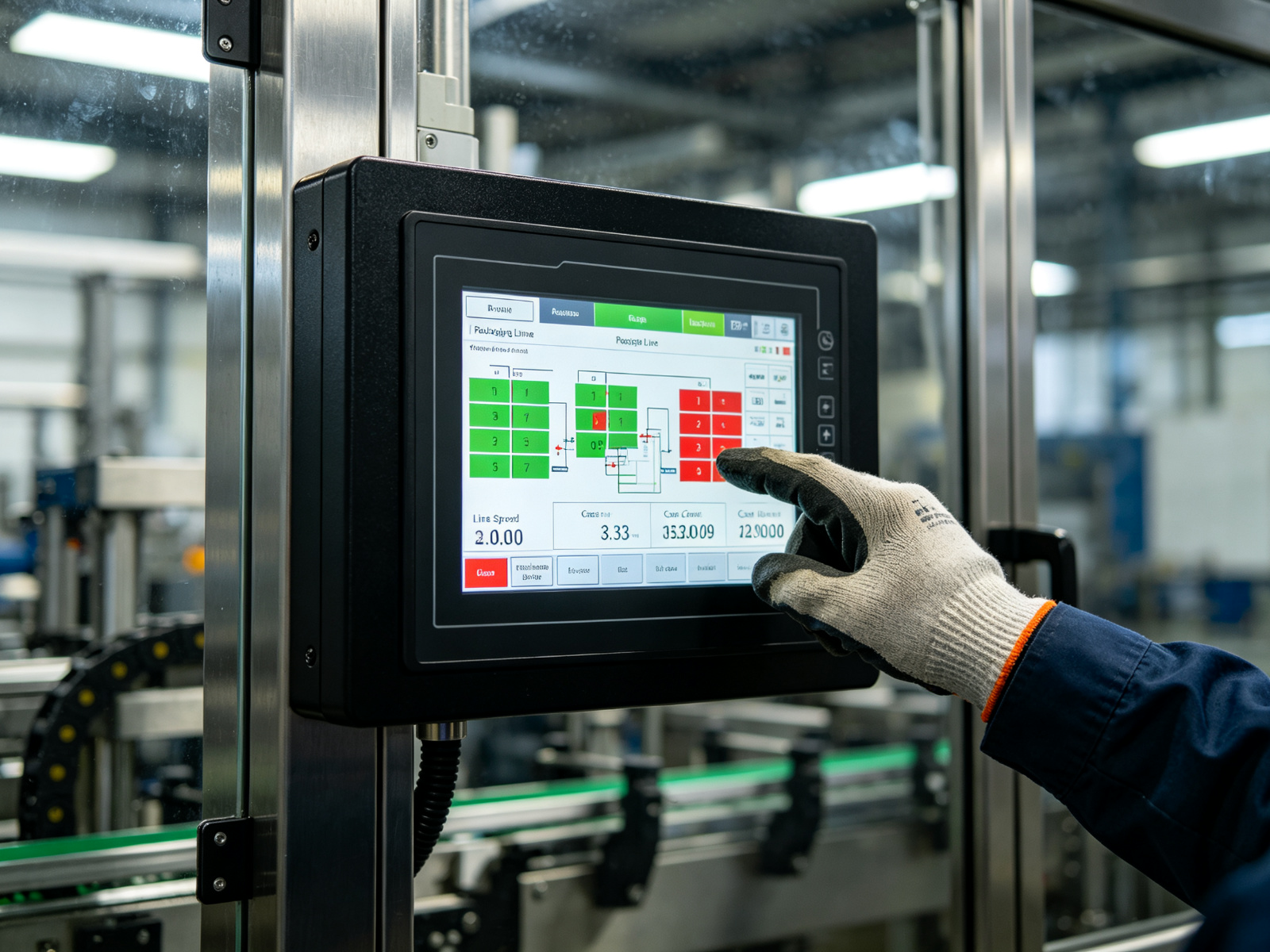
The specification sections in this template apply directly to palletizing equipment: the recent collaborative robot palletizer delivery shows how the throughput, payload, and safety requirements translate into the RFP sections.
Section 1: Product Description
This is the most important section. If the supplier doesn’t understand what they’re packaging, they can’t recommend the right machine.
- Product name and category — e.g., “roasted coffee beans, medium roast, whole bean”
- Fill weight range — minimum and maximum net weight per pack, e.g., 250g–1kg
- Product physical properties — is it free-flowing powder, sticky liquid, fragile solid, abrasive, hot (temperature), oily? Does it foam? Is it dusty?
- Packaging temperature — are you filling hot (e.g., pasteurized sauce at 85°C), ambient, or frozen? This affects material contact and sealing.
- Food safety classification — is this dairy, meat, pharmaceutical, chemical? This determines the required material grade (304 vs 316 stainless, washdown rating).
Section 2: Packaging Format and Materials
The machine type is determined almost entirely by the package format. Specify exactly what the end package looks like.
| Specification | What to Specify |
|---|---|
| Package type | Pillow bag, gusseted bag, stand-up pouch, sachet, tray, carton, bottle, vacuum bag, shrink bundle |
| Dimensions | L × W × H for each SKU, including min and max sizes |
| Material structure | e.g., OPP/CPP laminated, PET/PE, aluminum foil, mono-PE, thickness in microns |
| Rollstock or premade | Are you forming the bag from a film roll, or feeding premade pouches? |
| Special features | Zipper, spout, degassing valve, easy-tear notch, euro-hole, hole punch |
| Printing | Is the film pre-printed? Does the machine need print registration (photocell)? |
Section 3: Production Throughput Requirements
Don’t just say “fast.” Specify the numbers that actually determine machine sizing.
- Target output — packs per minute or bottles per hour, for the fastest SKU
- Minimum acceptable output — the speed below which the line is uneconomical
- Shifts per day and days per week — 1 shift, 2 shifts, or 24/7? This determines whether you need a duty-rated machine.
- Annual volume — how many packs per year? This helps the supplier size the line for realistic utilization.
- Changeover frequency — how many times per shift do you switch between SKUs? This determines whether you need quick-change tooling and recipe recall.
Section 4: Required Functions and Options
List every function the machine needs. Don’t assume “it’s included” — specify it.
- Dosing/filling method — volumetric cup, auger, piston, load-cell multihead weigher, net-gravimetric filler, overflow filler
- Coding/marking — do you need a coder (inkjet, laser, thermal transfer) for date/lot codes? What’s the required print height and speed?
- Inspection and rejection — do you need checkweigher, metal detector, vision inspection? Where should rejects go?
- Gas flushing / vacuum — do you need MAP (modified atmosphere), vacuum, or nitrogen flush?
- Film splicing / auto-threading — for high-speed lines, do you require automatic film threading and splice detection?
- Data and connectivity — do you need the machine to connect to your MES/SCADA? What protocol (Profinet, EtherNet/IP, OPC-UA)?
Section 5: Line Integration
A packaging machine doesn’t exist in isolation. The supplier needs to know what comes before and after.
- Upstream equipment — what feeds product to the machine? Existing filler, mixer, conveyor? What’s the discharge height and orientation?
- Downstream equipment — what happens after the package? Checkweigher, case packer, palletizer, shrink bundler?
- Conveyor interfaces — what conveyor width and height do you need? Is there accumulation between machines?
- Footprint and floor loading — how much space is available? Is it on an upper floor (floor load limit)?
For line integration, our line layout guide covers the spatial decisions in more detail.
Section 6: Site Utilities and Conditions
Missing utility specs are the #1 cause of “the machine arrived and we can’t install it” problems.
| Utility | What to Specify |
|---|---|
| Electrical | Voltage (220V/380V/460V), phase (1 or 3), frequency (50Hz/60Hz), available kVA |
| Compressed air | Pressure (typically 6–8 bar), quality (dry/oil-free), required CFM |
| Water / drainage | Is washdown required? Hot water? CIP (clean-in-place)? Drain location? |
| Environment | Ambient temperature range, humidity, dust, washdown zone (IP rating required) |
| Compliance | CE (EU), UL (US), CSA (Canada), NSF (food), FDA contact materials, local electrical codes |
Section 7: Commercial and Timeline Requirements
Finally, tell the supplier what you need commercially so they can quote the right package.
- Required delivery date — when do you need the machine commissioned and running?
- Trade terms — FOB, CIF, DDP? Which port?
- Warranty expectations — how long, what’s covered? See our warranty terms guide.
- Training and installation — do you need on-site installation and operator training, or will your team install?
- Spare parts — what spare parts kit do you want with the machine? See our spare parts strategy.
- Reference customers — can you visit or call existing customers running the same model?
Ready to send an RFQ? Send your product, packaging format, throughput and utility requirements through the contact page. We’ll respond with a detailed proposal — and if your RFP is missing critical information, we’ll tell you what else we need before quoting. Browse our flow wrappers, liquid fillers and vacuum sealers for machine specifications. See also our ROI calculator guide for budgeting.
The bottom line: a good RFP isn’t a bureaucratic exercise. It’s how you get apples-to-apples quotes from three or four suppliers, avoid expensive surprises after delivery, and end up with the right machine the first time. Spend two hours writing a detailed specification now, and you’ll save two months of headaches later.