Thin-Gauge Roll-Fed vs Heavy-Gauge Thick-Sheet Thermoforming: Choosing a Machine by Gauge, Part Size, Output and Tooling
Two buyers can ask for a thermoforming line, use the same words, and mean almost entirely different machines. The first is running a thin, flexible web at a fast cycle to make cups, lids and clamshells by the thousand. The second is feeding a thick, rigid cut sheet, one at a time or in small stacks, to form pallets, refrigerator liners and large industrial panels. The dividing line is the gauge of the starting material, and it cascades into how the sheet is fed, how fast the machine cycles, how the tooling is built, how the part is trimmed and what kind of floor space and handling the line needs. Treating the two as the same purchase, or assuming the heavier machine is simply the better one, is a common and expensive mistake. This guide compares thin-gauge roll-fed and heavy-gauge thick-sheet thermoforming, where each one earns its place, and why the correct answer is set by the part rather than the brochure.
At SunAura Machinery we build both families of line, and the honest framing is that the gauge decision is fixed early by the product and only partly negotiable after that. A disposable cup or a thin clamshell wants the lowest material weight that still holds shape, which points to a roll-fed thin-gauge machine built for high cycles and inline trimming. A structural pallet, a vehicle panel or an appliance liner needs the stiffness of a thick sheet and the slower, more deliberate handling of a heavy-gauge press. The rest of this guide works through where that boundary sits, what changes when you cross it, and how to avoid buying a machine that is either over-built for a thin disposable part or too light to hold a thick one.
What Actually Separates Thin Gauge from Heavy Gauge
The distinction starts with the thickness of the plastic as it enters the machine. Thin-gauge work generally runs on a continuous web measured in fractions of a millimetre up to roughly one and a half millimetres, supplied as a roll and fed straight into the clamp chain without anyone handling individual sheets. Heavy-gauge work starts from a thicker, rigid sheet, commonly cut to size before it reaches the machine and presented as a single blank or a small stack rather than a continuous web. The exact crossover is not a universal number, and suppliers draw it in slightly different places, but the practical test is how the material behaves: a thin web is flexible enough to be unwound and indexed from a roll, while a thick sheet is rigid enough to stand on its own and has to be loaded and located as a blank.
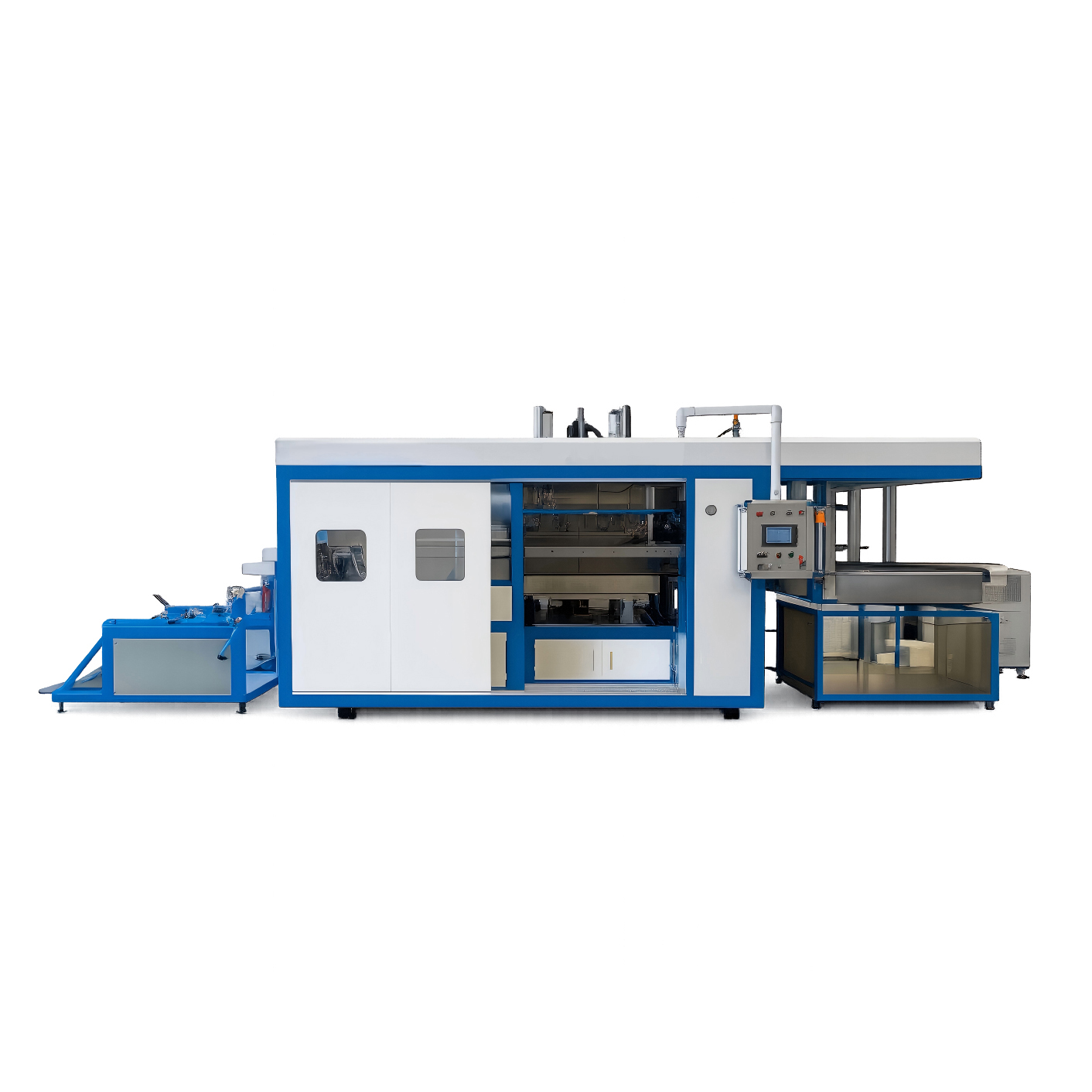
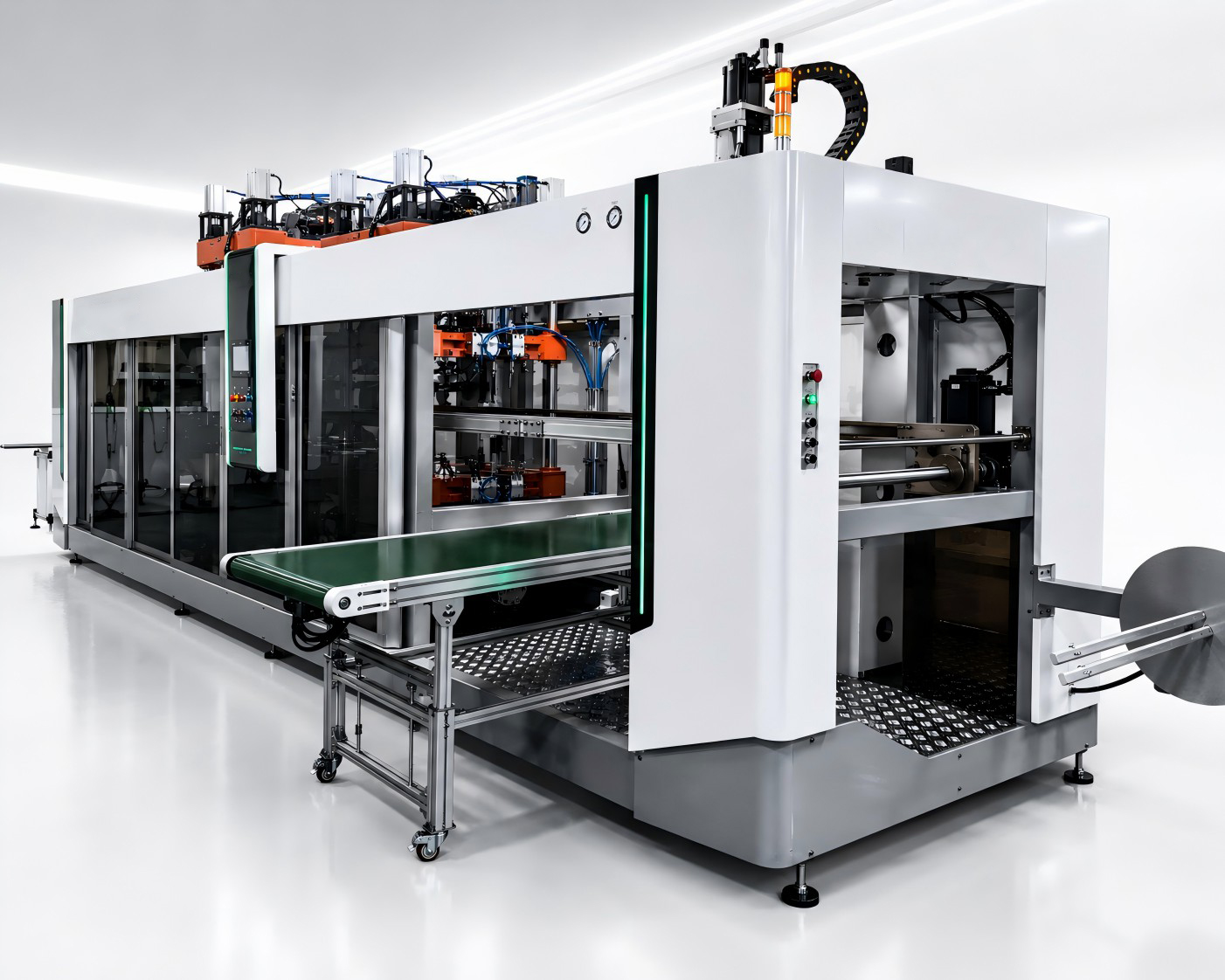
That single difference drives the layout of the whole line. A roll-fed thin-gauge machine is usually an in-line arrangement with the web moving continuously or in rapid indexed steps through heating, forming and trimming stations, and the finished parts are often die-cut and separated from the skeleton web on the same line. A heavy-gauge machine is more often a press-style arrangement: a single sheet is loaded, clamped, heated, formed over a large tool and cooled, and the part is then removed and trimmed on separate equipment such as a five-axis router. The thin line is built for repeatable high-cycle production of relatively small parts; the heavy press is built for the force and platen size that large, thick parts demand, even though its cycle is much longer.
Thin-Gauge Roll-Fed Forming: Speed, Material Weight and High Volume
Thin-gauge thermoforming is the economics of material and cycle. Because the part is thin, the cost of the plastic in each pack is a large share of the piece cost, and the whole process is tuned to hold the lowest usable gauge without losing the wall or the seal. The roll-fed web is indexed automatically, the oven brings it quickly to forming temperature, and the forming station, whether vacuum, pressure or a plug-assisted combination, sets the geometry before an inline trim separates the parts from the web. The machine runs a short, repeatable cycle and can produce a high number of parts per minute, often across many cavities in a single shot. This is the family for disposable cups and lids, thin clamshells, retail blister packs, food trays, inserts and the broad run of packaging that is bought in large volumes and where the material weight is being actively managed.
The strengths carry their own boundaries. A thin-gauge line is optimised around a web width and a gauge range, and pushing it far beyond that range, or asking it to run a rigid thick sheet it was never designed to feed, does not work. The tooling is built for fast cycling and inline trimming rather than for the large clamping forces of a heavy press, and the parts are limited to what a thin wall can structurally do. Thin-gauge work also tends to be tightly coupled to the trim tooling and the web skeleton, so a new part means a matched set of forming and trim tooling rather than a single mold. It is the right choice when the volume is high and the part is genuinely thin; it is the wrong place to force a large, rigid structural component that simply cannot be made in a thin wall.
Heavy-Gauge Thick-Sheet Forming: Force, Platen Size and Structural Parts
Heavy-gauge thermoforming is the economics of force and size. The thick sheet is stiff and carries its own structure, so the machine has to heat a much larger thermal mass evenly, clamp a rigid blank securely, and provide the platen size and forming force needed to draw a large part without tearing or thinning the corners. Sheets are commonly loaded as individual blanks, sometimes with automated de-stacking on the higher-volume lines, and the cycle is longer because heating and cooling a thick part takes more time. The formed part is then removed and routed or trimmed on separate equipment rather than being die-cut from a web. This is the family for plastic pallets, large containers and totes, appliance housings and refrigerator liners, automotive panels, recreational equipment, signage and the broad run of structural or large-format parts where the wall thickness is part of the engineering.
The trade-off is throughput and handling. A heavy-gauge press does not produce parts at the cycle of a roll-fed line, and the longer heating and cooling time, plus the separate trimming step, sets the real output. The machine and tooling are larger and heavier, the floor load and headroom requirements are higher, and moving thick sheets in and finished parts out needs handling equipment. The strength is that a thick-sheet line can make parts that a thin web physically cannot, with the rigidity and impact performance the application demands. It is over-specified for a thin disposable part, where the slow cycle and large platen would be wasted and the part could be made far more efficiently on a roll-fed line.
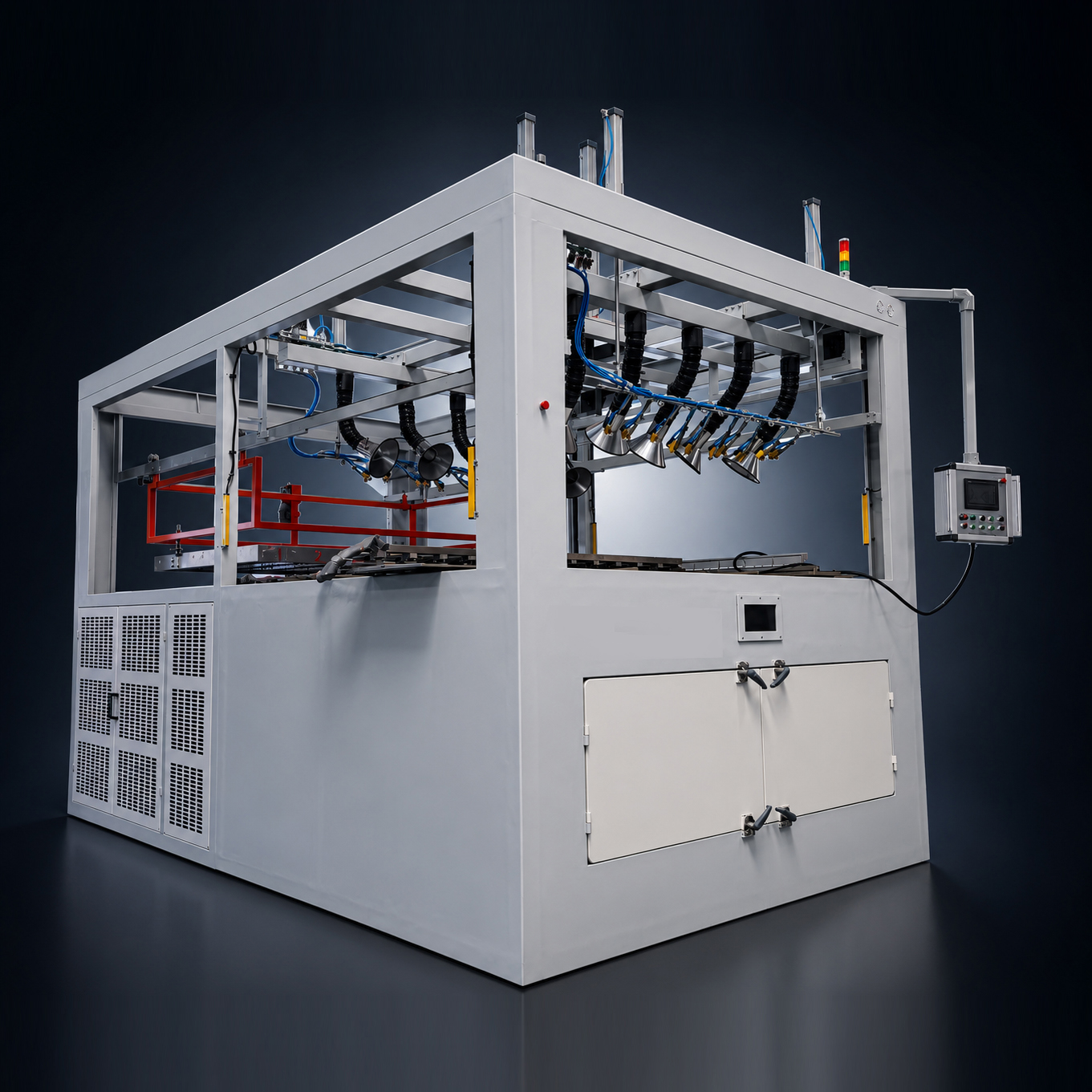
Some production sits between the two families and is worth naming rather than forcing into one. Double-layer and twin-sheet arrangements, automated de-stacking and continuous thick-web lines blur the boundary, and the right answer depends on the exact gauge and volume rather than a label. The useful discipline is to describe the part first, its gauge, dimensions, structural requirement and expected annual volume, and let the machine family follow, rather than choosing a machine and trying to make the part fit. The related choice of forming force is a separate decision from gauge; the thermoforming machines range spans both families, and the heavy-gauge sheet forming line and the thin-web negative-pressure station are specified against different parts, while the high-speed cup forming machine is a classic roll-fed thin-gauge application.
Selection Table: Thin-Gauge Roll-Fed vs Heavy-Gauge Thick-Sheet
| Dimension | Thin-gauge roll-fed | Heavy-gauge thick-sheet |
|---|---|---|
| Starting material | Flexible web on a roll, roughly up to 1.5 mm | Rigid cut sheet, thick and self-supporting |
| Material handling | Continuous web, auto-indexed | Individual blanks, often de-stacked |
| Cycle speed | Short, high parts-per-minute | Longer, heat and cool limited |
| Trimming | Inline die-cut from web skeleton | Separate routing or trimming |
| Tooling | Matched forming and trim, fast cycle | Large, heavy mold for high force |
| Machine build | In-line, web-width based | Large platen, heavy press frame |
| Part size and structure | Small to medium, thin wall | Large, structural, rigid wall |
| Price range | Lower to mid, gauge and cavity driven | Mid to high, platen and force driven |
| Changeover | Forming plus trim tool set | Large mold plus blank size |
| Maintenance cost | Moderate, web and trim focused | Higher, large frame and handling |
| Typical products | Cups, lids, clamshells, trays | Pallets, liners, panels, totes |
| Typical industries | Food packaging, retail, disposable | Appliance, automotive, logistics |
When Not to Choose Each Family
Do not specify a thin-gauge roll-fed line for a large structural part that needs a rigid, thick wall, because the web cannot carry the gauge and the inline trim and fast-cycle tooling are not built for the force and size the part requires. Equally, do not buy a heavy-gauge press for a thin disposable cup or clamshell, because the long cycle and large platen will leave the line under-used and the part cost far above what a roll-fed line can achieve. Do not assume the boundary is a single universal thickness: suppliers place it differently, and the reliable test is whether the material feeds as a flexible web or has to be handled as a rigid blank. Do not treat gauge and forming force as the same decision either, since a thin web can be pressure-formed and a thick sheet can be vacuum-formed. Finally, do not plan to switch a line between the two families after installation, because the feeding, clamping, trimming and handling are fundamentally different; the family has to be specified at order time against the actual part.
Tooling, Trim and the Cost Logic Across a Run
The two families carry tooling costs in different places, and the purchase should be framed against the full run rather than the machine price alone. Thin-gauge work needs a matched forming and trim set, because the part is cut from the web skeleton on the line, and the economics improve sharply with volume as the tooling is amortised across a high number of light parts while the material weight is held to the minimum. Heavy-gauge work needs a large, sturdy mold built to withstand the forming force on a thick blank, plus separate routing or trim fixtures, and the longer cycle means the economics are driven by part value and structural necessity rather than by raw throughput. The practical risk is choosing on initial price and ignoring the downstream trim: a thin-gauge quotation that omits the trim tool, or a heavy-gauge plan that forgets the routing cell, hides real cost and handling that surfaces only after the machine arrives.
Material and energy use deserve the same scrutiny. Thin-gauge lines are built to minimise the plastic in each part, which is where most of the saving is, but they run fast and continuously, so the steady-state energy and the web handling matter. Heavy-gauge lines heat a large thermal mass on every cycle, so the heating uniformity and the time the thick sheet spends in the oven dominate both quality and energy, and an unevenly heated thick sheet will thin and tear at the corners regardless of the press force. A supplier that can discuss the expected gauge window, the trim method, the wall distribution and the realistic cycle for the specific part, and that will run a trial on the actual material, is demonstrating the engineering support that separates a workable line from a machine that only runs at ideal conditions.
How This Connects to the Rest of the Line
The forming machine rarely works alone, and the part it makes is only as consistent as the equipment around it. Thin-gauge packaging often feeds a downstream flow-wrapping or sealing step, and the choice of how the film is handled on those machines has its own logic, which is covered in the guide to top-film versus bottom-film inverted flow wrappers. Where the product is weighed rather than formed, the choice between a simple and a combination weighing system is set out in the comparison of a linear weigher versus a multihead weigher. Keeping those decisions in the right order, part and gauge first, then forming force, then weighing and downstream handling, avoids specifying a capable machine in the wrong family.
Frequently Asked Questions
What is the difference between thin-gauge and heavy-gauge thermoforming?
Thin-gauge forming uses a flexible roll-fed web, runs a short high-volume cycle and trims parts inline, while heavy-gauge forming uses a thick, rigid cut sheet, a larger and slower press and separate trimming. The choice is set by the part’s gauge, size and structural requirement rather than by a preference for the heavier machine.
Can one machine run both thin and thick material?
The two families use different feeding, clamping and trimming, so a line is generally built for one or the other and switching is not a recipe change. A few intermediate, automated thick-web lines narrow the gap, but they are specified against a defined gauge range rather than being universal machines.
Which is cheaper, roll-fed or thick-sheet forming?
The machine and tooling are usually lower for thin-gauge work, but the real comparison is per part across the run. Thin-gauge economics depend on high volume and minimum material weight, while heavy-gauge parts carry a larger mold and longer cycle but are structural components that a thin web cannot make.
How do I know if my part is thin or heavy gauge?
Use the practical test: if the material is flexible enough to unwind and index from a roll, it is thin-gauge work, and if it is a rigid, self-supporting blank that has to be loaded and located, it is heavy-gauge. Confirm the expected gauge and annual volume with the supplier rather than relying on a single universal thickness.
Conclusion: Match the Machine Family to the Gauge and the Part
The decision is more straightforward than the brochures make it once the part is described honestly. If the product is a thin, high-volume disposable, a cup, lid, clamshell or tray where material weight and cycle dominate, a roll-fed thin-gauge line with inline trim is the correct family and a heavy press would be wasted. If the product is a large, rigid structural part, a pallet, liner, panel or tote where the wall thickness is part of the engineering, a heavy-gauge press with separate trimming is the only family that can make it. Specify the gauge and the part first, resist the pull to buy the heavier machine as a default, and treat the trim and handling as part of the purchase rather than an afterthought. To work through the gauge, web width, tooling and trim for your specific product, contact SunAura Machinery and we will size the line against the actual part and volume.