
QINGDAO, China — October 23, 2026 | by Ethan, SunAura Machinery Compliance and Export Engineering
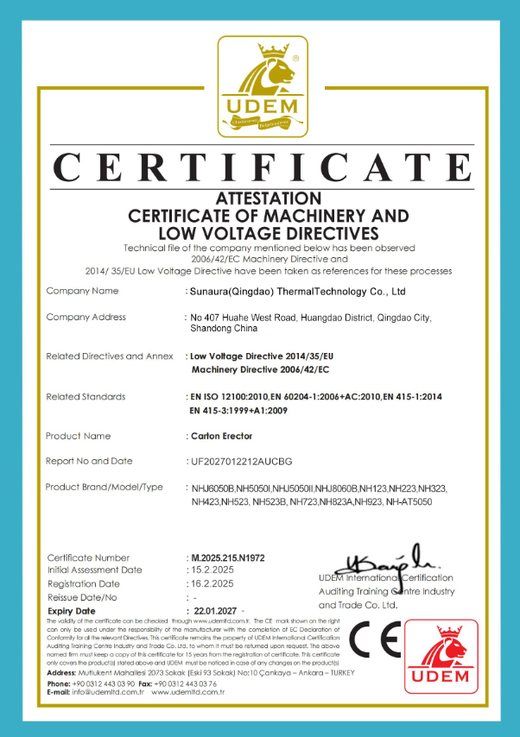
SunAura Machinery has completed the CE certification update for its new-generation servo piston filling platform ahead of the European Machinery Regulation deadline, following compliance testing by accredited third-party bodies including SGS and TUV Rheinland. The updated certification covers the company’s single-head and multi-head servo piston fillers for food, cosmetics, pharmaceutical and light-chemical applications, and it applies to every machine built to the current platform specification from October 2026. The reason for doing the work now rather than at the deadline is simple: the new Regulation (EU) 2023/1230 applies from 20 January 2027, and a filler ordered this quarter for a European customer has to be compliant on the day it is commissioned, not the day it is quoted.
What the Certification Update Covers
The update was driven by the change from the Machinery Directive 2006/42/EC to the Machinery Regulation (EU) 2023/1230, together with refreshed electrical and electromagnetic compatibility standards. The platform range tested and certified includes:
- Single-head servo piston fillers across roughly 100 ml to 5,000 ml, used for sauces, honey, pastes, creams and viscous chemical liquids.
- Inline multi-head servo piston fillers from four to twelve heads, for high-throughput food and cosmetic production.
- The associated control panels and electrical enclosures — PLC, servo drives, HMI and the guarding and e-stop circuits.
Testing covered mechanical safety (fixed and interlocked guards, emergency-stop and access-panel circuits), electrical safety (insulation resistance, protective-earth continuity, leakage current) and electromagnetic compatibility (emissions and immunity under the EMC Directive 2014/30/EU and the EN 61000 series, with control and measurement components meeting EN 61326). The machines passed on the first submission, which is less a stroke of luck than the result of designing the guarding and e-stop architecture to the standards before the first test.
The standards that sit behind the mark
A CE mark is a declaration, not a single test. For a servo piston filler the file references EN 60204-1 for electrical equipment of machines, EN ISO 12100 for the risk assessment, EN ISO 13849-1 for the reliability of safety-related control functions (the performance level of the e-stop and interlock circuits), ISO 14119 for interlocking devices, and EN ISO 13850 for emergency stops. Food-contact machines additionally document the 304/316 stainless and gasket materials against Regulation (EC) 1935/2004. Each of these is a traceable line in the technical construction file rather than a claim on a brochure.
Directive vs Regulation: What Actually Changes
Buyers sometimes ask why a recertification was needed at all. The shift from a Directive to a Regulation is more than a paperwork change; it is directly applicable in every member state without national transposition, tightens the obligations on operators and importers, and adds explicit treatment of digital and connected machinery. The practical differences for a filling-line buyer are set out below.
| Topic | Machinery Directive 2006/42/EC | Regulation (EU) 2023/1230 (from 20 Jan 2027) |
|---|---|---|
| Legal form | Transposed by national law | Directly applicable across all member states |
| Declaration of Conformity | Paper document | Digital DoC allowed and encouraged |
| Safety components | Narrower scope | Broader scope, more listed safety components |
| Digital and connected machinery | Limited provisions | Explicit cyber-security and software requirements |
| Economy operators | Manufacturer focus | Importer and distributor obligations strengthened |
| Documentation | TCF retained by manufacturer | Clearer instructions, risk and traceability duties |
What Physically Changed on the Machine
This is a component and documentation refresh, not a redesign of the filling mechanics, which is why the fill accuracy, throughput and changeover performance are unchanged. The visible upgrades on machines shipped after September 2026 include shielded cable glands and filtered power inputs on the servo drives and HMI to meet the tighter immunity requirements, re-graded e-stop and guard-interlock circuits documented to EN ISO 13849-1, updated warning labels and nameplates, and a revised technical file and risk assessment. The guarding geometry and the stainless product-contact parts remain the same, so spare parts and operator training carry over from the previous specification.
Why It Matters for European Buyers and Importers
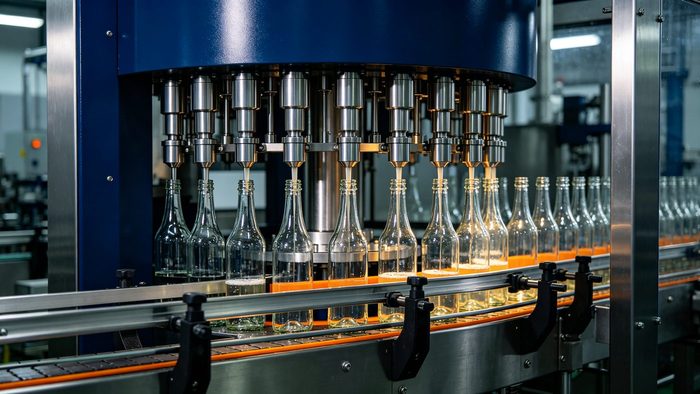
For the EU and EFTA markets, CE marking is the legal declaration by the manufacturer that the machinery meets the applicable health, safety and environmental requirements. The new Regulation sharpens the position of the importer and the distributor, which is the detail that matters most to a brand that buys under its own name or through an importer. Bringing non-compliant machinery into the market exposes the consignee to customs detention, market-surveillance action, the cost of rework in the EU, and liability in the event of an incident — costs that dwarf the price of a verified machine.
Three points in the update are worth noting:
- Current documentation. The updated certificates cover machines built from October 2026 and are recognized across all member states; older certificates remain valid for the machines they cover, so customers who ordered earlier do not need to change anything.
- EMC upgrade. The tighter immunity requirements are met by the shielded glands and filtered inputs already fitted to current machines; buyers should not accept a nominally new machine without these parts.
- Technical file on request. The Declaration of Conformity, the risk assessment and the supporting test reports are available to European buyers and their notified representatives for their own compliance records.
The Documentation a Buyer Should Actually Receive
A self-printed “CE” sticker is not evidence of compliance. When buying a servo filler for a European market, insist on the following before the balance payment, and keep them in the site’s machine file.
- Declaration of Conformity naming the machine, serial number, the applicable regulations and directives, and the harmonized standards applied, signed and dated by the manufacturer.
- Technical construction file summary, including the electrical schematics, the EN ISO 12100 risk assessment and the safety-function performance level.
- Test reports from an accredited or recognized body for electrical safety and EMC.
- A nameplate carrying the manufacturer’s details, the machine type and serial, the CE mark and the year of manufacture.
- Instructions in the language of the member state where the machine is used, with installation, maintenance and residual-risk information.
The mark is only as good as the file behind it. A reputable manufacturer offers these documents without argument and supports a third-party inspection at the factory before shipment, which is the cheapest point in the whole project to resolve a compliance gap.
The Same Platform Across Integrated Lines
Most SunAura fillers are not delivered as standalone heads. The same servo piston filling platform is built into the liquid filling machines family and the automatic linear filling machine for liquids, and it is the filling core of the fully automatic edible oil filling, capping and labeling line. When a project adds a capping stage, the controls are matched to the high-speed automatic bottle capping machine so the e-stop and guard logic is consistent across the whole line — a point that matters when the line is assessed as one installation. The same certified controls also appear in the small-format personal-care filling, capping and tube line delivered to a Dubai co-packer, which is ordered partly for Gulf and European re-export and was specified to the same documentation standard.
It is also worth remembering that compliance continues after the filler. Filled and sealed packs often move onto a flow wrapper for bundling or multipack, and that wrapper needs its own guarding and controls; the common faults and the correct machine settings are covered in the flow wrapper troubleshooting guide for seal leaks, film jams and registration, which is useful when the CE documentation for the full end-of-packaging line is being assembled.
Common Compliance Gaps on Low-Cost Fillers
After several years of helping customers retrofit machines that failed at the point of import, the same gaps recur, and they are the ones that cost the most to fix after delivery. The first is a missing or generic risk assessment: a filler that has no documented EN ISO 12100 analysis usually has a pinch point at the filling head or an unguarded drive, and a guard added in Europe is far more expensive than a guard designed in. The second is e-stop circuits that are not fail-safe — a stop button that simply removes a contactor signal rather than dropping a safety relay to the correct performance level under EN ISO 13849-1. The third is electrical: thin or non-color-coded wiring, missing protective-earth continuity and an enclosure that is not rated for the environment, all of which show up against EN 60204-1 and force a panel rebuild. The fourth is documentation that is present but unusable — a Declaration of Conformity that lists no standards, a manual with no residual-risk information, or a nameplate with no serial or manufacturer address. Each of these is trivial to correct at the factory and painful to correct on the buyer’s floor, which is why the inspection before shipment is the cheapest insurance in the purchase.
For food and cosmetic fillers specifically, buyers should also check the material documentation rather than trusting the word “stainless”: food-contact zones should be 304 or 316 with the mill certificates available, and the gaskets and seals should have their own food-contact declarations, since an elastomer without a declaration fails the food-contact part of the file even if the steel is correct.
How to Run a Pre-Shipment Compliance Check
A buyer who wants certainty rather than a paper promise should arrange a simple sequence before the balance payment. First, receive the Declaration of Conformity and the standard list and confirm the standards are current for the destination market. Second, ask for the risk assessment and the electrical safety and EMC test reports and check that the test body and machine type are identifiable. Third, commission an SGS, Bureau Veritas or TUV inspection at the factory, which photographs the guarding, the e-stop wiring, the nameplate and the documentation. Fourth, on arrival, verify the machine’s serial number matches the Declaration and the nameplate before the warranty clock starts. This is the same inspection sequence SunAura supports routinely, and it is the difference between a smooth import and a consignment held at the port waiting for a conformity file.
Frequently Asked Questions
Does CE mean a machine was tested by a European laboratory?
Not always. For most filling machinery the manufacturer self-declares conformity after applying harmonized standards, with third-party test reports supporting the electrical and EMC clauses. Ask for the actual test reports and the name of the body; the machine’s Declaration of Conformity states which procedure was used.
What is the difference between the old Directive and the new Regulation?
The new Machinery Regulation (EU) 2023/1230 applies directly in every member state, allows a digital Declaration of Conformity, broadens safety components and adds digital and connected-machinery requirements, while strengthening importer and distributor obligations. It applies from 20 January 2027.
Do I need to recertify a filler I already own?
No. Machines already placed on the market under the older Directive remain valid, and existing certificates continue to cover the machines named on them. The updated certification applies to new machines built from October 2026 onward.
Which document proves compliance at customs?
The signed Declaration of Conformity, supported by the nameplate, the invoice and the technical file. Customs and market-surveillance authorities typically request the DoC first and may follow up with the technical file or the test reports.
Can SunAura support an inspection before shipment?
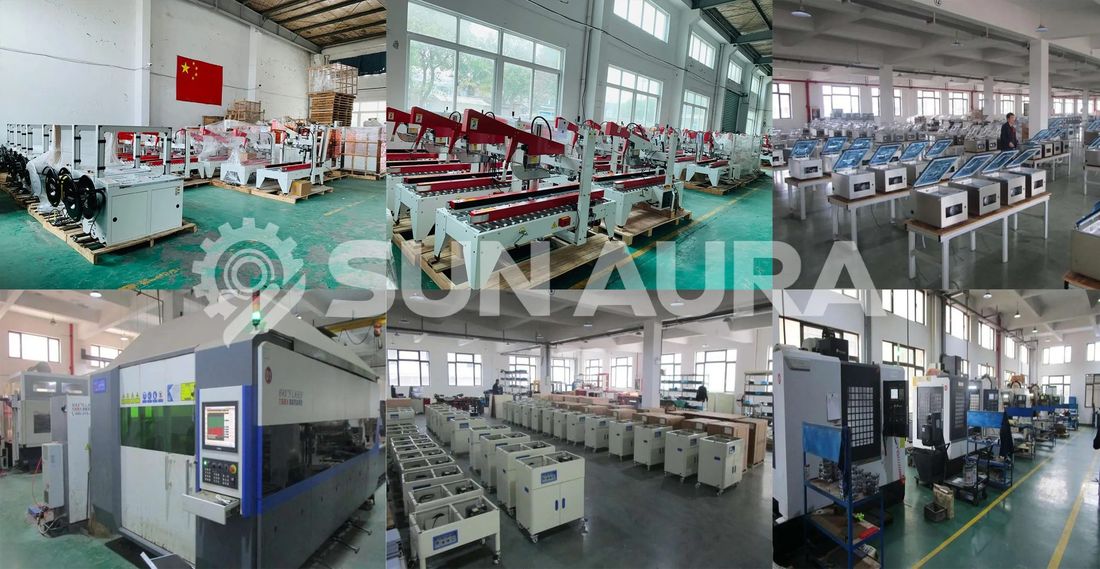
Yes. SGS, Bureau Veritas and TUV inspections at the Qingdao factory are routine, and the current CE certificates, EMC reports and risk assessments are available within one business day. Customers can also take a virtual or physical workshop tour to review the machines in build.
What about UKCA and markets outside the EU?
UKCA marking follows its own conformity framework for the United Kingdom and SunAura is adding it to the current platform, with completion expected in early 2027. Other markets such as the Gulf, Southeast Asia and Africa frequently accept CE documentation as part of their own import evidence, but the local importer should confirm the exact requirement for each destination.
Does the update change the machine’s performance or spares?
No. The filling mechanics, accuracy, throughput and stainless product-contact parts are unchanged; the update is the guarding documentation, EMC filtering, shielding and the technical file. Spare parts and operator training carry across from the previous specification, so an existing owner does not need to change anything.
Sourcing CE-compliant filling equipment for the EU, UK or EFTA? Send SunAura Machinery your product, viscosity range, bottle sizes and destination market, and the proposal will include the current CE documentation package, the applicable standards and the material declarations for food contact. Request a quote and the compliance documents, browse the full liquid filling machines range, or review the complete certifications and patents register. SunAura’s ISO 9001 quality system is maintained and UKCA marking is being added for the UK market.