
Qingdao, China — SunAura Machinery has expanded its robotic palletizing range with a dedicated heavy-duty robotic bag palletizer engineered for 20–50 kg sacks of flour, rice, sugar, animal feed, fertilizer, seeds and frozen vegetables. The new cell is designed around the problems that sack lines actually have: flexible film bags that swell, sharp corners that tear, patterns that must interlock to survive truck vibration, and a labour shortage that makes manual bag palletizing both slow and ergonomically unacceptable. This release note explains what buyers should understand before comparing robotic sack palletizers, because the headline “palletizes bags” hides a lot of engineering.
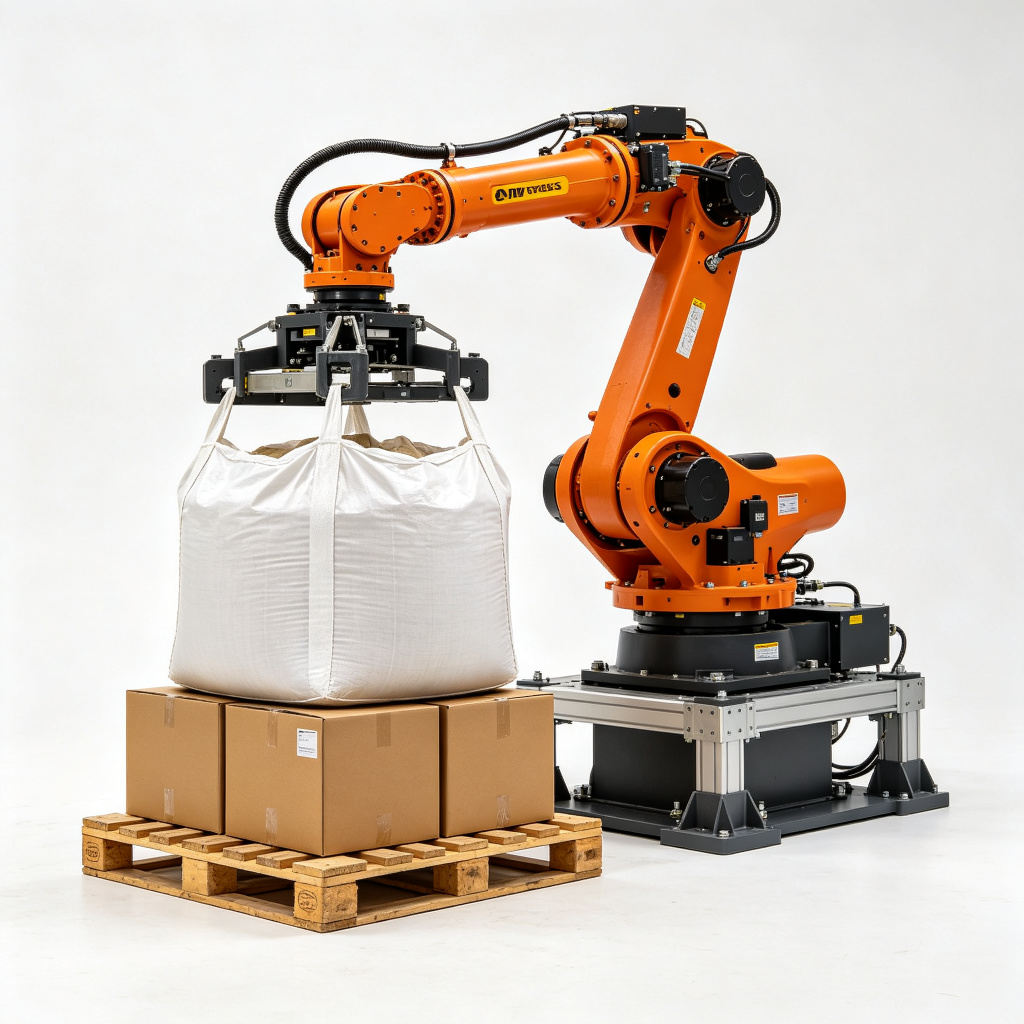
Why bag palletizing is a different problem from case palletizing
A rigid corrugated case is predictable: it is a fixed rectangle, it sits square on a conveyor, and a vacuum or fork gripper can hold it from almost any angle. A sewn or poly-woven sack is none of those things. It flexes, it is filled unevenly (more product at the bottom, an air pocket at the top), it twists on the conveyor if the centering guides are wrong, and it must be flattened and shaped as it is placed, or the stack leans. A standard automatic bag palletizer or a generic box gripper will “work” on a good day and produce a leaning, shifting pallet on a bad one. The new SunAura cell starts from that reality rather than treating a bag as a soft box.
How the sack gripper and shaping work
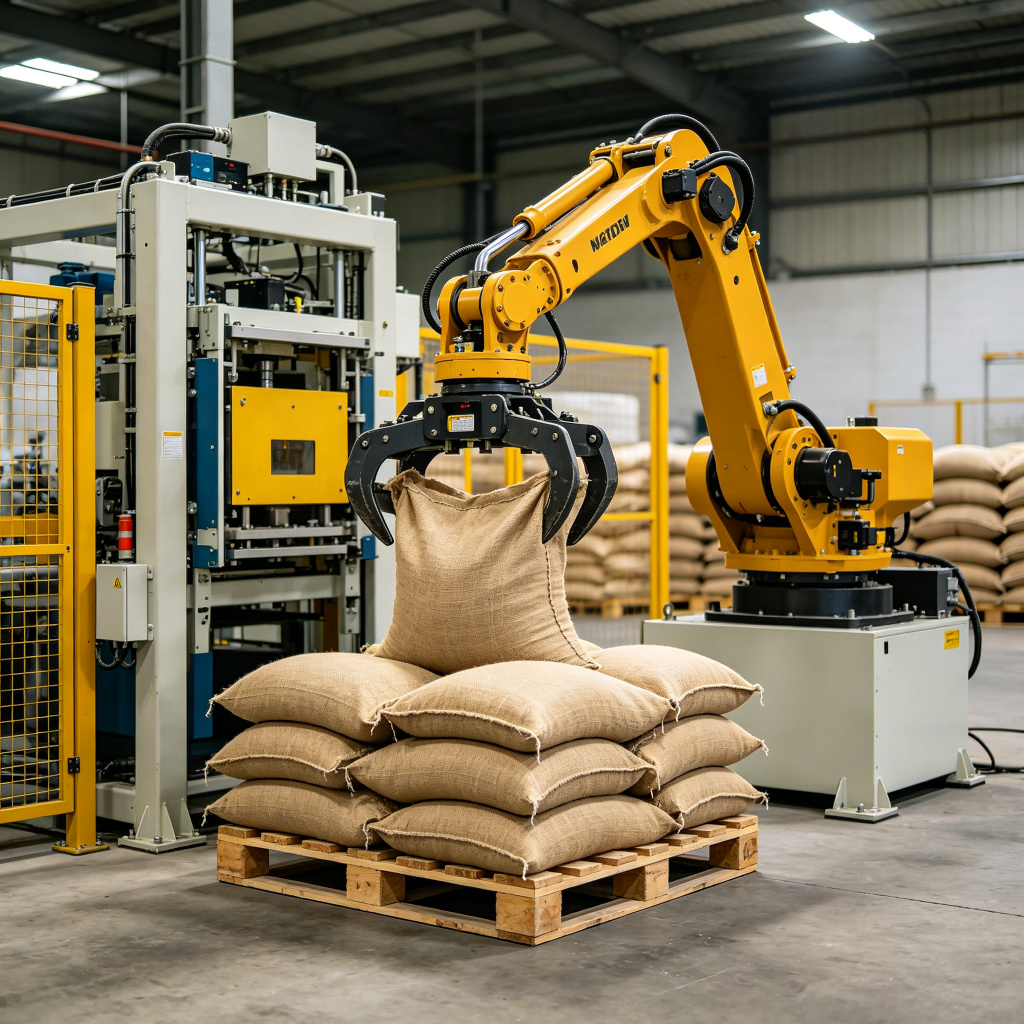
The cell uses a four-axis robotic arm fitted with a dedicated bag gripper: two opposing plates that close around the filled sack, hold it during transfer, and — critically — a flattening/finishing stroke that squares the bag against a backing plate before placement. That shaping step is what converts a floppy sack into a dimensionally controlled brick. The gripper handles 20 kg woven polypropylene bags, 25 kg paper sacks and 50 kg bulk bags without changing tooling; a roller-turn option is available for plants that need bags laid flat with the seam on the bottom rather than the top.
Discharge comes from an indexing belt or roller conveyor with side-centering guides, so every sack arrives at the pickup point in the same orientation. An optional product-present sensor confirms a bag is present before the arm moves, which prevents empty cycles that can crash a pattern. For plants running upstream multihead or net weighing, the cell can be timed to the feeder speed rather than running fixed cycles, which keeps the whole line balanced.
Stacking patterns that survive the journey
The difference between a pallet that arrives intact and one that collapses in a container is the stacking pattern. The SunAura cell stores the common sack patterns as recipes:
| Pattern | How bags lay | Best for |
|---|---|---|
| Column (1+1) | Bags aligned in straight columns | Short stacks, stable rigid sacks; lowest capacity per layer |
| Brick (running bond) | Alternating row offset by half a bag | Most food/grain sacks; best lateral stability in transit |
| Block with interlock | Rows rotated 90° alternately | Taller stacks, export containers, maximum pallet square-footage |
| Pinwheel / 4-bag rotation | Bags rotated around a centre | Square loads on wide pallets, minimal overhang |
For export — the single most demanding application — the brick and interlocked block patterns are the default, because they lock the load together so truck and container vibration cannot open a gap. A top-sheet dispenser and an optional pre-stretch pallet wrapping machine complete the cell so the finished, stacked load is unitised without manual intervention.
Throughput, reach and pallet size: the numbers that matter
Bag throughput is not a single number. It depends on bag size, pattern complexity, pallet dimensions and whether an infeed conveyor accumulates bags. As a planning range, the robotic sack cell handles roughly 6–12 bags per minute per arm for typical 25 kg food sacks, which matches most upstream weighing and bagging lines running at that speed. A second arm or a rotating platform can extend this for high-output flour or sugar plants.
Buyers should confirm three physical dimensions before specifying: the pallet footprint (ISO, EUR, or local wooden pallet), the required stacking height (including whether a corner post or slip sheet is needed), and the reach envelope of the arm. The cell is available as a heavy-duty robotic palletizer rated to 180 kg payload for the heaviest 50 kg sacks and tall stacks, and in a compact, lower-footprint configuration for smaller co-packers and single-line plants. A safety fence or light-curtain guarding package is included to meet CE requirements.
Why automate bag palletizing at all
Manual bag stacking is one of the worst jobs in a food plant. A worker lifting and placing 25 kg sacks all shift carries a repetitive-strain injury risk that insurers and food-safety auditors both flag. Automated robotic bag palletizing removes that ergonomic burden, removes human contact with the food-contact sack, runs consistently through an 20-hour day, and produces a uniform load every cycle. For export-focused plants it also removes the variability that causes pallets to arrive leaning — a common cause of customer complaints and rejected containers.
The payback is usually driven by three things: recovered labour (often two to three workers per shift on a busy sack line), reduced load damage in transit, and the ability to keep running when labour is simply unavailable. In grain, feed and seed regions where harvest-driven campaigns run 24 hours a day, the ability to hold the palletizing cell through a three-shift campaign without training new operators is decisive.
Robotic bag palletizer versus automatic layer palletizer
Not every sack line needs a robot. Buyers comparing options should understand the trade-off between a robotic arm cell and a mechanical layer palletizer (the “gantry” or “slat” type that sweeps a whole layer at once). A layer palletizer builds a complete layer of bags on a forming table, then transfers the whole layer to the pallet in one motion. It is extremely fast and repeatable for a narrow range of bag sizes and fixed patterns, and it has few wearing parts in the arm itself. Its weakness is flexibility: change bag size or pattern and the forming plates and sweep guides need mechanical re-setting, and the capital and floor space are fixed to a specific output. A robotic arm cell is slower per bag but changes pattern and product through the recipe, occupies less floor space, and can be redeployed later if the line changes.
The rule of thumb: a high-output, single-product plant (a single mill running one bag size, 24 hours a day) often prefers a high-speed mechanical layer palletizer. A multi-product co-packer, a feed plant running many bag weights, or an export operation that needs flexible patterns and later reconfiguration is usually better served by the robotic cell. For mixed lines the robot also integrates more naturally with vision-guided or irregular placements, and it can be programmed to interleave slip sheets or corner boards between layers without separate actuators.
Maintenance, guarding and uptime on sack cells
Robotic cells are mechanically simpler than the equipment they replace, but they are not maintenance-free. Expect scheduled checks on the gripper pads (the wear item, especially with abrasive poly-woven sacks), the infeed conveyor belts and bearings, and the teach/tool calibration that keeps placement accurate. A cell that loses gripper pressure drops bags; one that drifts placement builds leaning loads. The HMI should log placement errors and gripper cycles so maintenance can plan pad replacement rather than reacting to a dropped sack on the floor.
Guarding is a specification point, not an afterthought. Food and export buyers in CE-regulated markets need either a fixed fence with interlocked access gates, or light curtains on the load/unload side that pause the arm safely. Buyers should confirm the guard package is part of the base price and the CE documentation covers the complete cell, not just the arm. For dusty environments such as flour feed, an IP-rated shroud around the control cabinet and regular filter changes keep the electrical side reliable.
A worked ROI example
Take a sack line running 25 kg bags across two shifts, currently stacked by two operators per shift (four operators total across the day, at a loaded labour cost including space and supervision). A robotic cell removes roughly three operator-equivalents of stacking labour, reallocating them to inspection and packing. Against that, add reduced transit damage: leaning or collapsed pallets are a common cause of container claims, and a consistent interlocked pattern plus stretch wrapping typically cuts these complaints sharply. The recovered labour and avoided claims alone often return the cell within 12–24 months for a busy sack operation; the strategic value — being able to run through a harvest campaign without hiring and training stacking crews — is on top of that. Ask any vendor for a payback model built on your labour cost and bag volume, not a generic one.
What to ask before you buy a robotic sack palletizer
- Show a reference video of the gripper shaping and placing the exact bag film and size you run — poly-woven, paper or PE liner.
- Confirm the stored stacking patterns and whether a new pattern can be taught in minutes, not hours.
- Ask for the realistic bags-per-minute at your bag size and pattern, not the maximum mechanical cycle.
- Confirm infeed conveyor, centering guides and product-present sensing are included, not optional extras.
- Check reach and payload against your tallest stack and pallet footprint.
- Confirm guarding (fence or light curtains), CE documentation and interfacing with your upstream weigher and downstream stretch wrapper.
Slip sheets, corner boards and container loading
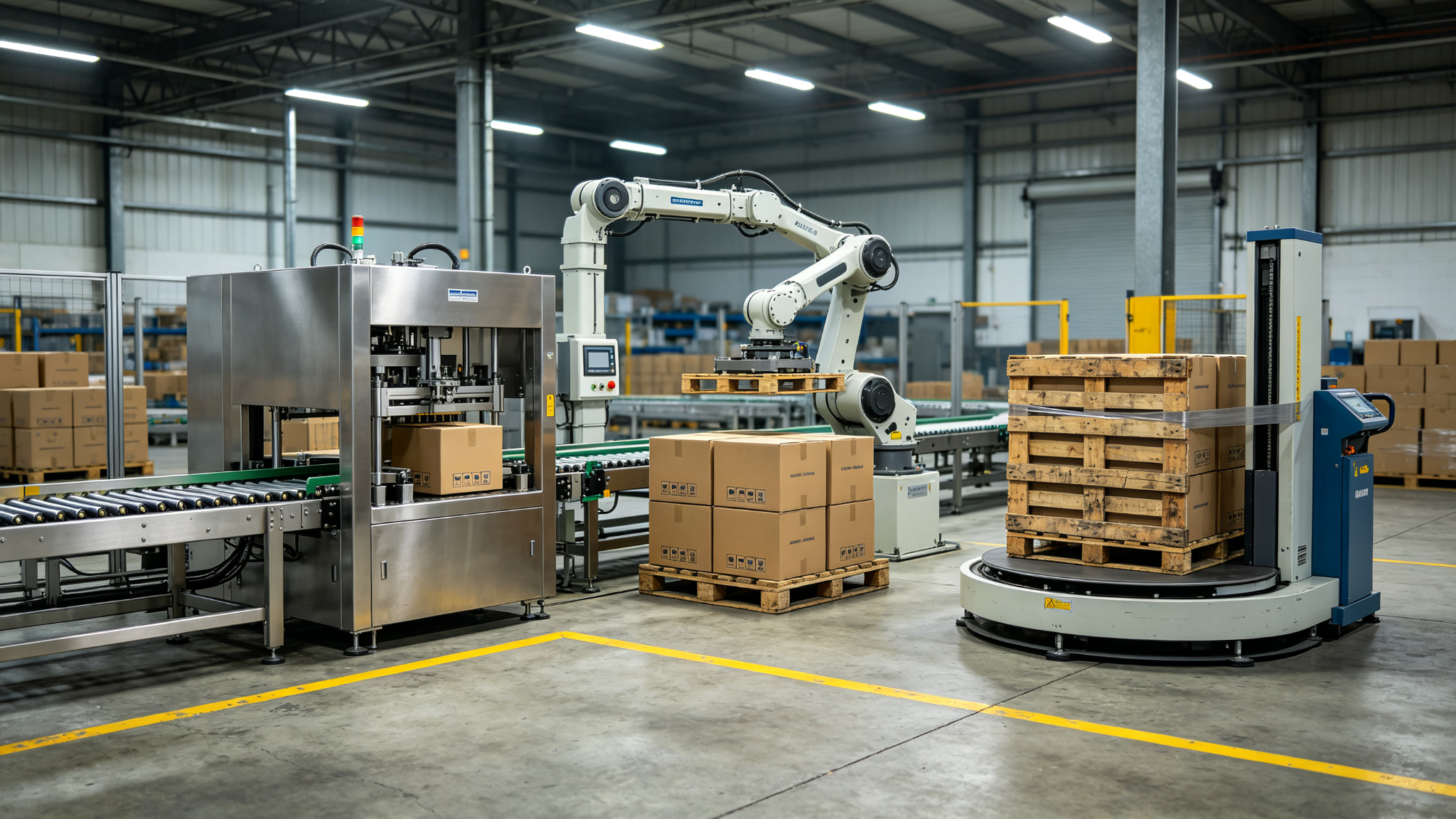
A pallet that looks perfect on the warehouse floor can still shift in a 30-day ocean container. The robotic cell can be programmed to interleave a slip sheet between layers automatically, or to place corner boards on the four vertical edges, so the load stays square when stretch wrap is applied and through transit. For export lines this is often the difference between a container that opens clean and one where the consignee finds a leaning wall of sacks. The downstream stretch wrapper then applies the correct pre-stretch and number of revolutions for the destination — a dry inland warehouse needs less containment than a container crossing the equator. Specifying the cell to handle slip sheets and corner boards as part of the recipe, rather than adding a worker to insert them by hand, keeps the load consistent and removes another manual step.
Frequently asked questions
How to palletize 25 kg bags automatically? Use a robotic arm with a dedicated sack gripper that flattens and shapes the bag as it places, fed by a centered infeed conveyor, and stack in a brick or interlocked block pattern rather than straight columns.
What bags can the robotic bag palletizer handle? 20–50 kg sewn paper sacks, poly-woven bags and flexible PE bags of flour, rice, sugar, feed, seed and fertilizer, with tool change only between gripper options for very different film types.
What is the throughput for a sack palletizing machine? Typically 6–12 bags per minute per robotic arm for 25 kg food sacks; a second arm or rotating platform raises this for high-output lines.
Does it work with existing upstream bagging? Yes — the cell interfaces to most net-weigh or multihead bagging lines via a simple infeed conveyor and sensor handshake, without rebuilding the upstream equipment.
Related reading
Summary
Bag palletizing is a shaping and pattern problem, not just a pick-and-place problem. The new SunAura heavy-duty robotic bag palletizer is built around a sack gripper that forms the bag as it places, recipe-driven interlocked stacking patterns, and a range of configurations from compact single-line cells to 180 kg heavy-duty export installations. It removes the ergonomic and quality risks of manual sack stacking while producing loads that survive container transit.
Request a sack-palletizing evaluation from SunAura Machinery: send your bag size, film type, pallet specification and target bags-per-minute, and we will specify the cell, pattern and guard package for your plant.