
Walk into almost any multi-SKU food, pharma or household-products plant at the end of the shift and you will hear the same complaint: the line spent more time changing over between runs than it spent actually producing. A 20 kg bag of nuts runs for four hours, then two hours are lost re-threading film, resetting back-seal jaws, swapping the forming shoulder, re-positioning the discharge chute, re-teaching the multihead weigher and asking the operator to “just make sure the bags look right.” Multiply that by three or four changeovers a week and a line that was sized for 60 cartons a minute is delivering 40. Most plants do not have a throughput problem. They have a changeover time problem.
This guide explains what packaging line changeover time really costs, where the wasted minutes hide, and how buyers and engineers can specify machines and cells that cut the changeover from two hours to under ten — the single-minute exchange of die (SMED) target that the best packaging lines already meet. It is written for the procurement manager comparing quotes and the equipment engineer designing the cell, not for the operator who is already expert at his own machine.
What “packaging line changeover time” actually measures
Changeover time is the elapsed time between the last good pack of run A and the first good pack of run B. Note that last-good to first-good, not button-press to button-press. It includes cleaning out the previous product, removing and fitting size parts, setting machine parameters, threading web, testing seals, adjusting the downstream case packer and palletizer, and running off the first trial packs until the quality sign-off passes. That is the number that appears on the OEE availability clock, and it is the number customers actually pay for.
A useful first exercise in any plant is to time five real changeovers and split the minutes into four buckets:
- Internal setup: work that can only happen while the line is stopped — swapping the forming tube, exchanging back-seal jaw inserts, cleaning the filler head.
- External setup: work that can be done while the line is still running the previous batch — gathering the size part kit, pre-heating the new film roll, staging labels and pallets.
- Adjustment and trial: dialing in back-seal temperature, registration, fill volume, sealing time, and running trial packs until they pass.
- Waiting: looking for tools, waiting for maintenance, waiting for the supervisor, or waiting for a spare part that was not staged.
In our experience the fourth bucket — waiting — is the single largest hidden cost, and it is almost entirely avoidable. The second bucket, external setup, is the one most often left on the table: plants treat changeover as a stopped-machine event instead of preparing everything before the line stops.
Why changeover time matters more than peak speed
Buyers obsess over the top-end rated speed on a datasheet: 80 bags a minute, 120 bottles a minute. But for a plant running 12 SKUs, the average output is set by how often the line stops and how long it takes to restart, not by the peak speed. A line that runs at 70 bags/min for four hours and loses 90 minutes per changeover produces less per shift than a line that runs at 55 bags/min but changes over in eight minutes.
The math is straightforward. On a 20-hour production day with two changeovers, cutting changeover from 120 minutes to 10 minutes frees nearly four hours of production capacity — roughly one extra 20 kg bag run per day, at almost no extra labour, film or energy. That capacity is effectively free, which is why a machine with slightly lower peak speed but genuinely fast, tool-less changeover is often the better purchase. When you compare quotes, ask vendors to commit a realistic changeover time for a specified SKU change, not a theoretical minimum.
The SMED method for packaging lines
SMED (Single-Minute Exchange of Die) was developed for metal stamping, but its two rules map directly onto packaging: convert internal work into external work, and simplify the internal work that truly must happen on the stopped machine. Applied to a pillow or flow wrapper, a multihead weigher, a piston filler and a downstream case erector, it produces concrete design decisions.
1. Stage everything while the line is still running
Before run A finishes, a technician should already have the next forming shoulder, the back-seal inserts, the correct film roll, the weigher calibration card and the case-size kit laid out on a dedicated changeover trolley. The trolley is parked beside the machine. Nothing is fetched from a tool room. This single practice removes the “waiting” bucket and typically cuts changeover by 20–30% before any mechanical change is made. On a medium-speed pillow wrapper the difference between an organised changeover trolley and a walk-to-the-warehouse changeover is usually 40 minutes.
2. Replace fasteners with levers, quick clamps and touchless change parts
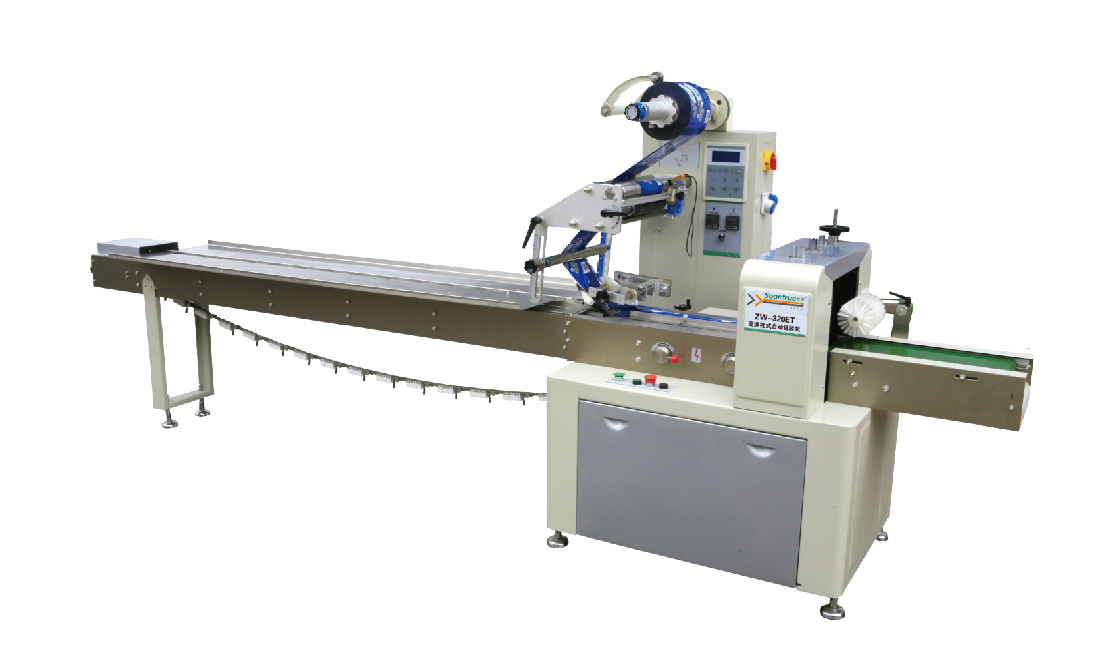
Every bolt, Allen key and screwdriver in a changeover is a minute. Modern servo-driven flow wrappers use tool-less locking: the forming shoulder slides on a central tube and locks with a lever; the film roll mounts on a quick-release air shaft; the end crimp rollers open and close from the HMI. Compare a medium-speed pillow flow wrapper where every size part is lever-locked against one where the operator still spanners the forming tube down. The labour and the risk of over-tightening (which warps the tube and ruins seal quality) both disappear.
3. Use recipe recall, not manual re-entry
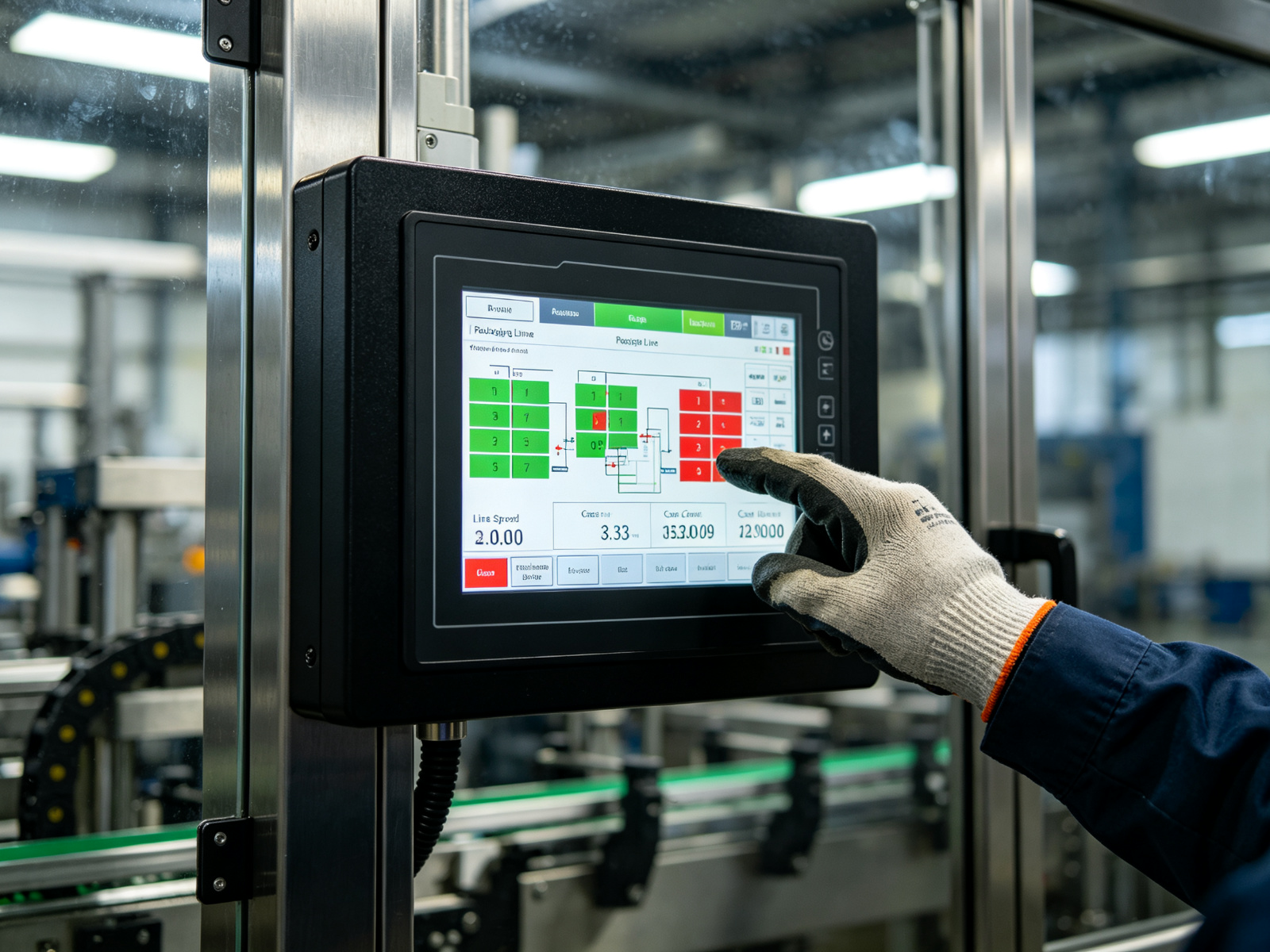
On a servo machine, the recipe — film length, jaw temperature, jaw dwell, belt speed, discharge timing, centre-guide position — should be stored per SKU and recalled from the HMI in one touch. The weigher target weights, the filler volume, the case erector blank size and the label orientation should all follow the same recipe. A line where the operator re-types eighteen parameters from memory will always drift and always needs trial packs. A line where the operator selects “SKU 42 – 250 g frozen berry pouch” and the whole cell re-positions itself is the target. This is where the HMI screen above earns its place: it is not a dashboard, it is a changeover tool.
4. Keep the multihead weigher and filler “size-flexible”
Upstream equipment drives changeover as much as the wrapper. A multihead weigher that needs its hoppers stripped and re-calibrated for every product is a bottleneck; one with product-group calibration, auto-zero and discharge timing stored in the wrapper recipe restarts in minutes. Similarly, a linear filling machine with quick-release nozzles and servo volume stored by recipe changes over faster than a mechanically-set timed filler, because the volume is a parameter, not an adjustment. When you size a line, treat the upstream equipment’s changeover as a first-class specification, not an afterthought.
5. Standardise the downstream end-of-line
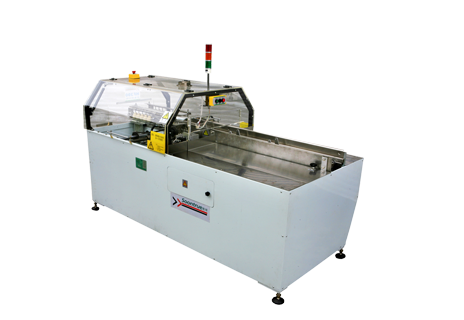
The upstream wrapper may restart in eight minutes, but the line is not “good to run” until the case erector, case packer and palletizer also know the new size. An automatic case erector that needs its magazine guides and tape head re-setting for every carton size, or a palletizer that must be re-taught a new stacking pattern by hand, quietly adds 30–40 minutes. Specify downstream machines with automatic guide rails, recipe-driven case-size change and stored pallet patterns, or the front of the line will be waiting for the back.
Quick changeover checklist: what to demand on the purchase order
| Machine area | Spec to demand | Target changeover contribution |
|---|---|---|
| Film roll / web path | Quick-release air shaft, auto-threading, tension stored by recipe | < 3 min |
| Forming shoulder / size parts | Tool-less lever locking, dedicated change trolley, colour-coded parts | < 5 min |
| Back seal / end seal jaws | Quick-swap inserts, temperature and dwell stored in recipe | < 3 min |
| Multihead weigher | Product-group calibration, target weights per recipe, auto discharge timing | < 5 min |
| Filler | Servo volume per recipe, quick-release nozzles, CIP-friendly wet-out | < 5 min |
| Case erector / packer | Automatic guides, stored case-size recipe | < 5 min |
| Palletizer | Stored stacking patterns, recipe recall, no hand re-teach | < 3 min |
Add those up and the target is a single-digit changeover for most SKU families — not the theoretical best case, but the realistic time a trained team hits on the shop floor. Get the vendor to confirm these numbers in writing, and ask for a reference video of a real changeover between two SKUs on a real customer line.
Common mistakes that sabotage fast changeover
- Buying on peak speed only. The fastest wrapper with the worst changeover wins the datasheet and loses the shift.
- No changeover trolley. When parts live in a cupboard, minutes disappear every run.
- One-off size parts that are not duplicated. If the plant runs SKUs A and B in the same shift, it needs two sets of change parts, not one shared set.
- Manual parameter re-entry. Operators forget numbers; recipes do not. If the HMI requires manual entry, it is not a recipe system.
- Ignoring the downstream. A fast front end feeding a slow case packer is a slow line.
- Unmeasured changeovers. You cannot improve what you do not time. Start logging last-good-to-first-good for every run.
Cost and ROI of a fast-changeover line
As a planning number, assume two changeovers per day, each cut from 120 minutes to 10 minutes: that is 220 minutes — about 3.7 hours — of recovered production time per day. At an average 50 packs/minute line that is roughly 11,000 extra packs per day from the same asset. Against a premium paid for servo-driven, tool-less, recipe-controlled equipment (typically a modest uplift versus a purely mechanical line), the payback on recovered capacity is usually measured in weeks, not months. Add reduced trial-pack giveaway, fewer operator errors and lower scrap on the first minutes of a run, and the case strengthens further.
This is the thinking SunAura Machinery applies when we scope a multi-SKU line: we price for changeover discipline — lever-locked parts, a single recipe across filler, weigher, wrapper and end-of-line, and a documented changeover procedure validated at FAT — because a line that restarts quickly is the line that actually makes the customer money. If you are comparing multi-SKU equipment and changeover time is not on the specification, raise it; it is the question that separates a good quote from a bad one.
Frequently asked questions
What is a good packaging line changeover time? For a well-designed servo line with tool-less parts and recipe recall, a realistic single-digit changeover (under 10 minutes) between similar SKUs is achievable. Mechanical lines without these features commonly need 60–120 minutes.
What does SMED mean for packaging machinery? Single-Minute Exchange of Die applied to packaging means converting as much work as possible to external (done while the line runs) and simplifying the internal work to levers, clamps and recipe recalls instead of tools and manual adjustment.
How do I reduce product changeover downtime on a multihead weigher? Use product-group calibration, store target weights per SKU in the recipe, keep discharge timing in sync with the wrapper, and stage all contact parts so they can be swapped and wiped without delaying restart.
Is a servo-driven machine always better for changeover? For multi-SKU plants, yes: servo axes move to stored positions and eliminate mechanical re-setting. For a plant running a single SKU at maximum speed, a simpler mechanical machine may be the better-value choice.
What is tool-less changeover? Designing size parts to lock with levers, quick clamps or pneumatic fixation, so the operator needs no spanners, Allen keys or screwdrivers during a SKU change.
Related reading
Summary
Changeover time is the hidden bottleneck on most multi-SKU packaging lines, and it is one of the cheapest problems to fix. Measure last-good to first-good, split the minutes into internal, external, adjustment and waiting, then specify tool-less parts, recipe recall across the whole cell, staged changeover trolleys and flexible upstream and downstream equipment. When a vendor quotes peak speed without quoting changeover, ask for the number that actually matters.
Talk to the SunAura Machinery team about scoping a multi-SKU line built for fast, repeatable changeover — send us your SKU matrix and expected batch sizes, and we will model the changeover time and recovered capacity for your plant.