
High-shrink PETG and OPS sleeves prefer steam; PVC and OPS work on IR; POF and PE overwrap films prefer hot air. Confirm with your film supplier and test at FAT.
How fast can a sleeve line run?
Steam tunnels commonly run beverage lines at up to roughly 50–70 ft/min. Speed is limited by the slowest zone, not the applicator; undersized tunnels cause warm packs and wrinkles.
Summary
For tapered glass and high-shrink PETG sleeves on a beverage line, steam is the tunnel that produces a wrinkle-free premium result. IR is the dry, cheaper choice for round bottles, and hot air is enough for simple bundling. Choose by your bottle shape, your film, and whether you have a steam supply. Send us your bottle drawings and film type and we will specify the tunnel that fits — or tell you if a cheaper method will do.
Sources
Technical figures referenced: PDC Corp “Steam Tunnel vs Heat Tunnel for Shrink Sleeves”; Karlville “Steam vs Hot Air vs Radiant Shrink Tunnels”; JFPolyFilm PETG steam vs hot-air comparison; Wolf Packing shrink sleeve technology overview. Temperature ranges and speeds are industry references; the Polish co-packer configuration is this project’s own.
Related reading
Not practically. The tunnel geometry, conveyor length and zone design are different. Choose the heating method up front based on your bottle shapes and film.
Which film works best with which tunnel?
High-shrink PETG and OPS sleeves prefer steam; PVC and OPS work on IR; POF and PE overwrap films prefer hot air. Confirm with your film supplier and test at FAT.
How fast can a sleeve line run?
Steam tunnels commonly run beverage lines at up to roughly 50–70 ft/min. Speed is limited by the slowest zone, not the applicator; undersized tunnels cause warm packs and wrinkles.
Summary
For tapered glass and high-shrink PETG sleeves on a beverage line, steam is the tunnel that produces a wrinkle-free premium result. IR is the dry, cheaper choice for round bottles, and hot air is enough for simple bundling. Choose by your bottle shape, your film, and whether you have a steam supply. Send us your bottle drawings and film type and we will specify the tunnel that fits — or tell you if a cheaper method will do.
Sources
Technical figures referenced: PDC Corp “Steam Tunnel vs Heat Tunnel for Shrink Sleeves”; Karlville “Steam vs Hot Air vs Radiant Shrink Tunnels”; JFPolyFilm PETG steam vs hot-air comparison; Wolf Packing shrink sleeve technology overview. Temperature ranges and speeds are industry references; the Polish co-packer configuration is this project’s own.
Related reading
Yes, or a compact electric steam generator sized to the tunnel. Budget for water treatment, a drain, and an air knife to dry bottles before case packing.
Can I convert a hot-air tunnel to steam later?
Not practically. The tunnel geometry, conveyor length and zone design are different. Choose the heating method up front based on your bottle shapes and film.
Which film works best with which tunnel?
High-shrink PETG and OPS sleeves prefer steam; PVC and OPS work on IR; POF and PE overwrap films prefer hot air. Confirm with your film supplier and test at FAT.
How fast can a sleeve line run?
Steam tunnels commonly run beverage lines at up to roughly 50–70 ft/min. Speed is limited by the slowest zone, not the applicator; undersized tunnels cause warm packs and wrinkles.
Summary
For tapered glass and high-shrink PETG sleeves on a beverage line, steam is the tunnel that produces a wrinkle-free premium result. IR is the dry, cheaper choice for round bottles, and hot air is enough for simple bundling. Choose by your bottle shape, your film, and whether you have a steam supply. Send us your bottle drawings and film type and we will specify the tunnel that fits — or tell you if a cheaper method will do.
Sources
Technical figures referenced: PDC Corp “Steam Tunnel vs Heat Tunnel for Shrink Sleeves”; Karlville “Steam vs Hot Air vs Radiant Shrink Tunnels”; JFPolyFilm PETG steam vs hot-air comparison; Wolf Packing shrink sleeve technology overview. Temperature ranges and speeds are industry references; the Polish co-packer configuration is this project’s own.
Related reading
SunAura Machinery Ships Steam Shrink Sleeve Labeling Line to Polish Beverage Co-Packer: Steam vs Infrared vs Hot-Air Tunnels Compared
A beverage co-packer outside Warsaw needed to apply full-body shrink sleeves to a run of craft cider bottles and sparkling water — tapered glass shapes, PETG film, and a tight register requirement. The question was not whether to sleeve-label, but which shrink tunnel to put after the applicator. SunAura Machinery supplied a steam shrink tunnel line, and this article lays out why steam won for this job, when infrared wins, and when a simple hot-air tunnel is enough. If you are choosing a shrink sleeve line, the tunnel choice matters more than the applicator itself.

Three ways to shrink a sleeve
A shrink sleeve is a printed PETG or OPS tube slipped over the container. The tunnel’s job is to heat the film until it shrinks tightly to the bottle shape, without burning the print, wrinkling the seam, or leaving a wet or warm pack. Three heating methods are common: steam, infrared (IR) radiant, and hot-air convection. They run at different temperatures and behave differently on complex shapes.
| Steam tunnel | Infrared (IR) tunnel | Hot-air tunnel | |
|---|---|---|---|
| Temperature range | 90–100°C (180–212°F) | 175–260°C (350–500°F) | 80–195°C (176–390°F) |
| Heat transfer | Very uniform, wet | Radiant, directional | Convection, even but slower |
| Complex/tapered shapes | Excellent | Good (line-of-sight issues) | Good with correct airflow |
| Film types | PETG, PVC, OPS, high-shrink | PVC, OPS; less forgiving on PETG | POF, PE, PVC, OPS |
| Moisture on pack | Yes (needs drying) | Dry | Dry |
| Infrastructure | Boiler/steam supply, drain | Power supply only | Power supply only |
| Best for | Contoured bottles, premium sleeves, high speed | Round bottles, simple shapes, dry product | Shrink bundles, carton overwraps, low-medium speed |
Why steam won for the Polish co-packer
The bottles were tapered glass with a shoulder contour, and the sleeve was a high-shrink PETG that needs gentle, even heat to pull tight without distorting the print. Steam transfers heat uniformly around the whole bottle because it condenses on the cool surface — the steam reaches the shoulders, the base and the recessed label panel that radiant heat cannot see well. PDC Corporation and Karlville both describe steam tunnels as the most versatile and highest-quality option for complex shapes, and industry references cite conveyor speeds up to roughly 70 ft/min with uniform shrink. The trade-off is moisture: the pack exits wet, so the line needs an air knife or drying section before the case packer. The co-packer already had compressed air and floor drain, so the moisture handling was easy.
When infrared is the better call
IR tunnels run hotter and use electric elements that radiate at the bottle. They are dry, fast to heat up, and need no boiler. But radiant heat is line-of-sight: the parts of the bottle facing the elements get hot, and the back or the recessed panels can lag. On round, straight-sided bottles with simple sleeves, that does not matter, and an IR tunnel gives a crisp shrink at lower capital. IR is also the choice when the product cannot tolerate moisture — for example, powder cans, electronics, or anything that must leave the tunnel dry and ready to case. If your bottles are round and your film is PVC or OPS, IR is usually the cheaper and simpler answer.
When a hot-air tunnel is enough
Hot-air convection tunnels are the workhorse for shrink bundling and overwrapping cartons, not for high-detail sleeve labels. They blow heated air through the tunnel at a moderate temperature, they are dry, and they are easy to maintain. They are slower to shrink a contoured sleeve and can leave wrinkles on complex shapes, but for a straight-sided jar, a rectangular carton or a multi-pack bundle, they are perfectly adequate and the lowest-cost option. If your sleeve is a simple brand band rather than a full-body contour label, a hot-air tunnel will often do the job.
What not to buy
Do not choose a steam tunnel if you have no steam supply and do not want to install a boiler, drain and water treatment — the infrastructure cost is real and ongoing. Do not choose an IR tunnel for tapered or contoured premium bottles; the back-side shrink will disappoint. Do not assume any tunnel will run every film: high-shrink PETG and OPS sleeves are happiest on steam, while POF and PE overwrap films prefer hot air. Test your actual bottle-and-film combination at FAT before committing — a tunnel that shrinks one film perfectly can wreck another. The line feeds into the rest of the end-of-line packaging equipment, and the sleeve label station sits between the filler and the capping and labeling already on site, so tunnel height and conveyor speed are matched to the existing line.
Operating cost: steam is not the expensive option people fear
Buyers often assume steam is expensive because it uses a boiler. In practice, a well-insulated steam tunnel recirculates condensate, and the marginal cost per bottle is low. IR tunnels draw large electrical currents and heat up fast but cycle heavily; hot-air tunnels use less power but run slower. The real cost driver is downtime from a bad shrink — rejected sleeves, re-work, and film waste — not the energy on the tunnel. For a high-value craft beverage, a wrinkle-free premium label is part of the product, and the steam tunnel pays back in reduced rejection.
The applicator matters as much as the tunnel
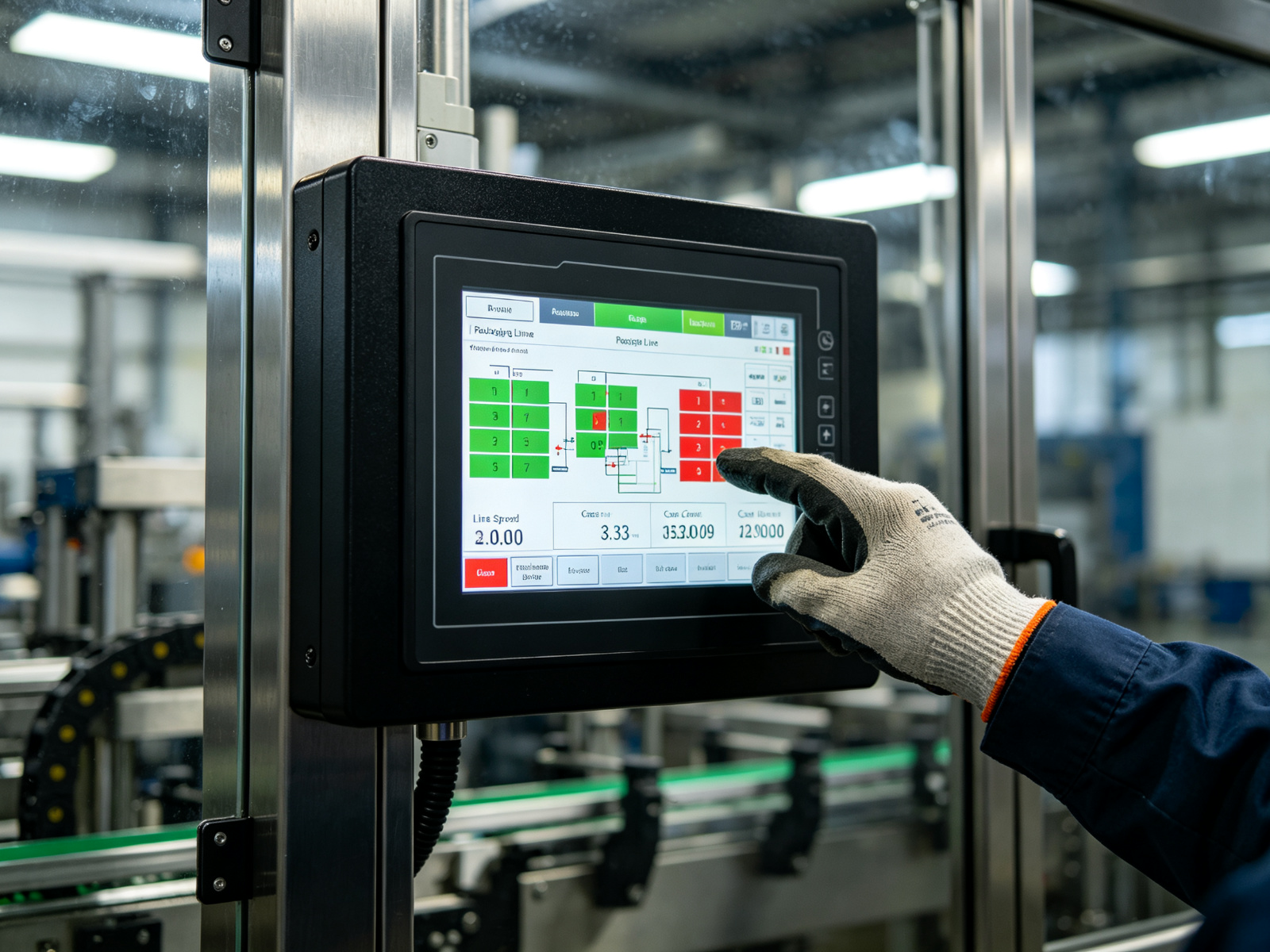
Buyers focus on the tunnel and forget the sleeve applicator upstream. A sleeve that is not cut square, not placed at the right height, or not captured around the bottle neck will wrinkle no matter what tunnel you put after it. The applicator denesters the sleeve off a mandrel, cuts it to length, and drops it over the bottle on a synchronised conveyor. For high-shrink PETG, the applicator must hold a tight tolerance on cut length — too much film and the label over-shrinks at the base; too little and the shoulder shows glass. The Polish co-packer took a mandrel-style applicator with a photoelectric eye that triggers a missing-sleeve reject, so a bottle that slips through without a label never reaches the tunnel. SunAura matches applicator mandrel, conveyor speed and tunnel zones as one recipe on the HMI; changing the bottle size is one recipe, not three separate adjustments.
Film choice drives the tunnel choice
Sleeve films are not interchangeable. PVC is cheap but shrinks at lower temperatures and is less environmentally friendly; OPS is clear and stiff but needs precise heat; PETG is the premium choice for high-shrink full-body labels and the reason most craft beverage lines moved to steam. The shrink ratio matters: a 70% shrink PETG sleeve pulls tightly into contours that a 50% sleeve cannot. If you plan to switch films later, tell us at design time — a tunnel tuned for OPS will not necessarily run PETG without re-zoning. The film supplier should give you a recommended temperature window; use that, not the tunnel’s maximum, as your starting recipe.
Steam infrastructure: plan the dry end
A steam tunnel needs three things buyers under-budget: a steam supply (boiler or compact electric generator), a floor drain and condensate return, and an air-knife drying section after the tunnel. The bottle exits the tunnel wet; if it goes into a case wet, the corrugation swells and the customer’s shelf looks damp. We size the generator to the tunnel’s steam consumption and add a water-treatment note — hard water scales the steam nozzles and that is the single most common maintenance complaint. The tunnel itself has adjustable steam zones (usually three to five), each with its own valve, so you can heat the neck, shoulder and base independently. That zoning is what produces a smooth, wrinkle-free label on a contoured bottle; a single-zone tunnel cannot do it.
When not to sleeve-label at all
Worth saying: a shrink sleeve is a premium label format. If your bottle is round, your graphics are simple, and your cost target is tight, a pressure-sensitive wrap-around or roll-fed label will be cheaper per unit and easier to run. Sleeves earn their cost when you need 360-degree graphics, tamper evidence on the neck, or a label that follows a contoured shape. For a low-margin water brand, sleeves may be the wrong investment; for a craft beverage where the label is the brand, they are the right one. We will say so on the quotation call rather than upselling a tunnel you do not need.
Rejection rate: the number buyers forget to ask
The tunnel’s job is to produce a perfect label every bottle. The buyer question that matters most after speed and temperature is rejection rate: how many bottles come out with a wrinkle, a mis-shrunk shoulder, or a wet label. A well-tuned steam tunnel on a contoured PETG bottle typically runs below half a percent rejection; a poorly zoned tunnel can run 3–5%, and on a high-value craft beverage that money walks out the door every hour. Ask the supplier for a measured rejection rate on a bottle shape similar to yours, not a theoretical number. On the Polish line we ran a two-hour trial with the customer’s own bottles and film before shipping, and the rejection rate was logged as part of the acceptance criteria — if it had not met the agreed number, the tunnel would have been re-zoned before leaving the workshop.
Line speed: do not undersize the tunnel
The most common mistake in a sleeve project is buying an applicator that runs fast and a tunnel that is too short. Heat takes time to transfer; if the conveyor speed exceeds what the tunnel can heat in one pass, the sleeve exits warm and only partially shrunk, and wrinkles appear in the carton rather than on the line. Steam tunnels need enough length — typically three to five heated zones — to heat the bottle through. When SunAura quotes a sleeve line, we size tunnel length to the applicator speed and the film’s shrink window, not to a catalog number. A tunnel that is 30 cm shorter than it should be costs more in wasted film than the extra 30 cm would have cost on the quote. Match tunnel length to your fastest planned SKU, and run slower SKUs through a longer heated zone rather than buying a tunnel that only works at one speed.
FAQ
Do I need a boiler for a steam tunnel?
Yes, or a compact electric steam generator sized to the tunnel. Budget for water treatment, a drain, and an air knife to dry bottles before case packing.
Can I convert a hot-air tunnel to steam later?
Not practically. The tunnel geometry, conveyor length and zone design are different. Choose the heating method up front based on your bottle shapes and film.
Which film works best with which tunnel?
High-shrink PETG and OPS sleeves prefer steam; PVC and OPS work on IR; POF and PE overwrap films prefer hot air. Confirm with your film supplier and test at FAT.
How fast can a sleeve line run?
Steam tunnels commonly run beverage lines at up to roughly 50–70 ft/min. Speed is limited by the slowest zone, not the applicator; undersized tunnels cause warm packs and wrinkles.
Summary
For tapered glass and high-shrink PETG sleeves on a beverage line, steam is the tunnel that produces a wrinkle-free premium result. IR is the dry, cheaper choice for round bottles, and hot air is enough for simple bundling. Choose by your bottle shape, your film, and whether you have a steam supply. Send us your bottle drawings and film type and we will specify the tunnel that fits — or tell you if a cheaper method will do.
Sources
Technical figures referenced: PDC Corp “Steam Tunnel vs Heat Tunnel for Shrink Sleeves”; Karlville “Steam vs Hot Air vs Radiant Shrink Tunnels”; JFPolyFilm PETG steam vs hot-air comparison; Wolf Packing shrink sleeve technology overview. Temperature ranges and speeds are industry references; the Polish co-packer configuration is this project’s own.