
QINGDAO, China — October 24, 2026 | by Monica, SunAura Machinery European Projects
SunAura Machinery has shipped a servo-driven thermoforming packaging line to a frozen food producer in central Poland, where it will pack pierogi, ready-meal components and frozen fish and vegetable portions in modified-atmosphere trays for retail and food-service across the EU. The order is the company’s third thermoforming line into Poland in two years, and it was specified to meet the European Machinery Regulation from day one rather than retrofitted after arrival. The customer chose roll-stock thermoforming over pre-made tray sealing after running the per-pack economics across its four highest-volume SKUs — the same decision logic set out in the thermoforming roll-stock versus pre-made tray sealing comparison — and the line reached cycle tests in Qingdao before sea freight to Gdansk.
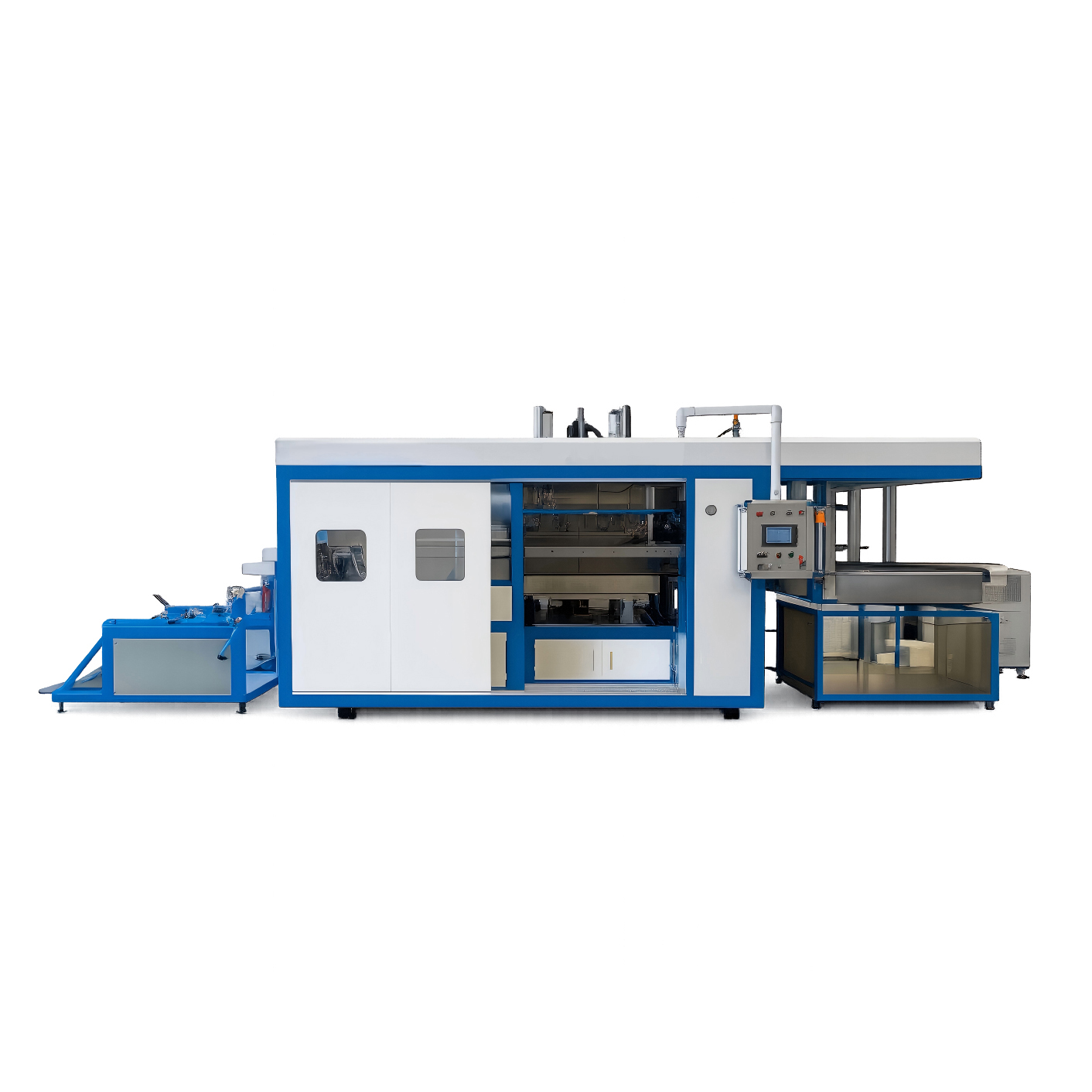
The Product and Why It Needed a Roll-Stock Line
The Polish producer runs four anchor products — frozen pierogi, dumplings and pasta parcels; vegetable mixes; fish portions; and ready-meal components — in high volumes and a limited number of tray depths. That profile is the textbook case for roll-stock: the same cavity formats run across long campaigns, the per-pack saving from film-on-roll versus converted trays is significant, and the products benefit from a consistent formed cavity and a controlled gas seal. Two products are frozen before packing and two are sealed then blast-frozen, which meant the line had to hold a seal at a flange that may be cold and damp, with frost the main enemy of a clean bond.
Line Configuration
The machine is a servo-driven thermoforming machine built around a multi-cavity forming area, with the web indexed by servos rather than a mechanical chain so the pitch and cycle time are repeatable within a fraction of a millimetre and the line can be re-sequenced for three tray formats. The stations run in order: unwind of the bottom film, a heated forming station that draws the cavities with combined vacuum and air pressure, a multi-lane filling and loading area, a gas-flush and top-film sealing station, cross and longitudinal cutting, and discharge to the customer’s metal detector and check-weigher. The chosen forming technology uses the positive and negative pressure thermoforming principle for the deeper ready-meal cavities, where vacuum alone thins the corners, and a simpler vacuum profile for the shallow pasta trays. The full family of configurations is covered in the thermoforming machines range.
| Parameter | Specification |
|---|---|
| Formats | Three tray depths, quick-change mould sets |
| Indexing | Servo-driven, repeatable pitch to under 0.5 mm |
| Forming | Positive-negative pressure for deep cavities; vacuum for shallow trays |
| Atmosphere | MAP gas flush, residual oxygen validated per product |
| Downstream | Metal detector, check-weigher, then existing freezing and case packing |
| Compliance | CE to current Machinery Regulation, food-contact materials documented |
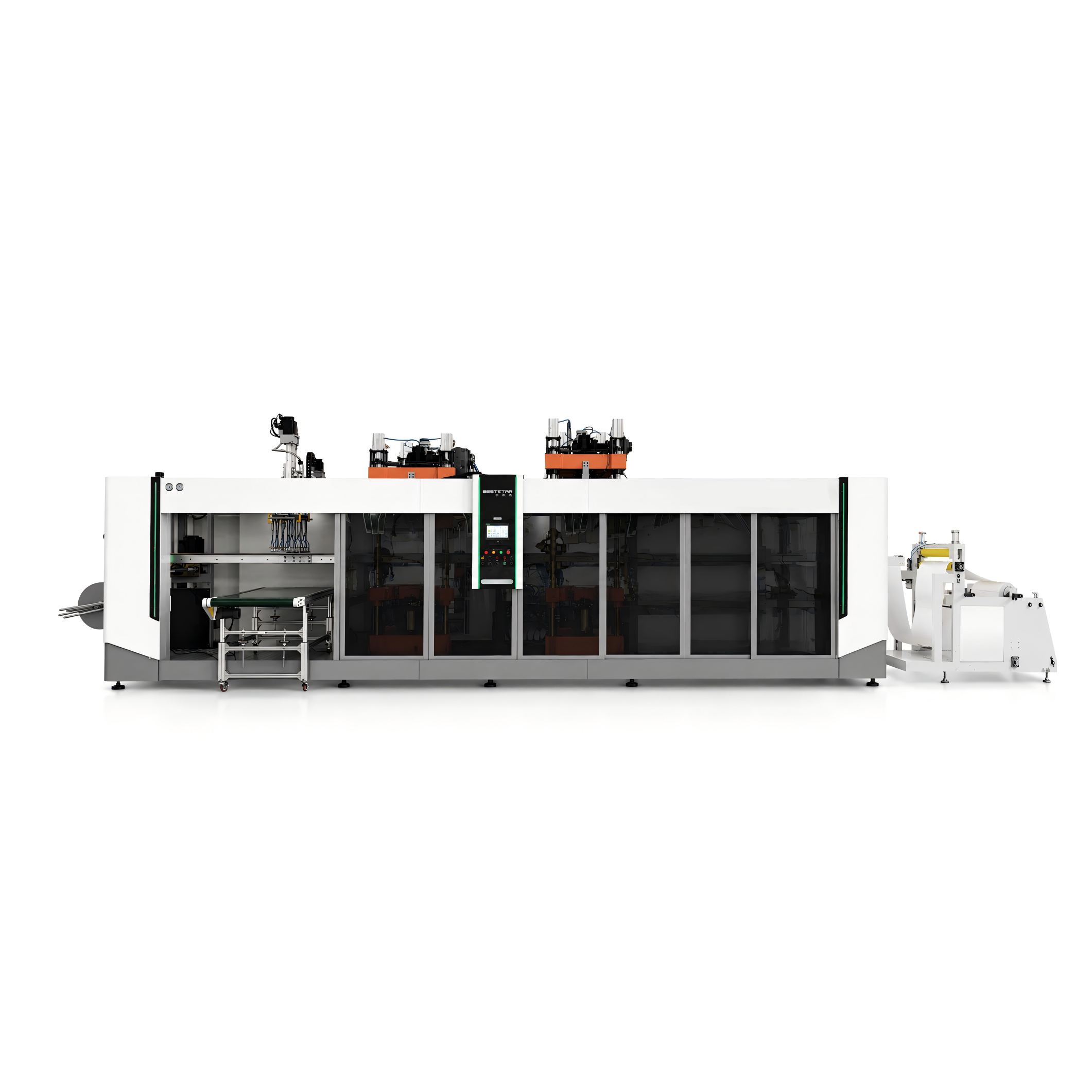
Frozen Is a Sealing Problem Before It Is a Refrigeration Problem
Customers building frozen lines often focus on the freezer and treat the packaging as routine. It is the reverse that causes the most rejected product. Product arriving at the sealer at minus temperatures carries frost and condensation, and any moisture or ice on the seal flange prevents the lidding film from bonding — a cold, damp flange is to a heat seal what product on the rim is to a tube seal. The line was therefore built with three safeguards: a controlled seal-flange design that keeps filling and frost off the sealing area, a heated sealing window that dries the flange at the moment of contact, and a gas-flush sequence that displaces the moist air inside the pack before the lid closes. The residual-oxygen and seal-strength targets were validated for each product in the factory rather than set to a single value, because fish and pasta do not carry the same moisture load into the seal.
For products sealed before blast freezing, the film structure had to survive the thermal shock of going through the freezer without shrinking or delaminating; the bottom web and the lidding film were specified as a matched pair with the barrier grade chosen for the target freezer shelf life, rather than buying the cheapest barrier film on spec. This is the same “match the film to the process” discipline applied to other sealing technologies on the floor — the South African plant installing induction foil sealing for peanut butter jars had to match foil and power to a high-temperature ambient environment instead of frost, but the principle of validating the seal against the actual operating condition is identical.
MAP, Gas Mixes and What Gets Validated
Modified atmosphere packaging for frozen food is sometimes dismissed as unnecessary because freezing already preserves the product, but that misses what the gas does in the customer’s cold chain. Retail and food-service packs repeatedly move between the freezer, the display cabinet and the customer’s shopping trip, and a barrier pack with the correct gas mix slows freezer burn, fat oxidation and the off-flavours that develop on fish even below zero. The line’s gas system was commissioned to a per-product residual-oxygen target, with the flushing time and headspace adjusted for the cavity depth and the gas verified on a sample basis after sealing. The customer’s quality team receives the gas settings and the validation records as part of the handover, so a new product can be brought online against a documented starting point rather than trial and error.
European Compliance and the Handover
The machine was ordered to the current EU Machinery Regulation and shipped with the Declaration of Conformity, the risk assessment, the electrical and guarding documentation and the food-contact material declarations, which kept the import into Poland straightforward. Commissioning was planned as a joint two-week program: mechanical install and utilities in the first week, then recipe and gas validation on the four anchor products in the second week, with each product signed off against a filled-weight, seal-strength and residual-oxygen record. A remote-support connection was retained for the first ninety days of production, and the common wear parts and sealing elements shipped with the line so the plant would not be waiting on a courier for a consumable.
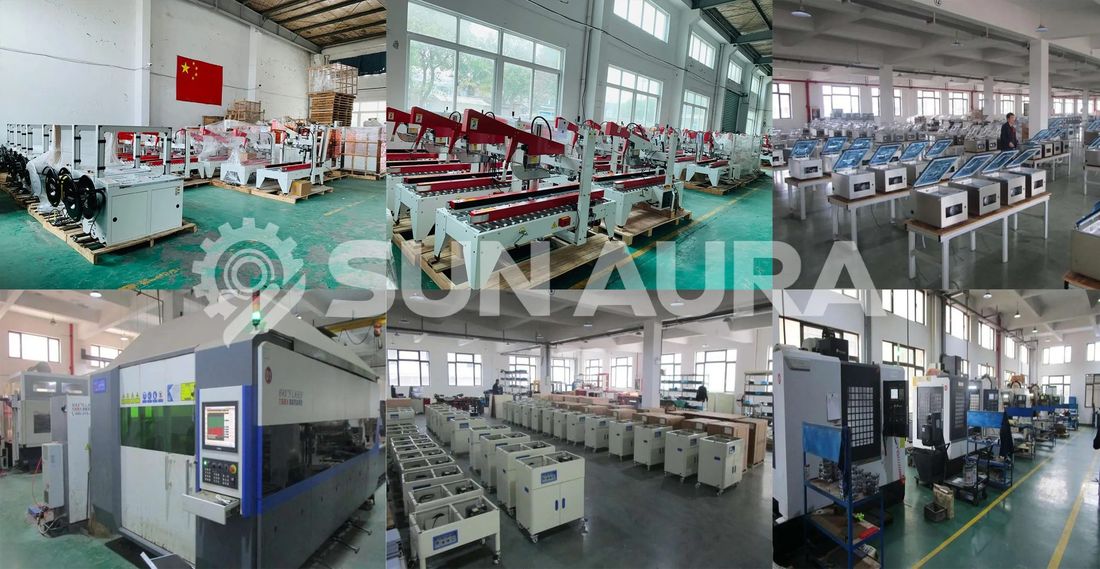
What the Customer Bought Beyond the Machine
Three parts of the package mattered as much as the hardware. First, the line was tested on the customer’s actual films and the three mould sets in Qingdao, so the seal windows were established on the real materials before the machine was crated; a line that is first tested on arrival at minus ten degrees in a Polish factory is a much harder problem to solve. Second, the servo settings, gas parameters and film draw for each of the three formats were stored as recipes, restoring a validated state at the start of each campaign. Third, the capacity was deliberately specified against the two seasonal peaks rather than the average month, because dumpling and ready-meal demand spikes in the winter holiday season and a line sized to the average would have been a bottleneck in November. A complete description of the engineering team and the export process is available on the about SunAura Machinery page, and the documentation register can be reviewed under certifications and patents.
The Economics That Won the Order
The customer’s purchasing team ran the comparison before the engineering team did, which is usually how these projects are decided. The four anchor products together account for the majority of the plant’s output and share three tray depths, so the number of mould sets was small and the monthly volume was high — the exact conditions under which the film-on-roll saving compounds. Their calculation combined three line items: the per-pack delta between barrier film webs and converted pre-made trays, the inbound freight and warehouse space freed up by carrying rolls instead of thousands of nested empty trays, and the labour saved by having the tray formed, filled and sealed in one continuous cycle instead of denested from a stack. The break-even on the additional capital over a tray sealer came out well inside the machine’s payback horizon even before counting the tighter residual-oxygen performance, which supports the longer freezer shelf life the retailer had begun asking for. The seasonal peak was deliberately excluded from the headline saving and treated as a separate risk: a line sized only to the average month would have been running at capacity in November and December, so the indexing speed and the cavity count were chosen for the peak rather than the mean.
Training, Recipes and the First Campaign
One of the less visible risks in a roll-stock installation is operator confidence. A web of barrier film, a heated forming station and a gas-flush sequence are more to understand than a tray denester, and a nervous operator will run slow or, worse, keep changing settings during a campaign. The handover therefore included a documented recipe per format — the forming temperature, web index, fill volume, gas-flush time, sealing temperature and die-cut position stored on the HMI — and the customer’s operators ran the first two campaigns side by side with the commissioning engineer, changing moulds themselves at least once before the handover was signed. The quality team was given a simple start-of-run checklist: verify the film is the correct structure, confirm the flange is clean and dry, run the first index and inspect the cavity, seal a short lead and measure the seal and the residual oxygen, and only then release the run. The plant’s most common first-week correction was a damp flange on the line that packs already-frozen product; the heated sealing window resolved it, and the fix is now in the checklist rather than in an engineer’s head.
Frequently Asked Questions
Can a thermoforming line seal product that is already frozen?
Yes, but frost and condensation on the seal flange must be controlled. The line uses a protected flange design, a heated sealing window and a gas-flush sequence to dry the flange at the moment of sealing, and the seal window is validated per product on the real film. Frozen and blast-frozen-after-sealing products need different settings.
Why choose roll-stock over pre-made trays for frozen food?
High-volume frozen lines with few tray formats earn the per-pack saving from film on rolls quickly, and forming the cavity in-line gives a controlled gas seal. The crossover depends on the SKU count and monthly volume; for the Polish plant’s four anchor SKUs across long campaigns, roll-stock was clearly the lower total cost.
What gas mix is used for frozen pierogi and fish?
The mix is product-specific. High-fat fish and ready-meal components need a higher-carbon-dioxide mix to slow oxidation, while pasta and vegetable packs use their own balance. The line was commissioned to a residual-oxygen target per product rather than a single blanket setting, and the records are handed to the customer.
How long does installation and validation take?
The mechanical install and utilities take about a week, followed by roughly a week of recipe and gas validation on the anchor products, with each product signed off against fill weight, seal strength and residual oxygen. Testing on the customer’s own film in Qingdao reduces the on-site commissioning risk considerably.
Does the line meet the new European Machinery Regulation?
Yes. It was specified to the current regulation from the order and shipped with the Declaration of Conformity, risk assessment, electrical and guarding documentation and food-contact material declarations, supported by a remote-service connection for the first ninety days.
What happens to the existing pre-made trays and tray sealer?
The customer keeps its tray sealer for limited-edition formats, seasonal shapes and the shorter premium SKUs that do not justify a mould set, so the two machines now split the catalogue by volume and format rather than one replacing the other. The remaining stock of pre-made trays was planned into the first months of the schedule so nothing was written off. This hybrid split is a common and sensible outcome: roll-stock handles the high-volume anchors, and the tray sealer keeps its value on the long tail of the range.
Planning a frozen-food MAP or thermoforming line? Send SunAura Machinery your products, tray formats, whether you freeze before or after sealing, the target shelf life and your monthly volumes, and the engineering team will specify the forming technology, gas system and downstream stations with the per-pack economics. Request a line layout and quotation, browse the thermoforming machines range, or review the negative-pressure vacuum forming option for standard trays. Test runs on your own film can be arranged at the Qingdao workshop before shipment.