

After 15 years in the packaging machinery industry, I have helped over 500 companies select pallet wrapping machines. The most common mistake I see? Buying based on price alone, then dealing with downtime, film waste, and load damage for years. This guide walks you through the exact decision framework we use with our clients — so you get the right machine the first time.
Start With Your Load, Not the Machine
Most people start by browsing machine catalogs. That is backwards. The machine exists to wrap your specific load, so we begin by understanding exactly what you are wrapping.
Grab a tape measure and a scale, and answer these four questions:
- Pallet footprint: Standard 1200×1000mm (EUR) or 1219×1016mm (US)? Or do you use custom sizes?
- Maximum load height: Measure your tallest pallet including the product. Most machines handle up to 2000mm, but tall loads need special consideration.
- Load weight: Under 500kg? 500-1500kg? Over 2000kg? This determines whether you need a reinforced turntable or a stationary-pallet design.
- Load stability: Is your load rock-solid, or does it shift when you nudge it? Lightweight boxes, bags, and irregular shapes need a top press pallet wrapper to hold the load steady during wrapping.
Pro Tip: If your load center of gravity is above 1200mm or the load weighs under 300kg, a standard turntable machine may cause the load to shift or tip. Consider a rotary arm pallet wrapper instead — the pallet stays completely still.
Calculate Your Real Volume (Not the Wishful Number)
I cannot tell you how many times a client says “we do about 50 pallets a day” when the real number is 120. Be honest with yourself — under-sizing is the #1 reason companies outgrow their wrapper within 18 months.
Count your pallets for one full week, including peak days. Then add 30% for growth. That is the number you should spec for.
| Daily Volume | Recommended Machine Type | Typical ROI |
|---|---|---|
| Under 20 pallets/day | Manual wrapping or entry-level semi-auto | 12-18 months |
| 20-50 pallets/day | Semi-automatic turntable wrapper | 8-12 months |
| 50-100 pallets/day | Online automatic wrapper with conveyor | 5-8 months |
| 100+ pallets/day | Rotary arm or gantry high-speed wrapper | 3-5 months |
Choose Your Wrapping Technology
There are five main wrapping technologies, and each exists for a reason. Picking the right one is about matching the technology to your load type and volume.
1. Turntable Wrappers (Most Common)
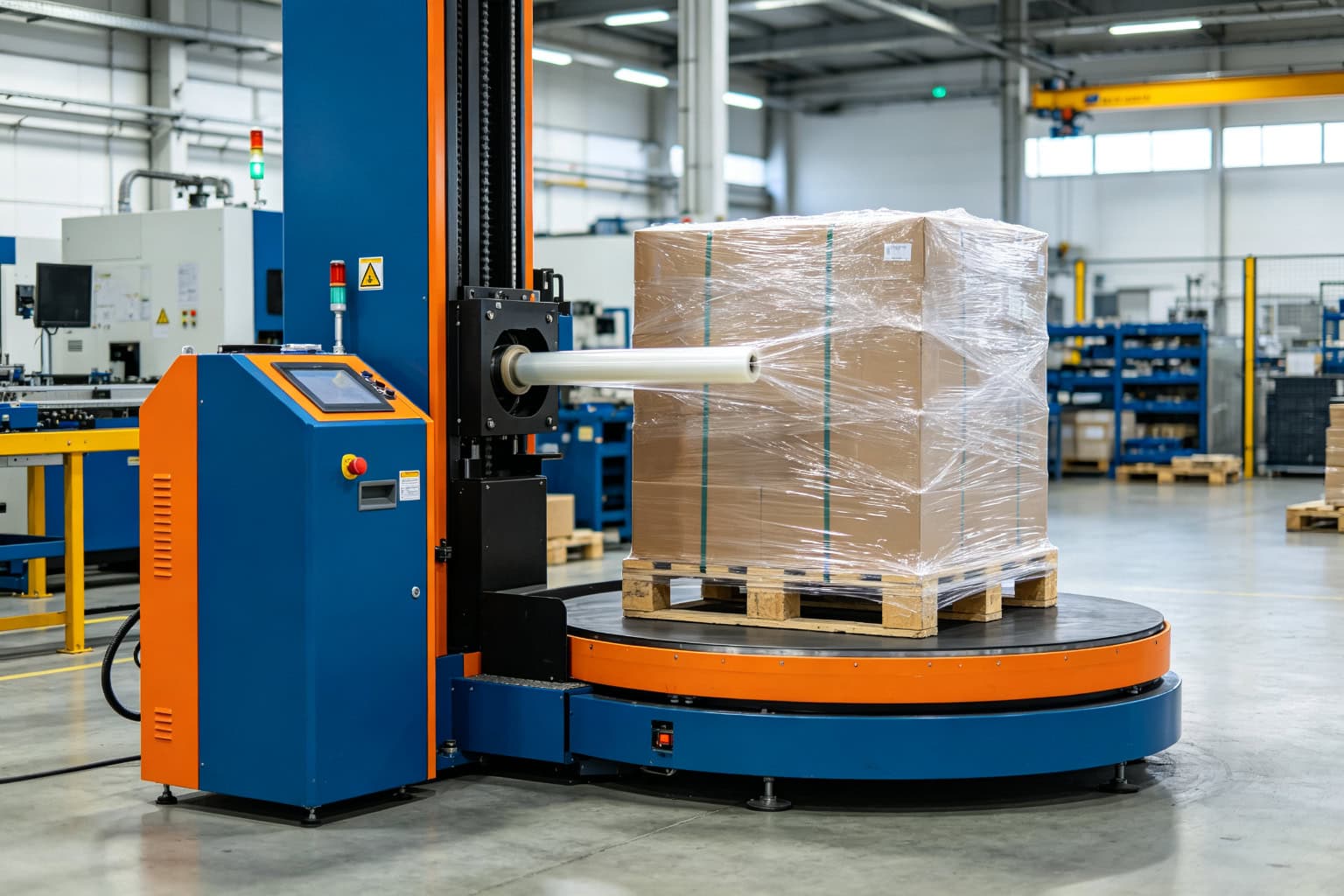
The pallet sits on a rotating platform while a film carriage moves up and down. This is the workhorse of the industry — simple, reliable, and cost-effective for stable loads under 2000kg.
Best for: Standard pallets, stable loads, low-to-medium volume
Watch out for: Unstable or lightweight loads can shift on the turntable
2. Rotary Arm Wrappers
The pallet stays completely still while a rotating arm swings film around it. This eliminates any risk of load tipping, making it ideal for heavy, tall, or unstable loads.
Best for: Heavy loads (2000kg+), tall loads, unstable products, high-volume distribution centers
Watch out for: Larger footprint than turntable machines
3. Gantry Wrappers
A film ring moves up and down on a gantry frame around a stationary pallet. This is the highest-throughput option, capable of 120+ pallets per hour.
Best for: Ultra-high volume, very heavy loads (3000kg+), integration with automated palletizing systems
4. Horizontal Wrappers
For products longer than a standard pallet — timber, steel bars, pipes, aluminum profiles — the product moves horizontally through a wrapping ring.
Best for: Long products that cannot be wrapped on a turntable
5. Radial / Ring Coil Wrappers
Specialized machines for cylindrical products — drums, barrels, cable reels, wire coils, tires. The wrapping ring rotates around the product axis.
Best for: Round or coil-shaped products
Decide on Automation Level
Semi-Automatic: The Sweet Spot for Most Companies
An operator places the pallet, attaches the film tail manually, presses start, and cuts the film when done. The machine handles the rotation and film carriage automatically.
One operator can typically run 2-3 semi-automatic machines simultaneously, loading and unloading while the machines wrap. This is why the ROI is so compelling — you are not replacing one operator with one machine; you are multiplying each operator’s output.
Fully Automatic: For High-Volume Lines
Conveyor-fed machines handle the entire process automatically — film attach, wrap, cut, and discharge. No operator intervention needed per pallet. These integrate directly with your conveyor system or palletizer.
Common Mistake: Buying a fully automatic machine when your volume does not justify it. The conveyor, controls, and automation add significant cost. If you are under 80 pallets/day, a semi-automatic machine with a good operator is usually more cost-effective.
The Specs That Actually Matter
Every manufacturer lists dozens of specifications. Most are marketing fluff. Here are the five that determine real-world performance:
- Pre-stretch ratio: This is where your film savings come from. Look for 250% pre-stretch — it means 1 meter of film becomes 3.5 meters before wrapping. Machines with only 150% pre-stretch will cost you thousands extra per year in film.
- Film carriage quality: The carriage is the heart of the machine. Check for sealed bearings, adjustable tension, and a reliable film break detection system. Cheap carriages cause film breaks and inconsistent wrapping.
- Turntable drive: Chain drive is more durable than belt drive for heavy loads. Variable speed control lets you adjust rotation speed for different load types.
- Control system: A PLC with multiple wrap recipes lets you store different settings for different products. Look for at least 10 recipe memory, and ideally Ethernet/IP or Modbus for future integration.
- Electrical component brands: Ask specifically for the brands of PLC, inverter, and sensors. Reputable machines use Siemens, Schneider, or Omron. Generic Chinese components mean downtime and spare parts headaches.
Total Cost of Ownership, Not Purchase Price
The cheapest machine is rarely the cheapest to own. Over a 10-year lifespan, film consumption, maintenance, and downtime far exceed the initial purchase price.
When comparing quotes, calculate the 5-year total cost:
- Purchase price + installation
- Annual film cost (ask for a film consumption test with your actual film)
- Annual maintenance and spare parts
- Estimated downtime cost (how much does a stopped wrapping line cost you per hour?)
- Labor cost difference
A machine that costs $3,000 more upfront but saves $2,000/year in film and has 50% less downtime pays for itself quickly.
Before You Buy: Demand a Factory Test
Any reputable manufacturer will offer a factory acceptance test (FAT) before shipment. This is non-negotiable.
Send them your actual pallets and your actual film. Have them run the machine for at least 2 hours continuously. Ask for:
- Actual cycle time per pallet
- Actual film consumption per pallet (weigh the film before and after)
- Wrap force measurement (they should have a force gauge)
- Noise level at operator position
- Any film breaks or issues during the test
If a manufacturer refuses a factory test, that is a red flag. Walk away.
Insider Secret: Visit the factory if you can. See the machines being built, talk to the technicians, and check the spare parts inventory. A 2-day factory visit can save you years of headaches.
Final Recommendation Framework
After working through all the above, here is how most decisions land:
| Your Situation | Our Recommendation |
|---|---|
| 20-50 pallets/day, stable loads, standard sizes | Semi-automatic turntable wrapper |
| Unstable or lightweight loads, any volume | Top press turntable wrapper |
| 50-100 pallets/day, conveyor integration needed | Online automatic wrapper |
| Heavy loads (2000kg+), high volume | Rotary arm wrapper |
| 100+ pallets/day, automated line | Gantry high-speed wrapper |
| Long products (timber, steel, pipes) | Horizontal wrapping machine |
| Coils, drums, cable reels | Ring coil wrapper |
Still Not Sure Which Machine Is Right for You?
Send us your pallet dimensions, weight, daily volume, and a photo of your load. Our engineers will recommend the exact machine for your application — with no obligation. We have helped 500+ companies get this right, and we can help you too.
Get Free Machine RecommendationExplore our full range of pallet wrapping machines to see all 13 models and find the perfect fit for your operation.
《“How to Choose the Right Pallet Wrapping Machine: A Complete Guide”》 有 1 条评论
[…] sure which is right for you? Read our complete pallet wrapping machine buyer’s guide for a step-by-step decision […]