

I have walked through hundreds of warehouses where workers manually wrap pallets — and I have seen the same story everywhere. Back injuries. Inconsistent wrapping. Film waste. Pallets arriving damaged. The question is never “should we automate?” — it is “when will the cost of not automating become too high to ignore?” Let us break down the real numbers.
The Hidden Cost of Manual Wrapping
When companies calculate the cost of manual wrapping, they usually only count the worker’s wage. That is the tip of the iceberg. The real cost is buried in five places most managers never look.
1. Labor: The Obvious Cost
A skilled worker can manually wrap about 15-20 pallets per hour. But that is the raw wrapping time — it does not include walking to get film, climbing on and off pallets, adjusting the wrap, and taking breaks. Real-world throughput is closer to 10-12 pallets per hour.
At 50 pallets per day, that is 4-5 hours of pure wrapping work. At $18/hour fully loaded, that is $72-90 per day, or $18,700-23,400 per year. And that is just one worker.
The Injury Factor: Manual wrapping is one of the most injury-prone tasks in a warehouse. The twisting, bending, and pulling causes chronic back problems. The average workers’ comp claim for a back injury is $40,000-80,000 — and that does not include the cost of training a replacement or the morale hit when a valued worker gets hurt.
2. Film Waste: The Silent Budget Killer
This is where manual wrapping gets really expensive. When a worker wraps by hand, they cannot consistently apply the right tension. Most wrap too loose in some areas and too tight in others. To compensate, they add extra layers — usually 50-100% more film than actually needed.
A machine with 250% pre-stretch uses about 30-60 grams of film per standard pallet. Manual wrapping typically uses 80-120 grams. That is 2-3x more film.
At 50 pallets/day and $2.50/kg for machine film:
Annual Film Cost Comparison (50 pallets/day)
And that is at 50 pallets/day. At 100 pallets/day, the film savings alone are $5,000+ per year.
3. Load Damage: The Cost You Only See When It Is Too Late
This is the hardest cost to quantify, but it is often the largest. Inconsistent manual wrapping means pallets arrive at your customer with shifted loads, crushed boxes, or product damage.
Industry data shows that properly machine-wrapped pallets have 50-80% fewer transit damage claims than manually wrapped pallets. If you currently spend $5,000-10,000 per year on damage claims and returns, a machine could cut that to $1,000-2,000.
Real Client Example: A beverage distributor we worked with was spending $18,000/year on damaged product claims. After installing an online automatic pallet wrapper, their damage claims dropped to $1,200/year. That is $16,800 in annual savings from damage reduction alone.
4. Throughput Bottleneck: The Cost of Waiting
Manual wrapping is slow. When your shipping area backs up because pallets are waiting to be wrapped, trucks sit idle, overtime increases, and orders ship late.
A semi-automatic turntable wrapper handles 20-30 pallets per hour — 2-3x faster than manual. One operator can load and unload while the machine wraps, effectively tripling their productivity.
For companies shipping 100+ pallets/day, the throughput gain alone often justifies the machine. No more overtime for wrapping. No more late shipments. No more bottleneck at the dock.
5. Quality and Brand: The Cost You Cannot Afford
Your pallet is the last thing your customer sees before they open your product. A sloppily wrapped pallet with loose film, uneven layers, and exposed corners says something about your company — and it is not good.
A machine-wrapped pallet is consistent, professional, and secure. It says “we care about quality” before the customer even opens the box. In competitive markets, that brand perception matters.
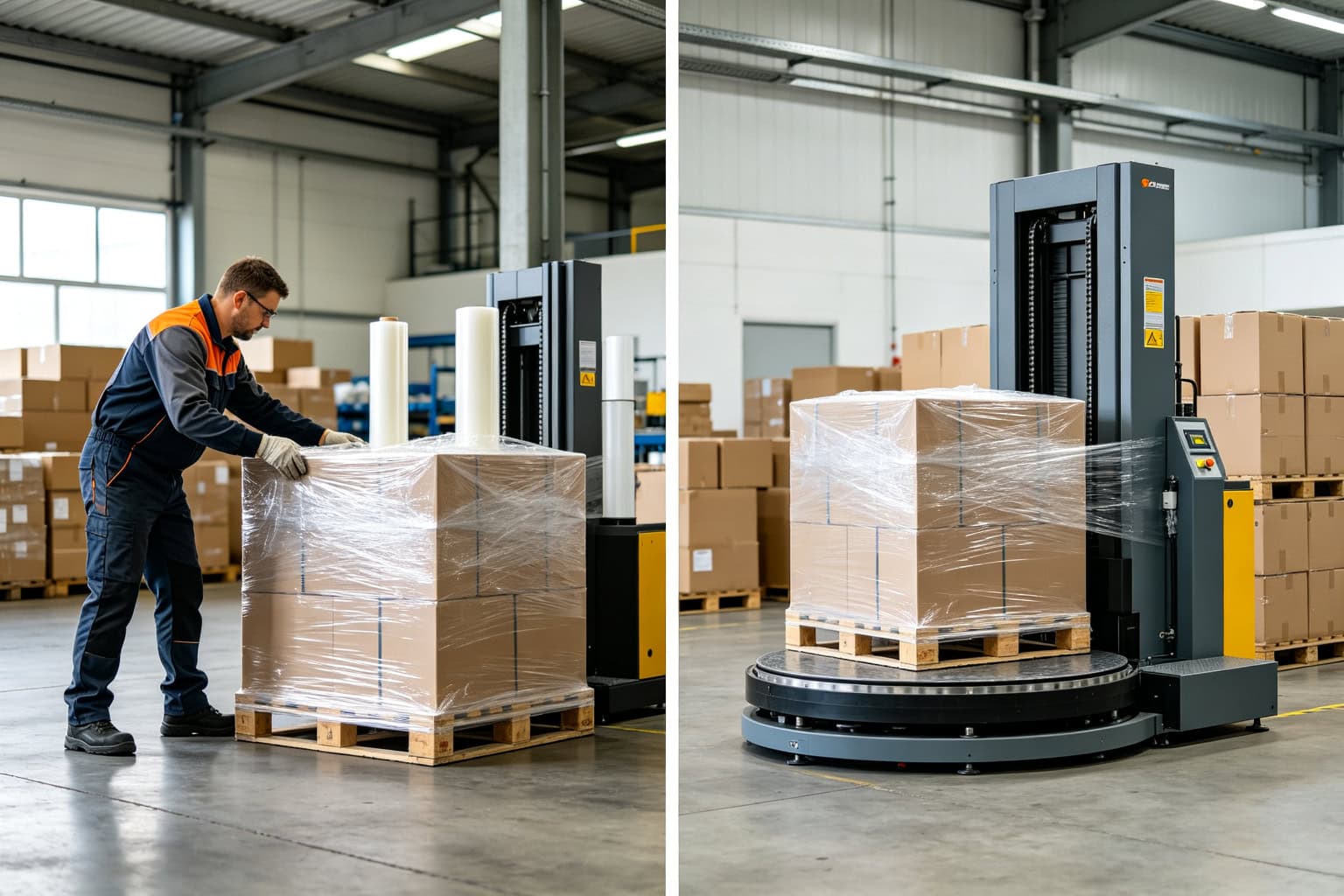
The Real ROI: A 50-Pallet/Day Example
Let us put this all together with a realistic example. A mid-sized manufacturing company ships 50 pallets per day, 250 days per year. They currently use two workers who split wrapping duties along with other warehouse tasks.
| Cost Category | Manual Wrapping | Machine Wrapping | Annual Savings |
|---|---|---|---|
| Labor (wrapping time only) | $18,700 | $6,200 | $12,500 |
| Film consumption | $4,563 | $2,053 | $2,510 |
| Damage claims | $8,000 | $1,600 | $6,400 |
| Overtime (peak periods) | $3,500 | $500 | $3,000 |
| Total annual cost | $34,763 | $10,353 | $24,410 |
A quality semi-automatic machine costs $8,000-12,000 installed. At $24,410 in annual savings, the payback period is 4-6 months. After that, the machine puts $24,000+ per year back into your pocket.
Even at 20 pallets/day: The math still works. Annual savings of $8,000-10,000 on a $6,000-8,000 machine means payback in 8-12 months. Below 15 pallets/day, the ROI starts to stretch beyond 18 months, and manual wrapping may still make sense — for now.
What Manual Wrapping Does to Your Workers
Beyond the numbers, there is a human cost. Manual pallet wrapping is recognized by OSHA as a high-risk task for musculoskeletal injuries. The repetitive twisting, bending, and pulling causes:
- Chronic lower back pain (reported by 60% of workers who wrap manually)
- Shoulder and rotator cuff injuries
- Wrist strain and carpal tunnel syndrome
- Slip and fall risks when climbing on pallets
When you automate wrapping, you are not just saving money — you are protecting your people. And in a tight labor market, providing a safer, less physically demanding workplace makes it easier to hire and retain good workers.
The Transition: What to Expect
Companies that switch from manual to machine wrapping typically go through three phases:
Week 1: Learning Curve
Your operators learn to load pallets, attach film, and use the controls. Productivity may dip slightly as everyone gets used to the new process. This is normal and temporary.
Weeks 2-4: Productivity Gain
Once operators are comfortable, throughput increases dramatically. Most companies see a 2-3x increase in wrapping output within the first month. Film consumption drops immediately as the consistent pre-stretch takes over.
Months 2-6: Full ROI Realization
By month two, the labor savings are obvious. By month three, damage claims start dropping as customers receive consistently wrapped pallets. By month six, most companies have fully recovered their investment and are counting the savings.
Choosing Your First Machine
If you are currently wrapping manually and ready to automate, here is how to choose your first machine:
- Under 50 pallets/day, stable loads: Start with a semi-automatic turntable wrapper. It is the most cost-effective entry point and handles 80% of applications.
- Unstable or lightweight loads: Choose a top press model to hold the load steady during wrapping.
- 50-100 pallets/day, growing fast: Consider an online automatic wrapper with conveyor to eliminate the loading/unloading bottleneck.
- Heavy loads (2000kg+) or high volume: A rotary arm wrapper keeps the pallet stationary and handles higher throughput.
Not sure which is right for you? Read our complete pallet wrapping machine buyer’s guide for a step-by-step decision framework.
Calculate Your Exact ROI
Every operation is different. Send us your daily pallet count, current film usage, and damage claim history. We will build a custom ROI analysis for your specific situation — with real numbers, not estimates. There is no obligation, and you might be surprised at how fast the machine pays for itself.
Get Your Custom ROI AnalysisExplore our full range of pallet wrapping machines to find the right solution for your operation.