

Vacuum packing is one of the oldest and most reliable methods for extending product shelf life — yet choosing the right vacuum packing machine is more complex than most procurement teams expect. The market ranges from small tabletop chamber sealers for laboratory samples to large double-chamber machines running continuous food production lines. Buy the wrong size, and you either underutilize a $20,000 machine or bottleneck your entire packaging operation. Buy the wrong type, and you struggle to seal your specific product shape or material.
At SunAura Machinery, we manufacture vacuum packing machines for food, pharmaceutical, electronics, and industrial parts factories. This guide walks you through every major type of vacuum sealer, explains how to match machine capacity to your production volume, and gives you a practical decision framework — so you can buy the right vacuum packing system the first time, not after three return shipments.
How Vacuum Packing Works: The Basics
Vacuum packing removes air from the packaging bag before heat-sealing it. Removing oxygen slows aerobic bacteria growth, reduces oxidation, and protects products from moisture and dust. The process has three stages:
- Evacuation: the bag is placed in a vacuum chamber; the pump removes air until the chamber reaches the target vacuum level (typically -0.08 to -0.1 MPa).
- Sealing: while the chamber is under vacuum, a heat bar seals the bag opening — creating an airtight package.
- Equalization: air re-enters the chamber, and the sealed package is removed.
The quality of the vacuum seal depends on pump speed, chamber size, seal bar length, and bag material. A slow pump or undersized chamber extends cycle time. A weak heat bar produces unreliable seals. These are the specifications that matter when comparing vacuum packing machines.
Types of Vacuum Packing Machines
1. Single-Chamber Vacuum Sealers
The most common configuration. The operator places products in bags, puts them in the chamber, closes the lid, and the machine automatically evacuates and seals. Cycle time is 20–40 seconds per batch. Best for:
- Small to medium food production (50–500 bags per hour)
- Laboratories and quality control departments
- Start-up food businesses and butcher shops
- Single-shift operations with moderate volume
Single-chamber machines come in tabletop models (chamber 300–400mm wide) and floor-standing models (chamber 500–600mm wide). Our DZ series single-chamber sealers cover the full range, from the compact DZ400 tabletop unit to the heavy-duty DZ600 floor model.
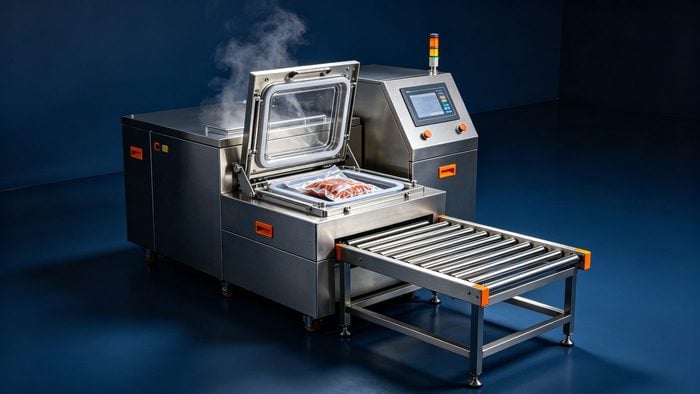
2. Double-Chamber Vacuum Sealers
Two chambers on a rotating platform. While one chamber is evacuating and sealing, the operator unloads and reloads the other. This doubles throughput with the same pump and seal bar. Cycle time remains 20–40 seconds, but output doubles because loading and unloading happen in parallel.
Best for:
- Medium to high volume food production (300–1,200 bags per hour)
- Meat processing, seafood, and cheese packaging
- Operations where labor efficiency matters
- Single-shift or two-shift production
Double-chamber machines typically have two seal bars (one per chamber). The investment premium over a single chamber is roughly 40–60%, but the throughput advantage justifies it for any operation running more than 300 bags per hour. Our DZP series double-chamber sealers are designed for continuous production use.
3. Continuous / Belt-Type Vacuum Sealers
Also known as continuous vacuum packaging machines or rolling vacuum sealers. Bags move along a conveyor belt through a series of stations: pre-vacuum, vacuum, sealing, and cooling. No chamber — the bag stays on the belt the entire time.
Best for:
- High-volume production (1,000–3,000 bags per hour)
- Products in flat pouches that lie flat on a conveyor
- Integration with upstream filling or weighing equipment
- Food processing plants with continuous production lines
Continuous vacuum sealers are faster than chamber machines but less flexible for irregularly shaped products. They are the standard choice for snack foods, dried fruit, and pharmaceuticals in flat pouches.
4. External Vacuum Sealers (Nozzle Type)
The nozzle is inserted into the bag opening, air is sucked out through the nozzle, and then the bag is heat-sealed. No chamber required. Best for large bags or bulky products that do not fit inside a chamber.
Best for:
- Large bags (20kg+ rice bags, grain sacks)
- Bulky industrial parts that do not fit in a chamber
- Products where chamber size would be cost-prohibitive
External sealers are less vacuum-tight than chamber machines — there is always some air leakage around the nozzle. They are suitable for products where vacuum level is not critical (industrial parts, hardware, textiles) but not for foods requiring long shelf life.

Key Specifications to Evaluate
Pump Size and Vacuum Level
The vacuum pump is the heart of the machine. Pump displacement (liters per minute) determines how fast the chamber reaches target vacuum. Small pumps (20 m³/h) take 30 seconds to evacuate; large pumps (63–100 m³/h) do it in 10–15 seconds. For food applications, a pump that can reach -0.1 MPa (full vacuum) within 20 seconds is the minimum.
Oil-sealed rotary vane pumps are standard. They provide deep vacuum (0.1 mbar) but require periodic oil changes (every 2,000 hours). Oil-free pumps are available for cleanroom or pharmaceutical applications but cost 2–3 times more and reach only moderate vacuum levels.
Chamber Dimensions
The chamber must accommodate your largest product with clearance for the bag to lie flat. Measure your longest and tallest product before specifying chamber size. A chamber that is too small forces you to fold bags, causing poor seals and vacuum leakage. Chamber height matters for products that stand upright (bottles, jars).
Seal Bar Length and Width
The seal bar must span the full width of your largest bag. Seal width is typically 8–10mm for food packaging. Wider seals (12mm+) are available for heavy-duty or boiling-bag applications. Confirm that the machine’s seal bar length exceeds your maximum bag width by at least 20mm.
Gas Flush Option (MAP)
Modified Atmosphere Packaging (MAP) replaces the air in the bag with a protective gas mixture (usually nitrogen, CO₂, or a blend). Gas flush extends shelf life for fresh products like meat, cheese, and baked goods. If you need MAP, specify a machine with a gas flush port and gas flow control — not all vacuum sealers support this.

Single vs. Double Chamber: The Cost-Benefit Calculation
| Factor | Single Chamber | Double Chamber |
|---|---|---|
| Typical price | $2,500–$6,000 | $5,000–$12,000 |
| Bags per hour (avg) | 100–200 | 250–500 |
| Operator required | 1 (loading + unloading same chamber) | 1 (loading one chamber while other runs) |
| Best volume range | 50–300 bags/hr | 300–800 bags/hr |
| Footprint | Small (1.0 × 0.8m) | Medium (1.5 × 1.0m) |
| Flexibility for varied products | High | Medium |
The break-even calculation is straightforward: if you currently pack 400 bags per hour manually or with a single chamber and want to double output, the double chamber’s $2,500–$6,000 premium pays for itself within 6–12 months through increased output and labor efficiency. For operations below 200 bags per hour, the single chamber remains the rational investment.
Vacuum Bag Materials: Match the Film to the Product
The bag material determines the vacuum seal quality and shelf life. Three common materials:
- PA/PE (Nylon/Polyethylene): the standard food-grade vacuum bag. Good oxygen barrier (50–100 cc/m²/day), puncture-resistant, heat-sealable. Suitable for most meats, cheeses, and prepared foods.
- PA/PP (Nylon/Polypropylene): higher heat resistance, suitable for boiling or retort applications. More expensive than PA/PE.
- EVOH barrier bags: premium oxygen barrier (1–5 cc/m²/day) for long shelf-life products. Used for cured meats, coffee, and pharmaceutical products. Significantly more expensive.
Always specify the bag material and thickness when ordering a vacuum sealer. Seal bar temperature settings differ for 70-micron PE bags versus 150-micron EVOH bags. A machine tuned for thin bags will burn thicker films; one tuned for thick bags will not seal thin films properly.
Common Buying Mistakes
Mistake 1: Under-sizing the Vacuum Pump
A machine with a small pump takes 45 seconds per cycle instead of 20. Over an 8-hour shift, that is the difference between 640 bags and 1,440 bags. When comparing quotes, ask for the actual evacuation time for your chamber size at full load — not the brochure vacuum level.
Mistake 2: Buying a Chamber Too Small
It is tempting to buy the smallest chamber that fits your current product. But if you add a taller product line next quarter, the machine cannot accommodate it. Buy a chamber with at least 50mm of headroom above your tallest product.
Mistake 3: Ignoring Pump Maintenance
Vacuum pump oil must be changed every 2,000 operating hours. Dirty oil reduces pump performance and shortens pump life. Ask the supplier: what oil grade is recommended, how accessible is the oil drain plug, and do they stock replacement pumps? A pump that takes 2 hours to replace costs you dearly in downtime.
Mistake 4: Not Testing With Your Actual Bags
Bag material, thickness, and bag size all affect seal quality. Send your actual bag samples to the supplier before purchase and ask them to run a test cycle. Watch the seal: is it continuous? Does the vacuum hold after sealing? A 30-minute sample run prevents weeks of post-delivery troubleshooting.
FAQ: Vacuum Packing Machine Questions
How long does a vacuum packed product stay fresh?
It depends on the product and bag material. With standard PA/PE bags: cooked meats 30–90 days, hard cheeses 6 months, dry goods 12+ months. With EVOH barrier bags and MAP gas flush: fresh meat extends to 21–30 days, bakery products 7–14 days. Always test shelf life under your specific storage conditions.
Can a vacuum packing machine handle liquids?
Chamber vacuum sealers can handle small amounts of liquid (marinade, brine, sauce) but not free-flowing liquids — the liquid will boil under vacuum and spill. For liquid products, use a nozzle-type sealer with liquid trap, or specify a chamber machine with anti-boil feature that pauses evacuation when liquid reaches the seal bar.
What maintenance does a vacuum sealer require?
Daily: clean chamber and seal bars. Weekly: check seal bar Teflon fabric, inspect pump oil level. Monthly: change pump oil (every 2,000 hours), check vacuum level with a gauge. The seal bar Teflon fabric lasts 3–6 months — keep a spare. At SunAura vacuum packing machines, every unit ships with a maintenance kit and spare Teflon fabric.
How noisy is a vacuum packing machine?
Oil-sealed rotary vane pumps produce 65–75 dB — about the same as a vacuum cleaner. In an open production area, this is acceptable. For office or lab environments, specify a sound-dampened enclosure or a smaller pump.
Can I use my existing vacuum bags with a new machine?
If your bags are standard PA/PE in 70–100 micron thickness, they will work with most chamber sealers. If you use specialized materials (EVOH, retort bags, textured embossed bags), confirm compatibility with the supplier before ordering. Seal bar temperature and dwell time must be matched to your bag material.
What is the typical price range for a vacuum packing machine?
Tabletop single-chamber sealers start at $1,500–$3,000. Floor-standing double-chamber machines run $5,000–$12,000. Continuous belt-type vacuum sealers range from $15,000 to $40,000 depending on speed and automation. Contact our SunAura sales team for a quote based on your product and volume.
Conclusion: Match the Machine to Your Product and Volume
Vacuum packing is not a one-machine-fits-all process. The right system depends on your product type, bag material, daily volume, and whether you need MAP gas flush. Start with your actual production rate and product dimensions, then compare chamber size, pump capacity, and seal bar length. Request sample runs with your real bags, and calculate the total cost including pump maintenance and consumables.
Vacuum packing rarely works in isolation. Sealed products typically move to a case erector and carton sealer before palletizing. For upstream liquid products, see our liquid filling machine guide.
Ready to find the right vacuum packing machine? Send us your product type, bag dimensions, and hourly output, and our engineers at SunAura Machinery will recommend the optimal configuration — single chamber, double chamber, or continuous belt — with a transparent quote and delivery timeline. For complete packaging line integration, see our turnkey packaging system solutions. We also offer carton sealer selection guidance for downstream case sealing needs.
《“Vacuum Packing Machine Buying Guide: Chamber, Double Chamber, and Continuous Selection”》 有 1 条评论
[…] trays pair with downstream equipment — vacuum packing machines for MAP applications and induction sealers for bottle lines. For heavy loads, see our new ring coil […]