

Choosing the right liquid filling machine is one of the most consequential procurement decisions in a beverage, food, cosmetics, or chemical packaging operation. A filler that handles water perfectly will stall on honey. A gravity filler calibrated for thin sauces will overfill viscous products. And a piston filler designed for 500ml bottles will struggle when you add a 5-liter container to the product line. Yet in our conversations with factory managers, filling machine selection often comes down to price comparison rather than a systematic match between fluid properties and filler technology.
At SunAura Machinery, we design and manufacture liquid filling machines for food, beverage, cosmetic, and chemical products. This guide explains the four main filling technologies — gravity, piston, overflow, and flow meter — and how to match each to your product viscosity, container type, and production volume. By the end, you will know exactly which filler type your operation needs, what specifications to compare, and what pitfalls to avoid.
Why Filling Machine Type Matters
The filling machine determines three critical outcomes:
- Fill accuracy: how close each container is to the target fill volume. Overfilling means wasted product; underfilling means customer complaints and regulatory issues.
- Speed: containers per minute, which directly determines your production output.
- Product compatibility: whether the filler handles your specific fluid viscosity, temperature, and chemical properties.
Get any of these wrong, and you either waste product, miss production targets, or contaminate the line. The filler is not a commodity purchase — it is a precision system that must be matched to your product.
Four Main Filling Technologies
1. Gravity Fillers
The simplest and most affordable filling technology. Product flows from a tank through a valve into the container, driven entirely by gravity. Fill volume is controlled by opening the valve for a set time or by a level sensor.
Best for:
- Thin, free-flowing liquids (water, juice, oil, vinegar)
- Products with low viscosity (under 100 cP)
- Clear liquids where fill level matters more than exact volume
- Low to medium speed production (30–120 bottles/minute)
Gravity fillers are inexpensive, easy to clean, and accurate to ±0.5% for thin liquids. They cannot handle viscous products — honey, syrup, lotion — because gravity alone does not push thick fluids through the nozzle fast enough.
2. Piston Fillers
A precision cylinder and piston draws a fixed volume of product from the supply tank and pushes it into the container. The piston stroke determines the fill volume — highly repeatable and adjustable.
Best for:
- Viscous products (sauce, honey, cream, lotion, paste)
- Products with particulates (salsa with chunks, jam with fruit pieces)
- High-accuracy requirements (±0.2% or better)
- Medium speed production (20–80 containers/minute per head)
Piston fillers are the workhorse of the food and cosmetic industry. They handle everything from free-flowing liquids to heavy creams, and the fill volume is set precisely by adjusting the piston stroke. Our single-head servo piston filler uses a servo motor to drive the piston, enabling recipe-driven fill volume changes without manual adjustment.
3. Overflow Fillers
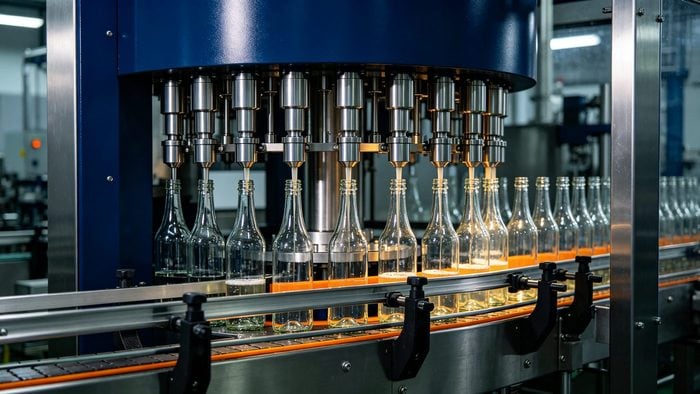
Designed for clear liquids in transparent containers. The nozzle inserts into the bottle and fills until the liquid reaches a predetermined level; excess liquid overflows back to the tank. This ensures every bottle has the same visual fill level, regardless of bottle volume variation.
Best for:
- Clear beverages (water, juice, wine, spirits)
- Transparent containers where fill level must look consistent
- Products with low to medium viscosity
- High-speed production (60–200 bottles/minute)
Overflow fillers are not volume fillers — they are level fillers. They work well when customers judge product quantity by eye-level in a clear bottle, but they are not suitable for opaque containers or products where exact volume is required.
4. Flow Meter Fillers
The most advanced technology. A Coriolis or turbine flow meter measures the exact volume of product dispensed, and the valve closes automatically when the target volume is reached. No piston, no timing — direct volume measurement.
Best for:
- High-accuracy applications (±0.1% or better)
- Products with variable viscosity (temperature changes change fluid behavior)
- High-speed production lines (100–300 containers/minute)
- Operations where product changeover is frequent
Flow meter fillers are the most expensive but offer the highest accuracy and fastest changeover. They are standard in pharmaceutical and premium beverage applications where fill accuracy is non-negotiable.
Choosing by Viscosity: The Quick Guide
| Product Type | Typical Viscosity | Recommended Filler |
|---|---|---|
| Water, juice, vinegar | 1–10 cP | Gravity or overflow |
| Cooking oil, shampoo | 50–500 cP | Overflow or piston |
| Ketchup, sauce, lotion | 1,000–10,000 cP | Piston |
| Honey, paste, butter | 10,000–100,000 cP | Piston (heated hopper) |
| Chemicals, solvents | Variable | Flow meter (corrosive-resistant) |
Key Specifications to Compare
Number of Filling Heads
Throughput scales with the number of heads. A 6-head piston filler at 30 cycles per minute produces 180 containers per minute. A 12-head version at the same cycle speed produces 360. But adding heads costs money — each head adds a pump, valve, and nozzle assembly. Match the head count to your target output and leave 20% headroom for future speed increases.
Material of Construction
Food and pharmaceutical fillers use 304 or 316 stainless steel for all product contact surfaces. Chemical fillers may require specialty alloys or PTFE seals. For hot-fill products (jams, sauces at 80–90°C), specify a heated hopper and heat-resistant seals. Always confirm that wetted parts meet your product’s compatibility requirements.
Fill Volume Range
A piston filler has a minimum and maximum stroke length that defines its fill volume range. A 100ml cylinder cannot fill 500ml containers. A 1-liter cylinder will not accurately fill 10ml vials. Choose a cylinder size that covers your current and foreseeable product volumes, with at least 20% margin on both ends.
Clean-in-Place (CIP) Capability
For multi-product lines, CIP capability eliminates manual disassembly between product changes. The filler automatically flushes with cleaning solution, rinses with water, and dries — all without operator intervention. CIP adds $5,000–$15,000 to the machine cost but is essential for food and pharmaceutical operations that run multiple products on the same line.

Semi-Automatic vs. Fully Automatic
Semi-Automatic Fillers
The operator places the container under the nozzle and triggers the fill (foot pedal or button). The filler dispenses the set volume; the operator removes the container. One operator typically runs 20–40 containers per minute.
Best for: small batches, product development, low-volume production. Price range: $2,000–$8,000 for single-head piston fillers.
Semi-automatic fillers are also the right choice for operations that run frequent product changes — cosmetics laboratories, contract packaging shops, and craft food producers. The operator can switch between containers and products without reconfiguring automatic tooling, making the semi-automatic format the most flexible option for low-volume, high-mix work.
Fully Automatic Fillers
Containers are fed on a conveyor, nozzles auto-position above each container, and the filling sequence runs automatically. No operator touches individual containers. Typical speed: 60–200 containers per minute depending on head count and fill volume.
Best for: high-volume production lines, integration with capping, labeling, and packaging. Price range: $20,000–$80,000+ for multi-head automatic systems.
Fully automatic fillers are almost always part of an integrated line. They connect to upstream unscramblers or turntables and downstream cappers, labelers, and case packers. The line’s overall speed is limited by the slowest machine — so the filler must be specified with enough headroom to handle the full line speed.
The decision comes down to your containers-per-minute target and labor cost. If you fill fewer than 1,000 containers per day, semi-automatic is the rational choice. If you fill 10,000+ containers per day, the automatic version pays back through labor savings within 12–18 months.
Common Buying Mistakes
Mistake 1: Buying a Filler for Today’s Product Only
You currently fill 500ml juice bottles. Next year you plan to add 250ml and 1L sizes. A filler with a narrow cylinder range cannot handle both. Buy a cylinder that covers your projected product sizes for the next 3 years.
Mistake 2: Ignoring Foam and Splashing
Certain products (soap, beer, carbonated drinks) foam during filling. A standard nozzle splashes product and creates foam overflow. For foamy products, specify an anti-foam nozzle that fills from the bottom up, or a gravity filler with slow-flow startup.
Mistake 3: Underestimating CIP Requirements
If you run multiple products on the same line, manual cleaning between changes takes 1–2 hours. CIP reduces this to 15–20 minutes. Over a year, the labor saving justifies the CIP investment for any multi-product operation.
Mistake 4: Not Requesting a Sample Fill Test
Every product behaves differently under filling. Send 5–10 liters of your actual product to the supplier and ask them to run a test fill. Measure fill accuracy, check for dripping or foaming, and confirm the fill speed matches your target. This 30-minute test prevents months of post-delivery adjustments.
FAQ: Liquid Filling Machine Questions
How accurate is a piston filler?
A well-maintained piston filler achieves ±0.2% to ±0.5% fill accuracy. This means a 500ml fill varies by ±1–2.5ml between containers. Servo-driven piston fillers improve this to ±0.1%. Gravity fillers are less accurate at ±0.5–1%. Flow meter fillers are the most accurate at ±0.1% or better.
Can one filler handle both thin and thick liquids?
Piston fillers handle a wide viscosity range (1 cP to 100,000 cP) by adjusting fill speed. Slow the piston for thick products; speed it up for thin ones. Gravity fillers cannot handle viscous products. Flow meter fillers handle all viscosities but are more expensive. A piston filler is the most versatile single-machine choice for multi-product lines.
What is the difference between hot fill and cold fill?
Hot fill (80–90°C) is used for jams, sauces, and juices that require heat pasteurization during filling. It requires a heated hopper, heat-resistant seals, and bottles designed for thermal shock. Cold fill is room-temperature filling for beverages, cosmetics, and chemicals. Hot fill equipment costs 20–30% more but eliminates a separate pasteurization step.
How often should I calibrate the filler?
For food and pharmaceutical operations, calibrate weekly with a graduated cylinder. Run 10 fills, weigh them, and adjust the piston stroke or fill time to match target. For cosmetic and chemical operations, calibrate monthly. Keep calibration records — audits require them.
Can I fill carbonated drinks with a piston filler?
Not directly. Carbonated drinks release CO₂ under agitation, which causes foaming and inconsistent fill. Use an overflow filler with a de-pressurizing nozzle, or a counter-pressure filler designed specifically for carbonated beverages. Piston fillers work for still products only.
How much does a liquid filling machine cost?
Semi-automatic single-head piston fillers start at $2,000–$5,000. Multi-head automatic piston fillers range from $20,000 to $60,000. High-speed flow meter fillers for beverage lines start at $80,000+. Contact our SunAura Machinery sales team for a quote based on your product, container, and speed requirements.
Conclusion: Match the Filler to Your Fluid
The right filling machine is not the cheapest quote — it is the one that matches your product viscosity, container size, and production speed. Start with your product’s viscosity range, your target containers per minute, and your container types. Then select the filler technology (gravity, piston, overflow, or flow meter) that fits. Compare head count, material compatibility, and CIP capability. And always request a sample fill test before purchase.
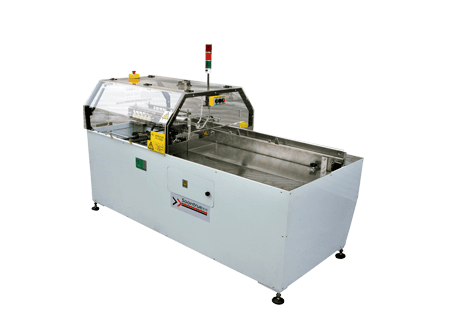
After filling and capping, products often move to secondary packaging — vacuum packing for preservation, carton sealing for shipping, and pallet wrapping for unitization. See our vacuum packing machine guide and case erector selection guide.
Ready to spec your liquid filling system? Send us your product type, viscosity, container size, and target output, and our applications engineers at SunAura Machinery will recommend the optimal filler configuration with a transparent quote and lead time. For downstream packaging integration, also see our guides on carton sealer selection and pallet wrapping machine selection.