
October 22, 2026 | by Monica, SunAura Machinery Applications Engineering
If you are specifying a pillow packaging machine — also called a flow wrapper or horizontal form-fill-seal machine — one of the most consequential decisions you will make is whether to buy a mechanical cam-driven wrapper or a full-servo model. The price gap between the two can be 30–60%, and the wrong choice either locks you into recurring maintenance and changeover costs or overspends on capability you will never use. This guide compares the two architectures across speed, changeover, film handling, maintenance, integration and total cost of ownership, and it ends with the decision rules buyers use to match the machine to the actual production reality rather than to the brochure.
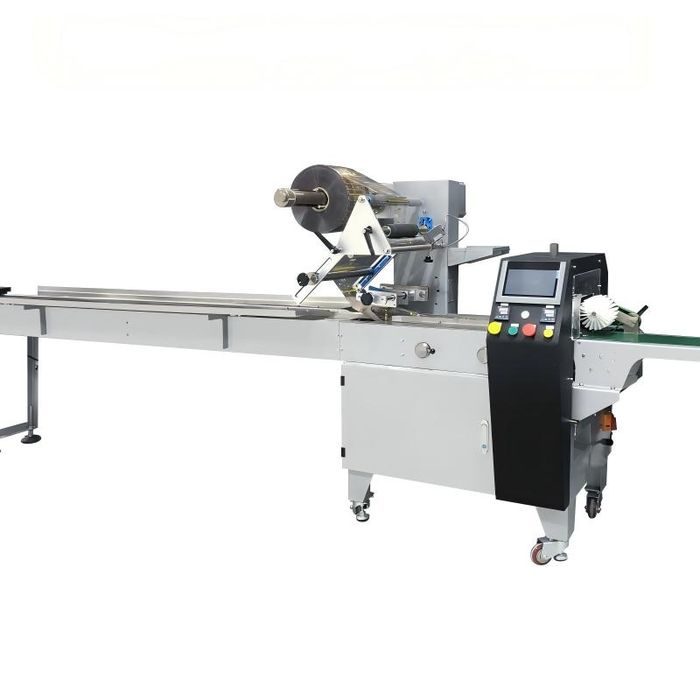
How Each Architecture Works
Mechanical (Cam-Driven) Flow Wrapper
A mechanical wrapper uses a single main motor, typically 2.2–4 kW, connected through timing belts and gearboxes to a long camshaft that runs the length of the machine. Precision-machined steel cams drive the sealing jaw motion, film pull rolls and end-seal operations in a fixed mechanical relationship. To change speed or product length, an operator changes gear sprockets, adjusts cam positions and re-times the sealing jaw by hand. Mechanical wrappers have been the industry standard for fifty years and they remain simple, robust and familiar to maintenance teams in most food plants. The tradeoff is that every motion is locked to every other motion by the cam geometry: you cannot independently adjust jaw dwell, film feed speed or discharge speed without changing mechanical parts.
Full-Servo Flow Wrapper
A servo wrapper replaces the camshaft with three or more independent servo motors, typically 400 W to 1.5 kW each: one for film pull, one for the end-seal jaw and one for the discharge conveyor. A motion controller coordinates the servos electronically, so the timing relationship between film feed, jaw sealing and discharge is set in software rather than machined into cams. Recipe changes are made through the HMI: enter pack length, jaw temperature and dwell time, and the controller recalculates every motion profile. There are no gears to change, no cams to re-time and no belts to tension daily. The high-speed servo pillow packaging machine is the direct expression of this design.
Speed and Throughput
Both architectures can reach similar peak speeds — most makers quote 150–250 bags per minute on single rectangular products. The difference is sustained speed and flexibility, not the headline number.
| Metric | Mechanical wrapper | Servo wrapper |
|---|---|---|
| Peak speed (rectangular product) | 150–200 bpm | 180–250 bpm |
| Sustained 8-hour speed | 80–90% of peak | 90–95% of peak |
| Speed range on one machine | Fixed ratio, gear change | 10–100% variable |
| Acceleration and deceleration | Limited by cam profile | Programmable, fast ramp |
| Speed change between SKUs | 15–30 min (gear swap) | Under 1 min (recipe) |
If you run one product at a constant speed around the clock, the mechanical wrapper’s modest peak-speed disadvantage is irrelevant because you will never push either machine to its limit. If you run many SKUs at different speeds, or ramp up and down to match upstream equipment, the servo machine’s flexibility has real value. The noodle producer in the servo pillow line shipped to an Indonesian instant noodle plant chose servo specifically because it had to pace the wrapper to block formers that did not run flat out for the whole shift.
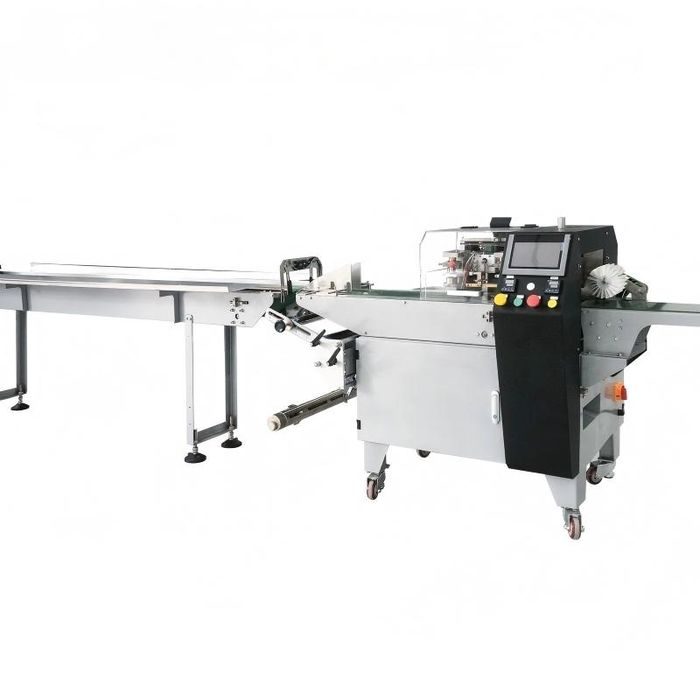
Changeover and Recipe Flexibility
This is where the two architectures diverge most dramatically. A mechanical changeover normally involves changing the forming shoulder to match the new product width (10–20 min), swapping gear sprockets for the new pack length (10–15 min), adjusting the end-seal jaw by hand (5–10 min) and setting temperatures while jogging to check registration (10–15 min): 35–60 minutes in total, and it needs a trained mechanic. If you change over four times a shift, that is two to four hours of lost production every day. A servo changeover keeps the same forming-shoulder swap, but the rest is a ten-second recipe recall and minor temperature tweaks, for 15–25 minutes total, and an operator can do it without a mechanic. For plants running five or more SKUs per day, the recovered production time alone often justifies the servo premium within 12–18 months.
Film Handling and Print Registration
For producers using printed film — which is most branded food and consumer goods — registration accuracy directly drives film waste, because every millimetre of misregistration is off-cut that becomes scrap. Mechanical wrappers pull film through fixed gearing: the registration sensor reads the print mark and the machine corrects the pull-roll speed slightly, but because the pull roll is mechanically linked to the sealing jaw, the correction range is limited to roughly ±3–5 mm and drift accumulates when the film stretches or the roll is off-center. Servo wrappers decouple film pull from jaw motion, so the registration controller can make corrections of ±10–15 mm without disturbing seal timing. In customer trials, servo wrappers typically cut printed-film waste by 2–4% versus mechanical equivalents, which is significant when printed laminate costs $3–5 per kilogram.
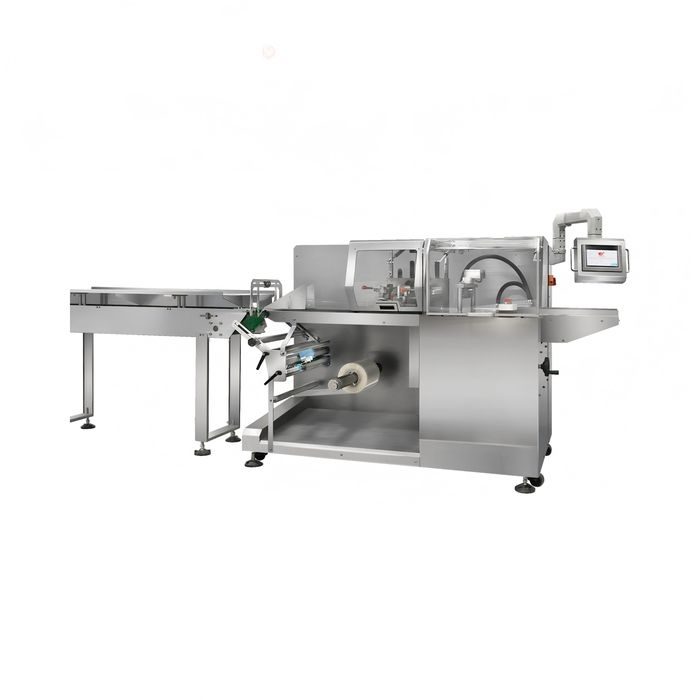
Maintenance and Wear Parts
| Maintenance item | Mechanical wrapper | Servo wrapper |
|---|---|---|
| Daily lubrication points | 8–12 grease fittings | 2–3 (seal jaw bearings) |
| Quarterly cam or belt inspection | Required | Not applicable |
| Annual wear-parts budget | $1,500–3,000 | $500–1,000 |
| Skill required | Mechanical fitter, 2+ years | Controls tech for faults |
| Mean time between failures | ~2,000 hours | ~5,000 hours |
The mechanical wrapper’s wear pattern is predictable and well understood, and any plant mechanic can fix it. The servo wrapper’s failure modes are more electronic — servo drive faults, encoder errors, HMI failures — and may need a controls technician or OEM support. For a plant without an in-house controls team, this support dependency has to be factored into the decision, and the spares package should include the controller and sensor items that the maintenance team cannot fabricate on site.
Integration, Data and the Weigher Question
The deepest difference is often invisible until a line grows. Servo wrappers expose standard communication protocols — PROFINET, EtherNet/IP and Modbus TCP — so they integrate directly with multihead weighers, metal detectors, upstream feeders and factory data systems. That matters whenever the flow wrapper is part of a weighed line rather than a single product feed, because the bagger must pace itself to the weighers’ discharge. A weighing-and-bagging line such as the multihead weighing and pillow bagging line for an Indian salted-snacks producer is built around exactly that electronic handshake. A mechanical wrapper has no easy way to follow a variable weigher feed and is usually retrofitted with an awkward buffer or run at a fixed, slower speed.
Servo machines also generate useful data: run speed, dwell time, film consumption, reject counts and changeover logs that feed an OEE calculation and a preventive-maintenance schedule. Mechanical machines produce little or no data without aftermarket sensors. For buyers who expect to connect the line to an MES, or who need a tamper-evident record for a retailer audit, the servo architecture is the practical choice.
Total Cost of Ownership: A Worked Example
Consider a snack producer running two shifts, six days a week, across twelve SKUs. A mechanical wrapper costs $18,000 and the servo equivalent $28,000, a $10,000 premium.
- Recovered changeover time: three changeovers per day at 30 minutes saved each, six days a week for 50 weeks, is about 450 hours per year. At an average 150 bpm that is roughly four million additional packs.
- Reduced film waste: 3% less scrap on 200 kg of film per day is 6 kg daily, or 1,800 kg per year; at $4/kg that is $7,200.
- Lower maintenance: about $1,500 less in wear parts and labor each year.
The annual savings are roughly $8,700 plus the value of the added packs, so the $10,000 premium pays back in under fourteen months. The same math in reverse explains why a single-SKU, single-shift operation should stay mechanical: with few changeovers and no integration plans, the premium never earns itself.
Matching the Machine to the Product Range
Speed and architecture are not the only choices. The model must fit the pack size and the product type, and SunAura’s range is structured around this:
| Model tier | Best fit | Typical products |
|---|---|---|
| Mini / small wrapper | Compact packs, low volume, pilot lines | Single biscuits, soap, small hardware |
| Medium-speed flow wrapper | Steady single-shift lines, 2–6 SKUs | Bakery, snacks, magazines |
| High-speed servo wrapper | Multi-SKU, high volume, printed film | Noodles, chocolate, confectionery |
| Heavy-duty wrapper | Long, large or awkward products | Tubes, profile, furniture parts |
The medium-speed pillow flow wrapper suits the steady single-shift producer; the heavy-duty pillow wrapping machine for large products covers long industrial items; and the small-size mini pillow packing machine is for compact products and small batches. Choosing by architecture alone, without matching the pack-size envelope, is the other common buying mistake.
What to Put in the RFQ and Verify at FAT
Most of the buying risk in a flow wrapper is resolved by running real product and film before the machine is accepted rather than by reading specifications afterwards. Put the following in the RFQ and require them to be demonstrated at FAT.
- Sustained speed on your product. Ask for a two-hour or eight-hour run at the quoted rate on your actual product, not a short peak burst on the OEM’s standard test item, and record the actual sustained rate including splices and minor stops.
- Registration on your real film. Run the printed laminate you buy, measure the registration accuracy and the startup scrap, and have the result recorded. A number achieved on a plain test film is not the number you will get.
- Timed changeover by an operator. Have an operator, not an OEM technician, perform the changeover between your two most frequent SKUs and time it, because the forming-shoulder change is the same on both machines and the real saving is in what happens around it.
- Seal test on the specified film. Burst or peel tests on the actual laminate, including any thicker export or multipack film, with the seal temperature and dwell recorded.
- Integration demonstration. If a weigher, detector or MES is planned, have the communication protocol and the timing handshake demonstrated, even with a simulated upstream signal, before acceptance.
- Spares and support terms. The wear-parts list, the controller and sensor items, the lead time for a drive or HMI, and the availability of remote diagnosis in your time zone.
Energy use is a secondary but increasingly quoted factor. A servo wrapper draws power only as the motors demand it and can hold the sealing bars at a controlled temperature rather than heating on a fixed duty cycle, so it usually uses less energy per thousand packs than a constantly turning mechanical drivetrain; the difference is modest at low utilization but widens on high-utilisation, multi-shift lines. Treat it as a supporting argument rather than the deciding one.
Frequently Asked Questions
Is a servo flow wrapper always faster than a mechanical one?
Peak speeds overlap, so not in a meaningful sense. The servo advantage is sustained speed, quick ramping and the ability to run different speeds without changing gears. A single-product line running flat out may see little difference; a multi-SKU line will.
How much does a servo wrapper cost over a mechanical one?
Typically 30–60% more at purchase, but the premium can pay back in under 14–18 months where changeovers are frequent and printed film is expensive. The savings come from recovered changeover time, lower film waste and reduced maintenance.
Can a mechanical wrapper be upgraded to servo later?
Not economically. The camshaft, frame and drives are designed around the mechanical architecture; retrofitting servos usually costs close to a new machine and never matches a purpose-built servo wrapper. Buy the architecture you expect to need for the machine’s life.
Which is better for a multihead weigher bagging line?
Servo, because the wrapper must follow the variable discharge of the weigher over a standard communication protocol. Mechanical wrappers cannot easily pace to a weighing head and are usually run slower with a buffer. The weigher interface should be specified when the line is ordered.
What maintenance support does a servo machine need?
Far fewer mechanical wear parts, but a controls technician or an OEM support arrangement for drive and encoder faults. Specify a spares package with controllers and sensors if the plant has no in-house controls team, and confirm remote-diagnosis access before purchase.
Decision Rules Before You Buy
Choose a mechanical wrapper if you run one or two SKUs at constant speed on a single shift, your maintenance team is mechanically oriented with no controls support, your film is unprinted so registration is irrelevant, and the capital budget requires a short payback. Choose a servo wrapper if you run five or more SKUs with frequent changeovers, use printed film and care about registration waste, need variable speed to follow upstream equipment, or plan to integrate a weigher, detector or data system. The honest answer is that many buyers default to servo for prestige when their product range does not justify it; the decision should follow the changeover count, film type and integration plan, not the machine generation.
Not sure which architecture fits your product range? Send SunAura Machinery your product dimensions, SKU count, daily changeovers, target speed and film specification. The engineering team will run your samples on both mechanical and servo wrappers in the Qingdao test lab and share the actual registration and speed data. Request a test run or quote, browse the full pillow packaging machines range, and see the servo choice in production in the Indonesian instant noodle line case study.